







This topic describes how to create a notification channel.
Create a notification channel
Log in to the OceanBase Developer Center (ODC) console. Choose Projects > Notification. On the Notification tab, choose Notification Channels > Create Notification Channel.
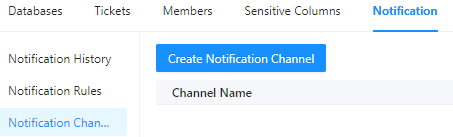
On the Create Notification Channel page, configure the channel information.
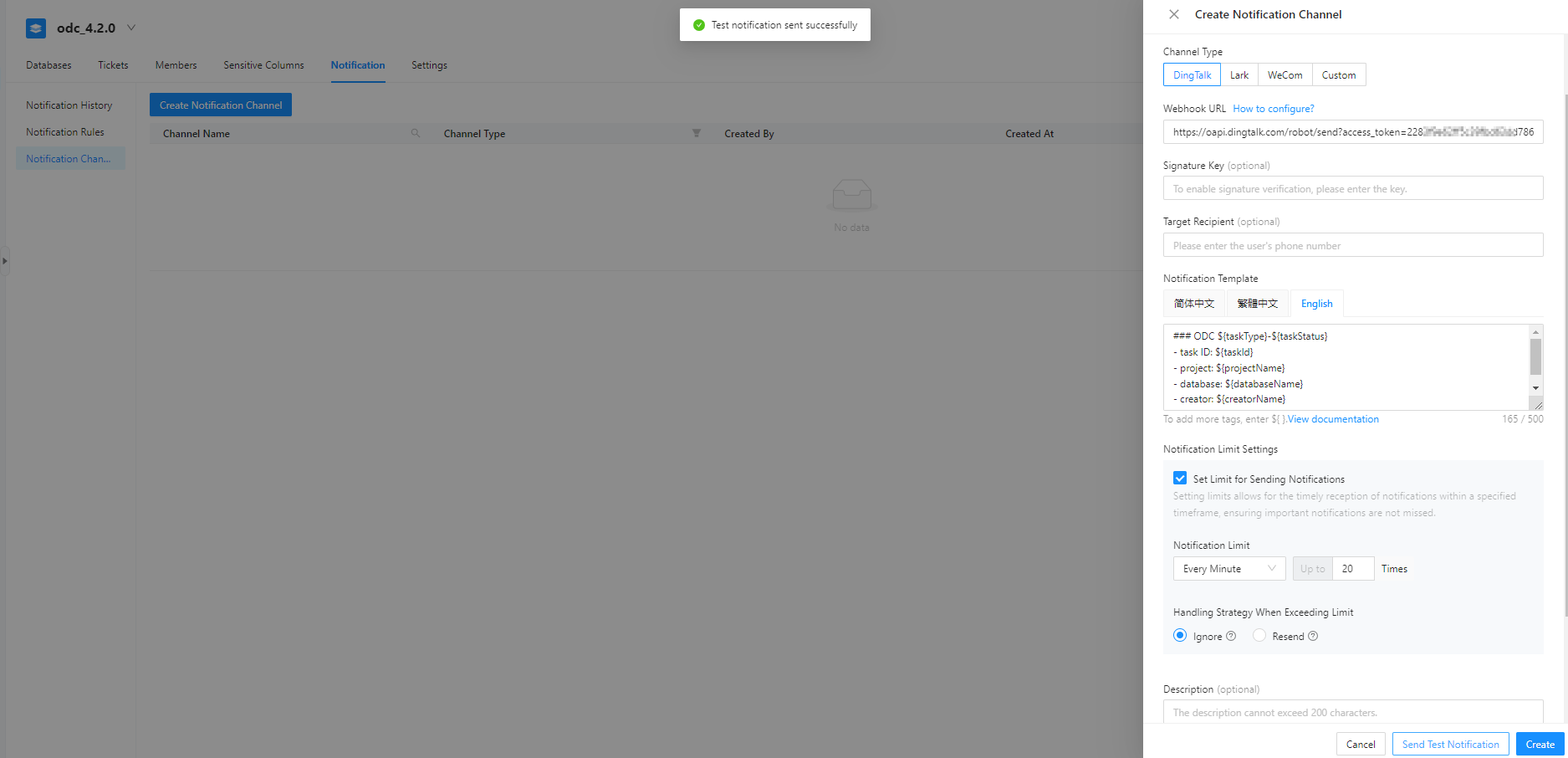 ParameterDescription
Channel Name The name of the channel. Channel Type The webhook URL of the channel.
When you add a DingTalk or Lark chatbot, you must enter ODC in the Custom Keywords field in the Security Settings section.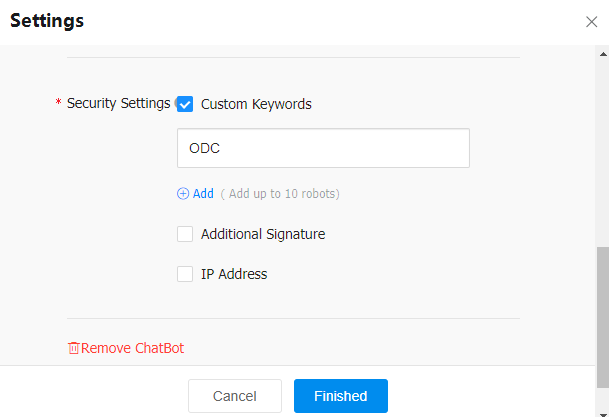
Signature Key The signature key of the chatbot. Specified User The mobile number of the user. Notification Template The template for sending notifications in the specific language. Notification Limit Settings The number of times to send notifications within the specified period. Description Optional. Additional information about the notification channel, which cannot exceed 200 characters in length. Click Send Test Message. If a test message is successfully sent, click Create.

Channel types
ODC supports sending notifications by using DingTalk, Lark, WeCom, and custom methods.
Channel type |
Parameter |
|---|---|
| DingTalk |
|
| Lark |
|
| WeCom |
|
| Custom |
|
Notification templates
ODC allows you to define notification templates separately in Simplified Chinese, Traditional Chinese, and English. By default, the notification templates are in the Markdown format.
Simplified Chinese
### ODC ${taskType}-${taskStatus}
 - 任务ID: ${taskId}
 - 项目: ${projectName}
 - 数据库: ${databaseName}
 - 发起人: ${creatorName}
 - 触发时间: ${triggerTime}
Traditional Chinese
### ODC ${taskType}-${taskStatus}
 - 任務ID: ${taskId}
 - 項目: ${projectName}
 - 數據庫: ${databaseName}
 - 發起人: ${creatorName}
 - 觸發時間: ${triggerTime}
English
### ODC ${taskType}-${taskStatus}
 - task ID: ${taskId}
 - project: ${projectName}
 - database: ${databaseName}
 - creator: ${creatorName}
 - trigger time: ${triggerTime}
The following table describes the supported labels.
Label nameDescriptionregion The region of ApsaraDB for OceanBase. taskType The type of the task. taskStatus The status of the task. projectId The ID of the project. projectName The name of the project. creatorId The ID of the creator. creatorName The username of the creator. taskId The ID of the task. connectionId The ID of the data source. databaseId The ID of the database. databaseName The name of the database. clusterName The name of the cluster. tenantName The name of the tenant. environment The environment of the data source. triggerTime The time when the event was triggered. message The body of the notification. title The title of the notification. approverId The ID of the user that approved the task. approverName The username of the user that approved the task. description The description of the ticket. ticketUrl The link to the ticket. Two methods are available for obtaining the domain name of ODC. The first method has a higher priority. - Obtain the ODC domain name from the
odc.site.urlparameter in theconfig_system_configurationtable of the MetaDB. - Use the IP address of the ODC server as the ODC domain name.
- Obtain the ODC domain name from the
Notification throttling settings
The frequency to send notifications is limited on some notification platforms. For example, a custom DingTalk chatbot supports sending at most 20 notifications per minute. If this threshold is reached, the chatbot will be throttled for 10 minutes. If you receive a large number of messages within a short period of time, important messages may be missed.
Therefore, ODC provides the notification throttling feature. You can set the maximum number of notifications that can be sent per minute, hour, or day through a specific channel. You can select either of the following options to handle notifications when the specified threshold is exceeded.
- Ignore: Notifications generated after the specified threshold is exceeded are ignored and will not be resent. In this case, the notifications are in the Ignore state on the Notification History page.
- Resend: After the throttling period of time elapses, notifications generated after the specified threshold is exceeded are automatically resent. The notifications are in the To Be Sent state before being resent.