







Instance parameters are instance-level configuration items. By modifying instance parameters, you can set load balancing, resource allocation, module switches, and more to make the behavior of the OceanBase Cloud database align with your business needs. You can search for instance parameters on the instance parameter list page to view the current running values, default values, whether a restart is required for the changes to take effect, and the modifiable range of the parameter values. You can also modify and undo changes to these parameters.
View the parameter list
Log in to the OceanBase Cloud Console.
Click the target analytical instance in the Instances list to enter the Overview page of the instance.
In the left-side navigation pane, click Parameters to navigate to the Parameters page.
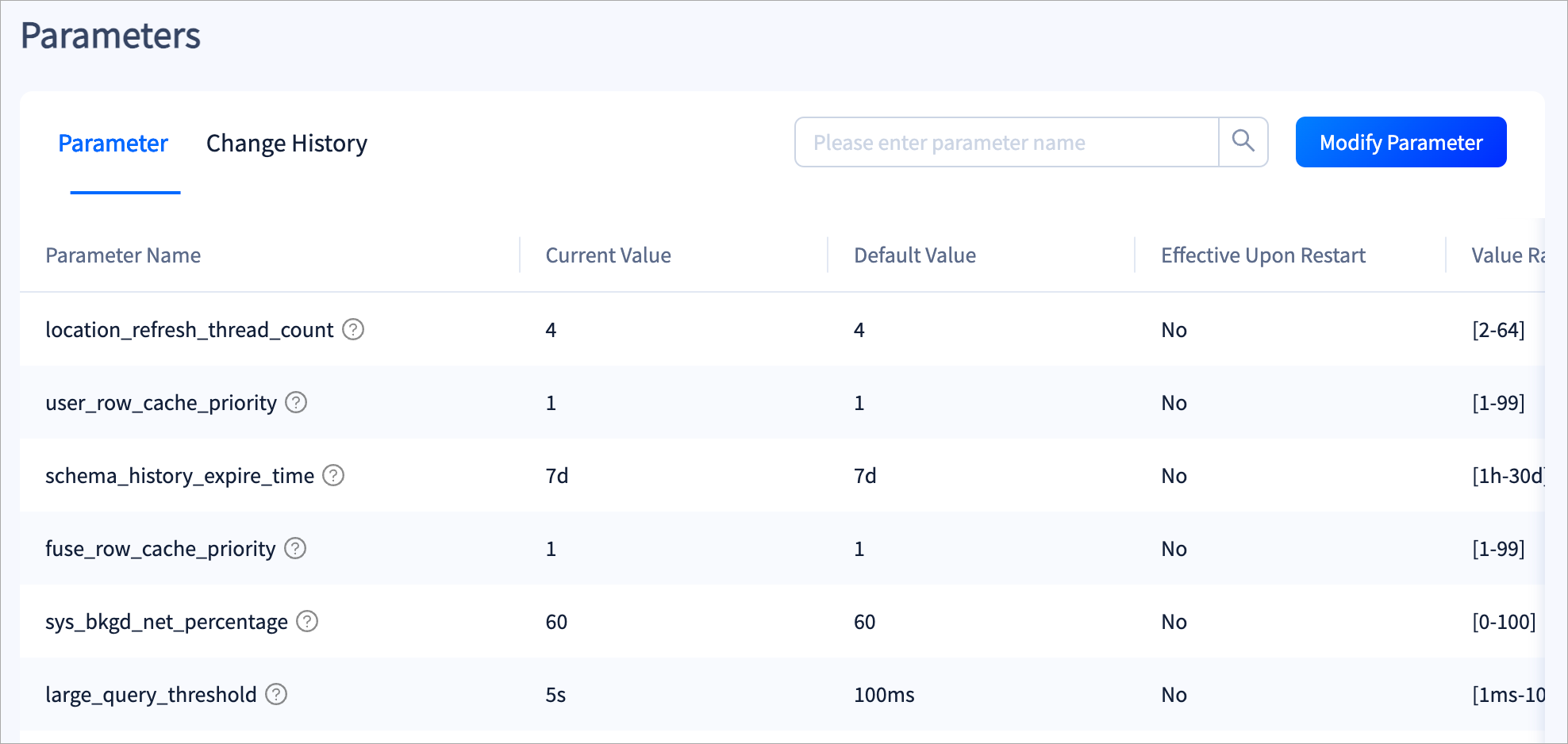
Enter a parameter name in the search box and click the Search icon to view details of the parameter. The Parameters list contains the following columns: Parameter Name, Current Value, Default Value, Effective Upon Restart, and Value Range. For a complete list of supported parameters and descriptions for analytical instances, refer to the Parameter List section of this topic.
Modify parameters
Find the parameter you need to modify (you can search directly using the search box), and click Modify Parameter in the upper-right corner to modify the values in the Current Value column.
After the modification, click Submit to submit the modification. To restore the default settings, click Revoke All.
View the change history
On the Parameters page, click the Change History tab.
In the upper-right corner, specify a time range to view the change history during that period.
The change history list contains the following columns: Parameter Name, Old Value, New Value, Effective Or Not, and Modification Time.
Parameter list
The parameters supported by analytical instances and their descriptions are as follows:
Parameter |
Description |
|---|---|
| connect_timeout | Connection timeout duration, in seconds. |
| ob_check_sys_variable | If enabled, updates system variables when the schema version changes. |
| div_precision_increment | Increment of precision in division results based on the precision of the dividend. A MySQL compatibility feature. |
| ob_sql_work_area_percentage | Percentage limit of tenant memory used for SQL execution. |
| tx_isolation | Transaction isolation level. |
| wait_timeout | Number of seconds the server waits for activity before closing non-interactive connections. At thread startup, the session wait_timeout value is initialized from the global wait_timeout or global interactive_timeout value, depending on the client type (defined by the CLIENT_INTERACTIVE option to mysql_real_connect()). See also interactive_timeout. |
| auto_increment_increment | Auto-increment step size, used only for MySQL client login. |
| foreign_key_checks | Whether to check foreign key constraints. |
| autocommit | Whether to auto-commit. |
| read_only | Whether in read-only mode. |
| ob_trx_timeout | Transaction timeout duration, in microseconds. |
| net_read_timeout | Number of seconds to wait for more data from a connection before interrupting the read. Controls the timeout value for when the server reads from the client; when the server writes to the client, net_write_timeout controls the timeout value. |
| ob_enable_index_direct_select | Whether to allow users to query index tables directly. |
| sql_throttle_rt | Specifies the RT value, in microseconds. If the query's RT value is not less than this value, the query is not allowed to execute. |
| ob_enable_transmission_checksum | Whether to perform checksum on data packets between proxy and server. |
| ob_early_lock_release | Whether to enable ELR optimization for transactions. |
| ob_plan_cache_evict_low_percentage | Memory usage percentage limit for stopping plan cache eviction. |
| ob_plan_cache_percentage | Percentage of tenant memory resources that can be used by the plan cache. |
| max_sp_recursion_depth | Number of times any given stored procedure can be recursively called. |
| sql_throttle_network | Network utilization threshold. When network utilization exceeds this threshold, the SQL will not be executed. |
| undo_retention | Specifies the retention time for multi-version data, in seconds. |
| query_cache_type | Query cache type.
|
| sql_throttle_logical_reads | Logical read count threshold. When the logical read count exceeds this threshold, the SQL will not be executed. |
| auto_increment_cache_size | Number of auto-increment cache entries. |
| sql_auto_is_null | Used by some special drivers, such as ODBC, to control whether to retrieve the auto-increment column value of the last inserted row. |
| recyclebin | Recycle bin switch. When enabled, objects deleted from the database will enter the recycle bin. |
| ob_enable_plan_cache | Whether to enable the Plan Cache. |
| ob_enable_aggregation_pushdown | Whether to allow aggregation operations to be pushed down. |
| net_write_timeout | Number of seconds to wait for blocks to be written to the connection before interrupting the write. Controls the timeout value for when the server writes to the client; when the server reads from the client, net_read_timeout controls the timeout value. |
| ob_enable_transformation | Whether to allow SQL rewriting. |
| sql_quote_show_create | Whether to enable quoting of identifiers in the SHOW CREATE TABLE and SHOW CREATE DATABASE statements. |
| sql_throttle_io | I/O count threshold. When the I/O count exceeds this threshold, the SQL will not be executed. |
| ob_enable_jit | JIT execution engine mode.
|
| ob_enable_truncate_flashback | Whether to allow truncate operation objects to enter the recycle bin. |
| ob_trx_idle_timeout | Transaction idle timeout duration. Transactions will timeout if the execution interval between two statements exceeds this value, in microseconds. |
| optimizer_capture_sql_plan_baselines | Whether to enable automatic capture of SQL plan baselines. |
| auto_increment_offset | Determines the starting point for AUTO_INCREMENT column values. |
| ob_read_consistency | Read consistency level. |
| block_encryption_mode | Specifies the encryption algorithm used in the aes_encrypt and aes_decrypt functions. |
| sql_throttle_cpu | SQL will not be executed if CPU usage exceeds this value. |
| error_on_overlap_time | Dynamic parameter that controls whether to error out on ambiguous time during daylight saving time overlap. |
| interactive_timeout | Number of seconds the server waits for activity before closing interactive connections. Interactive clients are defined as those that use the CLIENT_INTERACTIVE option to mysql_real_connect(). See also wait_timeout. |
| query_cache_size | Memory allocated for storing old query results (yet unused), in bytes. |
| ob_query_timeout | Query timeout duration, in microseconds. |
| sql_throttle_priority | SQL priority threshold. SQL with a priority lower than this value will not be executed. |
| ob_plan_cache_evict_high_percentage | Memory usage percentage limit that triggers plan cache eviction. |
| explicit_defaults_for_timestamp | Controls whether to enable non-standard behavior for default values and NULL values in the timestamp data type. |
| optimizer_use_sql_plan_baselines | Whether to enable the use of SQL plan baselines. |
| sql_warnings | Controls whether to generate an information string for single-row INSERT statements when warnings occur. |
| group_concat_max_len | Maximum length of the result allowed for the GROUP_CONCAT() function, in bytes. |
| sql_throttle_current_priority | Current priority for SQL throttling. |