







To handle varying peak loads across different business scenarios, OceanBase Cloud provides flexible elastic scaling strategies and on-demand resource adjustment mechanisms. The system supports scaling from nodes to regions, ensuring maximum resource utilization, stable and efficient performance during business peaks, and reduced resource costs for businesses.
Features and advantages
OceanBase Cloud provides elastic scaling capabilities for cloud databases, ensuring a seamless user experience. The scaling process is fully transparent, guaranteeing business continuity and high performance. OceanBase Cloud's multi-layer isolation and resource limitation strategies, supported by physical resources from the IaaS layer of the cloud vendor, ensure fair, transparent, and stable resource allocation across multiple tenants. The system balances performance and resource optimization, efficiently handling compute, storage, and high-concurrency workloads.
Seamless and transparent scaling
Peer nodes: Nodes can be categorized into full-featured replicas (read/write), read-only replicas (read-only), and columnar replicas (read-only). The number of nodes can be adjusted as needed.
Automatic load balancing: OceanBase automatically migrates and re-balances data based on resource quantity and object definitions, ensuring balanced distribution of data replicas, size, and leader nodes across nodes.
Temporary scaling: In high-traffic scenarios, you can temporarily upgrade the specifications of related products without changing the service plan. After the temporary upgrade period, the resources are automatically released or converted to a permanent plan.
Transparent application: Upgrade and downgrade do not affect business applications, and no downtime is required. The entire process is transparent to the application.
Load balancing adjustment: By evenly distributing tasks across nodes, efficient load management is achieved. The overall load pressure distribution can be dynamically adjusted based on requirements.
Multi-layer scaling
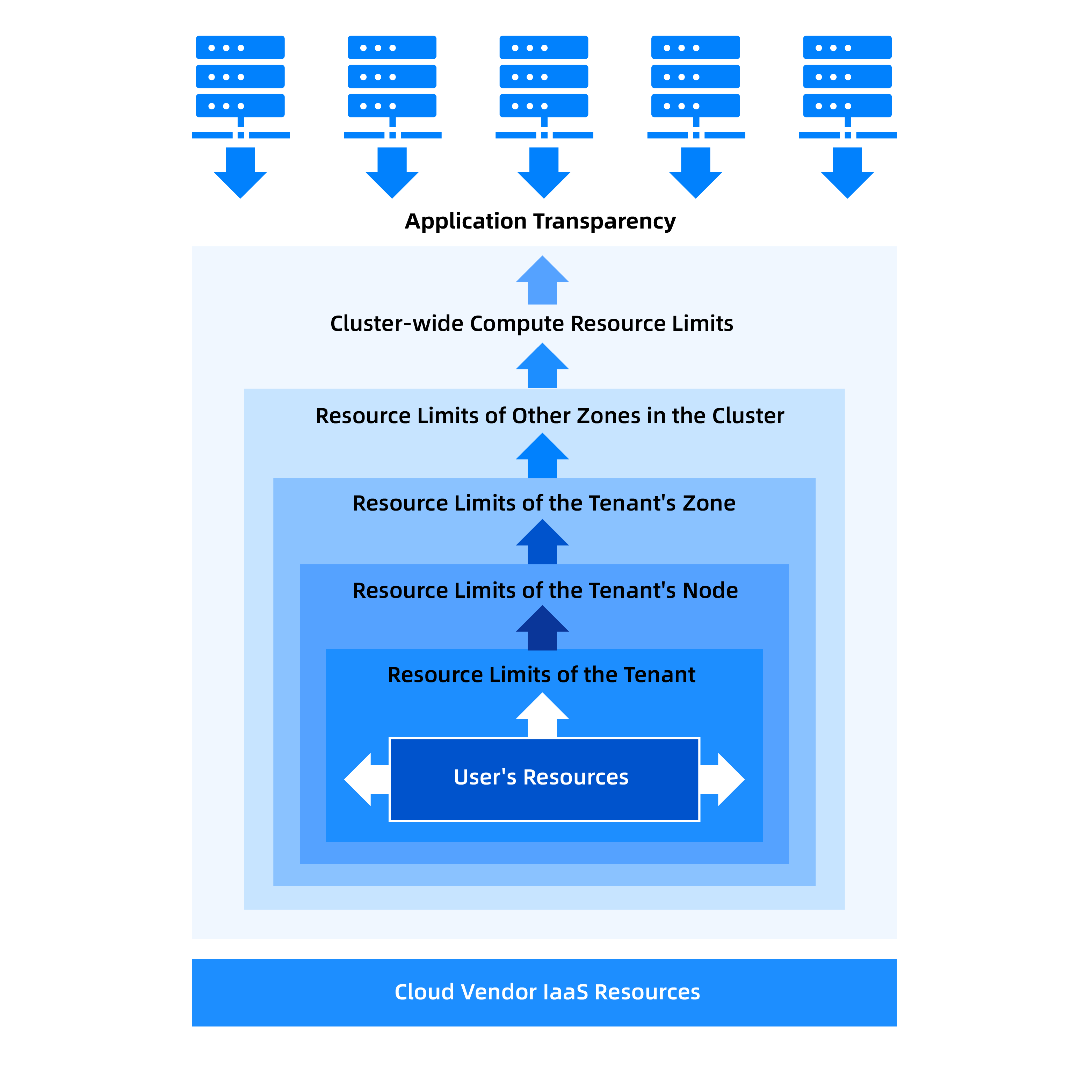
OceanBase Cloud supports multi-layer scaling across users, tenants, zones, and nodes.
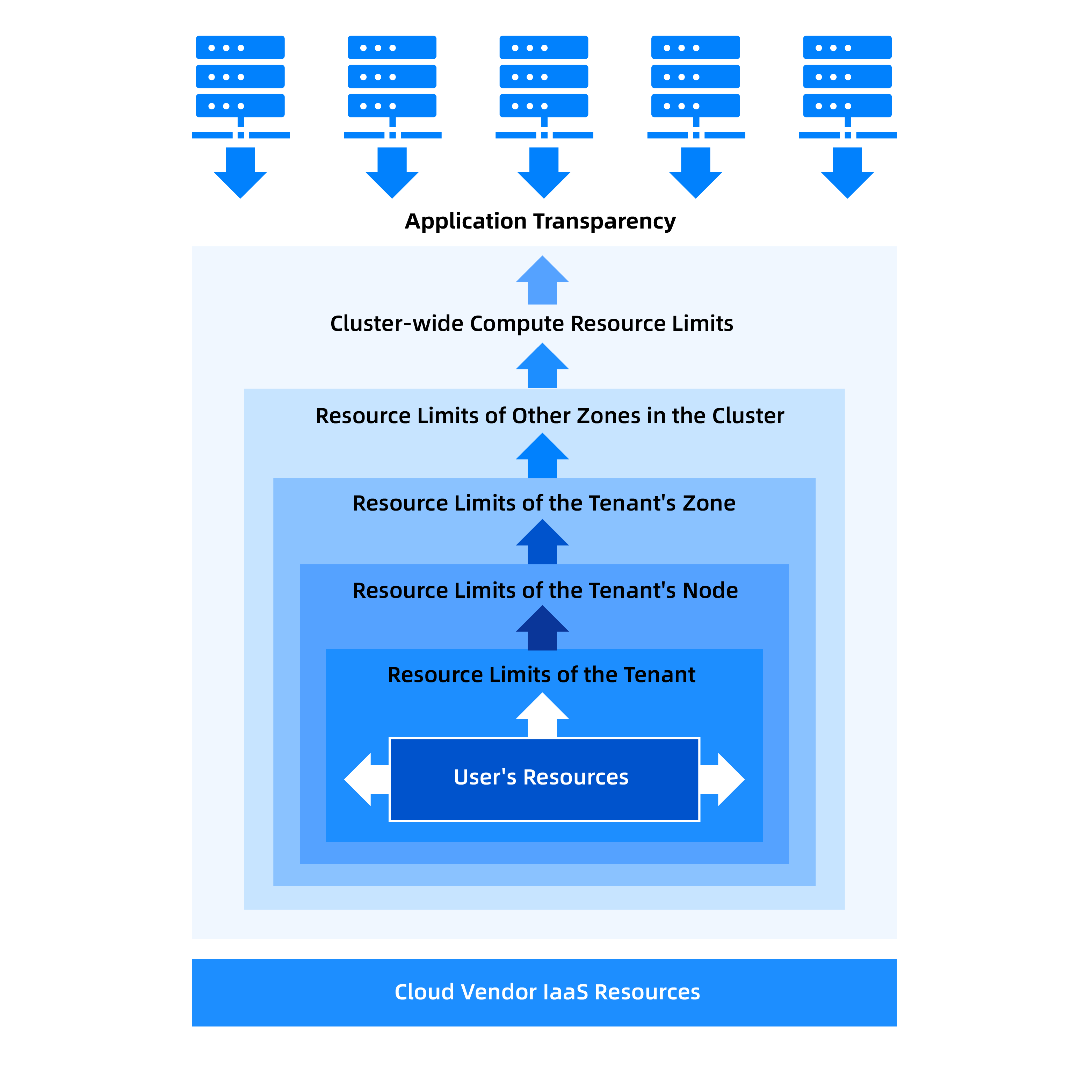
User resource scaling: When user resources are limited, the resource allocation strategy can be dynamically adjusted based on the actual scenario. For more information, see Overview of resource isolation.
Tenant resource scaling (vertical and horizontal): When tenant resources are insufficient, you can increase the resource limits of the node by adjusting resource units or migrating resources. When node resources reach the limits, you can increase the number of resource units to extend resources to other nodes in the zone.
Tenant resource extension across zones: When resources in a zone are insufficient, you can modify the resource pool to extend tenant resources to other zones.
Cluster node scaling: When cluster resources are insufficient, you can scale up the cluster node specifications (vertical scaling) or add new node servers in the zone (horizontal scaling) to expand the cluster's compute resources.
Storage scaling: When storage capacity or performance is insufficient, you can change the storage capacity, type, and other parameters to meet resource requirements.
Principle Introduction
OceanBase Cloud supports the scaling of single users, user groups, regions, and nodes, providing a multi-dimensional scaling solution that flexibly adapts to complex business scenarios. This document introduces the design and implementation details of OceanBase Cloud's dynamic scaling and resource management capabilities from three core layers: database access, computing, and storage. It also covers the elastic design of the billing model to meet various business needs.
Elastic management capabilities that grow with your business:
The database access layer efficiently manages front-end resources, ensuring a consistent and flexible user experience (from proxy selection to bandwidth adjustment).
The computing layer supports immediate scaling up and scaling out to adapt to high-concurrency or short-term peak scenarios.
The storage layer provides backend data support, automatically scaling storage capacity to match demand.
Elastic designs:
Dynamic resource adjustment mechanisms.
Layered and refined proxy control, computing expansion, and storage dynamic scheduling capabilities.
Seamless scaling and performance optimization processes without user intervention.
Layer |
Function Module |
Core Function |
Elastic Design and Features |
|---|---|---|---|
| Database Access Layer | ODP Technology | Address management (primary address / read-only address / read/write separation address) |
|
| Database Access Layer | Proxy Mechanism |
|
|
| Database Access Layer | Connection Control | Dynamically adjusts the number of connections and bandwidth to adapt to traffic demands. | The database access layer is transparent to users, with automated expansion and adjustment processes. |
| Computing Layer | Scaling Up | Enhances single-node processing capabilities by increasing CPU, memory, and other resources to optimize performance. |
|
| Computing Layer | Scaling Out | Dynamically adds/removes computing nodes to enhance concurrent processing capabilities and adapt to business traffic peaks. |
|
| Computing Layer | Computing expansion (node addition) and resource release (node reduction) are automatically completed without user intervention. | Computing resources are automatically adjusted to ensure computing performance and cost-effectiveness. | |
| Storage Layer | Automatic Expansion | Automatically adds storage units to meet business growth needs. |
|
| Storage Layer | Dynamic Reduction | Releases excess storage units when data volume decreases to reduce costs. | Ensures efficient storage resource utilization and avoids waste. |
| Storage Layer | Pay-as-You-Go Model | Charges based on dynamic usage, suitable for short-term or flexible needs, such as sudden business peaks. | Pay only for what you use, with real-time scaling to avoid long-term idle resource retention. |