







OceanBase Developer Center (ODC) is a GUI-based database development tool. It is also a collaborative management platform for data development, production, and changes. ODC is provided in two forms: client ODC and web ODC. Client ODC focuses on database development. It is lightweight and easy to deploy on Windows, macOS, and Linux. As for web ODC, in addition to database development, web ODC also provides collaborative management features to ensure the security, compliance, and efficiency of database changes.
You can use ODC in the following ways:
- Download the client ODC from the OceanBase Download Center.
- Log in to the Web ODC.
ODC console
Project collaboration window
After you log in to OceanBase Developer Center (ODC), the ODC workspace is displayed by default. This topic describes the contents of the ODC project collaboration window.

No. |
Module |
Description |
|---|---|---|
| 1 | Workspace | You can click the workspace to switch the organization in OceanBase Cloud. |
| 2 | Workbench | The workbench displays the following information, which you can view and access as needed:
|
| 3 | Projects | You can create projects as the project admin and configure members and databases for projects. A project contains four types of resources: databases, tickets, members, and sensitive data. A project is the minimum unit of collaboration. Tickets are most commonly used for collaboration in a project. Sensitive data is the subject for data desensitization strategies. |
| 4 | Tickets | You can submit a ticket to perform operations such as importing, exporting, mocking, and archiving data, modifying a database, implementing lock-free structure changes, and managing SQL plans. You can also review the created tickets. |
| 5 | Data Sources | ODC allows you to connect to OceanBase Database and MySQL Database to edit and manage data sources, including database objects and resources. |
| 6 | Users | You can create and edit users as the ODC system administrator and assign roles to users to grant them the permissions on resource management and system operations. You can also configure automatic authorization rules to automatically grant specific roles or permissions to users that meet the specified conditions. |
| 7 | Security | On the Security page, you can perform the following operations:
|
| 8 | SQL Console | Quickly jump to the SQL development window. |
| 9 | Settings | On the homepage of ODC, click Settings in the lower-left corner to set the database, editor, appearance, and account. |
| 10 | Help | On the homepage of ODC, click Help in the lower-left corner to view tutorials for common ODC operations and new features of the current version. You can report questions to Github or support email. |
| 11 | Me | On the homepage of ODC, you can click Me in the lower-left corner. The menu that appears provides options for you to change the password, view the operation records, and log off. |
SQL development window
After you log in to a database, go to the SQL development window.

No. |
Module |
Description |
|---|---|---|
| 1 | Workspace | You can click Team Workspace or Individual Workspace to switch between the two workspaces.
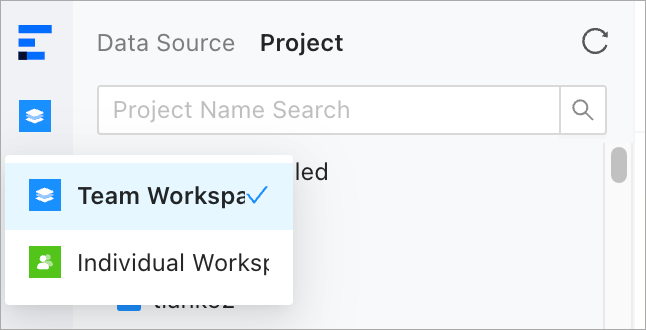 |
| 2 | Databases | You can create and manage database objects in databases of the data source or project. 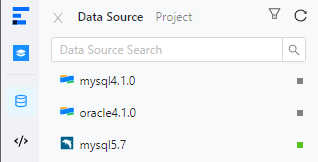 |
| 3 | Scripts | You can save edited scripts in the SQL Window and Anonymous Block Window and manage the saved scripts on the Script tab. You can also manage snippets on the Snippets tab. 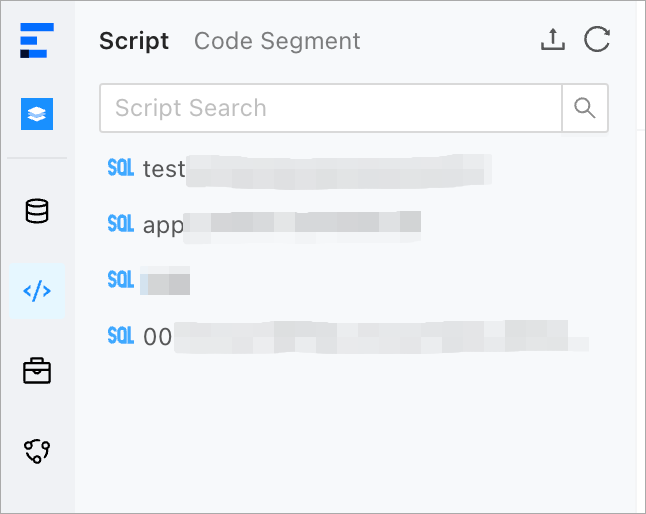 |
| 4 | Tickets | You can submit a ticket to perform operations such as importing, exporting, mocking, and archiving data, modifying a database, implementing online schema changes, and managing SQL plans. You can also review the created tickets. 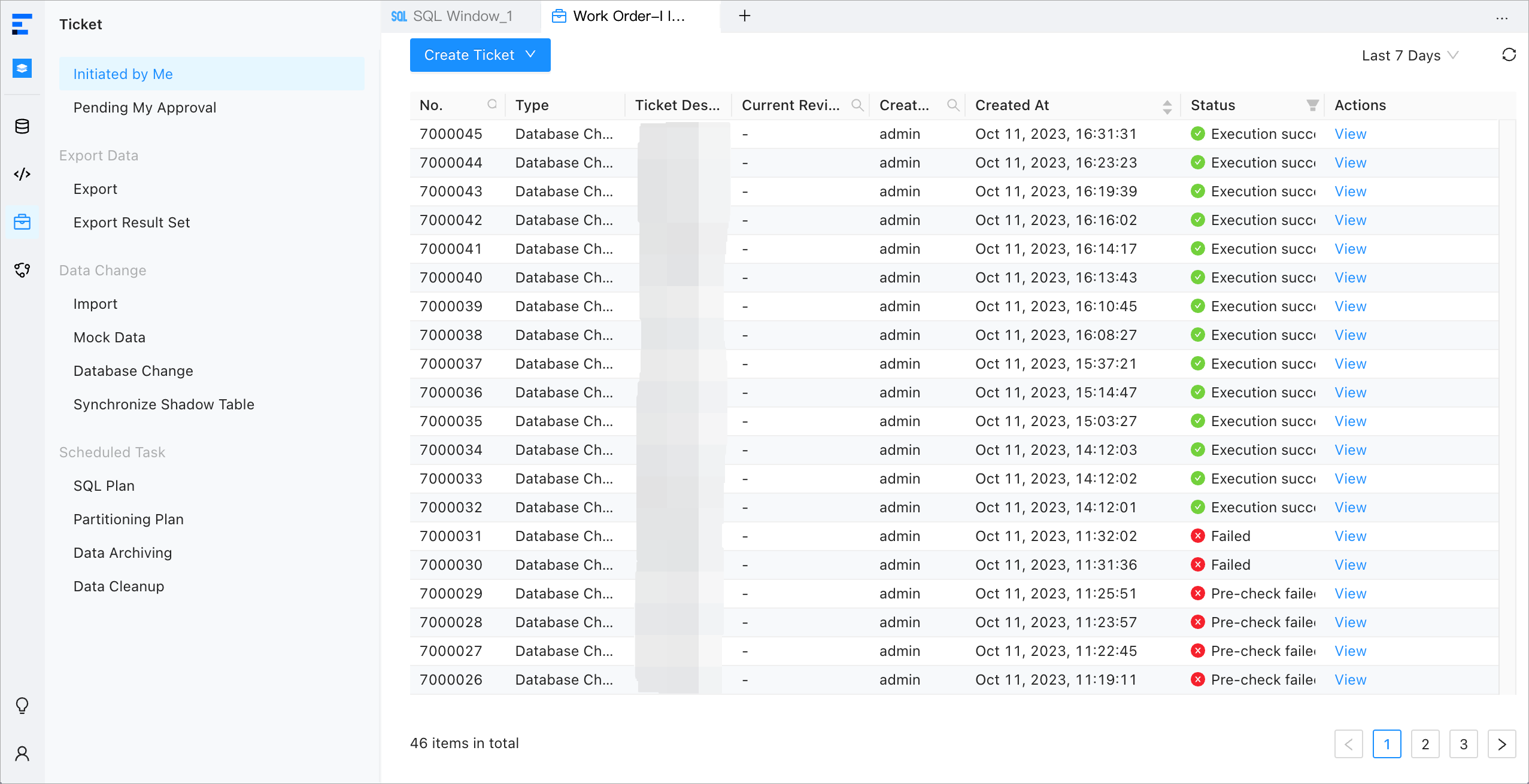 |
| 5 | O&M Management |
 |
| 6 | SQL Window | 
|
| 7 | Anonymous Block Window | You can compile, run, and debug PL objects and anonymous blocks.  |