

OceanBase logo

OceanBase

A unified distributed database ready for your transactional, analytical, and AI workloads.

Product Overview
DEPLOY YOUR WAY

OceanBase Cloud

The best way to deploy and scale OceanBase

OceanBase Enterprise

Run and manage OceanBase on your infra

TRY OPEN SOURCE

OceanBase Community Edition

The free, open-source distributed database

OceanBase seekdb

Open source AI native search database

Customer Stories

Real-world success stories from enterprises across diverse industries.

View All
BY USE CASES

Mission-Critical Transactions

Global & Multicloud Application

Elastic Scaling for Peak Traffic

Real-time Analytics

Active Geo-redundancy

Database Consolidation

Resources

Comprehensive knowledge hub for OceanBase.

Blog

Live Demos

Training & Certification

Documentation

Official technical guides, tutorials, API references, and manuals for all OceanBase products.

View All
PRODUCTS

OceanBase Cloud

OceanBase Database

Tools

Connectors and Middleware

QUICK START

OceanBase Cloud

OceanBase Database

BEST PRACTICES

Practical guides for utilizing OceanBase more effectively and conveniently

Company

Learn more about OceanBase – our company, partnerships, and trust and security initiatives.

About OceanBase

Partner

Trust Center

Contact Us

International - English
中国站 - 简体中文
日本 - 日本語
Sign In
Start on Cloud

OceanBase

A unified distributed database ready for your transactional, analytical, and AI workloads.

Product Overview
DEPLOY YOUR WAY

OceanBase Cloud

The best way to deploy and scale OceanBase

OceanBase Enterprise

Run and manage OceanBase on your infra

TRY OPEN SOURCE

OceanBase Community Edition

The free, open-source distributed database

OceanBase seekdb

Open source AI native search database

Customer Stories

Real-world success stories from enterprises across diverse industries.

View All
BY USE CASES

Mission-Critical Transactions

Global & Multicloud Application

Elastic Scaling for Peak Traffic

Real-time Analytics

Active Geo-redundancy

Database Consolidation

Comprehensive knowledge hub for OceanBase.

Blog

Live Demos

Training & Certification

Documentation

Official technical guides, tutorials, API references, and manuals for all OceanBase products.

View All
PRODUCTS
OceanBase CloudOceanBase Database
ToolsConnectors and Middleware
QUICK START
OceanBase CloudOceanBase Database
BEST PRACTICES

Practical guides for utilizing OceanBase more effectively and conveniently

Learn more about OceanBase – our company, partnerships, and trust and security initiatives.

About OceanBase

Partner

Trust Center

Contact Us

Start on Cloud
编组
All Products
    • Databases
    • iconOceanBase Database
    • iconOceanBase Cloud
    • iconOceanBase Tugraph
    • iconInteractive Tutorials
    • iconOceanBase Best Practices
    • Tools
    • iconOceanBase Cloud Platform
    • iconOceanBase Migration Service
    • iconOceanBase Developer Center
    • iconOceanBase Migration Assessment
    • iconOceanBase Admin Tool
    • iconOceanBase Loader and Dumper
    • iconOceanBase Deployer
    • iconKubernetes operator for OceanBase
    • iconOceanBase Diagnostic Tool
    • iconOceanBase Binlog Service
    • Connectors and Middleware
    • iconOceanBase Database Proxy
    • iconEmbedded SQL in C for OceanBase
    • iconOceanBase Call Interface
    • iconOceanBase Connector/C
    • iconOceanBase Connector/J
    • iconOceanBase Connector/ODBC
    • iconOceanBase Connector/NET
icon

OceanBase Cloud

  • Product Updates & Announcements
    • What's new
      • Release notes for 2026
      • Release notes for 2025
      • Release notes for 2024
      • Release history
    • Product announcements
      • Data development module deprecation notice
      • Optimization of Backup and Restore commercialization strategy
      • Cross-AZ data transfer billing (OceanBase Cloud on AWS)
      • Database Proxy pricing update
      • AWS instance pricing adjustment
  • Product Introduction
    • Overview
    • Management mode and scenarios
    • Core features
      • High availability with cross-cloud active-active architecture
      • High availability with cross-cloud primary-standby databases
      • Multi-level caching in shared storage
      • Multi-layer online scaling and on-demand adjustment
    • Deployment modes
    • Storage architecture
    • Product specifications
    • Product billing
      • Overview
      • Instance billing
        • Tencent Cloud instance billing
        • Alibaba Cloud instance billing
        • Huawei Cloud instance billing
        • AWS instance billing
        • GCP instance billing
      • Backup and restore billing
      • SQL audit billing
      • Migrations billing
      • Database proxy billing
      • Binlog service billing
      • Overview of OceanBase Cloud support plans
      • Read-only replica billing
    • Supported database versions
  • Get Started
    • Get started with a transactional instance
    • Get started with an analytical instance
    • Get started with a Key-Value instance
  • Work with Transactional Instances
    • Overview
    • Create an instance
      • Overview
      • Create via OceanBase Cloud official website
      • Create via AWS Marketplace
      • Create via GCP Marketplace
      • Create via Huawei Cloud Marketplace
      • Create via Alibaba Cloud Marketplace
      • Create via Azure Marketplace
    • Connect to an instance
      • MySQL compatible mode
        • Overview
        • Get connection string
          • Overview
          • Connect using AWS PrivateLink
          • Connect using Azure Private Link
          • Connect using Google Cloud Private Service Connect
          • Connect using Huawei Cloud VPC Endpoint
          • Connect using Alibaba Cloud VPC
          • Connect using a public IP address
          • Connect using a Huawei Cloud peering connection
        • Connect with clients
          • Connect to OceanBase Cloud by using Client ODC
          • Connect to OceanBase Cloud by using a MySQL client
          • Connect to OceanBase Cloud by using OBClient
        • Connect with drivers
          • Java
            • Connect to OceanBase Cloud using SpringBoot
            • SpringBatch sample application for connecting to OceanBase Cloud
            • spring-jdbc
            • SpringDataJPA sample application for connecting to OceanBase Cloud
            • Hibernate application development with OceanBase Cloud
            • Sample program for connecting to OceanBase Cloud
            • connector-j
            • Use TestContainers to connect to and use OceanBase Cloud
          • Python
            • Connect to OceanBase Cloud using mysqlclient
            • Connect to OceanBase Cloud using PyMySQL
            • Use the MySQL-connector-python driver to connect to and use OceanBase Cloud
            • Use SQLAlchemy to connect to an OceanBase Cloud database
            • Connect to an OceanBase Cloud database using Django
            • Connect to an OceanBase Cloud database by using peewee
          • C
            • Use MySQL Connector/C to connect to OceanBase Cloud
          • Go
            • Connect to OceanBase Cloud using the Go-SQL-Driver/MySQL driver
            • Connect to OceanBase Cloud using GORM
          • PHP
            • Use the EXT driver to connect to OceanBase Cloud
            • Connect to OceanBase Cloud by using the MySQLi driver
            • Use the PDO driver to connect to OceanBase Cloud
          • Rust
            • Rust application example for connecting to OceanBase Cloud
            • SeaORM example for connecting to OceanBase Cloud
          • ruby
            • ActiveRecord sample application for OceanBase Cloud
            • Connect to OceanBase Cloud by using mysql2
            • Connect to OceanBase Cloud by using Sequel
        • Use database connection pool
          • Database connection pool configuration
          • Connect to OceanBase Cloud by using a Tomcat connection pool
          • Connect to OceanBase Cloud by using a C3P0 connection pool
          • Connect to OceanBase Cloud by using a Proxool connection pool
          • Connect to OceanBase Cloud by using a HikariCP connection pool
          • Connect to OceanBase Cloud by using a DBCP connection pool
          • Connect to OceanBase Cloud by using Commons Pool
          • Connect to OceanBase Cloud by using a Druid connection pool
      • Oracle compatible mode
        • Overview
        • Get connection string
          • Overview
          • Connect using AWS PrivateLink
          • Connect using Azure Private Link
          • Connect using Google Cloud Private Service Connect
          • Connect using Huawei Cloud VPC Endpoint
          • Connect using a public IP address
        • Connect with clients
          • Connect to OceanBase Cloud by using OBClient
          • Connect to OceanBase Cloud by using Client ODC
        • Connect with drivers
          • Java
            • Connect to OceanBase Cloud using OceanBase Connector/J
            • Connect to OceanBase Cloud by using Spring Boot
            • SpringBatch application example for connecting to OceanBase Cloud
            • Connect to OceanBase Cloud using Spring JDBC
            • Connect to OceanBase Cloud by using Spring Data JPA
            • Connect to OceanBase Cloud by using Hibernate
            • Use MyBatis to connect to OceanBase Cloud
            • Use JFinal to connect to OceanBase Cloud
          • Python
            • Python Driver for Oracle Mode
          • C
            • Connect to OceanBase Cloud using OceanBase Connector/C
            • Connect to OceanBase Cloud using OceanBase Connector/ODBC
            • Use SqlSugar to connect to OceanBase Cloud
        • Use database connection pool
          • Database connection pool configuration
          • Sample program that uses a Tomcat connection pool to connect to OceanBase Cloud
          • C3P0 connection pool connects to OceanBase Cloud
          • Connect to OceanBase Cloud using Proxool connection pool
          • Sample program that uses HikariCP to connect to OceanBase Cloud
          • Use DBCP connection pool to connect to OceanBase Cloud
          • Connect to OceanBase Cloud by using Commons Pool
          • Connect to OceanBase Cloud by using a Druid connection pool
    • Developer guide
      • MySQL compatible mode
        • Plan database objects
          • Create a database
          • Create a table group
          • Create a table
          • Create an index
          • Create an external table
        • Write data
          • Insert data
          • Update data
          • Delete data
          • Replace data
          • Generate test data in batches
        • Read data
          • Single-table queries
          • Join tables
            • INNER JOIN queries
            • FULL JOIN queries
            • LEFT JOIN queries
            • RIGHT JOIN queries
            • Subqueries
            • Lateral derived tables
          • Use operators and functions in queries
            • Use arithmetic operators in queries
            • Use numerical functions in queries
            • Use string concatenation operators in queries
            • Use string functions in queries
            • Use datetime functions in queries
            • Use type conversion functions in queries
            • Use aggregate functions in queries
            • Use NULL-related functions in queries
            • Use the CASE conditional operator in queries
            • Use the SELECT ... FOR UPDATE statement to lock query results
            • Use the SELECT ... LOCK IN SHARE MODE statement to lock query results
          • Use a DBLink in queries
          • Set operations
        • Manage transactions
          • Overview
          • Start a transaction
          • Savepoints
            • Mark a savepoint
            • Roll back a transaction to a savepoint
            • Release a savepoint
          • Commit a transaction
          • Roll back a transaction
      • Oracle compatible mode
        • Plan database objects
          • Create a table group
          • Create a table
          • Create an index
          • Create an external table
        • Write data
          • Insert data
          • Update data
          • Delete data
          • Replace data
          • Generate test data in batches
        • Read data
          • Single-table queries
          • Join tables
            • INNER JOIN queries
            • FULL JOIN queries
            • LEFT JOIN queries
            • RIGHT JOIN queries
            • Subqueries
            • Lateral derived tables
          • Use operators and functions in queries
            • Use arithmetic operators in queries
            • Use numerical functions in queries
            • Use string concatenation operators in queries
            • Use string functions in queries
            • Use datetime functions in queries
            • Use type conversion functions in queries
            • Use aggregate functions in queries
            • Use NULL-related functions in queries
            • Use CASE functions in queries
            • Use the SELECT ... FOR UPDATE statement to lock query results
          • Use a DBLink in queries
          • Set operations
        • Manage transactions
          • Overview
          • Start a transaction
          • Savepoints
            • Mark a savepoint
            • Roll back a transaction to a savepoint
          • Commit a transaction
          • Roll back a transaction
    • Manage instances
      • Manage instances
        • View the instance list
        • Instance overview
        • Stop and restart instances
        • Unit migration
      • Manage tenants
        • Tenant overview
        • Create a tenant
        • Modify tenant specifications
        • Modify tenant names
        • Add an endpoint
        • Resource isolation
          • Overview
          • Manage resource groups
            • Create a resource group
            • View a resource group
            • Edit a resource group
            • Delete a resource group
          • Manage isolation rules
            • Create an isolation rule
            • View isolation rules
            • Edit an isolation rule
            • Delete a quarantine rule
        • Modify primary zone
        • Modify the maximum number of connections for a tenant proxy
        • Monitor tenant performance
          • Overview
          • View performance and SQL monitoring details
          • View transaction monitoring details
          • View storage and cache monitoring details
          • View Binlog service monitoring
          • Customize a monitoring dashboard for a tenant
        • Diagnostics
          • Real-time diagnostics
            • SQL diagnostics
              • Top SQL
              • Slow SQL
              • Suspicious SQL
              • High-risk SQL
            • SQL audit
        • Manage tenant parameters
          • Manage tenant parameters
          • Parameters for tenants
          • Parameter template overview
        • Delete a tenant
        • Manage databases and accounts
          • Create accounts
          • Manage accounts
          • Create a database (MySQL compatible mode)
          • Manage databases (MySQL compatible mode)
      • Monitor instance performance
        • Overview
        • Monitor the performance of databases in an instance
        • Monitor multidimensional metrics of an instance
        • Monitor the performance of hosts in an instance
        • Monitor database proxy
        • Monitor database proxy hosts
        • Monitor cross-cloud network performance
        • Customize a monitoring dashboard for an instance
      • Manage major compactions
        • Initiate a major compaction
        • View compaction records
        • Update time for compactions
      • Manage instance parameters
        • Manage parameters
        • Parameters for cluster instances
      • Change instance configurations
        • Enable storage auto-scaling
        • View history of configuration changes
        • Change configuration
        • Change configuration temporarily
        • Switch the deployment mode
      • Manage standby instances
        • Overview
        • Create a standby instance
        • Create a cross-cloud standby instance
        • Create a standby instance for an Alibaba Cloud primary instance
        • View details of primary and standby instances
        • Configure global endpoint
        • Enable automatic forwarding for write requests of standby databases
        • Primary-standby instance switchover
        • Initiate failover
        • Detach a standby instance
        • Release a standby instance
      • Release an instance
      • Database proxy
        • Overview
        • Manage database proxy
        • Direct load
      • Manage alerts
        • Overview
        • Manage alert rules
          • Create an alert rule
          • View an alert rule
          • Edit an alert rule
          • Delete an alert rule
        • View alert history
        • Manage alert templates
          • Create an alert template
          • View an alert template
          • Edit an alert template
          • Copy an alert rule template
          • Delete an alert template
        • Manage muting rules
          • Create an alert muting rule
          • View an alert muting rule
          • Edit an alert muting rule
          • Delete an alert muting rule
        • Manage alert notification templates
          • Create an alert notification template
          • View an alert notification template
          • Edit an alert notification template
          • Copy an alert notification template
          • Delete an alert notification template
        • Manage alert contacts
          • Add an alert contact
          • Add an alert contact group
          • View an alert contact
          • Edit an alert contact
          • Delete an alert contact
          • Obtain a webhook URL
        • Monitoring metrics for alerts
      • Backup and restore
        • Overview
        • Backup strategy
        • Initiate a backup immediately
        • Data backup
        • Initiate a restore
        • Data restore
        • Restore data from the instance recycle bin
      • Diagnostics
        • View performance monitoring data
        • Capacity diagnostics
        • One-click diagnostics
          • Initiate one-click diagnostics
          • View one-click diagnostic report
            • Exceptions
            • Real-time diagnostics
            • Optimization suggestions
            • Capacity management
            • Security management
        • Real-time diagnostics
          • SQL diagnostics
            • Top SQL
            • Slow SQL
            • Suspicious SQL
            • High-risk SQL
            • SQL details
            • SQL monitoring metrics list
          • Session management
            • Session management
          • Request analysis
            • Request analysis
        • Root cause diagnostics
          • Exception handling
          • Enable system autonomy
        • SQL audit
        • Materialized view analysis
        • Optimization center
          • Optimization suggestions
          • Manage active outlines
          • SQL review
          • View the optimization history
      • Manage tags
      • Manage read-only replicas
        • Overview
        • Instance read-only replicas
          • Add a read-only replica to an instance
          • View read-only replicas of an instance
          • Manage read-only replicas of an instance
          • Delete a read-only replica of an instance
        • Tenant read-only replicas
          • Add a read-only replica to a tenant
          • View read-only replicas of a tenant
          • Manage read-only replicas of a tenant
          • Delete a read-only replica of a tenant
      • Manage JVM-dependent services
    • Data source management
      • Create a data source
      • Manage data sources
      • User privileges
        • User privileges for compatibility assessment
        • User privileges for data migration
        • User privileges for performance assessment
        • User privileges for data archiving
        • User privileges for data cleanup
      • Connect via private network
        • AWS
        • Huawei Cloud
        • Alibaba Cloud
        • Google Cloud
        • Azure
        • Private IP address segments
      • Connect via public network
        • AWS
        • Huawei Cloud
        • Alibaba Cloud
        • Google Cloud
        • Azure
    • Data lifecycle management
      • Archive data
      • Clean up data
    • Manage recycle Bin
      • Instance recycle bin
      • Manage databases and tables in recycle bin
        • Overview
        • Instance-level recycle bin
        • Tenant-level recycle bin
  • Work with Analytical Instances
    • Overview
    • Core features
    • Create an instance
    • Connect to an instance
      • Overview
      • Get connection string
        • Overview
        • Connect using AWS PrivateLink
        • Connect using a public IP address
      • Connect with clients
        • Connect to OceanBase Cloud by using Client ODC
        • Connect to OceanBase Cloud by using a MySQL client
        • Connect to OceanBase Cloud by using OBClient
      • Connect with drivers
        • Java
          • Connect to OceanBase Cloud by using Spring Boot
          • Connect to OceanBase Cloud by using Spring Batch
          • Connect to OceanBase Cloud by using Spring Data JDBC
          • Connect to OceanBase Cloud by using Spring Data JPA
          • Connect to OceanBase Cloud by using Hibernate
          • Connect to OceanBase Cloud by using MyBatis
          • Connect to OceanBase Cloud using MySQL Connector/J
        • Python
          • Connect to OceanBase Cloud by using mysqlclient
          • Connect to OceanBase Cloud by using PyMySQL
          • Connect to OceanBase Cloud using MySQL Connector/Python
        • C
          • Connect to OceanBase Cloud using MySQL Connector/C
        • Go
          • Connect to OceanBase Cloud using Go-SQL-Driver/MySQL
        • PHP
          • Connect to OceanBase Cloud using PHP
      • Use database connection pool
        • Database connection pool configuration
        • Connect to OceanBase Cloud by using a Tomcat connection pool
        • Connect to OceanBase Cloud by using a C3P0 connection pool
        • Connect to OceanBase Cloud by using a Proxool connection pool
        • Connect to OceanBase Cloud by using a HikariCP connection pool
        • Connect to OceanBase Cloud by using a DBCP connection pool
        • Connect to OceanBase Cloud by using Commons Pool
        • Connect to OceanBase Cloud by using a Druid connection pool
    • Data table design
      • Table overview
      • Best practices
        • Unit 1: Best practices for optimizing storage structures and query performance
        • Unit 2: Best practices for creating special indexes
    • Export data
    • OceanBase data processing
    • Query acceleration
      • Statistics
      • Materialized views for query acceleration
      • Select a query parallelism level
    • Manage instances
      • Instance overview
      • Change configuration
      • Modify primary zone
      • Manage parameters
      • Backup and restore
        • Backup overview
        • Backup strategies
        • Immediate backup
        • Data backup
        • Initiate restore
        • Data restore
      • Monitor instance performance
        • Overview
        • Monitor the performance of databases in an instance
        • Monitor the performance of hosts in an instance
      • Manage major compactions
        • Initiate a major compaction
        • View compaction records
        • Update time for compactions
      • Database proxy
        • Overview
        • Manage database proxy
        • Direct load
      • Manage alerts
        • Overview
        • Manage alert rules
          • Create an alert rule
          • View an alert rule
          • Edit an alert rule
          • Delete an alert rule
        • View alert history
        • Manage alert templates
          • Create an alert template
          • View an alert template
          • Edit an alert template
          • Copy an alert template
          • Delete an alert template
        • Manage muting rules
          • Create an alert muting rule
          • View an alert muting rule
          • Edit an alert muting rule
          • Delete an alert muting rule
        • Manage alert notification templates
          • Create an alert notification template
          • View an alert notification template
          • Edit an alert notification template
          • Copy an alert notification template
          • Delete an alert notification template
        • Manage alert contacts
          • Add an alert contact
          • Add an alert contact group
          • View an alert contact
          • Edit an alert contact
          • Delete an alert contact
          • Obtain a webhook URL
        • Monitoring metrics for alerts
      • Diagnostics
        • View performance monitoring data
        • Capacity diagnostics
        • Real-time diagnostics
          • SQL diagnostics
            • Top SQL
            • Slow SQL
            • Suspicious SQL
            • High-risk SQL
            • SQL details
            • SQL monitoring metrics list
          • Session management
            • Session management
          • Optimization management
            • Manage active outlines
            • View the optimization history
          • Request analysis
            • Request analysis
      • Stop and restart instances
      • Release instances
      • Manage databases and accounts
        • Create and manage accounts
        • Create a database
        • Manage databases
      • Manage tags
    • Data lifecycle management
      • Archive data
      • Clean up data
    • Performance diagnosis and tuning
      • Use the DBMS_XPLAN package for performance diagnostics
      • Use the GV$SQL_PLAN_MONITOR view for performance analysis
      • Views related to AP performance analysis
    • Performance testing
    • Product integration
    • Manage recycle Bin
      • View instance recycle bin
      • Manage databases and tables in recycle bin
        • Overview
        • Instance recycle bin
  • Work with Key-Value Instances
    • Try out Key-Value instances
      • Create an instance
      • Create a tenant
      • Create an account for a database user
      • OBKV HBase data operation examples
    • Use Table model
      • Create an instance
      • Manage instances
        • Manage instances
          • View the instance list
          • Instance overview
          • Stop and restart instances
          • Release an instance
        • Manage tenants
          • Create a tenant
          • Modify tenant specifications
          • Modify tenant names
          • Delete a tenant
          • Tenant overview
          • Resource isolation
            • Overview
            • Manage resource groups
              • Create a resource group
              • View a resource group
              • Edit a resource group
              • Delete a resource group
            • Manage isolation rules
              • Create an isolation rule
              • View isolation rules
              • Edit an isolation rule
              • Delete a quarantine rule
          • Monitor tenant performance
            • Overview
            • View performance and SQL monitoring details
            • View transaction monitoring details
            • View storage and cache monitoring details
            • OBKV-Table
            • Customize a monitoring dashboard for a tenant
          • Diagnostics
            • Top SQL
          • Manage tenant parameters
            • Manage tenant parameters
            • Parameters for tenants
          • Manage databases and accounts
            • Create and manage accounts
            • Create a database
            • Manage databases
          • Switch primary zone
        • Monitor instance performance
          • Overview
          • Monitor the performance of databases in an instance
          • Monitor multi-dimensional metrics of an instance
          • Monitor the performance of hosts in a cluster
          • Customize monitoring dashboards for an instance
        • Manage major compactions
          • Initiate major compactions
          • View compaction records
          • Update time for compactions
        • Manage instance parameters
          • Parameter management overview
          • Parameters for cluster instances
        • Change instance configurations
          • View history of configuration changes
          • Change configuration
          • Switch the deployment mode
        • Database proxy
          • Overview
          • Manage database proxy
        • Manage alerts
          • Overview
          • Manage alert rules
            • Create an alert rule
            • View an alert rule
            • Edit an alert rule
            • Delete an alert rule
          • View alert history
          • Manage alert templates
            • Create an alert template
            • View an alert template
            • Edit an alert template
            • Copy an alert template
            • Delete an alert template
          • Manage muting rules
            • Create an alert muting rule
            • View an alert muting rule
            • Edit an alert muting rule
            • Delete an alert muting rule
          • Manage alert contacts
            • Add an alert contact
            • Add an alert contact group
            • View an alert contact
            • Edit an alert contact
            • Delete an alert contact
            • Obtain a webhook URL
          • Monitoring metrics for alerts
        • Backup and restore
          • Backup overview
          • Backup strategies
          • Immediate backup
          • Data backup
          • Initiate restore
          • Data restore
        • Diagnostics
          • View performance monitoring data
          • Top SQL
          • Capacity diagnostics
          • Request analysis
        • Manage tags
        • Manage recycle Bin
          • View instance recycle bin
          • Manage databases and tables in recycle bin
            • Overview
            • Instance-level recycle bin
            • Tenant-level recycle bin
    • Use HBase model
      • OBKV-HBase Overview
      • Create an instance
      • Develop in HBase model
        • Connect to an instance by using the OBKV-HBase client
      • Manage instances
        • Manage instances
          • View the instance list
          • Instance overview
          • Stop and restart instances
          • Release an instance
        • Manage tenants
          • Create a tenant
          • Modify tenant specifications
          • Modify tenant names
          • Delete a tenant
          • Tenant overview
          • Resource isolation
            • Overview
            • Manage resource groups
              • Create a resource group
              • View a resource group
              • Edit a resource group
              • Delete a resource group
            • Manage isolation rules
              • Create an isolation rule
              • View isolation rules
              • Edit an isolation rule
              • Delete a quarantine rule
          • Monitor tenant performance
            • Overview
            • View performance and SQL monitoring details
            • View transaction monitoring details
            • View storage and cache monitoring details
            • OBKV-HBase
            • Customize a monitoring dashboard for a tenant
          • Diagnostics
            • Top SQL
          • Manage tenant parameters
            • Manage tenant parameters
            • Parameters for tenants
          • Manage databases and accounts
            • Create and manage accounts
            • Create a database
            • Manage databases
          • Switch primary zone
        • Monitor instance performance
          • Overview
          • Monitor the performance of databases in an instance
          • Monitor multi-dimensional metrics of an instance
          • Monitor the performance of hosts in a cluster
          • Customize monitoring dashboards for an instance
        • Manage major compactions
          • Initiate major compactions
          • View compaction records
          • Update time for compactions
        • Manage instance parameters
          • Parameter management overview
          • Parameters for cluster instances
        • Change instance configurations
          • View history of configuration changes
          • Change configuration
          • Switch the deployment mode
        • Database proxy
          • Overview
          • Manage database proxy
        • Manage alerts
          • Overview
          • Manage alert rules
            • Create an alert rule
            • View an alert rule
            • Edit an alert rule
            • Delete an alert rule
          • View alert history
          • Manage alert templates
            • Create an alert template
            • View an alert template
            • Edit an alert template
            • Copy an alert template
            • Delete an alert template
          • Manage muting rules
            • Create an alert muting rule
            • View an alert muting rule
            • Edit an alert muting rule
            • Delete an alert muting rule
          • Manage alert contacts
            • Add an alert contact
            • Add an alert contact group
            • View an alert contact
            • Edit an alert contact
            • Delete an alert contact
            • Obtain a webhook URL
          • Monitoring metrics for alerts
        • Backup and restore
          • Backup overview
          • Backup strategies
          • Immediate backup
          • Data backup
          • Initiate restore
          • Data restore
        • Diagnostics
          • View performance monitoring data
          • Top SQL
          • Capacity diagnostics
          • Request analysis
        • Manage tags
        • Manage recycle Bin
          • View instance recycle bin
          • Manage databases and tables in recycle bin
            • Overview
            • Instance-level recycle bin
            • Tenant-level recycle bin
      • Performance test
    • Connect Key-Value instances
      • Overview
      • Connect using a public IP address
  • Migrations
    • Data migration and import solutions
    • Data assessment and migration quick start
    • Assess compatibility
      • Overview
      • Perform online assessment
      • Perform offline assessment
      • Manage compatibility assessment tasks
        • View a compatibility assessment task
        • View and download a compatibility assessment report
        • Stop a compatibility assessment task
        • Delete a compatibility assessment task
      • Obtain files for upload
      • Configure PrivateLink
      • Add an IP address to an allowlist
    • Migrate data
      • Overview
      • Migrations specification
      • Purchase a data migration instance
      • Migrate data from a MySQL database to a MySQL-compatible tenant of OceanBase Database
      • Migrate data from a MySQL-compatible tenant of OceanBase Database to a MySQL database
      • Migrate data between OceanBase database tenants of the same compatibility mode
      • Migrate data between OceanBase database tenants of different compatibility modes
      • Migrate data from an Oracle database to an Oracle-compatible tenant of OceanBase Database
      • Migrate data from an Oracle-compatible tenant of OceanBase Database to an Oracle database
      • Configure a two-way synchronization task
      • Migrate data from an OceanBase database to a Kafka instance
      • Migrate data from a TiDB database to a MySQL-compatible tenant of OceanBase Database
      • Migrate incremental data from a MySQL-compatible tenant of OceanBase Database to a TiDB Database
      • Migrate data from a PostgreSQL database to an OceanBase database
      • Migrate incremental data from an OceanBase Database to a PostgreSQL database
      • Manage data migration tasks
        • View details of a data migration task
        • Rename a data migration task
        • View and modify migration objects
        • View and modify migration parameters
        • Configure alert monitoring
        • Manage data migration tasks by using tags
        • Start, stop, and resume a data migration task
        • Clone a data migration task
        • Terminate and release a data migration task
      • Features
        • Custom DML/DDL configurations
        • DDL synchronization scope
        • Use SQL conditions to filter data
        • Rename a migration object
        • Set an incremental synchronization timestamp
        • Instructions on schema migration
        • Configure and modify matching rules
        • Wildcard rules
        • Import migration objects
        • Download conflict data
        • Change a topic
        • Column filtering
        • Data formats
      • Authorize an Alibaba Cloud account
      • SQL statements for querying table objects
      • Online DDL tools
      • Create a trigger
      • Modify the log level of a self-managed PostgreSQL instance
      • Supported DDL statements for synchronization and their limitations
        • DDL synchronization from Aurora MySQL DB clusters to MySQL-compatible tenants of OceanBase Database
        • DDL synchronization from MySQL-compatible tenants of OceanBase Database to Aurora MySQL DB clusters
        • DDL synchronization between MySQL-compatible tenants of OceanBase Database
        • DDL synchronization from Oracle databases to Oracle-compatible tenants of OceanBase Database
        • DDL synchronization from Oracle-compatible tenants of OceanBase Database to Oracle databases
        • DDL synchronization between Oracle-compatible tenants of OceanBase Database
        • DDL synchronization from OceanBase databases to Kafka instances
    • Data subscription
      • Create a data subscription task
      • Manage data subscription tasks
        • View details of a data subscription task
        • Configure subscription information
        • Modify the name of a data subscription task
        • View and modify subscription objects
        • View data subscription parameters
        • Set up data subscription alerts
        • Start, stop, and resume data subscription tasks
        • Clone a data subscription task
        • Release a data subscription task
      • Manage private connections for data subscriptions
      • Configure consumer subscription
      • Message formats
    • Data validation
      • Overview
      • Create a data validation task
      • Manage data validation tasks
        • View details of a data validation task
        • View and modify validation objects
        • View and modify validation parameters
        • Manage data validation tasks with tags
        • Start, pause, and resume data validation tasks
        • Clone a data validation task
        • Release a data validation task
      • Features
        • Import validation objects
        • Rename the validation object
        • Filter objects by using SQL conditions
        • Configure the matching rules for the validation object
    • Assess performance
      • Overview
      • Obtain traffic files from a database instance
      • Create a full performance assessment task
      • Create an SQL file parsing task
      • Create an SQL file replay task
      • Manage performance assessment tasks
        • View the details of a performance assessment task
        • View a performance assessment report
        • Retry and stop a performance assessment task
        • Delete a performance assessment task
      • Obtain a database instance
      • Create an access key
    • Import data
      • Import data
      • Direct load
      • Supported file formats and encoding formats for Data Import
      • Sample data introduction
    • Binlog service
      • Overview
      • Purchase the Binlog service
      • Manage Binlog Service
        • View details of the Binlog service
        • Change configuration
        • Modify the auto-scaling strategy for storage space
        • Modify the elasticity strategy for compute units
        • Disable the Binlog service
  • Security
    • OceanBase Cloud account settings
      • Modify login password
      • Multi-factor authentication
      • Manage AccessKeys
      • Time zone settings
      • Manage cloud marketplace accounts
      • Account audit
    • Organizations and projects
      • Overview
      • Manage organization information
      • Project management
        • Manage projects
        • Cross-project bidirectional authorization
        • Subscribe to project messages
      • Manage members
      • Permissions for roles
      • Cost management
        • Overview
        • Cost details
        • Manage cost units
      • Operation audit
    • Database accounts and privileges
      • Account privileges
      • Authorize cloud vendor accounts
      • AWS KMS key management
      • Support access control
    • Security and encryption
      • Set allowlist groups
      • SSL encryption
      • Transparent Data Encryption (TDE)
    • Monitoring dashboard
    • Events
  • SQL Console
    • Overview
    • Access SQL Console
    • SQL editing and execution
    • PL compilation
    • Result set editing
    • Execution analysis
    • Database object management
      • Create a table
      • Create a view
      • Create a function
      • Create a stored procedure
      • Create a program package
      • Create a trigger
      • Create a type
      • Create a sequence
      • Create a synonym
    • Session variable management
    • Functional keys in SQL Console
  • Integrations
    • Overview
    • Schema evolution
      • Liquibase
      • Flyway
    • Data ingestion
      • Canal
      • dbt
      • Debezium
      • Flink
      • Glue
      • Informatica Cloud
      • Kafka
      • Maxwell
      • SeaTunnel
      • DataWorks
      • NiFi
    • SQL development
      • DataGrip
      • DBeaver
      • Navicat
      • TablePlus
    • Orchestration
      • DolphinScheduler
      • Linkis
      • Airflow
    • Visualization
      • Grafana
      • Power BI
      • Quick BI
      • Superset
      • Tableau
    • Observability
      • Datadog
      • Prometheus
    • Database management
      • Bytebase
    • AI
      • LlamaIndex
      • Dify
      • LangChain
      • Tongyi Qianwen
      • OpenAI
      • n8n
      • Trae
      • SpringAI
      • Cline
      • Cursor
      • Continue
      • Toolbox
      • CamelAI
      • Firecrawl
      • Hugging Face
      • Ollama
      • Google Gemini
      • Cloudflare Workers AI
      • Qoder
      • OpenCode
      • Claude Code
      • GitHub Copilot
      • Codex
      • Jina AI
      • Augment Code
      • Claude Code
      • Kiro
    • Development tools
      • Cloudflare Workers
      • Vercel
  • Best practices
    • Best practices for achieving high availability through cross-cloud active-active deployment
    • High availability through cross-cloud primary-standby databases (1:1)
    • High availability through cross-cloud primary-standby databases (1:n)
    • High host CPU usage
    • Best practices for read/write splitting in OceanBase Cloud
  • References
    • System architecture
    • System management
    • Database object management
    • Database design and specification constraints
    • SQL reference
    • System views
    • Parameters and system variables
    • Error codes
    • Performance tuning
    • Open API References
      • Overview
      • Service endpoints
      • Using API
      • Open APIs
        • Cluster management
          • DescribeInstances
          • DescribeInstance
          • CreateInstance
          • DeleteInstance
          • ModifyInstanceName
          • describe-node-options
          • StopCluster
          • StartCluster
          • ModifyInstanceSpec
          • DescribeInstanceTopology
          • DescribeReadonlyInstances
          • CreateReadonlyInstance
          • ModifyReadonlyInstanceSpec
          • ModifyReadonlyInstanceDiskSize
          • ModifyReadonlyInstanceNodeNum
          • DeleteReadonlyInstance
          • DescribeInstanceAvailableRoZones
          • DescribeInstanceParameters
          • UpdateInstanceParameters
          • DescribeInstanceParametersHistory
          • ModifyInstanceTagList
          • ModifyInstanceNodeNum
        • Tenant management
          • DescribeTenants
          • DescribeTenant
          • CreateTenants
          • DeleteTenants
          • ModifyTenantName
          • ModifyTenant
          • ModifyTenantUserDescription
          • ModifyTenantUserStatus
          • GetTenantCreateConstraints
          • ModifyTenantPrimaryZone
          • GetTenantCreateCpuConstraints
          • GetTenantCreateMemConstraints
          • GetTenantModifyCpuConstraints
          • GetTenantModifyMemConstraints
          • CreateTenantSecurityIpGroup
          • DescribeTenantSecurityIpGroups
          • ModifyTenantSecurityIpGroup
          • DeleteTenantSecurityIpGroup
          • DescribeTenantPrivateLink
          • DeletePrivatelinkConnection
          • CreatePrivatelinkService
          • ConnectPrivatelinkService
          • AddPrivatelinkServiceUser
          • BatchKillProcessList
          • DescribeProcessStatsComposition
          • DescribeTenantAvailableRoZones
          • DescribeTenantAddressInfo
          • ModifyTenantReadonlyReplica
          • DescribeTenantParameters
          • UpdateTenantParameters
          • DescribeTenantParametersHistory
          • ModifyTenantTagList
        • Tenant user management
          • CreateTenantUser
          • DescribeTenantUsers
          • DeleteTenantUsers
          • ModifyTenantUserPassword
          • ModifyTenantUserRoles
        • Database management
          • CreateDatabase
          • DescribeDatabases
          • DeleteDatabases
          • ModifyDatabaseUserRoles
        • Backup and restore
          • DescribeDataBackupSet
          • DescribeRestorableTenants
          • ModifyBackupStrategy
          • CreateTenantRestoreTask
          • CreateDataBackupTask
          • DescribeOneDataBackupSet
        • Database proxy management
          • CreateTenantAddress
          • CreateTenantSingleTunnelSLBAddress
          • DeleteTenantAddress
          • DescribeTenantAddress
          • ModifyOdpClusterSpec
          • ModifyTenantAddressPort
          • ModifyTenantAddressDomainPrefix
          • ConfirmPrivatelinkConnection
          • DescribeTenantAddressInfo
        • Monitoring management
          • DescribeTenantMetrics
          • DescribeMetricsData
          • DescribeNodeMetrics
        • Diagnostic management
          • DescribeOasTopSQLList
          • DescribeOasAnomalySQLList
          • DescribeOasSlowSQLList
          • DescribeOasSQLText
          • DescribeSqlAudits
          • DescribeOutlineBinding
          • DescribeSampleSqlRawTexts
          • DescribeSQLTuningAdvices
          • DescribeOasSlowSQLSamples
          • DescribeOasSQLTrends
          • DescribeOasSQLPlanGroup
        • Security management
          • CreateSecurityIpGroup
          • DescribeInstanceSSL
          • ModifyInstanceSSL
          • DescribeTenantEncryption
          • ModifyTenantEncryption
          • ModifySecurityIps
          • DeleteSecurityIpGroup
          • DescribeTenantSecurityConfigs
          • DescribeInstanceSecurityConfigs
        • Tag management
          • DescribeTags
          • CreateTags
          • UpdateTag
          • DeleteTag
        • Historical event management
          • DescribeOperationEvents
      • Differences between ApsaraDB for OceanBase APIs and OceanBase Cloud APIs
    • Download OBClient
      • Download OBClient
      • Download OceanBase Connector/J
      • Download client ODC
      • Download OceanBase Connector/ODBC
      • Download OBClient Libs
    • Performance Tests
      • OLTP performance test: Sysbench benchmark
      • OLAP performance test: TPC-H benchmark
      • OLTP performance test: TPC-C benchmark
    • Metrics References
      • Cluster database
      • Cluster hosts
      • Binlog service
      • Cross-cloud network channel connection
      • Performance and SQL
      • Transactions
      • Storage and caching
      • Proxy database
      • Proxy host
    • ODC User Guide
      • What is ODC?
        • What is ODC?
        • Limitations
      • Quick start
        • Client ODC
          • Overview
          • Install Client ODC
          • Use Client ODC
        • Web ODC
          • Overview
          • Use Web ODC
      • Data source management
        • Create a data source
        • Data sources and project collaboration
        • Database O&M
          • Session management
          • Global variable management
          • Recycle bin management
      • SQL development
        • Edit and execute SQL statements
        • Perform PL compilation and debugging
        • Edit and export the result set of an SQL statement
        • Execution analysis
        • Generate test data
        • System settings
        • Database objects
          • Table objects
            • Overview
            • Create a table
          • View objects
            • Overview
            • Create a view
            • Manage views
          • Materialized view objects
            • Overview
            • Create a materialized view
            • Manage materialized views
          • Function objects
            • Overview
            • Create a function
            • Manage functions
          • Stored procedure objects
            • Overview
            • Create a stored procedure
            • Manage stored procedures
          • Sequence objects
            • Overview
            • Create a sequence
            • Manage sequences
          • Package objects
            • Overview
            • Create a program package
            • Manage program packages
          • Trigger objects
            • Overview
            • Create a trigger
            • Manage triggers
          • Type objects
            • Overview
            • Create a type
            • Manage types
          • Synonym objects
            • Overview
            • Create a synonym
            • Manage synonyms
      • Import and export
        • Import schemas and data
        • Export schemas and data
      • Database change management
        • User permission management
          • Users and roles
          • Automatic authorization
          • User permission management
        • Project collaboration management
        • Risk levels, risk identification rules, and approval processes
        • SQL check specifications
        • SQL window specification
        • Database change management
        • Batch database change management
        • Online schema changes
        • Synchronize shadow tables
        • Schema comparison
      • Data lifecycle management
        • Partitioning plan management
          • Manage partitioning plans
          • Set partitioning strategies
          • Examples
        • SQL plan task
      • Data desensitization and auditing
        • Desensitize data
        • Operation records
      • Notification management
        • Overview
        • View notification records
        • Manage notification channel
          • Create a notification channel
          • View, edit, and delete a notification channel
          • Configure a custom channel
        • Manage notification rules
      • Best practices
        • Tips for SQL development
        • Explore ODC team workspaces
        • Understanding real-time SQL diagnostics for OceanBase AP
        • OceanBase historical database solutions
        • ODC SQL check for automatic identification of high-risk operations
        • Manage and modify sharded databases and tables via ODC
        • Data masking and control practices
        • Enterprise-level control and collaboration: Safeguard every database change
    • Data Development
      • Overview
      • Workspace management
      • Worksheet management
      • Compute node pool management
      • Workflow management
      • Dashboard management
      • Manage Git repositories
      • SQL development
        • SQL editing and execution
        • Result set editing
        • Execution analysis
        • Database object management
          • Create a table
          • Create a view
          • Create a function
          • Create a stored procedure
        • Session variable management
        • Git integration
      • Sample datasets
      • Data development terms
  • Manage Billing
    • Access billing
    • View monthly bills
    • View payment details
    • View orders
    • Use vouchers for payment
    • View invoices
  • Legal Agreements
    • OceanBase Cloud Services Agreement
    • Service Level Agreement
    • OceanBase Data Processing Addendum
    • Service Level Agreement for OceanBase Cloud Migration Service

Download PDF

Release notes for 2026 Release notes for 2025 Release notes for 2024 Release history Data development module deprecation notice Optimization of Backup and Restore commercialization strategy Cross-AZ data transfer billing (OceanBase Cloud on AWS) Database Proxy pricing update AWS instance pricing adjustment Overview Management mode and scenarios High availability with cross-cloud active-active architecture High availability with cross-cloud primary-standby databases Multi-level caching in shared storage Multi-layer online scaling and on-demand adjustment Deployment modes Storage architecture Product specifications Overview Backup and restore billing SQL audit billing Migrations billing Database proxy billing Binlog service billing Overview of OceanBase Cloud support plans Read-only replica billing Supported database versions Get started with a transactional instance Get started with an analytical instance Get started with a Key-Value instance Overview Overview Create via OceanBase Cloud official website Create via AWS Marketplace Create via GCP Marketplace Create via Huawei Cloud Marketplace Create via Alibaba Cloud Marketplace Create via Azure Marketplace Release an instance Manage tags Manage JVM-dependent services Create a data source Manage data sources Archive data Clean up data Instance recycle bin Overview Core features Create an instance Overview Table overview Export data OceanBase data processing Statistics Materialized views for query acceleration Select a query parallelism level Instance overview Change configuration Modify primary zone Manage parameters Stop and restart instances Release instances Manage tags Archive data Clean up data Use the DBMS_XPLAN package for performance diagnostics Use the GV$SQL_PLAN_MONITOR view for performance analysis Views related to AP performance analysis Performance testing Product integration View instance recycle bin Create an instance Create a tenant Create an account for a database user OBKV HBase data operation examples Create an instance OBKV-HBase Overview Create an instance Performance test Overview Connect using a public IP address Data migration and import solutions Data assessment and migration quick start Overview Perform online assessment Perform offline assessment Obtain files for upload Configure PrivateLink Add an IP address to an allowlist Overview Migrations specification Purchase a data migration instance Migrate data from a MySQL database to a MySQL-compatible tenant of OceanBase Database Migrate data from a MySQL-compatible tenant of OceanBase Database to a MySQL database Migrate data between OceanBase database tenants of the same compatibility mode Migrate data between OceanBase database tenants of different compatibility modes Migrate data from an Oracle database to an Oracle-compatible tenant of OceanBase Database Migrate data from an Oracle-compatible tenant of OceanBase Database to an Oracle database Configure a two-way synchronization task Migrate data from an OceanBase database to a Kafka instance
OceanBase logo

The Unified Distributed Database for the AI Era.

Follow Us
Products
OceanBase CloudOceanBase EnterpriseOceanBase Community EditionOceanBase seekdb
Resources
DocsBlogLive DemosTraining & Certification
Company
About OceanBaseTrust CenterLegalPartnerContact Us
Follow Us

© OceanBase 2026. All rights reserved

Cloud Service AgreementPrivacy PolicySecurity
Contact Us
Document Feedback
  1. Documentation Center
  2. OceanBase Cloud
iconOceanBase Cloud

    ODC SQL check for automatic identification of high-risk operations

    Last Updated:2026-04-07 08:08:34  Updated
    share
    What is on this page
    Background information
    SQL check specifications
    Fine-grained configuration
    Guard the R&D process
    References

    folded

    share

    Background information

    Database development and changes are unavoidable topics for all enterprises. Good database storage design can maximize database performance and reduce maintenance costs. Standardized, controllable database changes are the cornerstone of stable business operations, all of which require support from SQL development standards.

    Currently, SQL development standards mostly remain on paper. This "word-of-mouth" approach lacks enforcement, and different people may have different interpretations of the same standard. The vast number of development standards also makes it difficult for novice DBAs to master them quickly.

    In production environments, a single SQL statement can sometimes cause significant impacts, such as:

    • Database deletion incident

      In 2020, an employee of a company, due to personal dissatisfaction and inability to repay loans, connected to the company's VPN from home, logged into servers, and deleted all company database data. This caused service paralysis, preventing millions of users from normal access. Although services were restored after several days of emergency repairs, it still resulted in tens of millions of yuan in economic losses and hundreds of millions in market value evaporation.

    • Inefficient queries

      A company had a business table defined as:

      create table bz_tbl (
          id bigint(11) primary key,
          name varchar(64),
          ...
          gmt_create timestamp,
          index bz_tbl_idx(name)
          );
      

      The table contained massive records. Developers executed select * from bz_tbl where name like '%xxx' and found extremely slow performance. Execution plan analysis showed that it did not use an index. After investigation, the cause was identified as follows:

      1. The left fuzzy match on the indexed name column caused index invalidation.

      2. The select * approach caused excessive back-table queries, degrading performance.

    • Unexpected query results

      A developer wanted to find records where col values were not 1, 2 or NULL using the following SQL statement:

      select col from bz_tbl where col not in (1,2,NULL);
      

      No results were returned, despite data existing:

      $ > select col from bz_tbl;
      +------+
      | COL  |
      +------+
      |    1 |
      |    2 |
      | NULL |
      |    3 |
      +------+
      4 rows in set (0.00 sec)
      

      The issue was the NULL value in the NOT IN expression.

    As seen from the above cases, these failures were caused by either developers' lack of SQL development experience or malicious attacks. For the issue of insufficient developer experience, the traditional approach has been to guide developers through documentation or word-of-mouth standards, which cannot enforce strong constraints and rely solely on developers' self-discipline. For malicious attacks, the only solution was to restrict developer database account privileges, but this often led to reduced development efficiency.

    To address these pain points, ODC introduced the SQL check feature in V4.2.0. This feature incorporates dozens of built-in SQL development rules that together form the best SQL practices for OceanBase, adapted for both OceanBase MySQL compatible and Oracle compatible modes. Through the SQL check feature, ODC solves the following problems:

    • Problem of SQL standards remaining only on paper: ODC embeds SQL check standards directly into the product, codifying the rules in programming language to avoid deviations during verbal transmission and differences in understanding between developers and DBAs regarding rule applicability.

    • Problem of weak enforcement of SQL standards: ODC integrates SQL check standards into daily development/change processes. Any development or changes made through ODC must pass SQL check, strengthening database protection and enforcing compliance among developers.

    • Problem of unclear SQL standard meanings: Developers might not previously understand why certain SQL check rules existed - if the database provides certain functionality, why restrict its use? When users violate a rule, ODC now provides detailed and complete explanations.

    • The SQL check feature offers different rule enforcement levels across various development environments, providing services for both database development and database change scenarios.

    SQL check specifications

    The SQL check feature allows for customized configurations to provide different levels of rule enforcement in different R&D environments, to meet the requirements of database development and change management.

    Fine-grained configuration

    Customize rule parameters

    The SQL check specification consists of dozens of rules. For more information about the rules, see SQL check specification in the ODC console. Some rules allow you to specify parameters to modify the behavior of the rules. For example, you can modify the Limit primary key data types rule, as introduced below. For more information about how to configure SQL check rules, see SQL check specifications.

    1. Log in to the Web ODC.

    2. In the left-side navigation pane, choose Security > Environment > Development > SQL check specification.

    3. On the SQL check specification tab, you can view all rules.
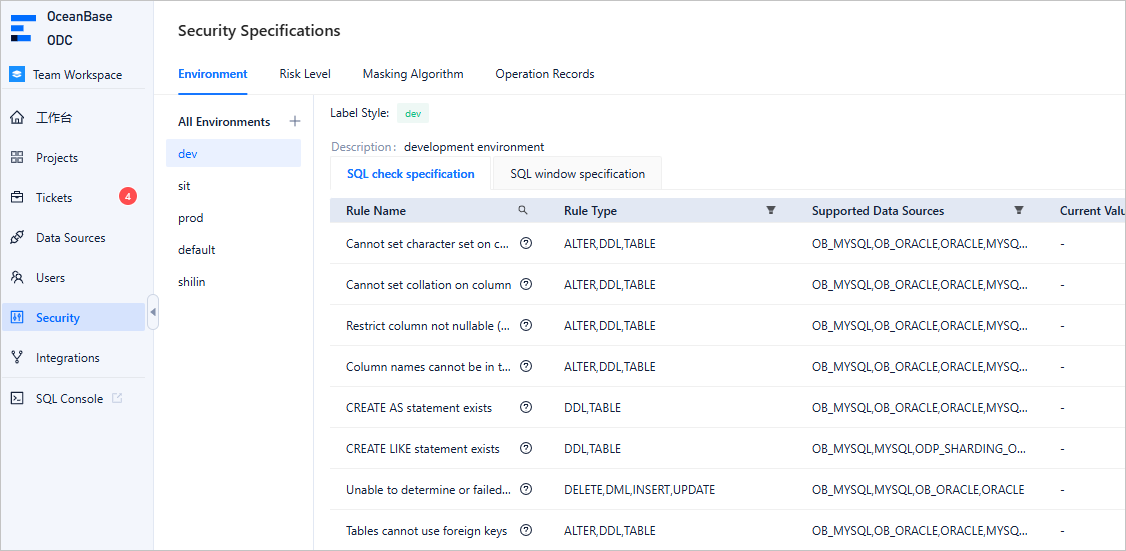
      1

    4. Scroll to find the Limit primary key data types rule. Click Edit in the Actions column of the rule.

    5. On the rule details page, view the current rule configurations. If the data type of the primary key reference column is not within the allowed data types specified in the rule, the rule is triggered. By default, the allowed data types for the primary key reference column include int, varchar2, number, float, and bigint. You can modify the Allowed data types for the primary key parameter to change the allowed data types:
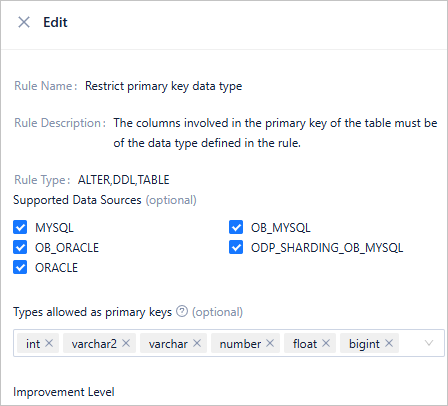
      2

    Adapt to heterogeneous development environments

    Generally, database resources of an enterprise are divided into different environments, such as the development environment, testing environment, and production environment. These environments are assigned different responsibilities. Correspondingly, different levels of control are exercised over these environments. In ODC V4.2.0, the system divides user databases into Default, Development, Production, and Testing environments:
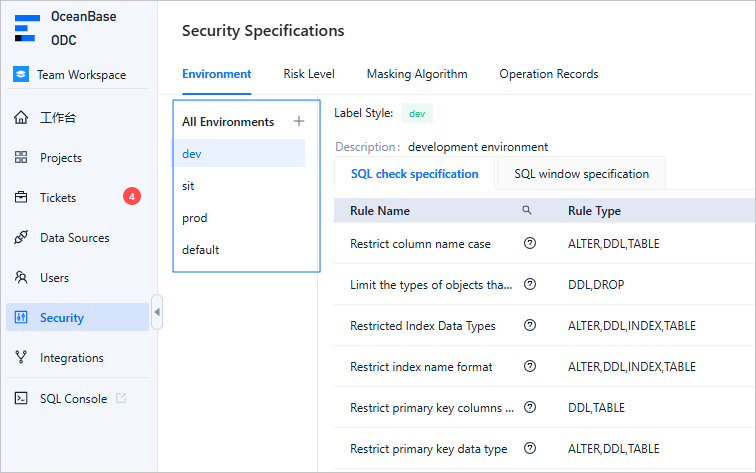
    3

    You can apply different SQL check specifications to different environments to implement different levels of control. For example, you can set different improvement levels for the same SQL rule in the production and testing environments so that the "SELECT statements should not use *" rule applies in the production environment but is disabled in the testing environment.

    Guard the R&D process

    The following example shows how SQL check rules can guard the entire database development process.

    Assume that the database development process is as follows:

    1. Create a table in the "test environment" with the following schema:

      CREATE TABLE IF NOT EXISTS `user`(
          `id` bigint NOT NULL,
          `name` varchar(128) NOT NULL,
          `account_name` varchar(128) NOT NULL,
          `organization_id` bigint NOT NULL,
          `email_address` varchar(320) DEFAULT NULL,
          `password` varchar(256) NOT NULL,
          `create_time` datetime NOT NULL DEFAULT CURRENT_TIMESTAMP COMMENT 'Record insertion time',
          `update_time` datetime DEFAULT CURRENT_TIMESTAMP ON UPDATE CURRENT_TIMESTAMP COMMENT 'Record modification time',
          `description` varchar(512) DEFAULT NULL,
          CONSTRAINT pk_user_id PRIMARY KEY(`id`),
          CONSTRAINT uk_user_organization_id_account_name UNIQUE KEY(`organization_id`, `account_name`)
          );
      
    2. Insert several test data records into the table in the "test environment".

      insert into `user` values (1, 'test', 'test_account', 1, 'xxx@test.com', '****', CURRENT_TIMESTAMP, null, 'desp info');
      insert into `user` values (2, 'test2', 'test_account2', 1, 'xxx@test2.com', '****', CURRENT_TIMESTAMP, null, 'desp info2');
      insert into `user` values (3, 'test3', 'test_account3', 1, 'xxx@test3.com', '****', CURRENT_TIMESTAMP, null, 'desp info3');
      
    3. Query the data in the table in the "test environment" to make sure that the data has been inserted.

      select * from `user`;
      
    4. Create a table with the same schema in the "production environment".

      CREATE TABLE IF NOT EXISTS `user`(
          `id` bigint NOT NULL,
          `name` varchar(128) NOT NULL,
          `account_name` varchar(128) NOT NULL,
          `organization_id` bigint NOT NULL,
          `email_address` varchar(320) DEFAULT NULL,
          `password` varchar(256) NOT NULL,
          `create_time` datetime NOT NULL DEFAULT CURRENT_TIMESTAMP COMMENT 'Record insertion time',
          `update_time` datetime DEFAULT CURRENT_TIMESTAMP ON UPDATE CURRENT_TIMESTAMP COMMENT 'Record modification time',
          `description` varchar(512) DEFAULT NULL,
          CONSTRAINT pk_user_id PRIMARY KEY(`id`),
          CONSTRAINT uk_user_organization_id_account_name UNIQUE KEY(`organization_id`, `account_name`)
          );


    #### Regulate database development

    This topic describes how to use SQL checks to regulate database development from the perspective of a database developer.

    The administrator has set the following SQL check specifications in the "Development Environment" mode:

    1. Table-level comments must be added to all table creation statements to help developers better understand the business meanings of the tables and reduce communication costs.

    2. Primary keys must be added to all table creation statements. The primary key column must be of the bigint type and must have the auto-increment attribute. The initial value of the auto-increment attribute can be left unspecified.

    3. Comments are recommended for all columns in a table creation statement. Approval is required to create a table without column comments.

    4. Columns declared NOT NULL in a table creation statement must have default values to avoid database write errors when the upper-layer business systems do not pass values.

    5. SELECT * queries are allowed.

    6. INSERT statements without explicit column specifications are allowed.

    Note

    • All specifications marked as mandatory must be followed unless the administrator adjusts the priority of the specification.
    • Approval is required for specifications with the approval priority. These specifications cannot be directly implemented.
    • Specifications with the allow priority are merely prompted but not enforced.

    A developer enters a table creation statement in an edit window of a development database. Before the execution, the developer can click the SQL Check button in the toolbar to verify whether the SQL statement violates any rules:
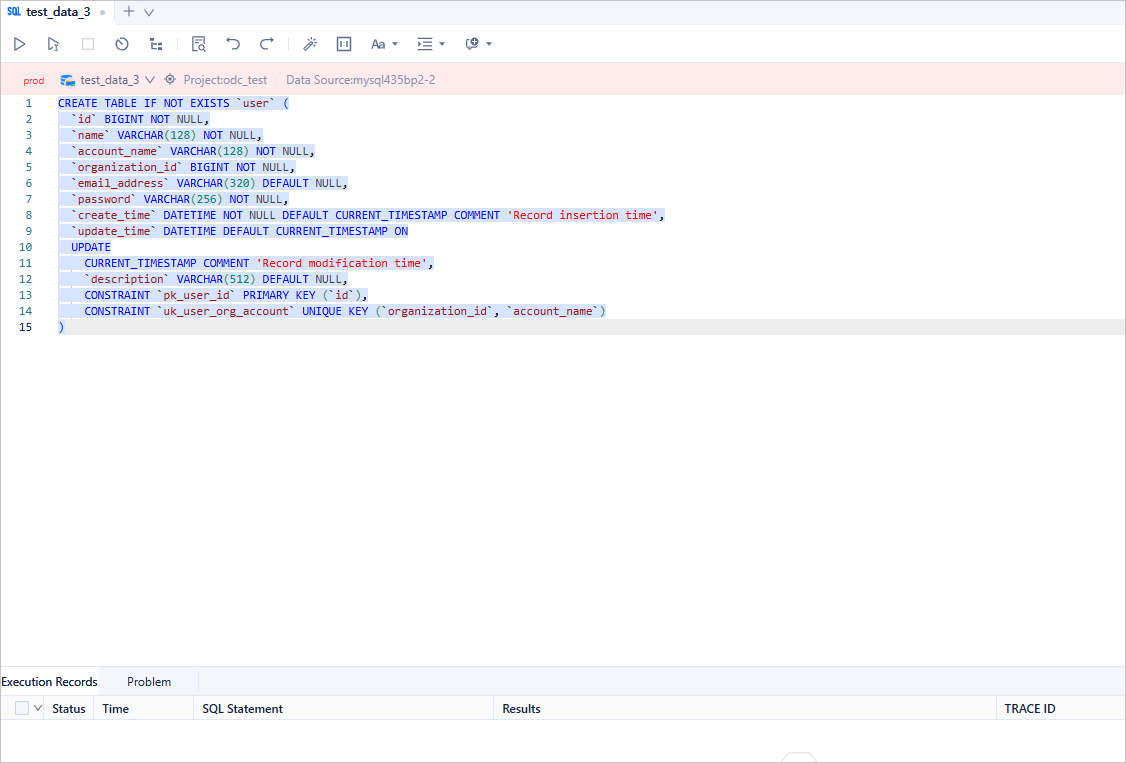
    4

    Violations of different rules are distinguished by colors. You can click the Locate button to locate the specific rule violated in the SQL statement. After modifying the SQL statement based on the check results, you can submit the SQL statement for execution. If you choose to submit the SQL statement for execution, ODC will process it according to the following procedure:
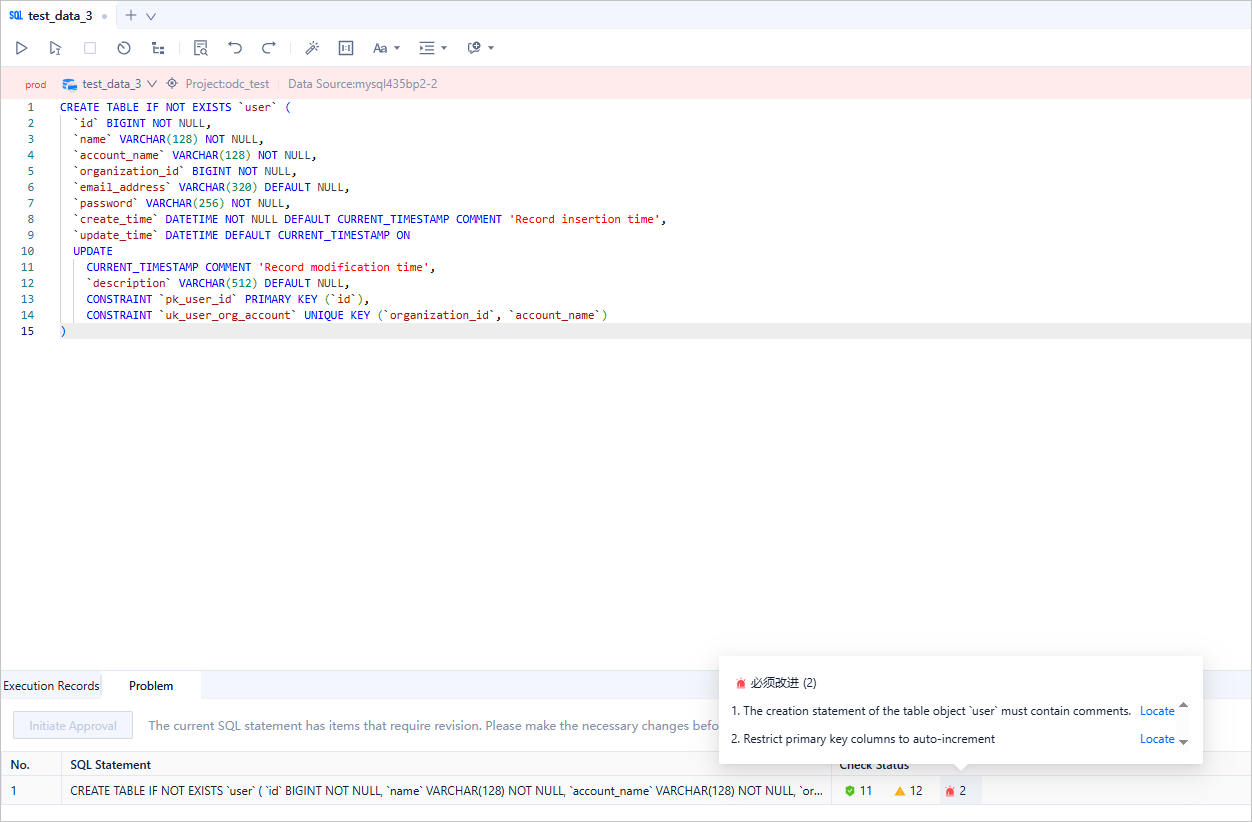
    5

    First, ODC determines whether the type of the SQL statement allows it to be executed. If yes, ODC checks whether the SQL statement violates any "Must Improve" rules. If it does, the execution is blocked. If not, ODC checks whether the SQL statement violates any "Approval Required" rules. If it does, the SQL statement is converted into a database change ticket. If it does not violate any of the above rules, the SQL statement is executed.

    Note

    You can go to Security > Environment > SQL Window Specifications > SQL Types Allowed for Direct Execution to modify the SQL types that are allowed to be executed directly.

    After modifying the SQL statement, the user clicks the Execute button. The execution result is as follows:
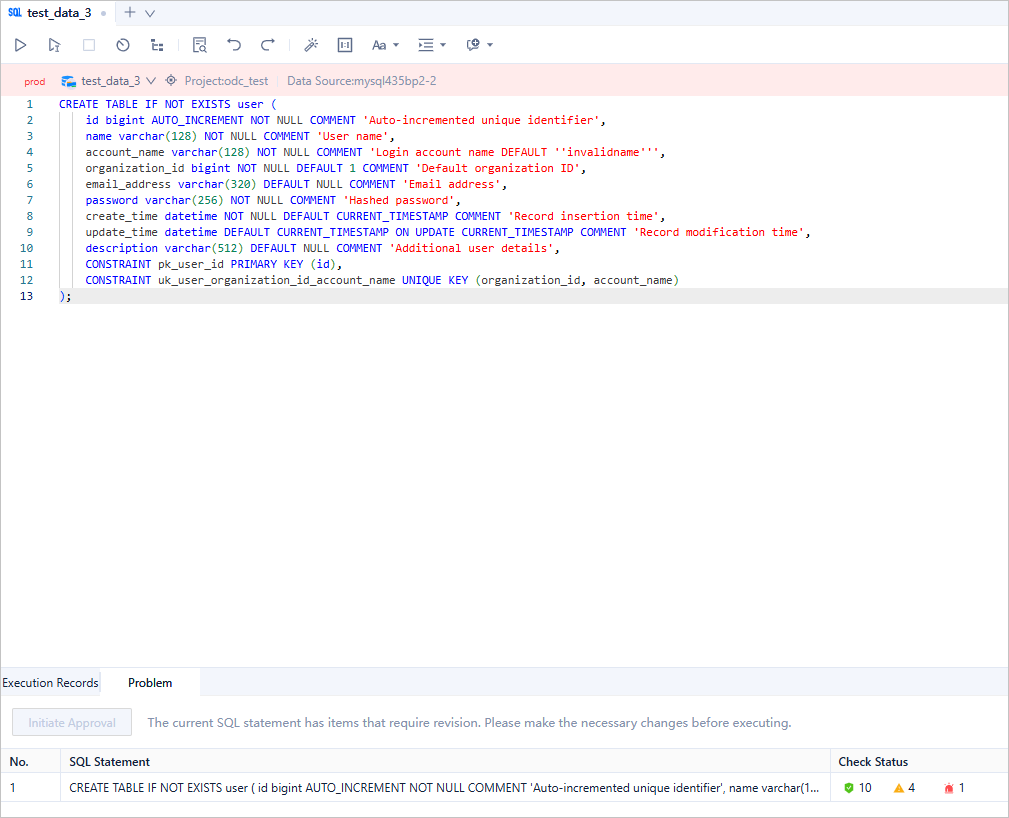
    6

    The SQL statement violates a "Must Improve" rule. Therefore, ODC intercepts the execution of the SQL statement. The user continues to modify the SQL statement until it does not violate any "Must Improve" rules. Some "Approval Required" rules are still violated:
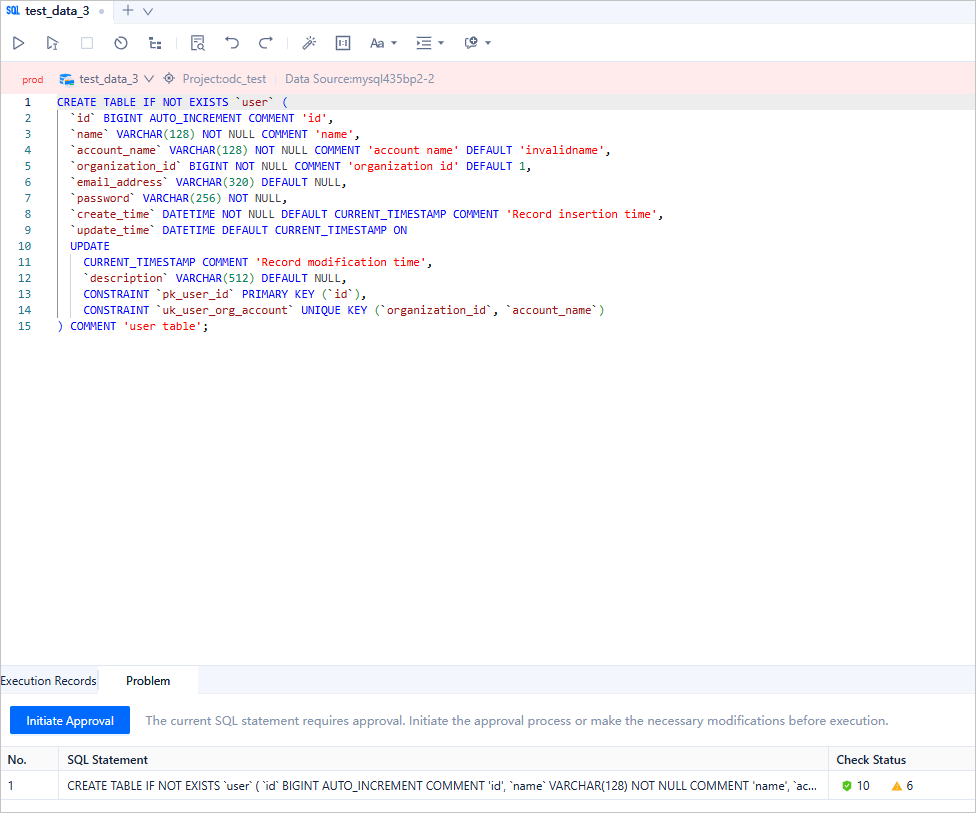
    7

    The SQL statement violates an "Approval Required" rule. Therefore, ODC still blocks the execution of the SQL statement. The user can click "Start Approval" to create a database change ticket, and ask the approver to decide whether the SQL statement can be executed.
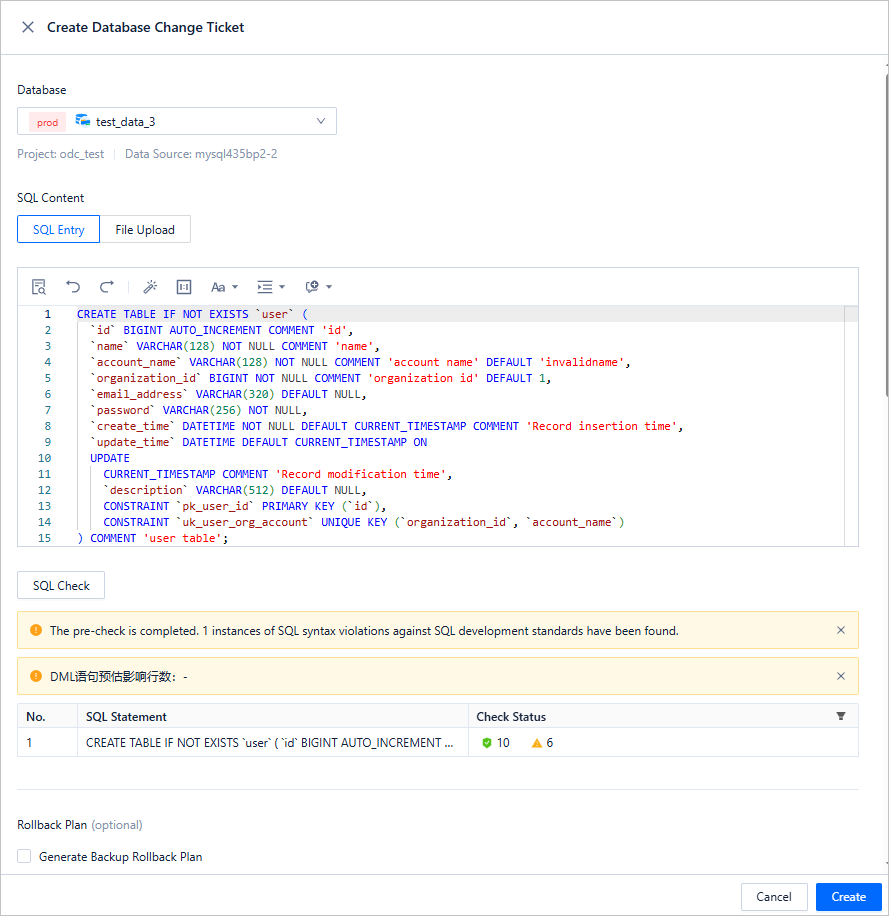
    8

    If the user has fixed all the violations, and the SQL statement does not violate any rules or violates only "No Improvement" rules, the SQL statement can then be executed in the SQL window:
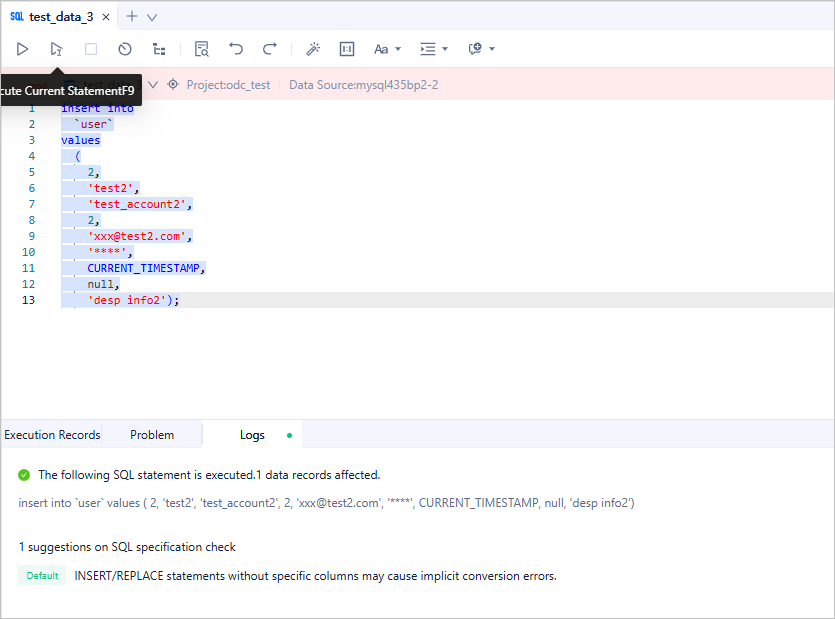
    9

    The user can also insert several test records into a table and query these records directly in the SQL window:
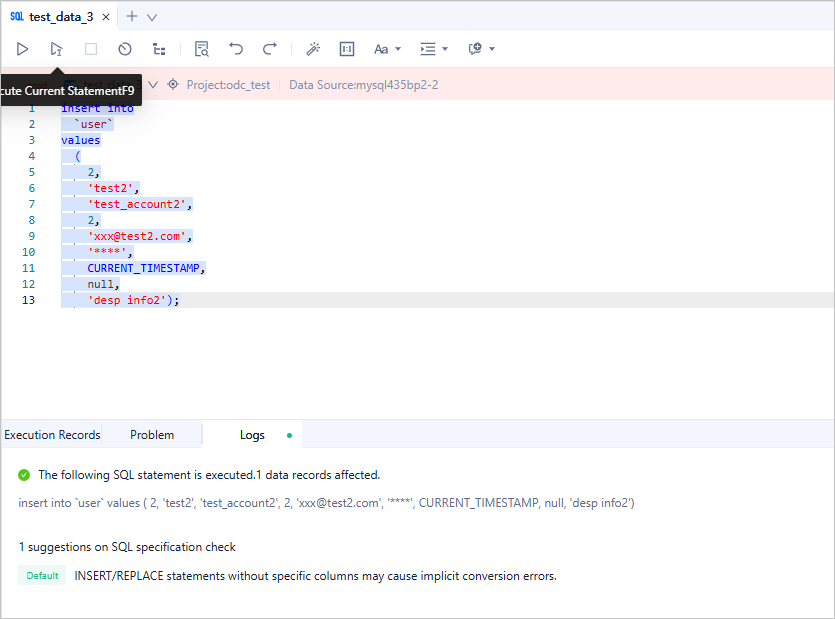
    10

    Although the INSERT statement and the SELECT statement violate the "No Improvement" rules, these rules do not affect the execution. In the "Production Environment", the administrator can change the risk levels of these two rules to "Must Improve". Then, if a user executes an SQL statement that violates these two rules, ODC will block the execution:
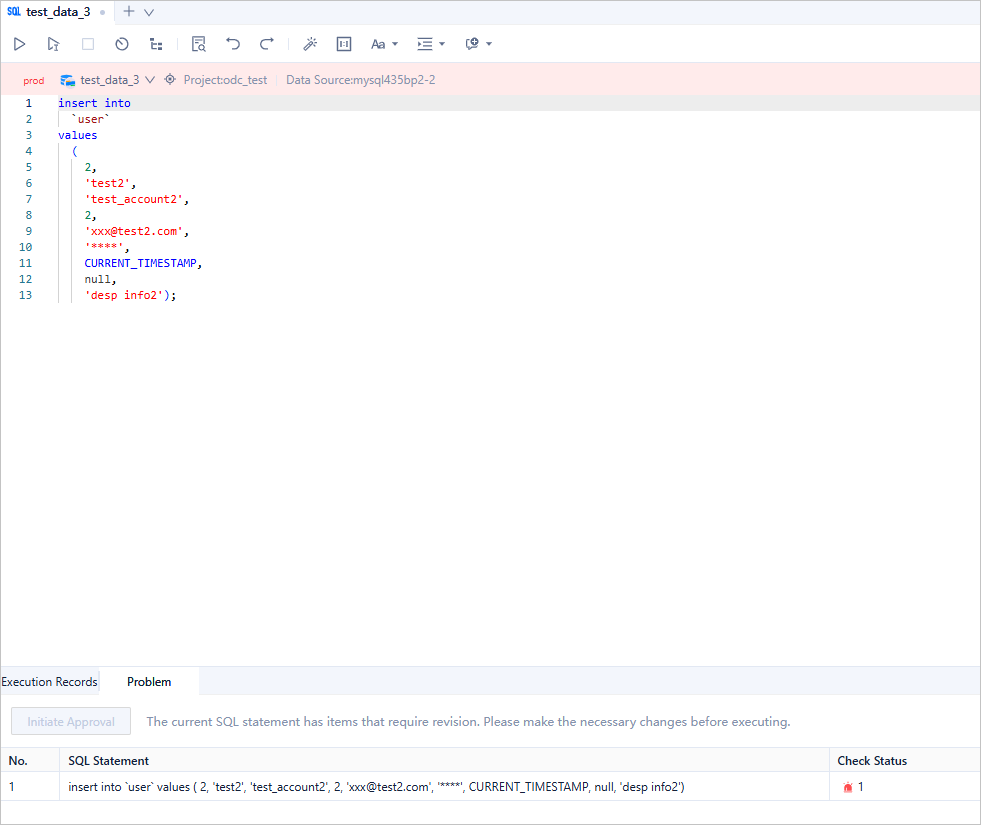
    11

    Protect database changes

    In a development environment, most users perform database operations through the SQL window. However, in a production environment, interactions with the database are strictly controlled and are typically performed through database changes. SQL checks play a crucial role in the following two scenarios:

    • Scenario 1: Whether to initiate a database change. If an SQL statement violates a "Must Improve" rule, a database change ticket cannot be initiated.

    • Scenario 2: Which approval process to match. ODC calculates the risk of the SQL statement based on the check results and matches an approval process based on the risk level.

    The following example shows how the SQL check rules protect database changes.

    The administrator configures the same rules as those specified in the "Regulate database development" section to constrain all SQL statements to be changed:

    1. Table-level comments are required in create table statements to help developers better understand the business meanings of the tables and reduce communication costs.
    2. Primary keys must be included in create table statements. The primary key must be of the bigint type and have the auto-increment attribute. The initial value of the auto-increment attribute can be specified.
    3. Comments are recommended for all columns in create table statements. If a table without column comments is created, approval is required.
    4. Columns declared NOT NULL in create table statements must have default values to avoid database write errors when the upper-layer business systems do not send values.

    A user initiates a database change ticket by using the following SQL statement:
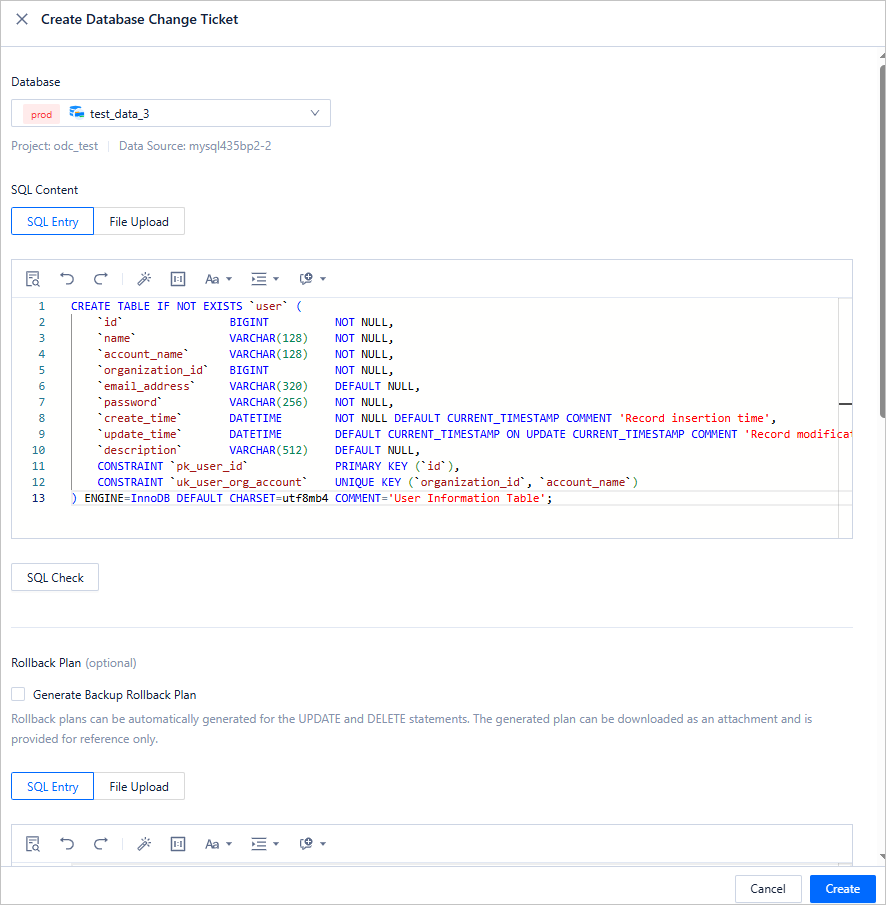
    12

    The SQL statement violates several "Must Improve" rules. Therefore, the ticket cannot be initiated. When the user clicks the details of the ticket, the specific violation rules are displayed:
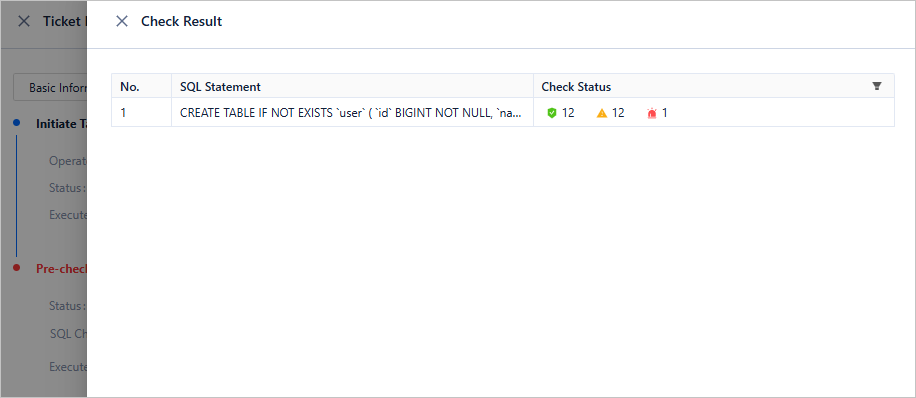
    13

    Note

    You can define risk levels based on multiple factors in the Security > Risk Level section, and use the risk levels to match approval processes.

    After the user fixes all "Must Improve" violations, the ticket can be initiated.

    15

    The SQL statement to be changed matches a "Approval Required" rule. Therefore, the risk level of the SQL statement is assessed to be "High", and requires joint approval from the project administrator and the project DBA:
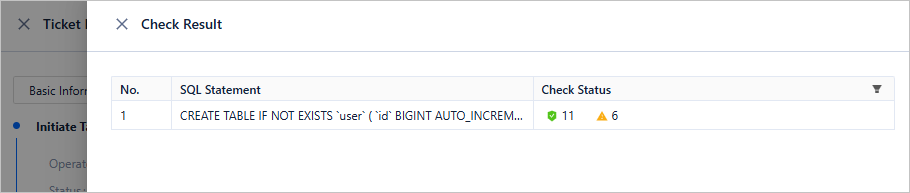
    16

    References

    • SQL check specification
    • Risk management
    • Database change management

    Previous topic

    OceanBase historical database solutions
    Last

    Next topic

    Manage and modify sharded databases and tables via ODC
    Next
    What is on this page
    Background information
    SQL check specifications
    Fine-grained configuration
    Guard the R&D process
    References