







A tenant is a logical concept that represents a resource allocation unit in OceanBase Database. It is the basis for the management of database objects and resources. It is critical for system O&M, especially for the O&M of cloud databases. After you log on to the OceanBase Cloud Platform (OCP) console, click Tenants in the left-side navigation pane. The Tenant Overview page appears. By default, the page displays a list of tenants that you have the permission to view, and displays performance monitoring charts of top 5 tenants.
On the Tenants page, you can see a Tenants list and charts of Top 5 Tenants . You can also perform tenant management operations on this page. For more information, see Unit specification management, Create a tenant, Lock a tenant, and Copy a tenant.
Tenants
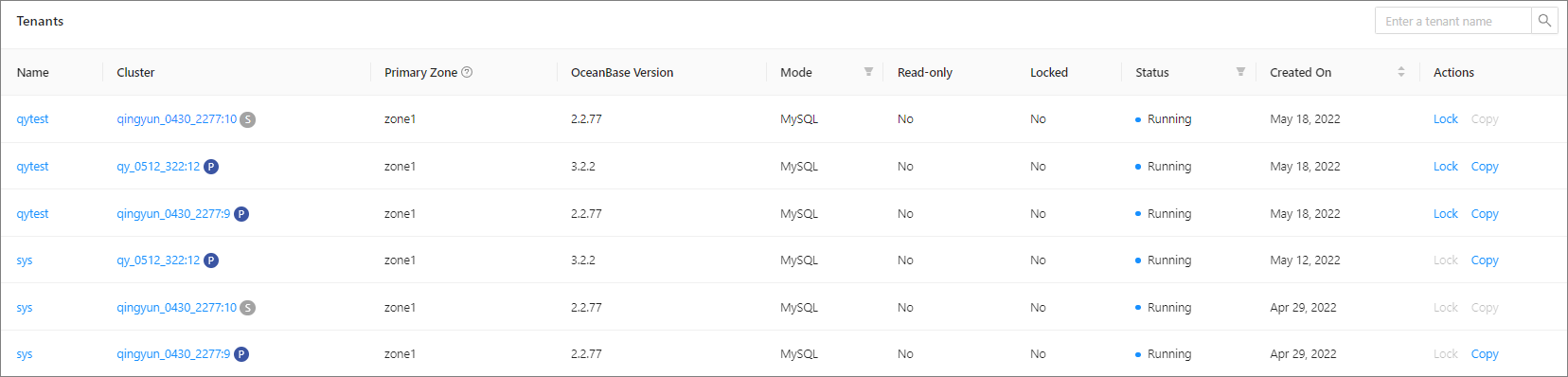
The Tenants list contains the following columns: Tenant Name, Cluster, Replica Distribution, Zone Priority, Tenant Mode, Read-only, Locked, Status, Created At , and Actions .
You can click the name of a tenant to go to the tenant details page. For more information, see Tenant overview.
Click the cluster that the tenant belongs to. The Overview page of the cluster appears. For more information, see Overview of the cluster details page.
Field |
Description |
|---|---|
| Replica Distribution | The replica type of the tenant in each zone, which may be Full-featured Replica, Read-only Replica, or Log Replica. |
| Zone Priority | The priority of the partition leader in the tenant. |
| Tenant Mode | The mode of the tenant, which may be Oracle or MySQL . You can filter tenants by mode. |
| Status | The status of the cluster, which can be Running, Creating, Maintaining , or Deleting . |
| Created At | You can sort the tenants by creation time. |
| Actions | This column provides the Lock and Copy options. If you lock a tenant, the tenant cannot be accessed. If you copy a tenant, a new tenant with the same settings will be created in the same cluster. |
Top 5 Tenants
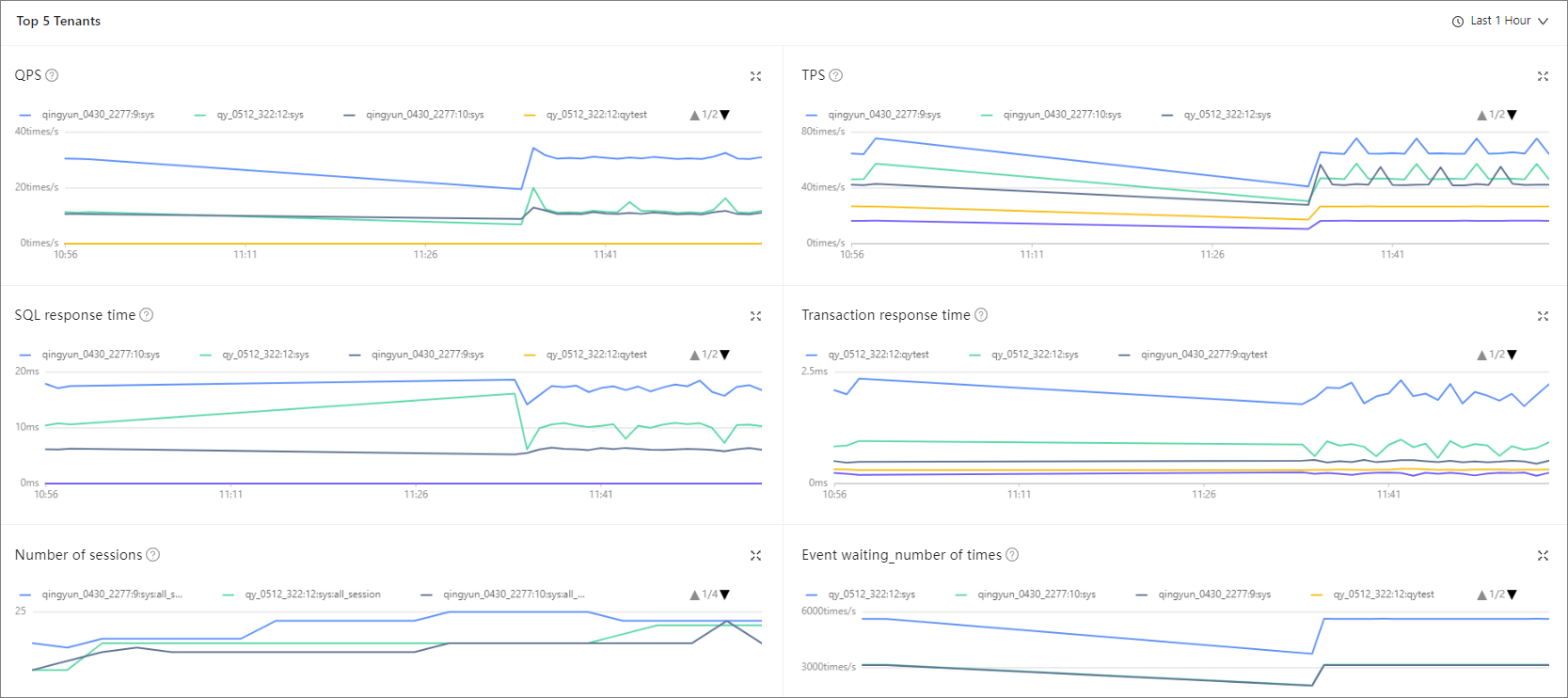
In this section, you can view the monitoring data of top 5 tenants sorted by the following metrics in the last hour, 24 hours, or 7 days: QPS, TPS, SQL response time, Transaction response time, Sessions, Event waiting_count, Event waiting_time, Capacity_tables , and Capacity_partitions .
Metric |
Description |
|---|---|
| QPS | The average number of SQL statements processed per second. |
| TPS | The average number of transactions processed per second. |
| SQL response time | The SQL response time, in µs. |
| Transaction response time | The average time taken by the server to process a transaction, in µs. |
| Sessions | The current number of sessions and the current number of active sessions. Data source: __all_virtual_processlist. |
| Event waiting_count | The average number of wait events per second. |
| Event waiting_time | The average wait time of each wait event, in μs. |
| Capacity_tables | The number of tables. |
| Capacity_partitions | The number of partitions. |
Tenant management operations
The following table describes the supported tenant management operations.
Operation |
Description |
|---|---|
| Create a tenant | You can perform this operation to create a tenant. |
| Unit specification management | You can perform this operation to add, modify, and delete unit specifications. |
| Create a user under an Oracle tenant | You can perform this operation to create a user under an Oracle tenant. |
| Lock a tenant | You can perform this operation to lock a tenant so that it cannot be accessed by users. |
| Copy a tenant | You can perform this operation to quickly create a tenant by copying an existing tenant. |
| Delete a tenant | You can perform this operation to delete a tenant that is in the disabled state. |
| Create a replica | You can perform this operation to create a replica for a tenant. |
| Change the password of the SYS tenant | You can perform this operation to change the password of the SYS tenant. |
| Edit a tenant replica in a zone | You can perform this operation to modify the tenant replica information, including the replica type, unit specification, unit quantity, and zone priority. |
| Delete a tenant replica from a zone | You can perform this operation to delete a tenant replica from a zone. |
| Modify zone priorities | You can perform this operation to modify the priority of a zone. |
| Modify the whitelist | You can perform this operation to enable other clients to access a tenant by modifying the whitelist of the tenant. |
| View the topology of a tenant | The tenant topology provides the following information: the distribution of the tenant replicas in the cluster, the cluster in which the replicas and tenant are located, and the status of the hosts on which the replicas depend. |
| Database management | You can perform this operation to view, create, delete, and modify databases in a tenant. |
| User management under a MySQL tenant | You can perform this operation to view users, create and delete a user, and grant and revoke user privileges in the current MySQL tenant. |
| User overview under an Oracle tenant | You can perform the user management operation to view users and roles in an Oracle tenant. |
| Create a user under an Oracle tenant | You can perform this operation to create a user under an Oracle tenant. |
| Change the password of a user under an Oracle tenant | You can perform this operation to change the password of a user under an Oracle tenant. |
| Delete a user under an Oracle tenant | You can perform this operation to delete a user under an Oracle tenant. |
| Create a role under an Oracle tenant | You can perform this operation to create a role under an Oracle tenant. |
| Manage users | You can perform this operation to modify system privileges and roles of a user under an Oracle tenant and add accessible objects for the user. |
| Manage roles | You can perform this operation to modify a role and its system privileges and add accessible objects for the role. |
| Performance monitoring | You can perform this operation to view the performance statistics of a tenant. |
| Tenant resource management | You can perform this operation to view the resource usage tendency and the information about databases and table groups of a tenant. |
| Transaction diagnostics | You can perform this operation to view large transactions in a database and handle the transactions. |
| Suspicious SQL diagnostics | You can perform this operation to view the SQL statements that meet the diagnostic conditions and the suggested solutions. |
| TopSQL diagnostics | You can perform this operation to view the SQL statements with the longest average execution time in a tenant and other execution-related information. |
| SlowSQL diagnostics | You can perform this operation to identify SQL statements whose execution time exceeds 100 ms. You can use the slow SQL diagnostics feature to identify risky statements and avoid risks. |
| ParallelSQL diagnostics | You can perform this operation to troubleshoot complex SQL problems such as analytical processing statements and irreproducible SQL problems. |
| View SQL statement details | You can perform this operation to view the running status, execution plans, bound indexes, and throttling status of SQL statements. |
| View the SQL collection enable/disable history | You can perform this operation to view the SQL collection enable/disable history. |
| View outlines | You can perform this operation to view the outline information of a tenant, including the throttling, execution plan binding, and index binding information. |
| View request analysis | You can perform this operation to learn of the overall SQL execution status based on the execution time distribution of different types of SQL statements. |
| Back up and recover a tenant | You can perform this operation to initiate a recovery task to recover the current tenant and view the backup strategies and details of recovery tasks. |
| View tenant sessions | You can perform this operation to view all sessions and active sessions of the current tenant and retrieve sessions. |
| View session statistics | You can perform this operation to view session statistics of the currently logged-on user in different dimensions. |
| View deadlock analysis | You can perform this operation to view the deadlock diagnostic and analysis details. |
| Manage the ASH report | The Active Sessions History (ASH) report provides you with the SQL statements that use the most database resources during a diagnostics period, the execution details of historical sessions of an OceanBase cluster, and other information. |
| View parameters | You can perform this operation to view all parameters of the current tenant or parameters that meet the specified search criteria. |
| Modify parameters | You can perform this operation to modify the parameter values of the current tenant. |
| View the parameter modification history | You can perform this operation to view the parameter modification records of the current tenant. |
| Manage tenant parameter templates | A tenant parameter template contains predefined tenant parameters. You can use a tenant parameter template to create a series of tenants that have similar configurations without the need to repeatedly configure tenant parameters. |