







This topic describes the system architecture of OceanBase Cloud Platform (OCP).
The following figure shows the system architecture of OCP.
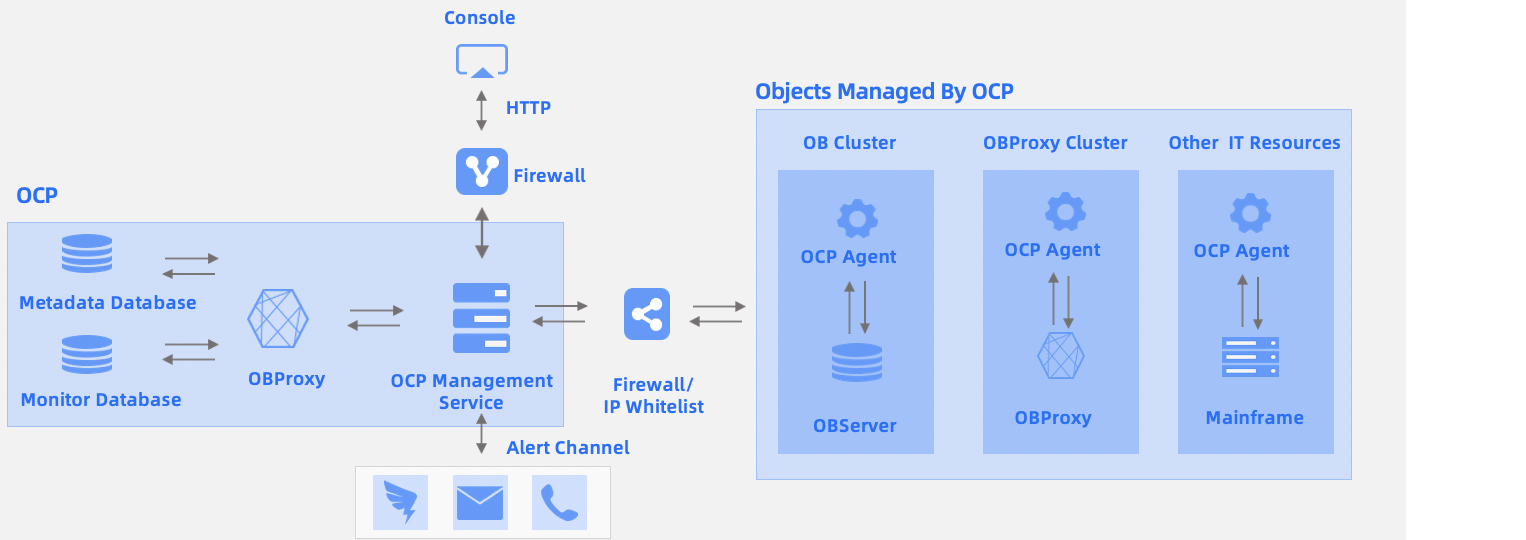
In the figure:
OCP-Server and OCP-Agent are OCP components.
MetaDB, MonitorDB, and OBProxy are databases or services that OCP depends on.
The alert channel is an external component of OCP. OCP pushes alert information to the alert channel by initiating client calls.
Note
OCP and targets under the management of OCP must be deployed in interconnected networks. The targets may include OceanBase clusters, OBProxy clusters, and backup and recovery clusters.
The following table describes the modules in the system architecture.
Module |
Description |
|---|---|
| OCP-Server |
|
| MetaDB | MetaDB stores metadata that OCP-Server depends on. In the production environment, we recommend that you create MetaDB in an OceanBase cluster with multiple replicas. This avoids data loss in the case of exceptions such as power outage in IDCs. |
| Monitor Repository | A monitor repository, also known as monitoring database or MonitorDB, is used to store the monitoring data collected by OCP. The monitor repository stores the performance metrics and the statistical and diagnostic information of hosts, clusters, tenants, sessions, and SQL statements. |
| OBProxy | Both MetaDB and MonitorDB are created in OceanBase clusters. OCP-Server accesses MetaDB and MonitorDB through OBProxy. |
| OCP-Console | The OCP administrator accesses OCP-Console through a browser. |
| Alert channel |
|
| OCP-Agent | To manage targets, OCP-Agent needs to be installed on the hosts of managed targets. OCP-Agent is used to collect monitoring data and run operation and maintenance commands. The host management module of OCP-Server automatically deploys and maintains OCP-Agent. |