







OceanBase Migration Service (OMS) allows you to synchronize data from a logical table of OceanBase Database Proxy (ODP) to a physical table in a MySQL-compatible tenant of OceanBase Database. This feature supports database and table sharding or database sharding only. This topic describes how to synchronize data from an ODP logical table to a physical table in a MySQL-compatible tenant of OceanBase Database.
Limitations
The logical table of ODP must have a primary key to synchronize data to a physical table in the MySQL-compatible tenant of OceanBase Database.
The name of a table to be synchronized, as well as the names of columns in the table, must not contain Chinese characters.
Data source identifiers and user accounts must be globally unique in OMS.
OMS supports the synchronization of only objects whose database name, table name, and column name are ASCII-encoded and do not contain special characters. The special characters are line breaks, spaces, and the following characters:
. | " ' ` ( ) = ; / & \.
Considerations
If the clocks between nodes or between the client and the server are out of synchronization, the latency may be inaccurate during incremental synchronization.
For example, if the clock is earlier than the standard time, the latency can be negative. If the clock is later than the standard time, the latency can be positive.
If you select only Incremental Synchronization when you create a data synchronization task, OMS requires that the local incremental logs in the source database be retained for more than 48 hours.
If you select Full Synchronization and Incremental Synchronization when you create the data synchronization task, OMS requires that the local incremental logs of the source database be retained for at least seven days. Otherwise, the data synchronization task may fail or the data in the source and target databases may be inconsistent because OMS cannot obtain incremental logs.
Supported DDL operations for synchronization and limitations
Supported DDL operations for synchronization
ADD COLUMN: When you execute this statement, specify the default value in the statement.MODIFY COLUMN: You can execute this statement only to increase the column length.
Only two types of DDL statements executed on the logical table are automatically synchronized to the target table in the incremental synchronization phase. A DDL statement executed on any physical table is automatically synchronized to other tables. This DDL statement is not synchronized to other tables if it is executed later.
Notice
By default, a DDL statement executed on a logical table is synchronized to all physical tables. The execution of the statement does not cause the schemas in physical tables of the logical table to be different.
Limitations
By default, schemas in a logical table are consistent. If they are inconsistent, DDL statements are executed only on some tables. Data synchronization fails because of inconsistent data.
When you execute the
ALTER TABLE ADD COLUMNstatement, specify the default value in the statement.Executing the
ALTER TABLE MODIFY COLUMNstatement does not work with the following case:A nullable column is set to a non-null column and the data is pulled back. In this case, data synchronization is likely to fail because the data is null but the constraint in the target database does not allow null values.
To solve this issue, you can execute a DDL statement on the target column to allow null values in this column. The following
MODIFYDDL statements are automatically synchronized.
Procedure
Create a data synchronization task.
Log in to the OMS console.
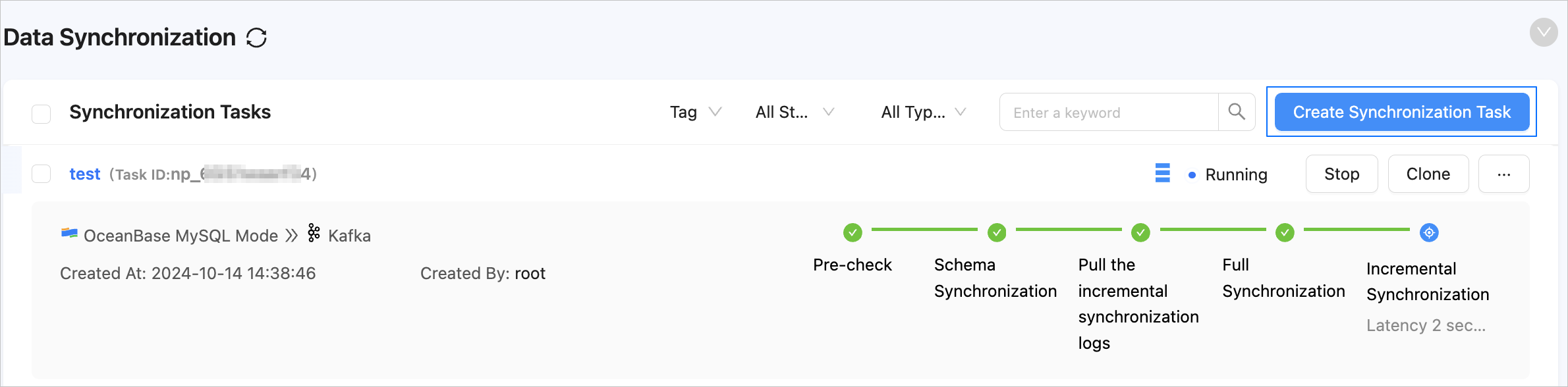
In the left-side navigation pane, click Data Synchronization.
On the Data Synchronization page, click Create Synchronization Task in the upper-right corner.
On the Select Source and Target page, configure the parameters.
ParameterDescriptionTask Name We recommend that you set it to a combination of digits and letters. It must not contain any spaces and cannot exceed 64 characters in length. Source If you have created an ODP data source, select it from the drop-down list. Otherwise, click New Data Source in the drop-down list and create one in the dialog box that appears on the right. For more information, see Create an ODP data source. Target If you have created a MySQL data source of OceanBase Database, select it from the drop-down list. Otherwise, click New Data Source in the drop-down list and create one in the dialog box that appears on the right. For more information, see Create a physical OceanBase data source. Tag Click the field and select a tag from the drop-down list. This parameter is optional. You can also click Manage Tags to create, modify, and delete tags. For more information, see Use tags to manage data synchronization tasks. Click Next. On the Select Synchronization Type page, specify the synchronization types for the current data synchronization task.
The supported synchronization types are Full Synchronization and Incremental Synchronization. Incremental Synchronization supports the DML Synchronization and DDL Synchronization options. The supported DML operations are
INSERT,DELETE, andUPDATE. Select the options based on your business needs. For more information, see Configure DDL/DML synchronization.Click Next. In the Select Synchronization Scope section of the Select Synchronization Objects page, select the target object in the left list and click >.
OMS allows you to import objects from text files and perform the following operations on the objects in the target database: rename objects, set sharding columns, and remove objects.
OperationDescriptionImport objects - In the list on the right, click Import Objects in the upper-right corner.
- In the dialog box that appears, click OK.
Notice
This operation will overwrite previous selections. Proceed with caution. - In the Import Synchronization Objects dialog box, import the objects to be synchronized.
You can import CSV files to configure synchronization objects. For more information, see Download and import the settings of synchronization objects. - Click Validate.
- After the validation succeeds, click OK.
Rename objects OMS allows you to rename databases or tables to be synchronized. For more information, see Rename a migration or synchronization object. Configure settings - In the list on the right, move the pointer over the object that you want to set.
- Click Settings.
- In the Settings dialog box, click Sharding Columns and select the sharding columns that you want to use from the drop-down list. You can select multiple fields as sharding columns. This parameter is optional.
Unless otherwise specified, select the primary key as sharding columns. If the primary keys are not load-balanced, select load-balanced fields with unique identifiers as sharding columns to avoid potential performance issues. Sharding columns can be used for the following purposes:- Load balancing: Threads used for sending messages can be recognized based on the sharding columns if the target table supports concurrent writes.
- Orderliness: OMS ensures that messages are received in order if the values of the sharding columns are the same. The orderliness specifies the sequence of executing DML statements for a column.
- Click OK.
Remove one or all objects OMS allows you to remove a single object or all objects to be synchronized to the target database during data mapping. - Remove a single synchronization object
In the list on the right, move the pointer over the object that you want to remove, and click Remove to remove the synchronization object. - Remove all synchronization objects
In the list on the right, click Remove All in the upper-right corner. In the dialog box that appears, click OK to remove all synchronization objects.
Click Next. On the Synchronization Options page, configure the following parameters.
Full synchronization
The following parameters are displayed only if you have selected Full Synchronization on the Select Synchronization Type page.
ParameterDescriptionFull Synchronization Resource Configuration You can select Small, Medium, or Large to use the corresponding default values of Read Concurrency, Write Concurrency, and Memory. You can also customize the resource configurations for full synchronization. By setting the resource configuration for the Full-Import component, you can limit the resource consumption of a task in the full synchronization phase. Notice
In the case of custom configurations, the minimum value is
1, and only integers are supported.Incremental synchronization
The following parameters are displayed only if you have selected Incremental Synchronization on the Select Synchronization Type page.
ParameterDescriptionIncremental Log Pull Resource Configuration You can select Small, Medium, or Large to use the corresponding default value of Memory. You can also customize the resource configurations for incremental log pull. By setting the resource configuration for the Store component, you can limit the resource consumption of a task in log pull in the incremental synchronization phase. Notice
In the case of custom configurations, the minimum value is
1, and only integers are supported.Incremental Data Write Resource Configuration You can select Small, Medium, or Large to use the corresponding default values of Write Concurrency and Memory. You can also customize the resource configurations for incremental data write. By setting the resource configuration for the Incr-Sync component, you can limit the resource consumption of a task in data writes in the incremental synchronization phase. Notice
In the case of custom configurations, the minimum value is
1, and only integers are supported.Incremental Record Retention Time The duration that incremental parsed files are cached in OMS. A longer retention period results in more disk space occupied by the Store component. Incremental Synchronization Start Timestamp - If you have selected Full Synchronization as the synchronization type, the default value of this parameter is the task startup time and cannot be modified.
- If you did not select Full Synchronization as the synchronization type, set this parameter to a certain point of time, which is the current system time by default. For more information, see Set an incremental synchronization timestamp.
If the parameter settings on the page cannot meet your requirements, you can click Parameter Configuration in the lower part of the page to configure more specific settings. You can also reference an existing task or component template.

Click Precheck.
During the precheck, OMS checks whether all the physical tables in the logical table are accessible based on the username and password entered in ODP and whether the user has the
SELECTprivilege. In addition, OMS checks whether theobconfig_urlparameter of OceanBase Database is correctly configured. You can run theshow parameters like "obconfig_url"command in thesystenant to obtain the value ofobconfig_urlfor pulling logs in subsequent incremental synchronization.If an error is returned during the precheck, you can perform the following operations:
Identify and troubleshoot the problem and then perform the precheck again.
Click Skip in the Actions column of a failed precheck item. In the dialog box that prompts the consequences of the operation, click OK.
Click Start Task. If you do not need to start the task now, click Save to go to the details page of the task. You can start the task later as needed.
OMS allows you to modify the synchronization objects when the data synchronization task is running. For more information, see View and modify synchronization objects. After the data synchronization task is started, it will be executed based on the selected synchronization types. For more information, see the View synchronization details section in the View details of a data synchronization task topic.
If the data synchronization task encounters an execution exception due to a network failure or slow startup of processes, you can click Recover on the Synchronization Tasks or Details page of the synchronization task.