







This topic describes how to view and modify the parameter configurations of a data synchronization task.
View parameter configurations
You can view the parameter configurations of a data synchronization task in the Running, Modifying, Integrating, Completed, Stopping, or Stopped state.
Log in to the OceanBase Migration Service (OMS) console.
In the left-side navigation pane, click Data Synchronization.
On the Synchronization Tasks page, click the More icon next to the target task and select Settings.

You can also click the name of the task to go to its details page. Then, click the More icon in the upper-right corner and select Settings.
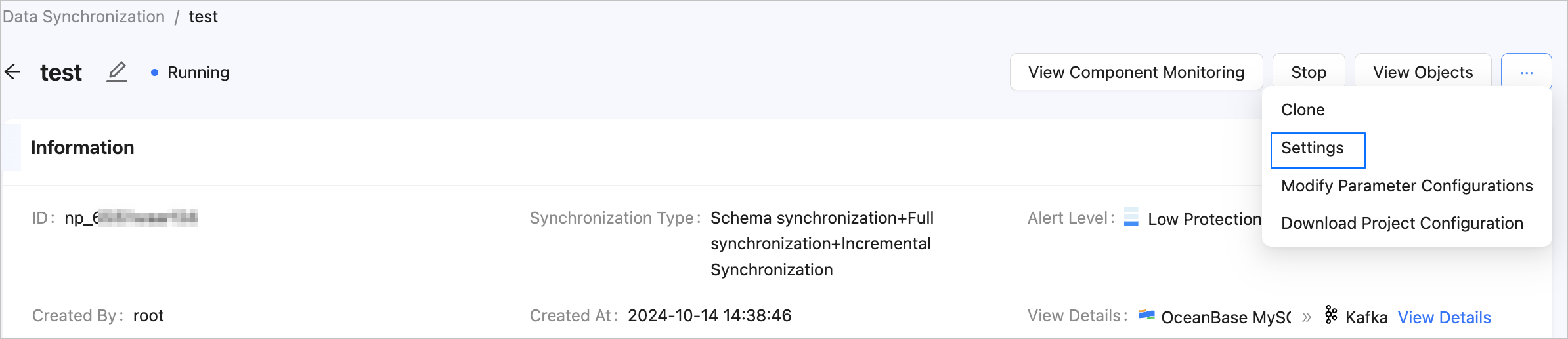
On the Settings page, view the parameter configurations of the current task.
Modify parameter configurations
You can modify the parameter configurations of a data synchronization task in the Not Started, Paused, or Failed state.
Log in to the OMS console.
In the left-side navigation pane, click Data Synchronization.
On the Synchronization Tasks page, click the More icon next to the target task and select Modify Parameter Configurations.
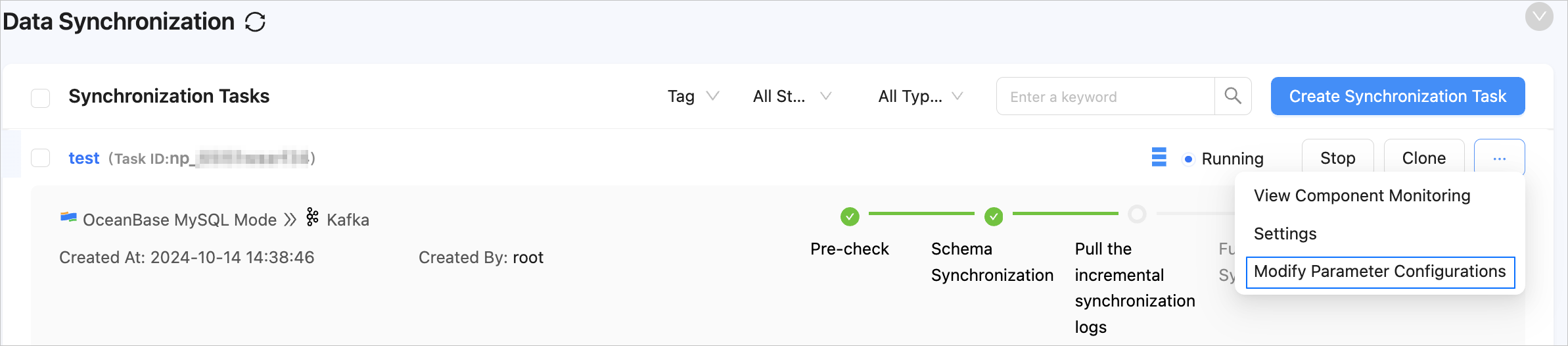
You can also click the name of the task to go to its details page. Then, click the More icon in the upper-right corner and select Modify Parameter Configurations.
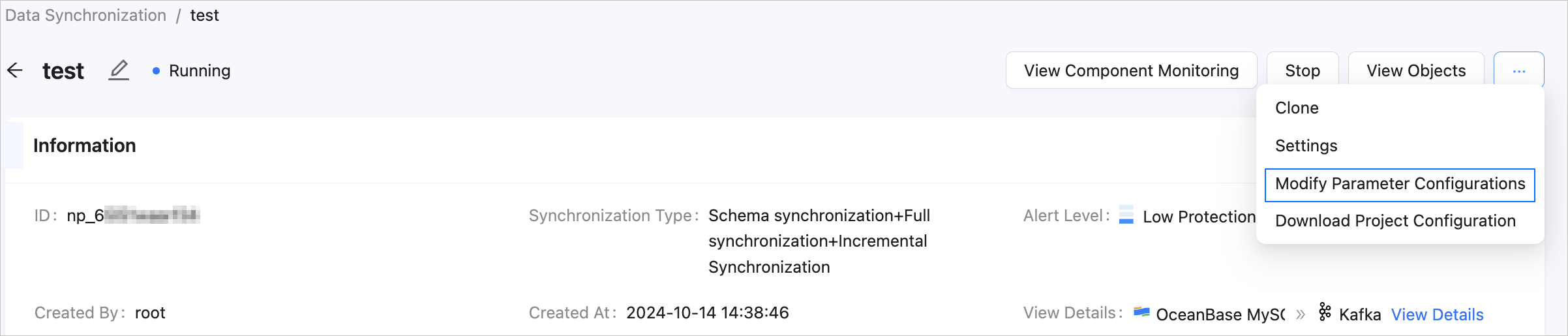
In the Modify Parameter Configurations panel, modify the parameter configurations as needed.
Full synchronization
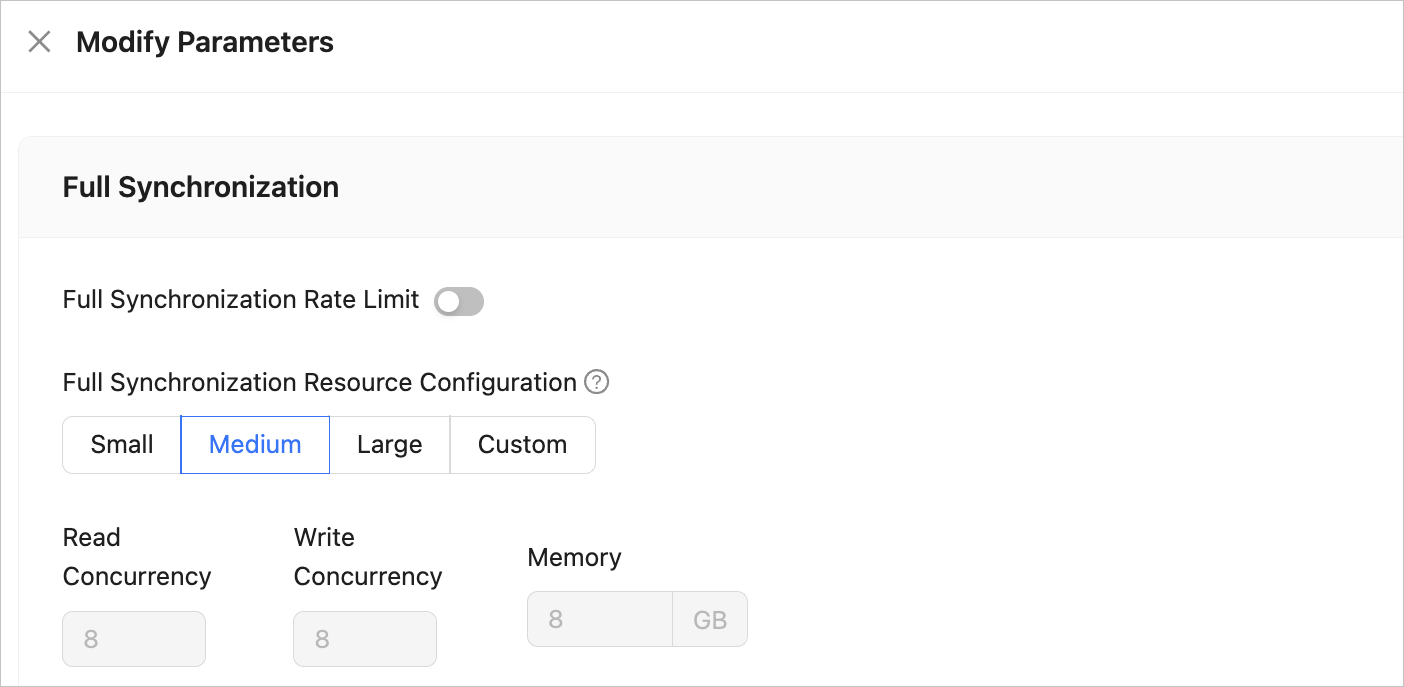
The following parameters are displayed only if you have selected Full Synchronization on the Select Synchronization Type page.
 ParameterDescription
Full Synchronization Rate Limit You can choose whether to limit the full synchronization rate as needed. If you choose to limit the full synchronization rate, you must specify the records per second (RPS) and bytes per second (BPS). The RPS specifies the maximum number of data rows synchronized to the target database per second during full synchronization, and the BPS specifies the maximum amount of data in bytes synchronized to the target database per second during full synchronization. Note
The RPS and BPS values specified here are only for throttling. The actual full synchronization performance is subject to factors such as the settings of the source and target databases and the instance specifications.
Full Synchronization Resource Configuration You can select Small, Medium, or Large to use the corresponding default values of Read Concurrency, Write Concurrency, and Memory. You can also customize the resource configurations for full synchronization. By setting the resource configuration for the Full-Import component, you can limit the resource consumption of a task in the full synchronization phase. Notice
In the case of custom configurations, the minimum value is
1, and only integers are supported.Incremental synchronization
The following parameters are displayed only if you have selected Incremental Synchronization on the Select Synchronization Type page.
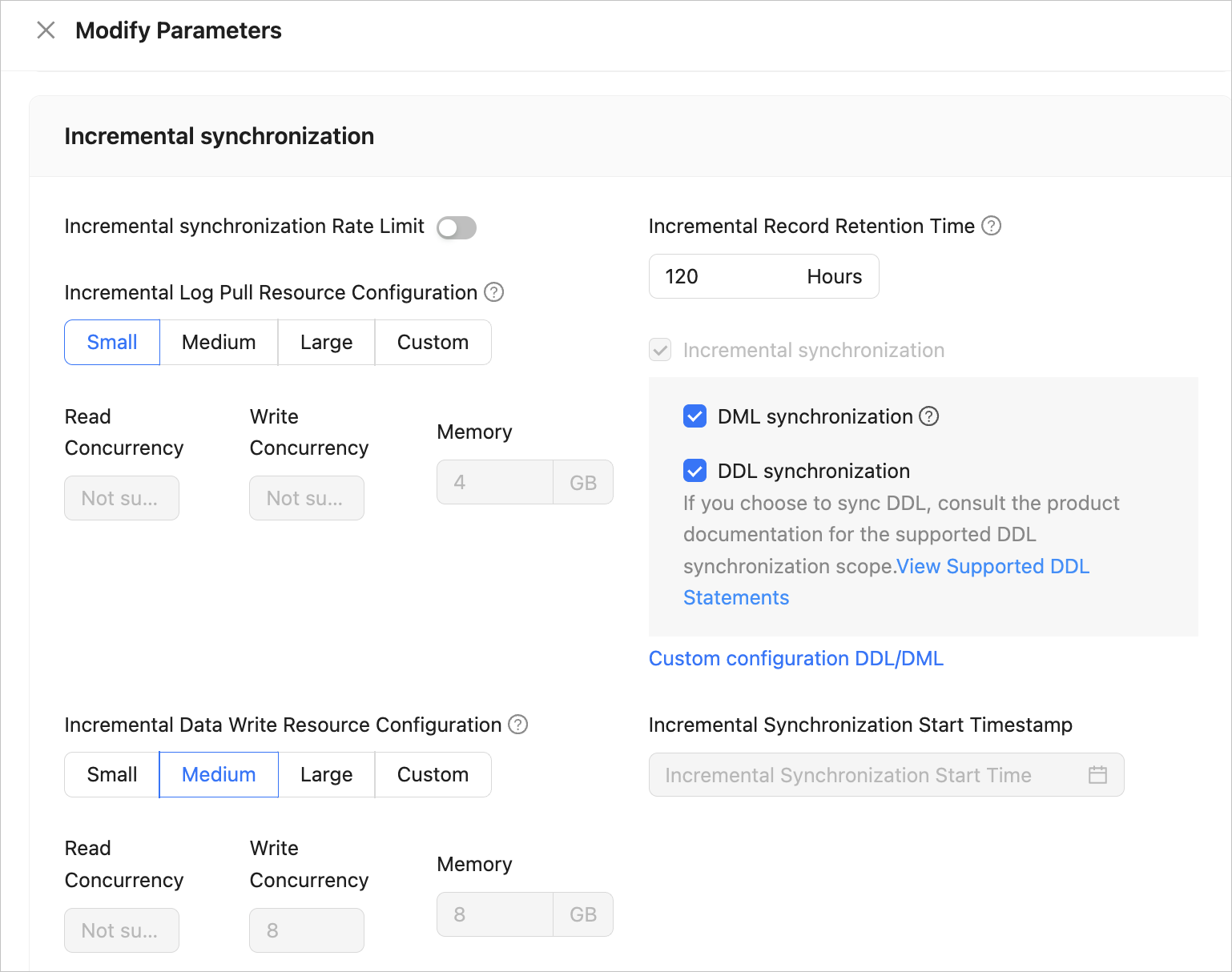 ParameterDescription
Incremental Synchronization Rate Limit You can choose whether to limit the incremental synchronization rate as needed. If you choose to limit the incremental synchronization rate, you must specify the RPS and BPS. The RPS specifies the maximum number of data rows synchronized to the target database per second during incremental synchronization, and the BPS specifies the maximum amount of data in bytes synchronized to the target database per second during incremental synchronization. Note
The RPS and BPS values specified here are only for throttling. The actual incremental synchronization performance is subject to factors such as the settings of the source and target databases and the instance specifications.
Incremental Log Pull Resource Configuration You can select Small, Medium, or Large to use the corresponding default value of Memory. You can also customize the resource configurations for incremental log pull. By setting the resource configuration for the Store component, you can limit the resource consumption of a task in log pull in the incremental synchronization phase. Notice
In the case of custom configurations, the minimum value is
1, and only integers are supported.Incremental Data Write Resource Configuration You can select Small, Medium, or Large to use the corresponding default values of Write Concurrency and Memory. You can also customize the resource configurations for incremental data write. By setting the resource configuration for the Incr-Sync component, you can limit the resource consumption of a task in data writes in the incremental synchronization phase. Notice
In the case of custom configurations, the minimum value is
1, and only integers are supported.Incremental Record Retention Time The duration that incremental parsed files are cached in OMS. A longer retention period results in more disk space occupied by the Store component. Incremental Synchronization Incremental Synchronization supports the DML Synchronization and DDL Synchronization options. The supported DML operations are INSERT,DELETE, andUPDATE. Select the options based on your business needs. For more information, see Configure DDL/DML synchronization.Incremental Synchronization Start Timestamp - If you have selected Full Synchronization as the synchronization type, the default value of this parameter is the task startup time and cannot be modified.
- If you did not select Full Synchronization as the synchronization type, set this parameter to a certain point of time, which is the current system time by default. For more information, see Set an incremental synchronization timestamp.
Click OK.