







You must configure data sources before you create a data migration task. Before you start a data migration task, you can create an OceanBase Database Proxy (ODP) data source as the source. This topic describes how to create an ODP data source in OceanBase Migration Service (OMS).
Background
ODP is a financial-grade distributed database middleware that is developed by Ant Group. It resolves the data access bottleneck and database disaster recovery problems under massive requests and provides online distributed database services featuring horizontal splitting, smooth scaling, and read/write splitting.
ODP is compatible with the MySQL protocols and syntax. It supports features such as database and table sharding, smooth scaling, service upgrading and downgrading, transparent read/write splitting, and distributed transactions. It also provides lifecycle O&M management for distributed databases.
After you create an ODP data source in OMS, you can manage all MySQL logical tables in the ODP data source. To create a task for synchronizing MySQL logical tables to physical tables in an OceanBase database in MySQL-compatible tenant mode, you need only to create an ODP data source.
Procedure
Log in to the OMS console.
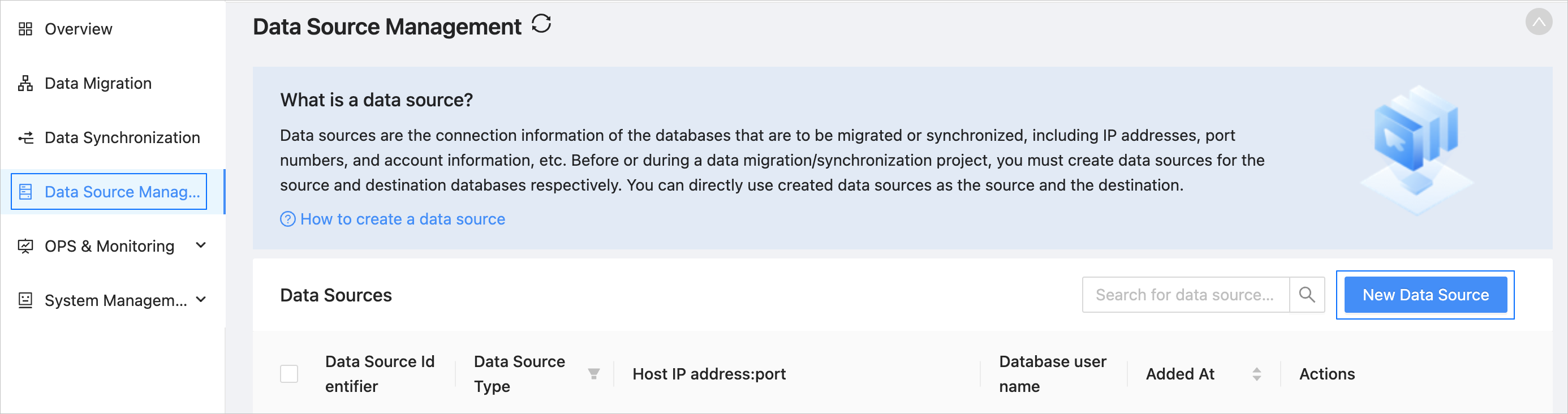
In the left-side navigation pane, click Data Source Management.
On the Data Source Management page, click New Data Source in the upper-right corner.
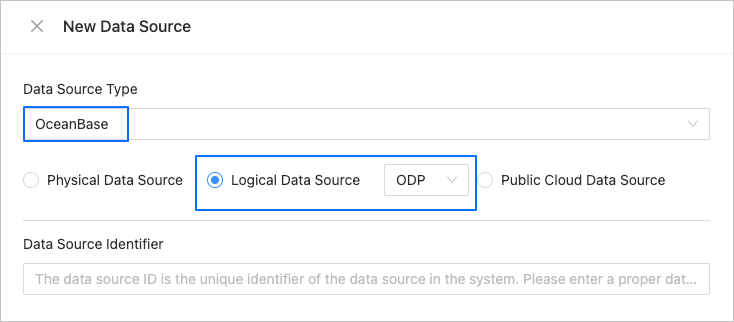
In the New Data Source dialog box, select OceanBase for Data Source Type.
Select Logical Data Source, select ODP from the drop-down list, and then configure the following parameters.
 ParameterDescription
Data Source Identifier We recommend that you set it to a combination of digits and letters. It must not contain any spaces and cannot exceed 32 characters in length.
Notice
The data source identifier must be globally unique in OMS.Connection Mode The access method. Default value: OP Gateway. Open Platform (OP) is an open platform developed by Ant Group. URL The URL of the OP gateway, or the URL of the OP gateway JSON file that can be obtained in standalone deployment mode. Route The API to route to, such as MiddleWareCluster-ODP. Access Key The access key of the visitor. Security Key The security key of the visitor. Instance ID The ID of the set of a middleware tenant and the related execution spaces. This ID is also used as the user identifier. ODP Instance ID The instance ID of the physical ODP node. OBProxy URL (Optional) The format is IP address:port. Database Username The username used to access the physical tables under the logical tables to be synchronized. This parameter is checked during the precheck of a full synchronization task but not during the connection test. Database Password The password used to access the physical tables under the logical tables to be synchronized. This parameter is checked during the precheck of a full synchronization task but not during the connection test. Remarks (Optional) Additional information about the data source. (Optional) In the New Data Source dialog box, click Show next to Advanced Options and configure the parameters.
If you select Schema Synchronization and Incremental Synchronization when you create a data synchronization task, you must also configure the following parameters. Note that a connectivity check is performed for this user when you select synchronization objects during task creation.
ParameterDescriptionDRC User Name (Optional) The username of the data replication center (DRC) user intended for reading database incremental logs and database object schemas in OceanBase Database. You must create this user in the sys tenant of your business cluster. Password (Optional) The password of the DRC user. Click Test Connection to test the network connection between OMS and the data source, and the validity of the username and password.
After the test is passed, click OK.