







You can create a cluster based on your business requirements.
Prerequisites
The logged-on user in the OceanBase Cloud Platform (OCP) console has the permission to create clusters .
(Optional) An OBProxy cluster exists in OCP. This is required if you want to create a multi-replica OceanBase cluster. For more information about how to create an OBProxy cluster, visit the following links:
Procedure
Log on to the OCP console, and find the entry to cluster creation based on the actual business scenario.
If you do not have clusters to be managed, the system displays a message on the Clusters page prompting you to create one. Click Create Cluster in the message.
If you have clusters to be managed, go to the Clusters page, and click Create Cluster in the upper-right corner.
On the Create Cluster page, set the basic information about the cluster.
Create a primary cluster.
 The following table describes the parameters that are required to create a primary cluster.ParameterDescription
Cluster Type Select Primary Cluster . Cluster Name The name of the cluster to be created. The cluster name must be 2 to 48 characters in length and can contain uppercase and lowercase letters, digits, and underscores (_). The cluster name must start with letters. root@sys Password This parameter can be customized or randomly generated. The password must be 8 to 32 characters in length, and contain at least two uppercase letters, two lowercase letters, two digits, and two special characters. The supported special characters are ~ ! @ # % ^ & * _ - + = ` | ( ) { } [ ] : ; ' , . ? / OceanBase Version You can select an OceanBase version from the drop-down list. You can also click Add Version at the bottom of the list to upload a version. Associate OBProxy Cluster Allows you to associate the cluster with an OBProxy cluster. If you want to create a multi-replica OceanBase cluster, you are advised to turn on this switch and select an existing OBProxy cluster to associate it with the cluster. After the association, the SQL requests of your business will be accurately forwarded to a replica. This ensures good experience that can rival access to a standalone database when you access an OceanBase database.
1. By default, the proxyro user is used for association. You do not need to enter a username or password.
2. Select the OBProxy cluster to be associated with from the drop-down list. If no OBProxy cluster is available in the drop-down list, create an OBProxy cluster. For more information, see the Prerequisites of this topic.Create a standby cluster.
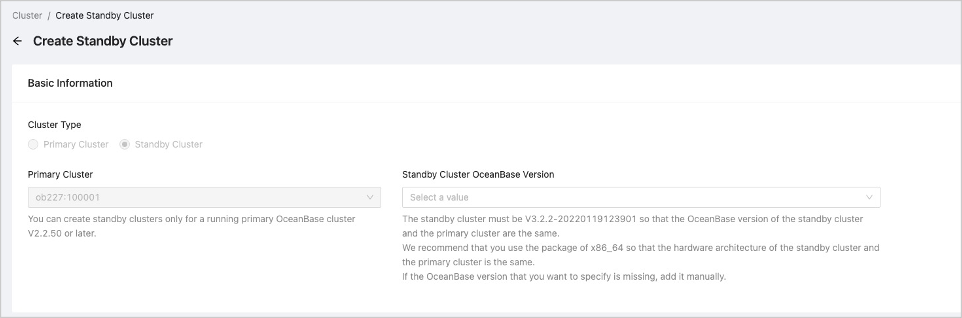 The following table describes the parameters that are required to create a standby cluster.ParameterDescription
Cluster Type Select Standby . Make sure that the primary cluster is created. OCP to Which Primary Cluster Belongs You must specify this parameterin multi-cluster mode. For more information, see OCP multi-cluster mode. Primary Cluster Select the primary cluster and the system will create a standby cluster of the selected primary cluster. root@sys Password You must specify this parameter in multi-cluster mode. Enter the root@sys password for the primary cluster. After the task is submitted, the password is saved in the password box. Standby Cluster OceanBase Version Select an OceanBase version that is the same as the primary cluster. If the version exists in the drop-down list, select it. Otherwise, click Add Version at the bottom of the list to upload the version.
Set the deployment mode of the cluster.
By default, three zones are added for a cluster. To deploy more than three zones for the cluster, click Add . To deploy less than three zones for the cluster, click the delete icon after the zone to be deleted.
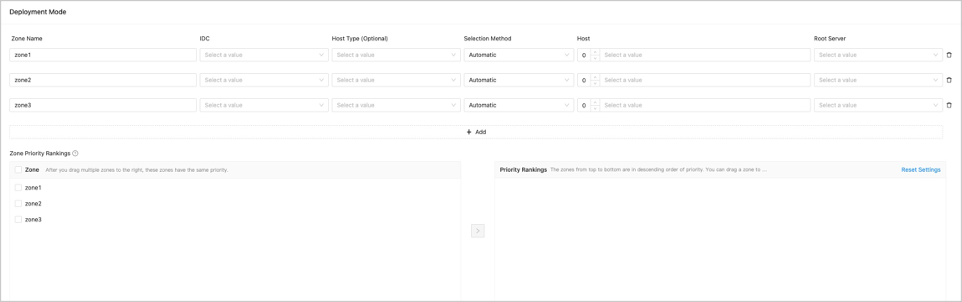 The following table describes the settings for each zone.ParameterDescription
Zone Name You can retain the default name or customize a name. A zone name must be 2 to 48 characters in length and can contain uppercase and lowercase letters, digits, and underscores (_). A zone name must start with a letter. In an OceanBase cluster that consists of multiple zones, there must be a zone that shares the same region with the primary zone. IDC The IDC of the zone. Each zone can be deployed in only one IDC. Host Type Optional. If you select a host type, the host list is filtered based on the host type. Server Selection Method Choose Automatic or Manual . IP You can select multiple IP addresses. - If Server Selection Method is Automatic , you only need to enter the number of servers.
- If Server Selection Method is Manual , you need to manually select several IP addresses from the list.
Root Server You can select an IP address for the host that runs RootService. If you want to create a multi-replica OceanBase cluster, you must specify this parameter for each zone. Zone Priority Rankings (This parameter is not required when you create a standby cluster.) The priorities of the zones. The zone with the highest priority is considered as the primary zone. Only one primary zone is allowed. Ranking method:
1. Select one or more zones from the left-side list. The left-side list shows all zones available in the cluster.
2. Click the closing angle bracket (>) in the middle. The selected zones are moved to the Priority Rankings list. The zones that are selected at the same time have the same priority.
3. Repeat steps 1 and 2 to add zones of a lower priority.
4. To adjust the priority, drag the target zone in the Priority Rankings list, and reorder it. The priority in the list decreases from top to bottom.Turn on Parameter Settings to modify parameters.

Set the Configure Installation Path .
 Customize as needed Software Installation Path, Data Disk Path , and Logs Path .
Click Test .
After the test succeeds, click Submit .
In the Confirmation dialog box, confirm the information and click OK .
You can view the progress of this task on the System Management > Tasks page.