

OceanBase logo

OceanBase

A unified distributed database ready for your transactional, analytical, and AI workloads.

DEPLOY YOUR WAY

OceanBase Cloud

The best way to deploy and scale OceanBase

OceanBase Enterprise

Run and manage OceanBase on your infra

TRY OPEN SOURCE

OceanBase Community Edition

The free, open-source distributed database

OceanBase seekdb

Open source AI native search database

Customer Stories

Real-world success stories from enterprises across diverse industries.

View All
BY USE CASES

Mission-Critical Transactions

Global & Multicloud Application

Elastic Scaling for Peak Traffic

Real-time Analytics

Active Geo-redundancy

Database Consolidation

Resources

Comprehensive knowledge hub for OceanBase.

Blog

Live Demos

Training & Certification

Documentation

Official technical guides, tutorials, API references, and manuals for all OceanBase products.

View All
PRODUCTS

OceanBase Cloud

OceanBase Database

Tools

Connectors and Middleware

QUICK START

OceanBase Cloud

OceanBase Database

BEST PRACTICES

Practical guides for utilizing OceanBase more effectively and conveniently

Company

Learn more about OceanBase – our company, partnerships, and trust and security initiatives.

About OceanBase

Partner

Trust Center

Contact Us

International - English
中国站 - 简体中文
日本 - 日本語
Sign In
Start on Cloud

A unified distributed database ready for your transactional, analytical, and AI workloads.

DEPLOY YOUR WAY

OceanBase Cloud

The best way to deploy and scale OceanBase

OceanBase Enterprise

Run and manage OceanBase on your infra

TRY OPEN SOURCE

OceanBase Community Edition

The free, open-source distributed database

OceanBase seekdb

Open source AI native search database

Customer Stories

Real-world success stories from enterprises across diverse industries.

View All
BY USE CASES

Mission-Critical Transactions

Global & Multicloud Application

Elastic Scaling for Peak Traffic

Real-time Analytics

Active Geo-redundancy

Database Consolidation

Comprehensive knowledge hub for OceanBase.

Blog

Live Demos

Training & Certification

Documentation

Official technical guides, tutorials, API references, and manuals for all OceanBase products.

View All
PRODUCTS
OceanBase CloudOceanBase Database
ToolsConnectors and Middleware
QUICK START
OceanBase CloudOceanBase Database
BEST PRACTICES

Practical guides for utilizing OceanBase more effectively and conveniently

Learn more about OceanBase – our company, partnerships, and trust and security initiatives.

About OceanBase

Partner

Trust Center

Contact Us

Start on Cloud
编组
All Products
    • Databases
    • iconOceanBase Database
    • iconOceanBase Cloud
    • iconOceanBase Tugraph
    • iconInteractive Tutorials
    • iconOceanBase Best Practices
    • Tools
    • iconOceanBase Cloud Platform
    • iconOceanBase Migration Service
    • iconOceanBase Developer Center
    • iconOceanBase Migration Assessment
    • iconOceanBase Admin Tool
    • iconOceanBase Loader and Dumper
    • iconOceanBase Deployer
    • iconKubernetes operator for OceanBase
    • iconOceanBase Diagnostic Tool
    • iconOceanBase Binlog Service
    • Connectors and Middleware
    • iconOceanBase Database Proxy
    • iconEmbedded SQL in C for OceanBase
    • iconOceanBase Call Interface
    • iconOceanBase Connector/C
    • iconOceanBase Connector/J
    • iconOceanBase Connector/ODBC
    • iconOceanBase Connector/NET
icon

OceanBase Cloud Platform

V3.1.1Community Edition

  • Document Overview
  • Product Introduction
    • What is OceanBase Cloud Platform?
    • System architecture
    • Features
    • Limits
      • System requirements
      • Dependencies
  • Deployment Guide
    • Overview
    • Installation process
    • Installation planning
      • User planning
      • Host planning
      • Disk and directory planning
      • Port planning
    • Prepare for the installation
    • Prepare MetaDB and MonitorDB
      • Deploy OBD
      • Deploy OceanBase Database
      • Create tenants
    • Deploy OCP
    • Check after installation
    • Appendix
      • Install Docker
      • \*-example.yaml
      • Restart OCP
  • User Guide
    • OCP overview
    • Log on to the OceanBase Cloud Platform console
    • Features
      • Clusters
        • Cluster management
        • Cluster overview
        • Overview of the Cluster Details page
      • Tenants
        • Tenant and resource management
        • Tenant overview
        • Overview of the Tenant Details page
      • Hosts
        • Host overview
        • Host details
      • Packages
      • OBProxy
        • OBProxy management overview
        • OBProxy overview
        • OBProxy cluster overview
      • System management
        • Alert overview
        • View tasks
        • Security overview
        • View system parameters
      • Personal center
        • Specify personal information
        • Change the logon password
        • Configure alert subscription
        • Password box
          • Manage connection credentials of an OceanBase cluster
          • Manage connection credentials of an OBProxy
          • Manage connection credentials of a host
        • Log off the OCP console
    • Manage clusters
      • Cluster management operations
      • Basic cluster operations
        • Take over a cluster
        • Create a cluster
        • Delete a cluster
        • Stop a cluster
        • Restart a cluster
        • Manage zones of a cluster
          • Create a zone
          • Restart a zone
          • Stop a zone
          • Delete a zone
        • Manage OBServers of a cluster
          • Add an OBServer
          • Restart an OBServer
          • Stop an OBServer
          • Replace an OBServer
          • Delete an OBServer
        • Create a tenant
        • Upgrade the version of an OceanBase cluster
        • Change a password
        • Download logs
        • Disable SQL collection
        • View the SQL collection history
      • View the topology of a cluster
      • Cluster tenant management overview
      • Performance monitoring
      • Cluster resource management
      • Major compaction management
        • Modify major freeze configurations
        • Major compaction details
        • Major freeze statistics
        • Perform a major compaction
      • Manage parameters
        • View parameters
        • Modify parameters
        • Parameter types
        • View the history of parameter changes
    • Manage tenants
      • Tenant management operations
      • Basic tenant operations
        • Create a tenant
        • Manage unit types
        • Lock a tenant
        • Copy a tenant
        • Delete a tenant
        • Add a replica
        • Change the password of the sys tenant
        • Edit a tenant replica of a zone
        • Delete a tenant replica from a zone
        • Modify zone priorities
        • Modify the whitelist
      • View a tenant topology
      • Database management
      • User management under a MySQL tenant
      • Performance monitoring
      • Tenant resource management
      • SQL diagnostics
        • TopSQL diagnosis
        • Slow SQL diagnosis
      • Manage sessions
        • View tenant sessions
        • View session statistics
      • Manage parameters
        • View the parameters
        • Modify a parameter
        • View the parameter modification history
    • Manage hosts
      • Host management operations
      • Add a host
      • Modify a host
      • Restart OCP Agent
      • Stop OCP Agent
      • Reinstall OCP Agent
    • Manage software packages
      • Upload a software package
      • Download a software package
      • Delete a software package
    • Manage OBProxies
      • Create an OBProxy cluster
      • Take over an OBProxy
      • Delete an OBProxy
      • Restart an OBProxy
      • Upgrade an OBProxy
      • Add an OBProxy
      • Refresh OBProxy configurations
      • Monitor OBProxy cluster performance
      • OBProxy cluster parameter management
      • Add a connectable OceanBase cluster
      • Delete an OBProxy cluster
      • Upgrade all OBProxies in an OBProxy cluster
      • Restart all OBProxies in an OBProxy cluster
      • Delete a connected OceanBase cluster
    • Manage alerts
      • Alert-related concepts
      • Create an alert item
      • View alert items
      • Copy an alert item
      • Edit an alert item
      • Delete an alert item
      • Alert groups
      • Create an alert channel
      • View alert channels
      • Edit an alert channel
      • Delete an alert channel
      • View an alert event
      • View the alert notification history
      • Create a blocking condition
      • Edit alert blocking conditions
      • Delete a blocking condition
      • Add a filtering keyword
      • Modify the expiration time of a filtering keyword
      • Delete a filtering keyword
      • Create an alert subscription
      • Manage alert subscriptions
    • Use system management
      • Role overview
      • Create a role
      • Manage roles
      • Copy a role
      • Create a user
      • View users
      • Edit a user
      • Copy a user
      • Change a user password
      • Delete a user
      • Logon history
      • Manage system parameters
      • Manage tasks
    • FAQ
    • Appendix
      • OCP configuration parameters
      • SQL performance module
      • OCP resource unit specifications
      • OCP error table
      • OCP alert template variables
      • Call an alert API
      • OCP background tasks
      • Monitoring metrics
      • Examples of alert channel configuration
      • OBProxy startup parameters
      • System privileges in a MySQL tenant
      • Component listening port list
      • OCP-Agent processes
      • Enable the OCP multi-cluster mode
      • Log error PAM Permission Denied
      • Failed to upload the software package
      • Check the sudo permissions of a user
      • Default OCP roles
      • FAQ about multi-zone mode
      • FAQ about OBProxy takeover
      • Install dependent software
  • Alert Reference
    • Overview
    • OceanBase alerts
      • ob_cannot_connected
      • ob_cluster_status_check_failed
      • ob_cluster_exists_inactive_server
      • ob_cluster_exists_index_fail_table
      • ob_cluster_frozen_version_delta_over_threshold
      • ob_cluster_merge_error
      • ob_cluster_merge_timeout
      • ob_cluster_no_frozen
      • ob_cluster_no_merge
      • ob_cluster_operation_info
      • ob_cluster_sync_failed
      • ob_cpu_assigned_percent_over_threshold
      • ob_cpu_percent_over_threshold
      • ob_host_connection_percent_over_threshold
      • ob_host_cpu_percent_over_threshold
      • ob_host_disk_percent_over_threshold
      • ob_host_disk_readonly
      • ob_host_exists_expired_trans
      • ob_host_load1_per_cpu_over_threshold
      • ob_host_mem_percent_over_threshold
      • ob_host_net_recv_percent_over_threshold
      • ob_host_net_send_percent_over_threshold
      • ob_host_partition_count_over_threshold
      • ob_host_tcp_retrans_percent_over_threshold
      • ob_log_alarm
      • ob_mem_assigned_percent_over_threshold
      • ob_server_sstable_percent_over_threshold
      • ob_server_exists_long_lived_trans
      • ob_tenant_operation_info
      • ob_tenant500_mem_hold_over_threshold
      • ob_tenant500_mem_hold_percent_over_threshold
      • ob_zone_sstable_percent_over_threshold
      • tenant_active_memstore_percent_over_threshold
      • tenant_connection_percent_over_threshold
      • tenant_cpu_percent_over_threshold
      • tenant_memstore_percent_over_threshold
      • obproxy_process_dead
      • obproxyd_process_dead
      • obproxy_cannot_connected
      • ob_cluster_sync_delay_time_too_long
      • ob_host_data_disk_percent_over_threshold
      • ob_host_log_disk_percent_over_threshold
      • ob_host_install_disk_percent_over_threshold
    • Application alerts
      • no_enough_exporter
      • no_port_mapping_for_exporter
      • host_unavailable
      • backup_schedule_fail
      • inc_backup_delay
      • base_backup_fail
      • base_backup_too_long_time_no_one_success_task
      • backup_process_dead
      • backup_storage_capacity_over_threshold
      • backup_storage_capacity_retry_times_exceeded
      • backup_storage_capacity_timeout_or_interrupted
      • ocp_remote_server_time_diff_too_large
      • monitor_exporter_unavaliable
      • system_obproxy_unavailable
      • host_ntp_service_not_exist
      • partition_create_failed
      • obagent_dead
      • host_ntp_offset_too_large
    • Appendix
      • Set an alert-blocking condition
      • Modify alert thresholds
      • Exception handling for OceanBase cluster compaction
      • OCP-Agent script
      • Apply throttling to an OceanBase cluster
      • Network troubleshooting
  • API Reference
    • Overview
    • API call description
    • Cluster information
      • Query clusters
      • Create an OceanBase cluster
      • Delete an OceanBase cluster
      • Stop an OceanBase cluster
      • Start an OceanBase cluster
      • Restart an OceanBase cluster
      • Upgrade an OceanBase cluster
      • Query zones of an OceanBase cluster
      • Create a zone for an OceanBase cluster
      • Delete a zone from an OceanBase cluster
      • Stop a zone in an OceanBase cluster
      • Start a zone in an OceanBase cluster
      • Restart a zone in an OceanBase cluster
      • Add an OBServer
      • Delete multiple OBServers at a time
      • Stop an OBServer
      • Start an OBServer
      • Restart an OBServer
      • Replace an OBServer
      • Change the password of an OceanBase cluster
      • Query the parameter metadata of an OceanBase cluster
      • Query parameters of an OceanBase cluster
      • Modify parameters of an OceanBase cluster
      • Query servers
      • Query servers in a zone
    • Tenant information
      • Query tenants of a cluster
      • Query all tenants
      • Query details about a tenant
      • Create a tenant
      • Delete a tenant
      • Lock a tenant
      • Unlock a tenant
      • Query units of a tenant
      • Delete a unit from a tenant
      • Add a replica for a tenant
      • Delete a replica of a tenant
      • Modify a replica of a tenant
      • Modify zone priorities of a tenant
      • Change the administrator password of a tenant
      • Modify the whitelist of a tenant
      • Query parameters of a tenant
      • Modify parameters of a tenant
      • OceanBase database management
        • Query databases
        • Create a database
        • Modify a database
        • Delete a database
    • Hosts
      • Query regions
      • Query details about a region
      • Add a region
      • Delete a region
      • Query IDCs
      • Query details about an IDC
      • Add an IDC
      • Delete an IDC
      • Query host types
      • Query details about a host type
      • Add a host type
      • Delete a host type
      • Query hosts
      • Query details about a host
      • Add multiple hosts at a time
      • Delete a host
      • Delete multiple hosts at a time
    • Software packages
      • Query software packages
      • Upload a software package
      • Delete a software package
    • OBProxy management
      • Create an OBProxy cluster
      • Delete an OBProxy cluster
      • Query OBProxy clusters
      • Query details about an OBProxy cluster
      • Update configurations of an OBProxy cluster
      • Add an OBProxy
      • Take over an OBProxy
      • Delete an OBProxy
      • Restart an OBProxy
      • Upgrade an OBProxy
      • Add a connectable OceanBase cluster for an OBProxy cluster
      • Remove a connectable OceanBase cluster from an OBProxy cluster
      • Query the parameter metadata of an OBProxy
      • Query parameters of an OBProxy cluster
    • Monitoring
      • Query the metadata of a monitoring metric
      • Query monitoring data
      • Query monitoring data and attach a tag to the data
    • Alerts
      • Alert events
        • Query the alert event list
        • Query alert events
      • Alert notifications
        • Query alert notifications
    • Task management
      • Query tasks
      • Query details about a task
      • Retry a task
      • Roll back a task
      • Query logs of a subtask instance
      • Retry a subtask
      • Skip a subtask
      • Cancel a subtask
    • OceanBase user and privilege management
      • Query database user details
      • Query database user details
      • Create a database user
      • Delete a database user
      • Change the password of a database user
      • Lock a database user
      • Unlock a database user
      • Query the database role details
      • Query database role details
      • Create a database role
      • Delete a database role
      • Query database objects
      • Grant global privileges to a user
      • Revoke global privileges of a user
      • Change global privileges of a user
      • Grant global privileges to a role
      • Revoke global privileges of a role
      • Change global privileges of a role
      • Grant roles to a user
      • Revoke roles of a user
      • Change roles of a user
      • Grant roles to a role
      • Revoke roles of a role
      • Change roles of a role
      • Grant database privileges to a user
      • Revoke database privileges of a user
      • Change database privileges of a user
      • Grant object privileges to a user
      • Revoke object privileges of a user
      • Change object privileges of a user
      • Grant object privileges to a role
      • Revoke object privileges of a role
      • Change object privileges of a role
    • OCP Agent management
      • Query OCP Agent details on a host
      • Stop basic OCP Agent processes on a host
      • Batch stop basic OCP Agent processes on a host
      • Restart basic OCP Agent processes on a host
      • Batch restart basic OCP Agent processes on a host
      • Query OCP Agent processes on a host
      • Restart OCP Agent processes on a host
      • Stop OCP Agent processes on a host
    • SQL performance
      • Query performance indicators of an SQL statement
      • Query the performance indicator trend of an SQL statement
      • Query SQL text
      • Query performance indicators of an execution plan
      • Query the performance indicator trend of an execution plan
      • Query the operator structure of an execution plan
    • Others
      • Query the basic information of an OCP application
      • Query OCP server time
      • Query OCP application status
    • Appendix
      • Task information

Download PDF

Document Overview What is OceanBase Cloud Platform?System architecture Features System requirementsDependencies Overview Installation process User planning Host planning Disk and directory planning Port planning Prepare for the installation Deploy OBD Deploy OceanBase DatabaseCreate tenants Deploy OCP Check after installation Install Docker \*-example.yaml Restart OCPOCP overview Log on to the OceanBase Cloud Platform console Packages Cluster management operations View the topology of a cluster Cluster tenant management overviewPerformance monitoring Cluster resource management Tenant management operationsView a tenant topology Database management User management under a MySQL tenant Performance monitoringTenant resource management Host management operations Add a host Modify a host Restart OCP Agent Stop OCP Agent Reinstall OCP Agent Upload a software package Download a software package Delete a software package Create an OBProxy cluster Take over an OBProxy Delete an OBProxy Restart an OBProxy Upgrade an OBProxy Add an OBProxy Refresh OBProxy configurations Monitor OBProxy cluster performance OBProxy cluster parameter management Add a connectable OceanBase cluster Delete an OBProxy cluster Upgrade all OBProxies in an OBProxy cluster Restart all OBProxies in an OBProxy cluster Delete a connected OceanBase cluster Alert-related conceptsCreate an alert item View alert items Copy an alert item Edit an alert item Delete an alert item Alert groups Create an alert channel View alert channels Edit an alert channel Delete an alert channel View an alert event View the alert notification history Create a blocking condition Edit alert blocking conditions Delete a blocking condition Add a filtering keyword Modify the expiration time of a filtering keyword Delete a filtering keyword Create an alert subscription Manage alert subscriptions Role overview Create a role Manage rolesCopy a role Create a user View users Edit a user Copy a user Change a user password Delete a user Logon history Manage system parameters Manage tasks FAQOCP configuration parameters SQL performance module OCP resource unit specifications OCP error table OCP alert template variablesCall an alert API OCP background tasks
OceanBase logo

The Unified Distributed Database for the AI Era.

Follow Us
Products
OceanBase CloudOceanBase EnterpriseOceanBase Community EditionOceanBase seekdb
Resources
DocsBlogLive DemosTraining & Certification
Company
About OceanBaseTrust CenterLegalPartnerContact Us
Follow Us

© OceanBase 2026. All rights reserved

Cloud Service AgreementPrivacy PolicySecurity
Contact Us
Document Feedback
  1. Documentation Center
  2. OceanBase Cloud Platform
  3. V3.1.1
iconOceanBase Cloud Platform
V 3.1.1Community Edition
  • V 4.3.6
  • V 4.3.5
  • V 4.3.4
  • V 4.3.3
  • V 4.3.2
  • V 4.3.1
  • V 4.3.0
  • V 4.2.2
  • V 4.0.0 and earlier
Community Edition
  • V 4.0.0
  • V 3.1.1
Enterprise Edition
  • V 4.0.0
  • V 3.3.1

Overview of the Cluster Details page

Last Updated:2026-04-14 03:56:05  Updated
share
What is on this page
View the basic information
View resource usage
Alert overview
View system events in the last 7 days
View zones
View OBServers
Cluster management
Protection mode
Switch between clusters

folded

share

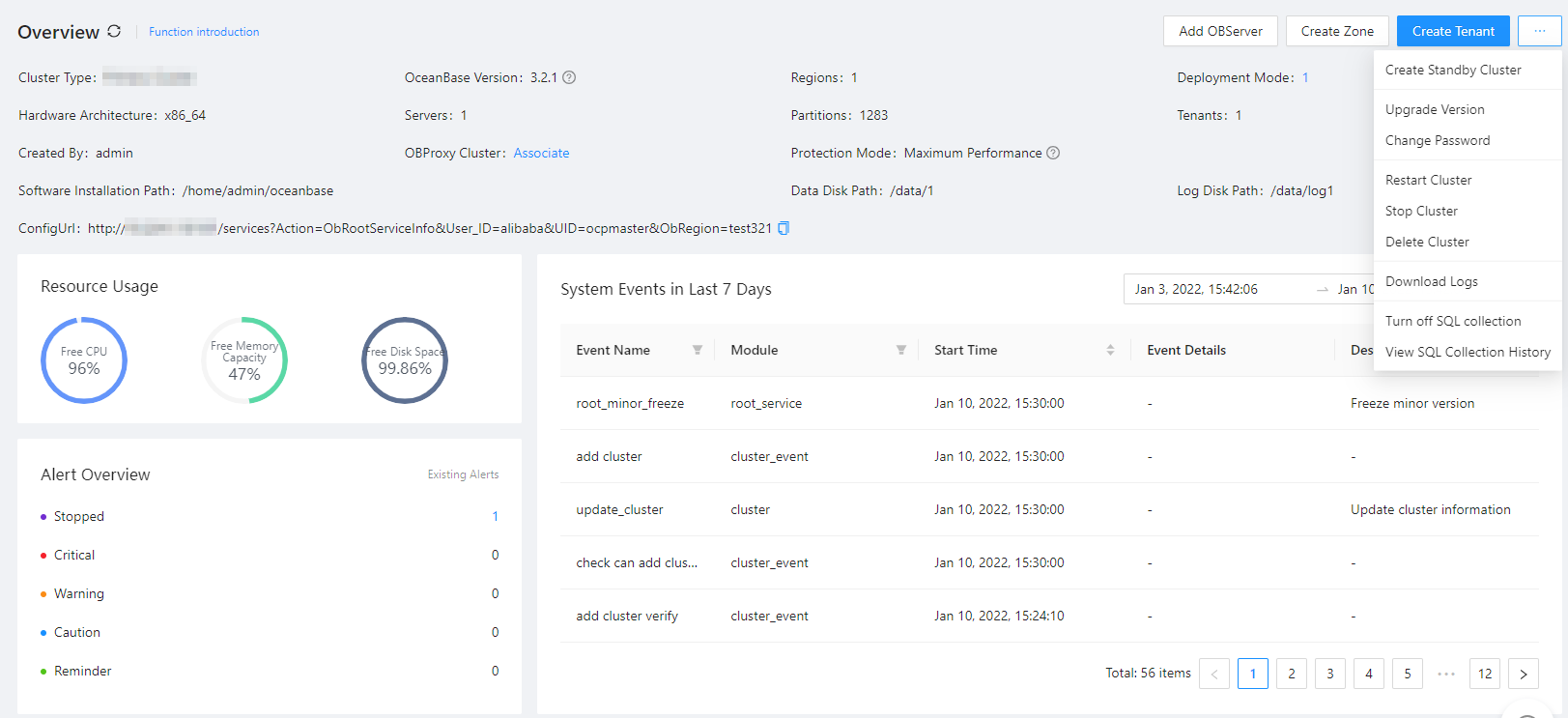
On the details page of a cluster, you can view its basic information, resource usage, alerts, system events of the last 7 days, zones, and OBServers, and can perform routine cluster maintenance.

View the basic information

On the Cluster Details page, you can view the basic information of the cluster, including Cluster Type, OceanBase Version, Regions, Zone Deployment Model, Hardware Architecture, Servers, Partitions, Tenants, Created By, OBProxy Cluster, Log Transfer Mode, Synchronization Status, Protection Mode, Software Installation Path, Data Disk Path, Log Disk Path , and ConfigUrl .

1

Parameter Description
Cluster Type Valid values: Primary and Standby .
OceanBase Version The version of OceanBase Database of the cluster.
Regions The number of regions in the cluster.
Zone Deployment Model The deployment mode of the cluster. The value 1 indicates that the cluster has one zone and the zone has one host. The value 1-1 indicates that the cluster has two zones, and each zone has one host. The value N-N-...N (M Ns) indicates that the cluster has M zones, and each zone has N hosts.
Hardware Architecture When you add a host, OCP automatically identifies its hardware architecture. The primary cluster and standby clusters must have the same hardware architecture.
Servers The number of hosts in the cluster.
Partitions The number of partitions for the tables in the cluster.
Tenants The number of tenants in the cluster.
Created By The username of the user who created the cluster.
OBProxy Cluster Displays the OBProxy cluster that is associated with the current OceanBase cluster.
  • If the cluster is not associated with an OBProxy cluster, click Associate OBProxy Cluster to associate it with one or more OBProxy clusters.
  • If the cluster is associated with OBProxy clusters, you can click the edit icon to add or delete OBProxy clusters.
  • Protection Mode This parameter is displayed only for the primary cluster. For more information, see Protection mode.
    Software Installation Path It was specified when the cluster was created.
    Data Disk Path The path specified when the cluster was created.
    Log Disk Path The path specified when the cluster was created.
    Log Transfer Mode This parameter is displayed for a standby cluster. Valid values: Synchronous and Asynchronous. Whether the synchronization mode can be asynchronous when the log transfer mode is synchronous depends on the protection mode.
    Synchronization Status This parameter is displayed for a standby cluster. It indicates the latency of log transfer.
    ConfigUrl The cluster URL. You can click the copy icon to copy it.

    View resource usage

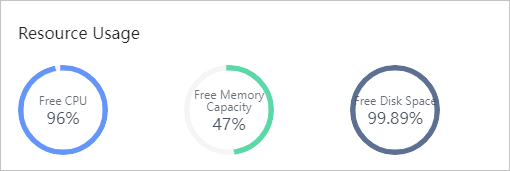
    The Resource Usage section displays Free CPU, Free Memory Capacity , and Free Disk Space . You can manage the cluster based on the resource usage.
    1

    Alert overview

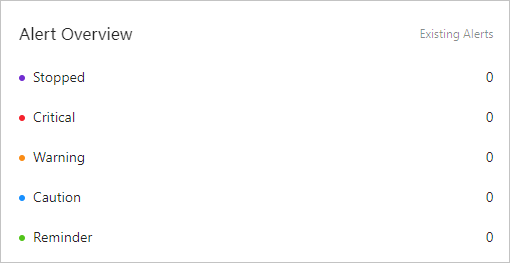
    The Alert Overview section displays the alerts in the system by alert levels, including Stopped, Critical, Warning, Caution , and Reminder . You can click Last 24 Hours, Last 7 Days, or Last 30 Days to view alerts in the specified time range. You can click the digit after an alert level to view the alert details.
    1

    View system events in the last 7 days

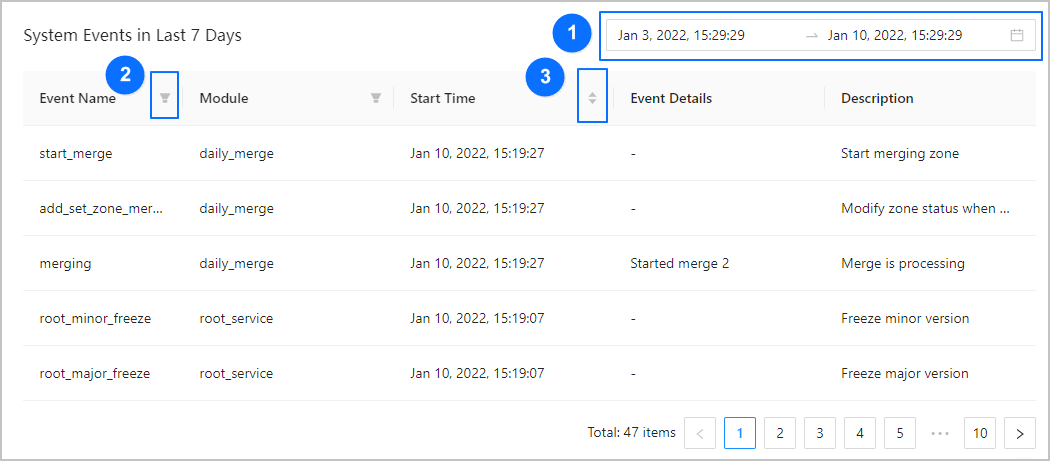
    The System Events in Last 7 Days section allows you to view the system events that happened in the last seven days.

    • You can specify the time range of events in the time selection field.

    • You can filter events in the Event Name column.

    • You can sort the events in ascending or descending order by the start time in the Start Time column.

    The system can combine the filter conditions, and list the system events you want to view.
    1

    View zones

    In the Zones section, you can search for zones. The table contains the following columns: Zone Name, Region, IDC, Servers, Root Server, Status , and Actions . The Actions column provides the following options: Add OBServer, Restart, Stop , and Delete . For more information, see Add an OBServer, Restart a zone, Stop a zone, and Delete a zone.

    1

    View OBServers

    The table in the OBServers section contains the following columns: IP, Port, IDC, Zone, Host Type, Available Resources, Status , and Actions . The Actions column provides the following options: Restart, Stop, Replace, Delete , and Download Logs . For more information, see Restart an OBServer, Stop an OBServer, Replace an OBServer, Delete an OBServer, and Download logs.

    1

    Cluster management

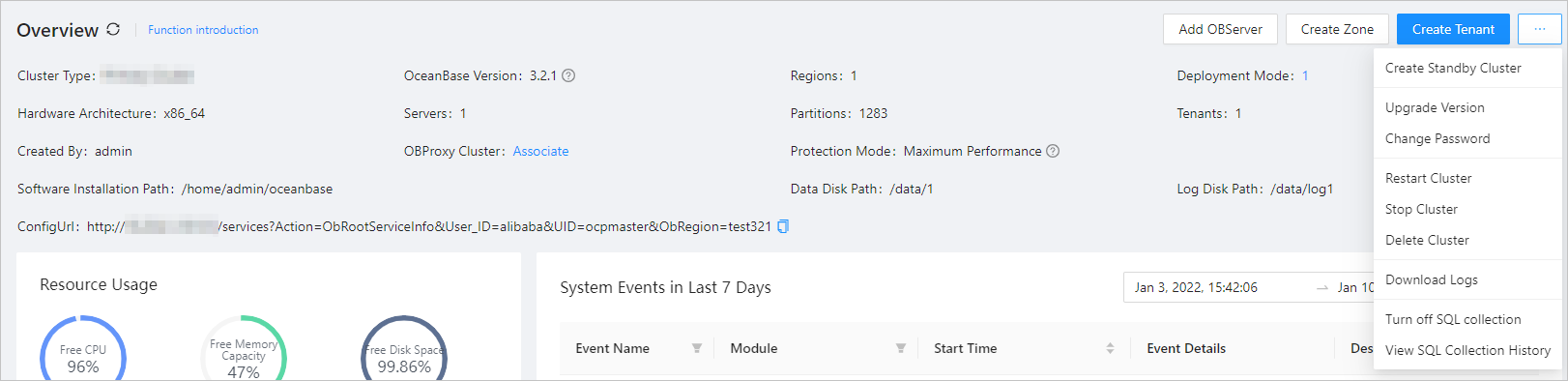
    You can also perform other cluster management operations on the Cluster Details page. For more information, see Add a zone, Create a tenant, Upgrade the cluster version, Change the password of the sys tenant, Restart a cluster, Delete a cluster, Disable SQL collection, and View the SQL collection history.
    1

    In the left-side navigation pane, you can also find the routine clusters maintenance features. For more information, see View the cluster topology, Performance monitoring, Cluster resource management, Major compaction details, and View parameters.
    1

    Protection mode

    Maximum performance: It protects user data and maximizes the performance of the primary cluster. In this mode, the log transfer between the primary cluster and all standby clusters is asynchronous.

    Maximum availability: Normally, the primary cluster keeps synchronous log transfer with only one standby cluster.

    Maximum protection: The primary cluster keeps synchronous log transfer with only one standby cluster, and asynchronous log transfer with other standby clusters.

    Switch between clusters

    To view the general information of another cluster, click the cluster name field in the upper left corner on the Overview page, and select the target cluster from the drop-down list.

    1

    Previous topic

    Cluster overview
    Last

    Next topic

    Tenant and resource management
    Next
    What is on this page
    View the basic information
    View resource usage
    Alert overview
    View system events in the last 7 days
    View zones
    View OBServers
    Cluster management
    Protection mode
    Switch between clusters