

OceanBase logo

OceanBase

A unified distributed database ready for your transactional, analytical, and AI workloads.

Product Overview
DEPLOY YOUR WAY

OceanBase Cloud

The best way to deploy and scale OceanBase

OceanBase Enterprise

Run and manage OceanBase on your infra

TRY OPEN SOURCE

OceanBase Community Edition

The free, open-source distributed database

OceanBase seekdb

Open source AI native search database

Customer Stories

Real-world success stories from enterprises across diverse industries.

View All
BY USE CASES

Mission-Critical Transactions

Global & Multicloud Application

Elastic Scaling for Peak Traffic

Real-time Analytics

Active Geo-redundancy

Database Consolidation

Resources

Comprehensive knowledge hub for OceanBase.

Blog

Live Demos

Training & Certification

Documentation

Official technical guides, tutorials, API references, and manuals for all OceanBase products.

View All
PRODUCTS

OceanBase Cloud

OceanBase Database

Tools

Connectors and Middleware

QUICK START

OceanBase Cloud

OceanBase Database

BEST PRACTICES

Practical guides for utilizing OceanBase more effectively and conveniently

Company

Learn more about OceanBase – our company, partnerships, and trust and security initiatives.

About OceanBase

Partner

Trust Center

Contact Us

International - English
中国站 - 简体中文
日本 - 日本語
Sign In
Start on Cloud

OceanBase

A unified distributed database ready for your transactional, analytical, and AI workloads.

Product Overview
DEPLOY YOUR WAY

OceanBase Cloud

The best way to deploy and scale OceanBase

OceanBase Enterprise

Run and manage OceanBase on your infra

TRY OPEN SOURCE

OceanBase Community Edition

The free, open-source distributed database

OceanBase seekdb

Open source AI native search database

Customer Stories

Real-world success stories from enterprises across diverse industries.

View All
BY USE CASES

Mission-Critical Transactions

Global & Multicloud Application

Elastic Scaling for Peak Traffic

Real-time Analytics

Active Geo-redundancy

Database Consolidation

Comprehensive knowledge hub for OceanBase.

Blog

Live Demos

Training & Certification

Documentation

Official technical guides, tutorials, API references, and manuals for all OceanBase products.

View All
PRODUCTS
OceanBase CloudOceanBase Database
ToolsConnectors and Middleware
QUICK START
OceanBase CloudOceanBase Database
BEST PRACTICES

Practical guides for utilizing OceanBase more effectively and conveniently

Learn more about OceanBase – our company, partnerships, and trust and security initiatives.

About OceanBase

Partner

Trust Center

Contact Us

Start on Cloud
编组
All Products
    • Databases
    • iconOceanBase Database
    • iconOceanBase Cloud
    • iconOceanBase Tugraph
    • iconInteractive Tutorials
    • iconOceanBase Best Practices
    • Tools
    • iconOceanBase Cloud Platform
    • iconOceanBase Migration Service
    • iconOceanBase Developer Center
    • iconOceanBase Migration Assessment
    • iconOceanBase Admin Tool
    • iconOceanBase Loader and Dumper
    • iconOceanBase Deployer
    • iconKubernetes operator for OceanBase
    • iconOceanBase Diagnostic Tool
    • iconOceanBase Binlog Service
    • Connectors and Middleware
    • iconOceanBase Database Proxy
    • iconEmbedded SQL in C for OceanBase
    • iconOceanBase Call Interface
    • iconOceanBase Connector/C
    • iconOceanBase Connector/J
    • iconOceanBase Connector/ODBC
    • iconOceanBase Connector/NET
icon

OceanBase Cloud Platform

V4.3.5

    Download PDF

    OceanBase logo

    The Unified Distributed Database for the AI Era.

    Follow Us
    Products
    OceanBase CloudOceanBase EnterpriseOceanBase Community EditionOceanBase seekdb
    Resources
    DocsBlogWhite PaperLive DemosTraining & CertificationTicket
    Company
    About OceanBaseTrust CenterLegalPartnerContact Us
    Follow Us

    © OceanBase 2026. All rights reserved

    Cloud Service AgreementPrivacy PolicySecurity
    Contact Us
    Document Feedback
    1. Documentation Center
    2. OceanBase Cloud Platform
    3. V4.3.5
    iconOceanBase Cloud Platform
    V 4.3.5
    Databases
    • OceanBase Database
    • OceanBase Cloud
    • OceanBase Tugraph
    • Interactive Tutorials
    • OceanBase Best Practices
    Tools
    • OceanBase Cloud Platform
    • OceanBase Migration Service
    • OceanBase Developer Center
    • OceanBase Migration Assessment
    • OceanBase Admin Tool
    • OceanBase Loader and Dumper
    • OceanBase Deployer
    • Kubernetes operator for OceanBase
    • OceanBase Diagnostic Tool
    • OceanBase Binlog Service
    Connectors and Middleware
    • OceanBase Database Proxy
    • Embedded SQL in C for OceanBase
    • OceanBase Call Interface
    • OceanBase Connector/C
    • OceanBase Connector/J
    • OceanBase Connector/ODBC
    • OceanBase Connector/NET
    • V 4.4.2
    • V 4.3.6
    • V 4.3.5
    • V 4.3.4
    • V 4.3.3
    • V 4.3.2
    • V 4.3.1
    • V 4.3.0
    • V 4.2.2
    • V 4.0.0 and earlier

    Overview

    Last Updated:2026-04-16 03:36:04  Updated
    Share
    What is on this page
    What is an arbitration service group?
    Priorities of arbitration services
    Switching strategy
    Prerequisites
    View the list of arbitration service groups
    Manage service groups

    folded

    Share

    OceanBase Database V4.1 and later provide the arbitration service, which consumes minimal resources and supports multiple clusters. You can use the arbitration service to deploy high-availability architectures based on OceanBase Database at lower costs. For example, you can deploy an architecture with two full-featured replicas and one arbitration service (2F1A) or a 4F1A architecture. These architectures help enterprises control the resource costs, ensure high availability of a database system, and greatly improve the cost effectiveness of the system.

    However, a single arbitration service introduces the risk of single points of failure during the operation. If the arbitration service fails, the high availability of the associated OceanBase clusters will be downgraded until the failure is fixed. This may cause a negative impact on business continuity and stability.

    In response to that issue, OceanBase Database allows you to create an arbitration service group. When an arbitration service node fails, the associated cluster can be switched to a healthy arbitration service node within seconds. This maximizes the stability of OceanBase clusters in various complex scenarios and ensures zero business interruptions.

    What is an arbitration service group?

    An arbitration service group contains multiple arbitration services. When OceanBase Cloud Platform (OCP) detects that an arbitration service fails, it automatically switches the associated clusters to another arbitration service in the group.
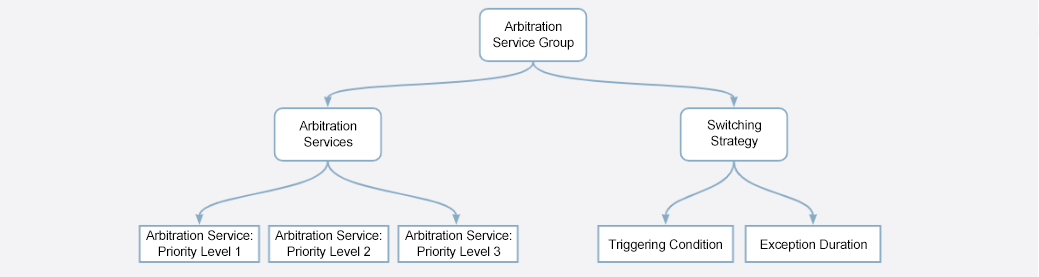
    1

    As shown in the preceding figure, an arbitration service group contains multiple arbitration services, and works based on a switching strategy.

    Priorities of arbitration services

    Arbitration services in an arbitration service group have a priority attribute. When the switching strategy is triggered for the associated OceanBase clusters, OCP switches the clusters to an arbitration service with a higher priority. If the resources of that arbitration service are insufficient, some OceanBase clusters are switched to an arbitration service of a lower priority.

    Switching strategy

    The switching strategy consists of a triggering condition and the duration of the exception.

    • Valid values of the triggering condition are as follows:

      • Default: Half of the replicas of tenants in an OceanBase cluster cannot connect to the arbitration service.
      • Number: The number of units in an OceanBase cluster that cannot connect to the arbitration service.
      • Percentage: The percentage of units in an OceanBase cluster that cannot connect to the arbitration service.
    • Duration of the exception: This parameter specifies when to switch the arbitration service for an OceanBase cluster after the specified condition is triggered.

    Prerequisites

    To view the list of arbitration service groups, make sure that you have the following permissions:

    • Resource permissions: Arbitration service read-only permission.
    • Menu permissions: Permission on the Overview menu of clusters.

    View the list of arbitration service groups

    Log in to the OCP console. In the left-side navigation pane, click Clusters. On the page that appears, click the Service Group tab.

    The list of arbitration service groups displays the following information of each arbitration service group: host, priority, service port, remarks, version, associated clusters, replacement condition upon exceptions, automatic execution, time of last modification, and status. You can search for an arbitration service by its host IP address or the name of an associated cluster.

    • You can click the IP address of a host to go to the host monitoring page. For more information, see View host performance data, View host resource monitoring data, and View host process monitoring data.

    • You can click the name of a cluster associated with an arbitration service to go to the Overview page of the cluster. For more information, see View the details of a cluster.

    • You can filter arbitration service groups by status.

    Manage service groups

    You can also upgrade, edit, and delete service groups. For more information, see Upgrade an arbitration service group, Edit an arbitration service group, and Delete an arbitration service group.

    Previous topic

    Delete an arbitration service
    Last

    Next topic

    Create an arbitration service group
    Next
    What is on this page
    What is an arbitration service group?
    Priorities of arbitration services
    Switching strategy
    Prerequisites
    View the list of arbitration service groups
    Manage service groups