

OceanBase logo

OceanBase

A unified distributed database ready for your transactional, analytical, and AI workloads.

DEPLOY YOUR WAY

OceanBase Cloud

The best way to deploy and scale OceanBase

OceanBase Enterprise

Run and manage OceanBase on your infra

TRY OPEN SOURCE

OceanBase Community Edition

The free, open-source distributed database

OceanBase seekdb

Open source AI native search database

Customer Stories

Real-world success stories from enterprises across diverse industries.

View All
BY USE CASES

Mission-Critical Transactions

Global & Multicloud Application

Elastic Scaling for Peak Traffic

Real-time Analytics

Active Geo-redundancy

Database Consolidation

Resources

Comprehensive knowledge hub for OceanBase.

Blog

Live Demos

Training & Certification

Documentation

Official technical guides, tutorials, API references, and manuals for all OceanBase products.

View All
PRODUCTS

OceanBase Cloud

OceanBase Database

Tools

Connectors and Middleware

QUICK START

OceanBase Cloud

OceanBase Database

BEST PRACTICES

Practical guides for utilizing OceanBase more effectively and conveniently

Company

Learn more about OceanBase – our company, partnerships, and trust and security initiatives.

About OceanBase

Partner

Trust Center

Contact Us

International - English
中国站 - 简体中文
日本 - 日本語
Sign In
Start on Cloud

A unified distributed database ready for your transactional, analytical, and AI workloads.

DEPLOY YOUR WAY

OceanBase Cloud

The best way to deploy and scale OceanBase

OceanBase Enterprise

Run and manage OceanBase on your infra

TRY OPEN SOURCE

OceanBase Community Edition

The free, open-source distributed database

OceanBase seekdb

Open source AI native search database

Customer Stories

Real-world success stories from enterprises across diverse industries.

View All
BY USE CASES

Mission-Critical Transactions

Global & Multicloud Application

Elastic Scaling for Peak Traffic

Real-time Analytics

Active Geo-redundancy

Database Consolidation

Comprehensive knowledge hub for OceanBase.

Blog

Live Demos

Training & Certification

Documentation

Official technical guides, tutorials, API references, and manuals for all OceanBase products.

View All
PRODUCTS
OceanBase CloudOceanBase Database
ToolsConnectors and Middleware
QUICK START
OceanBase CloudOceanBase Database
BEST PRACTICES

Practical guides for utilizing OceanBase more effectively and conveniently

Learn more about OceanBase – our company, partnerships, and trust and security initiatives.

About OceanBase

Partner

Trust Center

Contact Us

Start on Cloud
编组
All Products
    • Databases
    • iconOceanBase Database
    • iconOceanBase Cloud
    • iconOceanBase Tugraph
    • iconInteractive Tutorials
    • iconOceanBase Best Practices
    • Tools
    • iconOceanBase Cloud Platform
    • iconOceanBase Migration Service
    • iconOceanBase Developer Center
    • iconOceanBase Migration Assessment
    • iconOceanBase Admin Tool
    • iconOceanBase Loader and Dumper
    • iconOceanBase Deployer
    • iconKubernetes operator for OceanBase
    • iconOceanBase Diagnostic Tool
    • iconOceanBase Binlog Service
    • Connectors and Middleware
    • iconOceanBase Database Proxy
    • iconEmbedded SQL in C for OceanBase
    • iconOceanBase Call Interface
    • iconOceanBase Connector/C
    • iconOceanBase Connector/J
    • iconOceanBase Connector/ODBC
    • iconOceanBase Connector/NET
icon

OceanBase Migration Service

V4.3.1Enterprise Edition

  • OMS Documentation
  • OMS Introduction
    • Overview of OMS
    • Terms
    • OMS HA
    • Principles of Store
    • Principles of Full-Import and Incr-Sync
    • Data verification principles
    • Architecture
      • Overview
      • Hierarchical functional system
      • Basic components
    • OMS Oracle full migration design and impact
    • Limitations
  • Quick Start
    • Data migration process
    • Data synchronization process
  • Deploy OMS
    • Deployment types
    • System and network requirements
    • Memory and disk requirements
    • Environment preparations
    • Deploy OMS on a single node
    • Deploy OMS on multiple nodes in a single region
    • Deploy OMS on multiple nodes in multiple regions
    • Scale out
    • Scale down deployment
    • Check the deployment
    • Deploy a time-series database (Optional)
  • OMS console
    • Log in to the OMS console
    • Overview
    • User center
      • Configure user information
      • Change your login password
      • Log out
  • Data migration
    • Overview
    • Migrate data from a MySQL database to a MySQL-compatible tenant of OceanBase Database
    • Migrate data from a MySQL-compatible tenant of OceanBase Database to a MySQL database
    • Migrate data from an Oracle database to the MySQL compatible mode of OceanBase Database
    • Migrate data from the Oracle compatible mode of OceanBase Database to an Oracle database
    • Migrate data from an Oracle database to the Oracle compatible mode of OceanBase Database
    • Migrate data from a DB2 LUW database to an Oracle-compatible tenant of OceanBase Database
    • Migrate data from an Oracle-compatible tenant of OceanBase Database to a DB2 LUW database
    • Migrate data from a DB2 LUW database to a MySQL-compatible tenant of OceanBase Database
    • Migrate data from a MySQL-compatible tenant of OceanBase Database to a DB2 LUW database
    • Migrate data between OceanBase databases of the same tenant type
    • Configure a bidirectional synchronization task
    • Migrate data from a TiDB database to a MySQL-compatible tenant of OceanBase Database
    • Migrate data from a PostgreSQL database to the Oracle compatible mode of OceanBase Database
    • Migrate data from a PostgreSQL database to the MySQL compatible mode of OceanBase Database
    • Migrate data from a PolarDB-X 1.0 database to a MySQL-compatible tenant of OceanBase Database
    • Migrate incremental data from an Oracle-compatible tenant of OceanBase Database to a MySQL database
    • Manage data migration tasks
      • View details of a data migration task
      • Rename a data migration task
      • View and modify migration objects
      • Use tags to Manage data migration tasks
      • Perform batch operations on data migration tasks
      • Download and import settings of migration objects
      • View and modify migration parameters
      • Download a conflict log file
      • Start and pause a data migration task
      • End and delete a data migration task
    • Supported DDL operations and limits for synchronization
      • Synchronize DDL operations from a MySQL database to a MySQL-compatible tenant of OceanBase Database
        • Overview of DDL synchronization from MySQL to OceanBase Database's MySQL compatible mode
        • CREATE TABLE
          • Create a table
          • Create a column
          • Create indexes or constraints
          • Create partitions
        • Data type conversion
        • ALTER TABLE
          • Modify tables
          • Operations on columns
          • Operations on constraints and indexes
          • Partition operations
        • TRUNCATE TABLE
        • RENAME TABLE
        • DROP TABLE
        • CREATE INDEX
        • DROP INDEX
        • DDL incompatibilities between a MySQL database and a MySQL-compatible tenant of OceanBase Database
          • Overview
          • Incompatibilities of the CREATE TABLE statement
            • Incompatibilities of CREATE TABLE
            • Column types that are supported to create indexes or constraints
          • Incompatibilities of the ALTER TABLE statement
            • Incompatibilities of ALTER TABLE
            • Change the type of a constrained column
            • Change the type of an unconstrained column
            • Change the length of a constrained column
            • Change the length of an unconstrained column
            • Delete a constrained column
          • Incompatibilities of DROP INDEX operations
      • Synchronize DDL operations from the MySQL compatible mode of OceanBase Database to a MySQL database
      • DDL operations for synchronizing data from an Oracle database to an Oracle-compatible tenant of OceanBase Database
        • Overview of DDL synchronization from Oracle to OceanBase Database Oracle compatible mode
        • CREATE TABLE
          • Overview for CREATE TABLE
          • Create a relational table
            • Create a relational table
            • Define columns of a relational table
          • Virtual columns
          • Regular columns
          • Create partitions
            • Overview for creating partitions
            • Partitioning
            • Subpartitioning
            • Composite partitioning
            • User-defined partitioning
            • Subpartition templates
          • Constraints
            • Overview
            • Inline constraints
            • Out-of-line constraints
        • CREATE INDEX
          • Overview
          • Oracle compatible mode
        • ALTER TABLE
          • Overview
          • Modify, drop, and add table attributes
          • Column attribute management
            • Modify, drop, and add column attributes
            • Rename a column
            • Add columns and column attributes
            • Modify column attributes
            • Drop columns
          • Modify, drop, and add constraints
          • Partition management
            • Modify, drop, and add partitions
            • Drop a partition
            • Drop a subpartition
            • Add partitions and subpartitions
            • Modify partitions
            • Drop partition data
        • DROP TABLE
        • RENAME OBJECT
        • TRUNCATE TABLE
        • DROP INDEX
        • DDL incompatibilities between an Oracle database and an Oracle-compatible tenant of OceanBase Database
          • Overview
          • Incompatibilities of CREATE TABLE
          • Incompatibilities in table modification operations
            • Incompatibilities of ALTER TABLE
            • Change the type of a constrained column
            • Change the type of an unconstrained column
            • Change the length of a constrained column
            • Change the length of an unconstrained column
      • Synchronize DDL operations from the Oracle compatible mode of OceanBase Database to an Oracle database
      • Synchronize DDL operations from a DB2 LUW database to an Oracle-compatible tenant of OceanBase Database
      • Synchronize DDL operations from the Oracle compatible mode of OceanBase Database to a DB2 LUW database
      • Synchronize DDL operations from a DB2 LUW database to a MySQL-compatible tenant of OceanBase Database
      • Synchronize DDL operations from the MySQL compatible mode of OceanBase Database to a DB2 LUW database
      • Synchronize DDL operations between MySQL-compatible tenants of OceanBase Database
      • DDL synchronization between Oracle-compatible tenants of OceanBase Database
      • DDL operations for synchronizing data from a PostgreSQL database to the MySQL compatible mode of OceanBase Database
      • DDL synchronization from PostgreSQL to OceanBase Database in Oracle compatible mode
  • Data synchronization
    • Overview
    • Synchronize data from OceanBase Database to a Kafka instance
    • Synchronize data from OceanBase Database to a RocketMQ instance
    • Synchronize data from OceanBase Database to a DataHub instance
    • Synchronize data from an ODP logical table to a physical table in a MySQL-compatible tenant of OceanBase Database
    • Synchronize data from an ODP logical table to a DataHub instance
    • Synchronize data from an IDB logical table to a MySQL-compatible tenant of OceanBase Database
    • Synchronize data from an IDB logical table to a DataHub instance
    • Synchronize data from a MySQL database to a DataHub instance
    • Synchronize data from an Oracle database to a DataHub instance
    • Manage data synchronization tasks
      • View details of a data synchronization task
      • Change the name of a data synchronization task
      • View and modify synchronization objects
      • Use tags to Manage data synchronization tasks
      • Perform batch operations on data synchronization tasks
      • Download and import the settings of synchronization objects
      • View and modify the parameter configurations of a data synchronization task
      • Start and pause a data synchronization task
      • End and delete a data synchronization task
  • Data validation
    • Overview
    • Create a data validation task
    • Manage data validation tasks
      • View details of a data validation task
      • Change the name of a data validation task
      • View and modify validation objects
      • View and modify validation parameters
      • Manage data validation tasks by using tags
      • Import validation objects
      • Start, stop, and resume a data validation task
      • Clone a data validation task
      • Delete a data validation task
  • Create and manage data sources
    • Create data sources
      • Create an OceanBase data source
        • Create a physical OceanBase data source
        • Create an ODP data source
        • Create an IDB data source
        • Create a public cloud OceanBase data source
        • Create a standalone OceanBase data source
      • Create a MySQL data source
      • Create an Oracle data source
      • Create a TiDB data source
      • Create a Kafka data source
      • Create a RocketMQ data source
      • Create a DataHub data source
      • Create a DB2 LUW data source
      • Create a PostgreSQL data source
      • Create a PolarDB-X 1.0 data source
    • Manage data sources
      • View data source information
      • Copy a data source
      • Edit a data source
      • Delete a data source
    • Create a database user
    • User privileges
    • Enable binlogs for the MySQL database
    • Minimum privileges required when an Oracle database serves as the source
  • OPS & Monitoring
    • O&M overview
    • Go to the overview page
    • Server
      • View server information
      • Update the quota
      • View server logs
      • Manage resource groups
    • Components
      • Store
        • Add a Store component
        • View details of a Store component
        • Update the configurations of a Store component
        • Start and pause a Store component
        • Delete a Store component
      • Incr-Sync
        • View details of an Incr-Sync component
        • Start and pause an Incr-Sync component
        • Migrate an Incr-Sync component
        • Update the configurations of an Incr-Sync component
        • Batch O&M
        • Delete an Incr-Sync component
      • Full-Import
        • View details of a Full-Import component
        • Pause a Full-Import component
        • Rerun and resume a Full-Import component
        • Update the configurations of a Full-Import component
        • Delete a Full-Import component
      • Full-Verification
        • View details of a Full-Verification component
        • Pause a Full-Verification component
        • Rerun and resume a Full-Verification component
        • Update the configurations of a Full-Verification component
      • Incr-Verification
        • View details of the Incr-Verification component
        • Pause an Incr-Verification component
        • Rerun and resume an Incr-Verification component
        • Update an Incr-Verification component
      • Row-Verification
        • View details of a Row-Verification component
    • O&M Task
      • View O&M tasks
      • Skip a task or subtask
      • Retry a task or subtask
    • Parameter Template
      • Overview
      • Task Template
        • Create a task template
        • View and edit task templates
        • Copy and export a task template
        • Delete a task template
      • Component Template
        • Create a component template
        • View and edit component templates
        • Copy and export a component template
        • Delete a component template
      • Component parameters
        • Store component parameters
        • Incr-Sync component parameters
        • Full-Import component parameters
        • Full-Verification component parameters
        • Incr-Verification component parameters
        • Parameters of the Row-Verification component
        • CM component parameters
        • Supervisor component parameters
  • System management
    • Permission Management
      • Overview
      • Manage users
      • Manage departments
    • Alert center
      • View task alerts
      • View system alerts
      • Manage alert settings
    • Associate with OCP
    • System parameters
      • Modify system parameters
      • Modify HA configurations
      • oblogproxy parameters
    • Manage access keys
    • Operation audit
  • Troubleshooting Guide
    • Manage OMS services
    • OMS logs
    • Component O&M
      • O&M operations for the Supervisor component
      • CLI-based O&M for the Connector component
      • O&M operations for the Store component
    • Component tuning
      • Incr-Sync/Full-Import tuning
      • Oracle store tuning
    • Set throttling
    • Store performance diagnostics
  • Reference Guide
    • Features
      • Configure DDL/DML synchronization
      • DDL synchronization scope
      • Rename databases and tables
      • Use SQL conditions to filter data
      • Set the incremental synchronization start timestamp
      • Configure matching rules for migration or synchronization objects
      • Configure matching rules for validation objects
      • Wildcard patterns supported for matching rules
      • Hidden column mechanisms
      • Instructions on schema migration
      • Create and update a heartbeat table
      • Change a topic
      • Column filtering
      • Data formats
    • API Reference
      • Overview
      • CreateProject
      • StartProject
      • StopProject
      • ResumeProject
      • ReleaseProject
      • DeleteProject
      • ListProjects
      • DescribeProject
      • DescribeProjectSteps
      • DescribeProjectStepMetric
      • DescribeProjectProgress
      • DescribeProjectComponents
      • ListProjectFullVerifyResult
      • StartProjectsByLabel
      • StopProjectsByLabel
      • CreateMysqlDataSource
      • CreateOceanBaseDataSource
      • CreateOceanBaseODPDataSource
      • CreatePolarDBDataSource
      • ListDataSource
      • CreateLabel
      • ListAllLabels
      • DeleteDataSource
      • CreateProjectModifyRecords
      • ListProjectModifyRecords
      • StopProjectModifyRecords
      • RetryProjectModifyRecords
      • CancelProjectModifyRecord
      • SubmitPreCheck
      • GetPreCheckResult
      • UpdateProjectConfig
      • Download schema conversion information
      • DownloadConflictData
      • ListConflictData
      • ResetIncrStartTimestamp
      • AdvanceProject
      • DescribeRegions
    • Alert Reference
      • oms_host_down
      • oms_host_down_migrate_resource
      • oms_host_threshold
      • oms_migration_failed
      • oms_migration_delay
      • oms_sync_failed
      • oms_sync_status_inconsistent
      • oms_sync_delay
    • SSO
      • Integrate the OIDC protocol to OMS to implement SSO
      • Integrate the SAML 2.0 protocol to OMS to implement SSO
      • Access Microsoft Entra ID using OMS SAML 2.0
    • OMS error codes
    • SQL statements for querying table objects
    • Create a trigger
    • Change the log level for a PostgreSQL database instance
    • Online DDL tools
    • Supplemental logging in Oracle databases
  • Upgrade Guide
    • Overview
    • Upgrade OMS in single-node deployment mode
    • Upgrade OMS in multi-node deployment mode
    • FAQ
  • FAQ
    • General O&M
      • How do I modify the resource quotas of an OMS container?
      • How do I troubleshoot the OMS server down issue?
      • Deploy InfluxDB for OMS
      • Increase the disk space of the OMS host
    • Task diagnostics
      • How do I troubleshoot common problems with Oracle Store?
      • How do I perform performance tuning for Oracle Store?
      • What do I do when Oracle Store reports an error at the isUpdatePK stack?
      • What do I do when a store does not have data of the timestamp requested by the downstream?
      • What do I do when OceanBase Store failed to access an OceanBase cluster through RPC?
      • How do I use LogMiner to pull data from an Oracle database?
    • OPS & monitoring
      • What are the alert rules?
    • Data synchronization
      • FAQ about synchronization to a message queue
        • What are the strategies for ensuring the message order in incremental data synchronization to Kafka
    • Data migration
      • User privileges
        • What privileges do I need to grant to a user during data migration to or from an Oracle database?
      • Full migration
        • How do I query the ID of a checker?
        • How do I query log files of the Checker component of OMS?
        • How do I query the verification result files of the Checker component of OMS?
        • What do I do if the target table does not exist?
        • What can I do when the full migration failed due to LOB fields?
        • What do I do if garbled characters cannot be written into OceanBase Database V3.1.2?
      • Incremental synchronization
        • How do I skip DDL statements?
        • How do I migrate an Oracle database object whose name exceeds 30 bytes in length?
        • How do I update whitelists and blacklists?
        • What are the application scope and limits of ETL?
    • Installation and deployment
      • How do I upgrade Store?
  • Release Note
    • Release Note
      • Version number rules
      • V4.3
        • OMS V4.3.1
        • OMS V4.3.0
      • V4.2
        • OMS V4.2.5
        • OMS V4.2.4
        • OMS V4.2.3
        • OMS V4.2.2
        • OMS V4.2.1
        • OMS V4.2.0
      • V4.1
        • OMS V4.1.0
      • V4.0
        • OMS V4.0.2
        • OMS V4.0.1
      • V3.4
        • OMS V3.4.0
      • V3.3
        • OMS V3.3.1
        • OMS V3.3.0
      • V3.2
        • OMS V3.2.2
        • OMS V3.2.1
      • V3.1
        • OMS V3.1.0
      • V2.1
        • OMS V2.1.2
        • OMS V2.1.0

Download PDF

OMS Documentation Overview of OMS Terms OMS HA Principles of Store Principles of Full-Import and Incr-Sync Data verification principles Overview Hierarchical functional system Basic components OMS Oracle full migration design and impact Limitations Data migration process Data synchronization process Deployment types System and network requirements Memory and disk requirements Environment preparations Deploy OMS on a single node Deploy OMS on multiple nodes in a single region Deploy OMS on multiple nodes in multiple regions Scale out Scale down deployment Check the deployment Deploy a time-series database (Optional) Log in to the OMS console Overview Configure user information Change your login password Log out Overview Migrate data from a MySQL database to a MySQL-compatible tenant of OceanBase Database Migrate data from a MySQL-compatible tenant of OceanBase Database to a MySQL database Migrate data from an Oracle database to the MySQL compatible mode of OceanBase Database Migrate data from the Oracle compatible mode of OceanBase Database to an Oracle database Migrate data from an Oracle database to the Oracle compatible mode of OceanBase Database Migrate data from a DB2 LUW database to an Oracle-compatible tenant of OceanBase Database Migrate data from an Oracle-compatible tenant of OceanBase Database to a DB2 LUW database Migrate data from a DB2 LUW database to a MySQL-compatible tenant of OceanBase Database Migrate data from a MySQL-compatible tenant of OceanBase Database to a DB2 LUW database Migrate data between OceanBase databases of the same tenant type Configure a bidirectional synchronization task Migrate data from a TiDB database to a MySQL-compatible tenant of OceanBase Database Migrate data from a PostgreSQL database to the Oracle compatible mode of OceanBase Database Migrate data from a PostgreSQL database to the MySQL compatible mode of OceanBase Database Migrate data from a PolarDB-X 1.0 database to a MySQL-compatible tenant of OceanBase Database Migrate incremental data from an Oracle-compatible tenant of OceanBase Database to a MySQL database View details of a data migration task Rename a data migration task View and modify migration objects Use tags to Manage data migration tasks Perform batch operations on data migration tasks Download and import settings of migration objects View and modify migration parameters Download a conflict log file Start and pause a data migration task End and delete a data migration task Synchronize DDL operations from the MySQL compatible mode of OceanBase Database to a MySQL database Synchronize DDL operations from the Oracle compatible mode of OceanBase Database to an Oracle database Synchronize DDL operations from a DB2 LUW database to an Oracle-compatible tenant of OceanBase Database Synchronize DDL operations from the Oracle compatible mode of OceanBase Database to a DB2 LUW database Synchronize DDL operations from a DB2 LUW database to a MySQL-compatible tenant of OceanBase Database Synchronize DDL operations from the MySQL compatible mode of OceanBase Database to a DB2 LUW database Synchronize DDL operations between MySQL-compatible tenants of OceanBase Database DDL synchronization between Oracle-compatible tenants of OceanBase Database DDL operations for synchronizing data from a PostgreSQL database to the MySQL compatible mode of OceanBase Database DDL synchronization from PostgreSQL to OceanBase Database in Oracle compatible mode Overview Synchronize data from OceanBase Database to a Kafka instance Synchronize data from OceanBase Database to a RocketMQ instance Synchronize data from OceanBase Database to a DataHub instance Synchronize data from an ODP logical table to a physical table in a MySQL-compatible tenant of OceanBase Database Synchronize data from an ODP logical table to a DataHub instance Synchronize data from an IDB logical table to a MySQL-compatible tenant of OceanBase Database Synchronize data from an IDB logical table to a DataHub instance Synchronize data from a MySQL database to a DataHub instance Synchronize data from an Oracle database to a DataHub instance View details of a data synchronization task Change the name of a data synchronization task View and modify synchronization objects Use tags to Manage data synchronization tasks Perform batch operations on data synchronization tasks Download and import the settings of synchronization objects View and modify the parameter configurations of a data synchronization task Start and pause a data synchronization task End and delete a data synchronization task Overview Create a data validation task View details of a data validation task Change the name of a data validation task View and modify validation objects View and modify validation parameters Manage data validation tasks by using tags Import validation objects Start, stop, and resume a data validation task Clone a data validation task Delete a data validation task Create a MySQL data source Create an Oracle data source Create a TiDB data source
OceanBase logo

The Unified Distributed Database for the AI Era.

Follow Us
Products
OceanBase CloudOceanBase EnterpriseOceanBase Community EditionOceanBase seekdb
Resources
DocsBlogLive DemosTraining & Certification
Company
About OceanBaseTrust CenterLegalPartnerContact Us
Follow Us

© OceanBase 2026. All rights reserved

Cloud Service AgreementPrivacy PolicySecurity
Contact Us
Document Feedback
  1. Documentation Center
  2. OceanBase Migration Service
  3. V4.3.1
iconOceanBase Migration Service
V 4.3.1Enterprise Edition
Enterprise Edition
  • V 4.3.2
  • V 4.3.1
  • V 4.3.0
  • V 4.2.5
  • V 4.2.4
  • V 4.2.3
  • V 4.0.2
  • V 3.4.0
Community Edition
  • V 4.2.12
  • V 4.2.11
  • V 4.2.10
  • V 4.2.9
  • V 4.2.8
  • V 4.2.7
  • V 4.2.6
  • V 4.2.5
  • V 4.2.4
  • V 4.2.3
  • V 4.2.1
  • V 4.2.0
  • V 4.0.0
  • V 3.3.1

Create a physical OceanBase data source

Last Updated:2025-10-09 03:34:24  Updated
share
What is on this page
Prerequisites
Limitations
Procedure

folded

share

You must configure data sources before you create a data migration task. Before you start a data migration or synchronization task, you can add an OceanBase database as the source or the target. This topic describes how to create a physical OceanBase data source in OceanBase Migration Service (OMS).

Prerequisites

  • You have obtained the IP address and port number of the related database.

  • You have created a database user for data migration.

    We recommend that you create a dedicated database user for the data migration task and grant the required data operation privileges to the user. For more information, see Create a database user.

Limitations

At present, physical OceanBase data sources must use OBProxy to connect to an OceanBase cluster and do not support direct connection to an OBServer.

Procedure

  1. Log in to the OMS console.

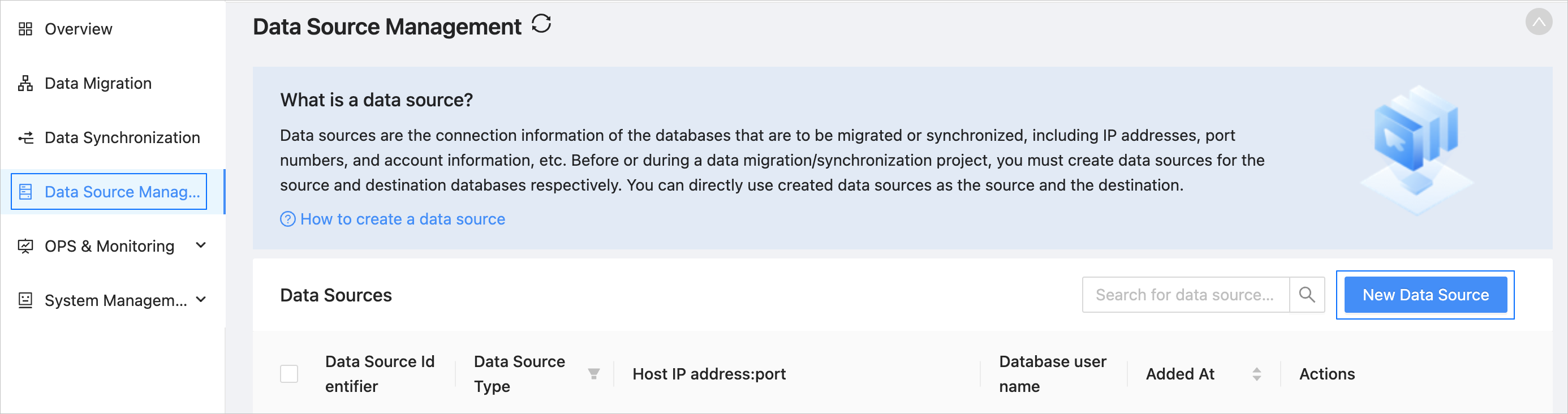
  2. In the left-side navigation pane, click Data Source Management.

  3. On the Data Source Management page, click New Data Source in the upper-right corner.
    data-source5-en

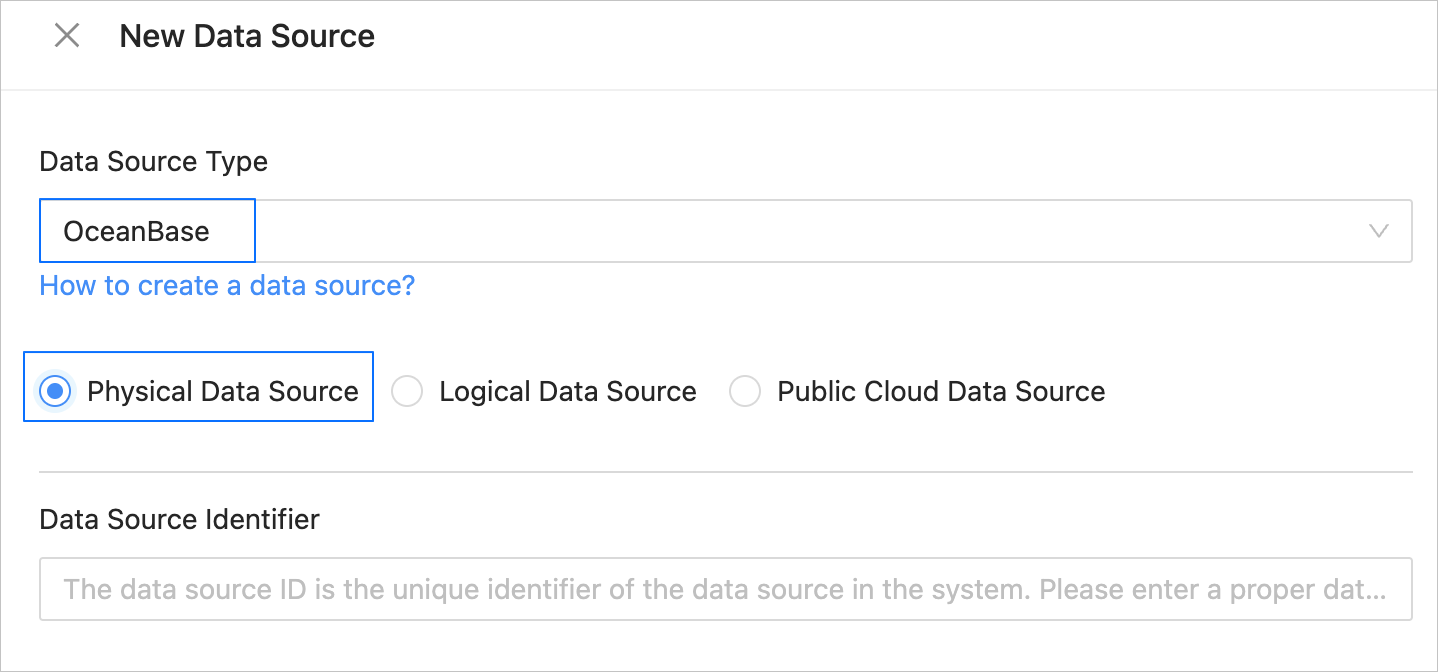
  4. In the New Data Source dialog box, configure the parameters. Data Source Type is set to OceanBase and Physical Data Source is selected by default.
    data-source3-en

    Parameter Description
    Data Source Identifier We recommend that you set it to a combination of digits and letters. It must not contain any spaces and cannot exceed 32 characters in length.
    Notice
    The data source identifier must be globally unique in OMS.
    Region Select the region where the data source resides from the drop-down list. The region is the value that you set for the cm_region parameter when you deploy OMS.
    Notice
    • This parameter is displayed only when multiple regions are available.
    • Make sure that the mappings between the data source and the region are consistent. Otherwise, the migration and synchronization performance can be poor.
    Tenant Type The type of the OceanBase Database tenant. Valid values: Oracle Compatible and MySQL Compatible.
    OCP Cluster (Optional) The OceanBase Cloud Platform (OCP) cluster associated with the data source. Select an OCP cluster from the drop-down list.
    Note
    • Check whether the data source is managed in the selected OCP cluster.
    • This parameter allows OMS to obtain the incremental logs of OceanBase Database. If you do not set this parameter, you cannot select Incremental Synchronization or Reverse Incremental Migration.
    If the OCP cluster is not available in the list, click Add OCP Cluster and configure the parameters on the Add Associated OCP Cluster page. For more information, see Associate with OCP.
    Input Method Valid values: Manual Input and Command-line Connection String.
    • Manual Input: Enter the public IP address and port number of the OceanBase database.
    • Command-line Connection String: Enter a command-line connection string.
    Host IP Address The IP address of the host where the database is located.
    Port The port number of the host where the database is located.
    Tenant Name The name of the OceanBase Database tenant.
    Cluster Name The name of the cluster to which the OceanBase Database tenant belongs.
    Database Username The username of the OceanBase database user for data migration or synchronization. We recommend that you create a dedicated database user for data migration or synchronization.
    Database Password The password of the database user.
    DB Name (Optional) The name of the database. This parameter is required only when the Tenant Type parameter is set to MySQL Compatible.
    Note
    If this parameter is specified, you can select migration or synchronization objects only in the specified database when the data source serves as the source of a data migration or synchronization task.
    Schema Name (Optional) The name of the schema. This parameter is required only when the Tenant Type parameter is set to Oracle Compatible.
    Note
    • If this parameter is specified, you can select only migration or synchronization objects in the specified schema when the data source serves as the source of a data migration or synchronization task.
    • If this parameter is not specified, you can select all accessible schemas as the migration or synchronization objects.
    Remarks (Optional) Additional information about the data source.
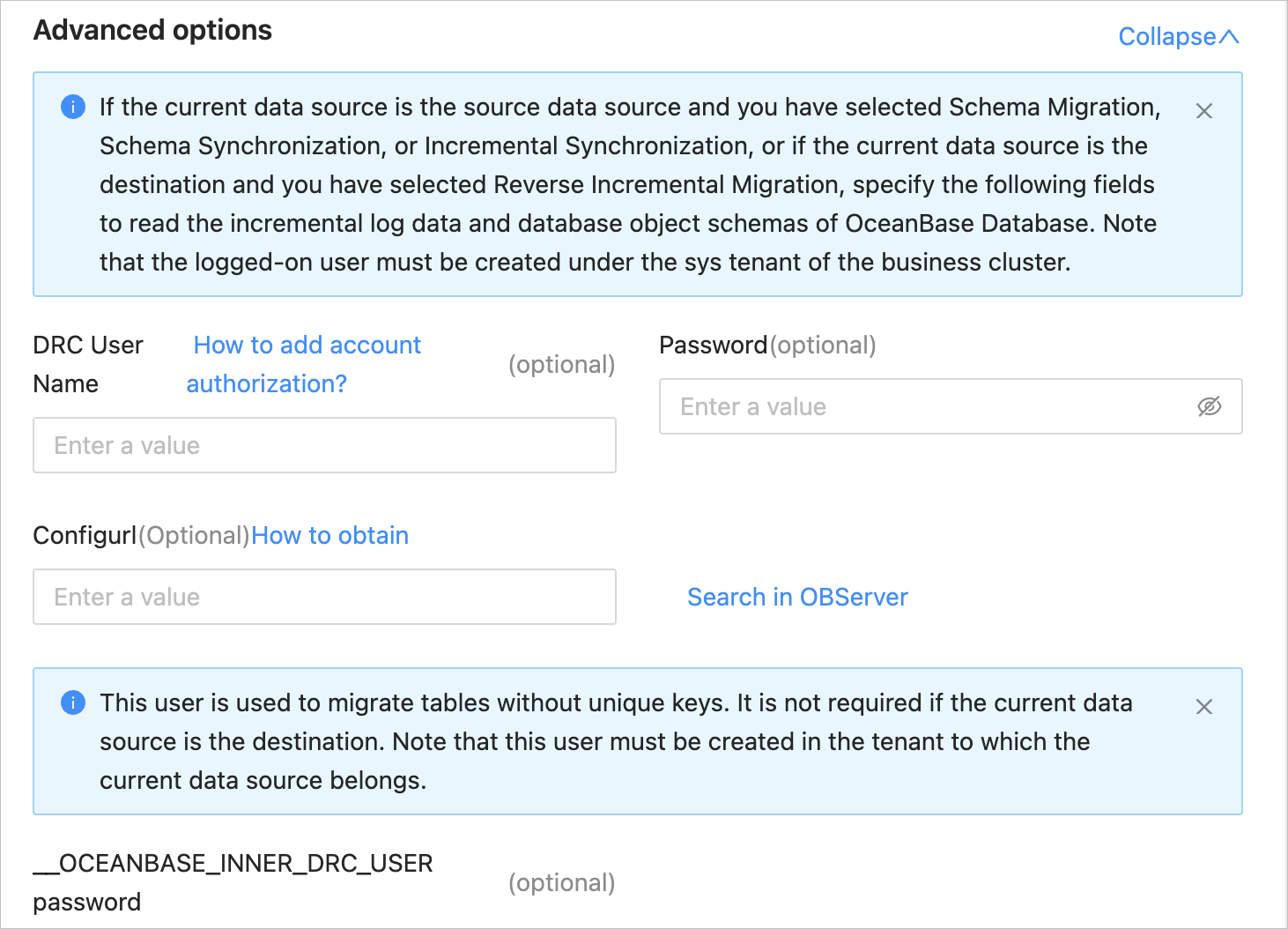
  5. (Optional) In the Create Data Source dialog box, click Show next to Advanced Options to set the parameters as needed.
    data-source4-en

    Parameter Description
    DRC User Name (Optional) The username of the data replication center (DRC) user intended for reading database incremental logs and database object schemas in OceanBase Database. You must create this user in the sys tenant of your business cluster.
    Password (Optional) The password of the DRC user.
    Configurl (Optional) The actual IP address of the server that runs OceanBase Database.
    • If you select OCP Cluster, this parameter is not displayed. OMS obtains the configurl from the OCP cluster to which the server belongs by default.
    • If you do not select OCP Cluster, you can specify the Username and Password parameters, click Search in OBServer next to ConfigUrl to obtain the IP address from the corresponding OBServer.
      If the query fails, you can run the show parameters like 'obconfig_url' command in the sys tenant of OceanBase Database. The returned value is the configurl.
    • If OCP is not deployed, you must deploy the web service config server to access the OceanBase metadata.
    __OCEANBASE_INNER_DRC_USER Password (Optional) The password of the __OCEANBASE_INNER_DRC_USER admin user. The admin user is used to migrate tables without unique keys in OceanBase Database. Note that you must create this user under the tenant where the current data source is located.
    • When you create a task to migrate or synchronize data from a physical OceanBase data source, you must perform the following operations:

      • You must enter the username and password for schema migration, schema synchronization, and incremental synchronization. If you do not specify OCP Cluster, you must specify Configurl.

      • When you migrate a table without a unique key, you must enter the password of the __OCEANBASE_INNER_DRC_USER user.

    • When you create a task to migrate data to a physical OceanBase data source, you must specify the username and password for reverse incremental migration. If you do not specify OCP Cluster, you must specify Configurl.

  6. Click Test Connection to test the network connection between OMS and the data source, and the validity of the username and password.

  7. After the test is passed, click OK.

Previous topic

Delete a data validation task
Last

Next topic

Create an ODP data source
Next
What is on this page
Prerequisites
Limitations
Procedure