







During routine O&M, you can restart, stop, delete, and upgrade a cluster.
Prerequisites
The target cluster can be managed in the OceanBase Cloud Platform (OCP) console.
If the cluster has not been added to OCP, request the administrator to add the cluster. For more information, see the Take over a cluster topic in the OCP User Guide of the corresponding version.
You have permissions of the CLUSTER_MANAGER role.
If you do not have permissions of the role, request the administrator to assign the role. For more information, see the Edit a user topic in the OCP User Guide of the corresponding version.
View cluster information
After a cluster is created, you can view basic information of the cluster from a view or in the OCP console, including the name, ID, role, and status of the cluster.
View cluster information from a view
Log on to the
systenant as therootuser.Access the database named
oceanbase.obclient> USE oceanbase;Execute the following statement to view the cluster information.
For example,
obclient> select * from v$ob_cluster;
+------------+--------------+----------------------------+--------------+----------------+-------------+-------------------+-----------------------------+------------------+----------------------------+--------------------+---------------------+---------------------+------------------------------+
| cluster_id | cluster_name | created                    | cluster_role | cluster_status | switchover# | switchover_status | switchover_info             | current_scn      | standby_became_primary_scn | primary_cluster_id | protection_mode     | protection_level    | redo_transport_options       |
+------------+--------------+----------------------------+--------------+----------------+-------------+-------------------+-----------------------------+------------------+----------------------------+--------------------+---------------------+---------------------+------------------------------+
|     100022 | test322_1205 | 2021-12-14 10:23:25.527305 | PRIMARY      | VALID          |           0 | NOT ALLOWED       | NONE SYNCED STANDBY CLUSTER | 1639532540674975 |                          0 |               NULL | MAXIMUM PERFORMANCE | MAXIMUM PERFORMANCE | ASYNC NET_TIMEOUT = 30000000 |
+------------+--------------+----------------------------+--------------+----------------+-------------+-------------------+-----------------------------+------------------+----------------------------+--------------------+---------------------+---------------------+------------------------------+
1 row in set
For more information about the fields in the
v$ob_clusterview, see v$ob_cluster.
View cluster information in the OCP console
Log on to the OCP console. The Clusters page automatically appears.
In the Clusters section, view the names, IDs, versions, deployment modes, and statuses of all clusters managed in the OCP console.
Click the target cluster. The Overview page of the cluster appears.
You can view the cluster type, number of regions, hardware architecture, and number of servers of the cluster.
Restart a cluster
You can restart one, several, or all zones in a cluster. Generally, you need to restart zones for parameter modifications to take effect.
Requirements and impact
Make sure that the OceanBase cluster to be restarted is a multi-replica cluster and has three or more replicas. In this case, the OceanBase cluster is restarted in rolling mode, without interrupting the business.
If the OceanBase cluster has less than three replicas, the business will be interrupted during the restart. Proceed with caution.
Procedure
Log on to the OCP console.
The Clusters page automatically appears.
In the Clusters list, find the target cluster and click its name.
Click the More icon in the upper-right corner on the Overview page and select Restart Cluster.
Set Restart Scope to All, a zone, or several zones.
If you set Restart Scope to All, the system will restart the observer processes of all nodes in the cluster.
If you set Restart Scope to specific zones, the system will restart the observer processes of these zones.
In the Restart Method section, the Restart (recommended) option indicates a restart in rolling mode, which requires at least 3 replicas to take effect. If you specify the Force Restart option, your business may be interrupted.
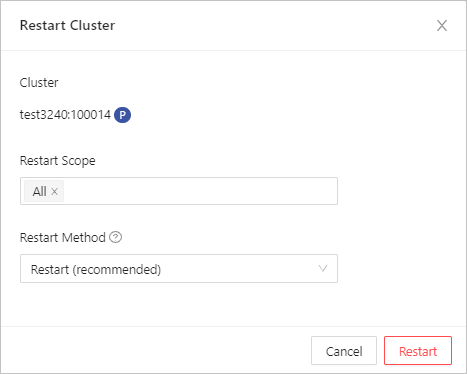
Click Restart.
In the dialog box that appears, you can click View Task to view the progress of the restart task.
You can also choose System Management > Tasks to view the progress of the restart task.
If the task status is Completed, and the specific zones in the Zones list on the Overview page are in Running state, the cluster is successfully restarted.
Delete a cluster
You can delete an OceanBase cluster that is no longer in use in the OCP console. In the primary/standby cluster configuration, make sure that the standby cluster has been deleted before you delete the primary cluster. For more information about the primary and standby clusters, see Primary/Standby cluster management.
Log on to the OCP console.
The Clusters page automatically appears.
In the Clusters list, find the cluster that you want to delete and click its name.
In the upper-right corner of the Overview page, click the More icon, and then select Delete Cluster.
In the Delete Cluster dialog box, enter delete.
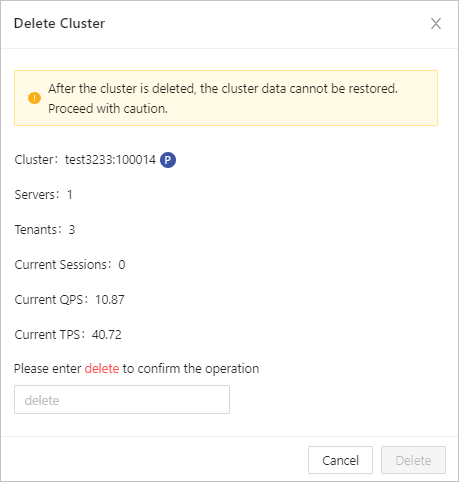
Click Delete.
In the dialog box that appears, you can click View Task to view the progress of the deletion task or the cause of the failure.
You can also choose System Management > Tasks to view the progress of the task.
When the task status is Completed, and the Clusters list on the Clusters page does not include the OceanBase cluster, the cluster is deleted.
Upgrade a cluster
OceanBase clusters are upgraded according to the specified path. You must upload an RPM package for each version in the path. You can upgrade OceanBase clusters in the OCP console. For more information, see the OceanBase Database Upgrade Guide.