







Overview

After you log on to OceanBase Developer Center (ODC), click the name of the target connection on the ODC homepage to go to the corresponding connection management page.
In the left-side navigation pane, click Table to get a list of tables.
Double-click the name of a table in the table list to go to the table management page.
In the navigation bar at the top of the page, click Attribute to go to the Attribute tab. You can view the basic information, columns, indexes, constraints, partitions, and DDL attributes of the current table.
Basic information
Click Basic Information in the left-side navigation pane of the Attribute tab to view the basic information of the current table.
Parameter |
Description |
|---|---|
| Table Name | Displays the name of the current table. You can rename the table here. |
| Default Character Set | Displays the character set that the table uses. |
| Default Sorting Rule | Displays the sorting rule that the table uses. |
| Description | Displays the description that you specified when you created the table. You can also modify the table description here. |
| Owner | Displays the database to which the table belongs. |
| Last Modified On | Displays the date on which the table was last modified. |
| Row Data Volume | Displays the number of rows in the table. |
| Size | Displays the size of data in the table. |
The basic information page provides the following icons.
Icon |
Description |
|---|---|
| Edit | Click  to modify the basic information. to modify the basic information. |
| Refresh | Click  to refresh the basic information. to refresh the basic information. |
| Export | Click the Export icon in the upper-right corner to export the data in the table. For more information, see the topics about import and export in this manual. |
Column information

Click Column in the let-side navigation pane of the Attribute tab to view the columns in the current table. On the Column tab, you can modify the name, length, nullability, and comment of a column.
The following table describes the icons provided in the toolbar.
Icon |
Description |
|---|---|
| Create | Click + to add a field (or column) to the table. |
| Delete | Click  to delete the selected field. to delete the selected field. |
| Refresh | Click to refresh the field information. |
| Filter | Click  in the Name or Type column to filter or search by a field. in the Name or Type column to filter or search by a field. |
| Export | Click the Export icon in the upper-right corner to export the data in the table. For more information, see the topics about import and export in this manual. |
Note
- You cannot set an auto-increment field in Oracle mode.
- You can change a non-nullable column to be nullable, but you cannot change a nullable column to be non-nullable.
- If the table does not contain an auto-increment column, you can add a column and set it as an auto-increment column.
- The default value and an auto-increment value are mutually exclusive, and you can specify only one of them. You can specify a default value only for a column for which Virtual Column is not selected. A specified default value cannot be canceled.
- You cannot modify a configured virtual column. You can add a column and set it to a virtual column.
Index information

Click Index in the left-side navigation pane of the Attribute tab to view the indexes in the current table.
On the Index tab, you can rename an index and make an index visible or invisible.
In ODC V4.2.2 and later, you can view whether an index is available. An index marked with the alert icon  is unavailable.
The following table describes the icons provided in the toolbar.
Icon |
Description |
|---|---|
| Create | Click + to add an index to the table. |
| Delete | Click to delete the selected index. |
| Refresh | Click to refresh the index information. |
| Filter | Click in the Index Name, Scope, Method, or Type column to filter or search by a field. |
| Export | Click the Export icon in the upper-right corner to export the data in the table. For more information, see the topics about import and export in this manual. |
Constraint information
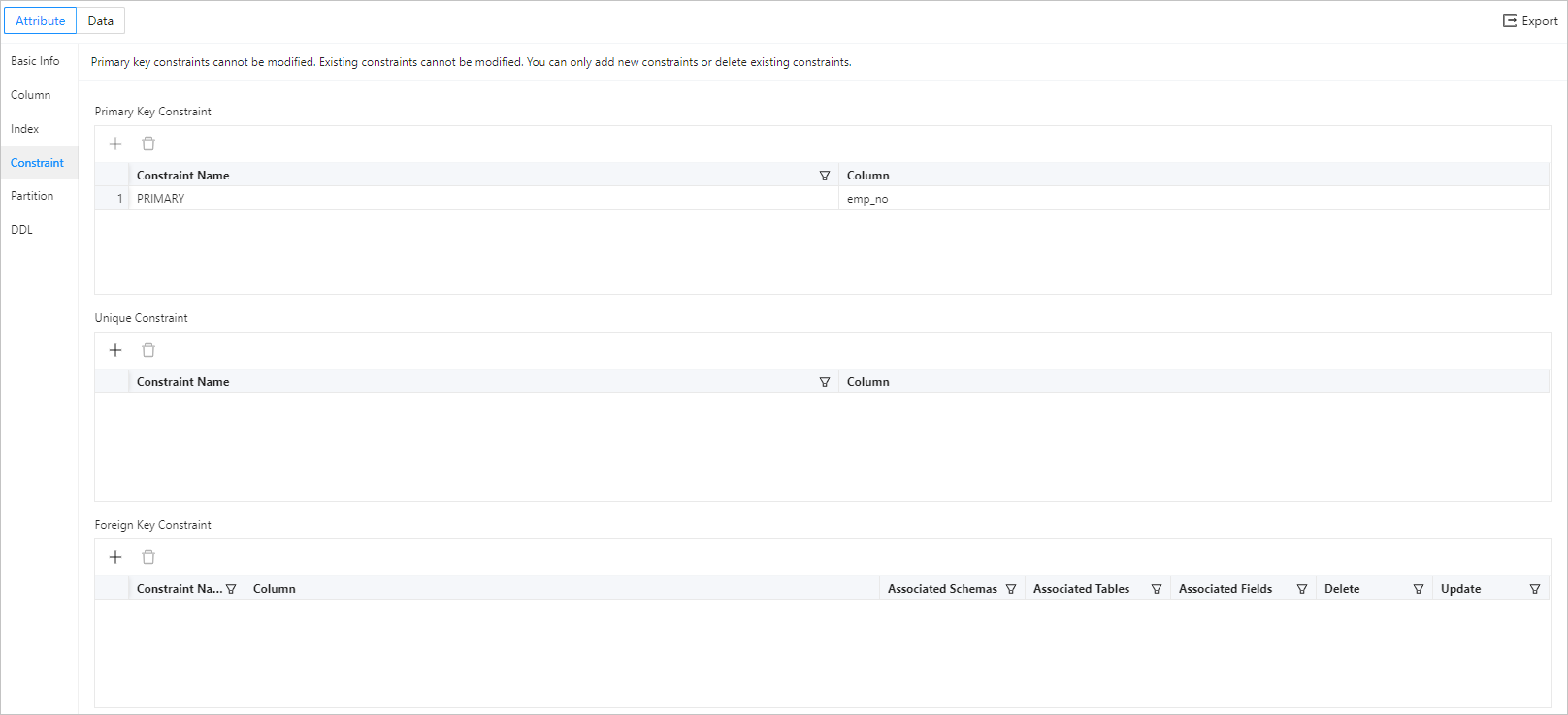
In the left-side navigation pane of the Attribute tab, click the Constraint tab and view the constraints on the current table.
On the Constraint tab, you can add or delete UNIQUE and CHECK constraints. You cannot modify existing objects.
The following table describes the icons provided in the toolbar.
Icon |
Description |
|---|---|
| Create | Click + to add a constraint to the table. |
| Delete | Click to delete the selected constraint. |
| Refresh | Click to refresh the constraint list. |
| Filter | Click to filter or search by a field. |
| Export | Click the Export icon in the upper-right corner to export the data in the table. For more information, see the topics about import and export in this manual. |
Note
- The icons provided vary with the constraint method. If an icon is dimmed out or not present in the navigation bar, it means that the constraint method does not support the corresponding action.
- You can query the
ALL_CONSTRAINTSview forFOREIGN KEYconstraints in OceanBase Database in Oracle mode, and query theINFORMATION_SCHEMA.KEY_COLUMN_USAGEtable forFOREIGN KEYconstraints in OceanBase Database in MySQL mode since V2.2.6. - OceanBase Database supports constraint checking only in Oracle mode.
Partition information

In the left-side navigation pane of the Attribute tab, click the Partition tab and view the name, sequence, partitioning method, expression (or the partitioning key in Oracle mode), upper limit of the range, and enumeration value of each partition. Here the partitioning method is the one specified when the table was created. The displayed partition information varies based on the partitioning method. The following table describes the icons provided in the toolbar.
Icon |
Description |
|---|---|
| Delete | Click to delete the selected partition and destroy the data in the partition. |
| Refresh | Click to refresh the partition list. |
| Filter | Click  to filter or search by a partition name, sequence, or upper limit of the range. to filter or search by a partition name, sequence, or upper limit of the range. |
| Export | Click the Export icon in the upper-right corner to export the data in the table. For more information, see the topics about import and export in this manual. |
Note
In ODC V3.3.0 and later, you can view the partitions of table objects not necessarily under the SYS tenant.
DDL information

Click DDL in the left-side navigation pane of the attribute tab to view the DDL statement of the current table, namely, the SQL statement that defines the table. This statement cannot be edited. The following table describes the icons provided in the toolbar.
Icon |
Description |
|---|---|
| Format | Click to format the statements. |
| Download | Click  to download the DDL statements to a local file. to download the DDL statements to a local file. |
| Refresh | Click to refresh the partition list. |
| Export | Click the Export icon in the upper-right corner to export the data in the table. For more information, see the topics about import and export in this manual. |