







This topic describes how to create a data source in OceanBase Developer Center (ODC).
Background information
ODC allows you to connect to OceanBase Database and MySQL Database to edit and manage data sources, including database objects and resources. ODC can connect to OceanBase Database in MySQL and Oracle modes on Apsara Stack and Alibaba Cloud, and connect to MySQL Database.
Prerequisites
For the functional limitations and version requirements on data sources, see Limitations.
You have deployed Web ODC.
You have logged on to Web ODC and gone to the data source management page.
You have obtained the connection information or connection string of the data source instance. The connection string of a MySQL tenant of OceanBase Database is in the following format:
mysql -h host name -P port number -u database username@tenant name#cluster name -D default database -p 'database password'-hxxx.x.x.x -P8080 -uodc@mysql_tenant#odc_cluster -Dodc -p'******'
Procedure
Create a single data source
Create an OceanBase data source
Example: Create an OceanBase data source in MySQL mode named obmysql4.2.0 in ODC, and bind the data source to the odc_4.2.0 project.
Parameter |
Example value |
|---|---|
| Project name | odc_4.2.0 |
| Data source name | obmysql4.2.0 |
| Host IP address | xxx.x.x.x |
| Port | 8080 |
| Cluster name | odc_cluster |
| Tenant name | mysql_tenant |
| Database username | odc |
| Database password | ****** |
| sys tenant account | test |
| sys tenant password | ****** |
Log on to Web ODC. In the left-side navigation pane of the project collaboration window, choose Data Sources > Create Data Source > OceanBase MySQL.
ODC supports the following OceanBase Database instance types:
OceanBase MySQL or OceanBase Oracle: a database instance that you build in your own environment.
OB Cloud MySQL or OB Cloud Oracle: a database instance on Alibaba Cloud.
OB Sharding MySQL: a logical database, which supports only the MySQL mode.
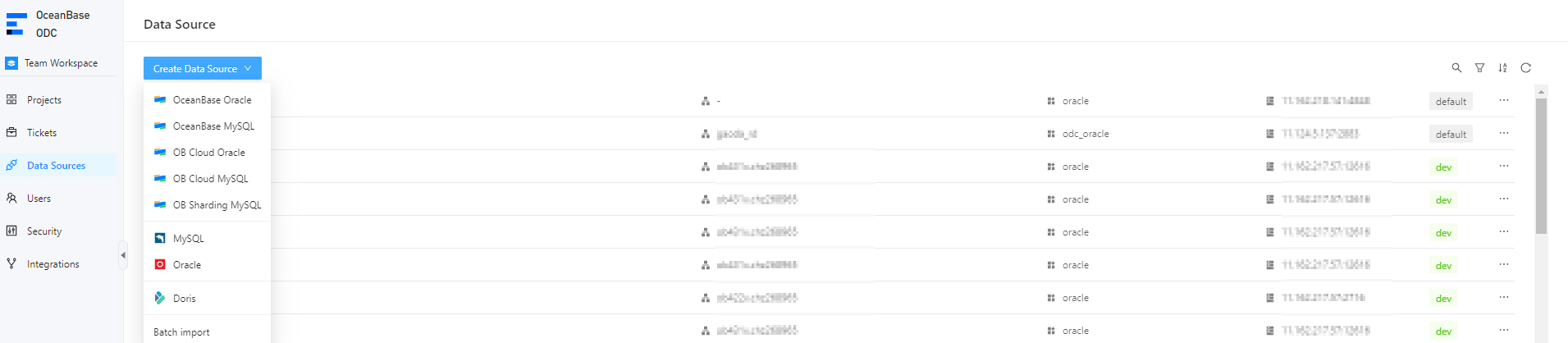
In the Create Data Source panel, specify the following information.
Note
If you have obtained the connection string of OceanBase Database, you can obtain the following information from the connection string or use the Intelligent Parsing tool provided on the tab to fill in the information.
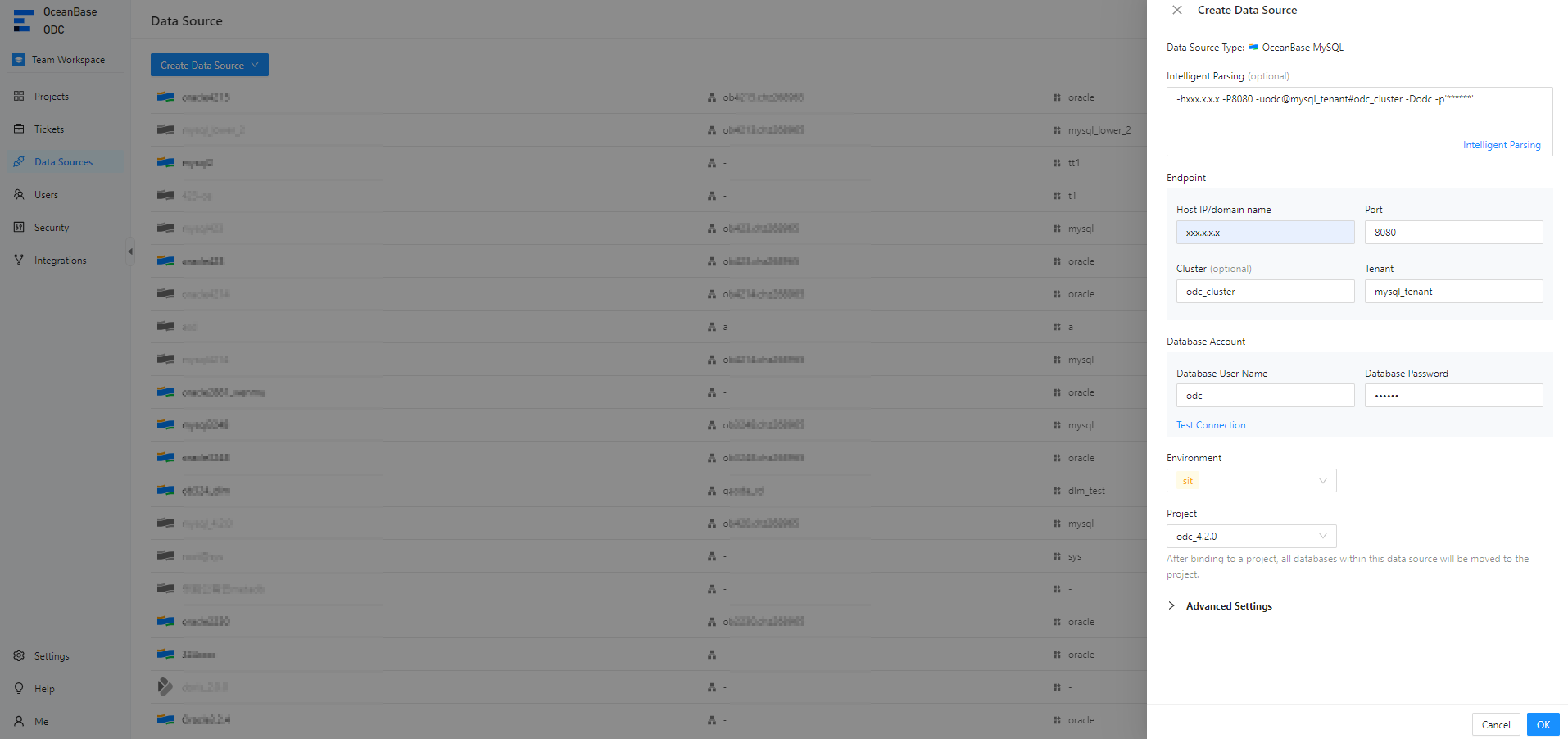 ParameterDescription
Data Source Type By default, the selected data source type is displayed. Intelligent Parsing You can paste a connection string to the field. ODC automatically identifies the string and fills in the corresponding values. Endpoint - Host IP: the IP address of the server where the target database is located.
- Port: the port number of the server where the target database is located.
- Cluster: the name of the cluster where the target database is located. This parameter is not required for logical databases.
- Tenant: the name of the tenant in which the target database is located. This parameter is not required for logical databases.
Note
- You can obtain the host name and port number from the details page of the tenant in which the target database is located, such as a tenant created on Alibaba Cloud or in OceanBase Cloud Platform (OCP).
- The cluster name is required only when you connect to OceanBase Database by using OceanBase Database Proxy (ODP).
Database Account - Database User Name: the username of an account created in the tenant. In MySQL mode, this account must have the permission to access the default database.
- Password: the password of the account created in the tenant. You can click Test Connection next to the password field to test whether you can connect to the target database.
Note
- An error will be returned if the configurations such as the username, password, or network settings are invalid.
- You can connect only to a database in the current tenant. Otherwise, a test failure error will be returned.
- Before you save the configurations, you can click Test Connection to test the database connection. If the database username and password are correct, the system returns a message indicating that the connection succeeded. In ODC V4.0.0 and later, you can save the connection without setting the database account and password.
Environment You can select an environment type as needed. Valid values: dev, sit, and prod. Project You can choose to bind the created data source to the specified project. After the data source is bound to the project, the databases created in the data source will be automatically moved to the project. Note
The system parameterodc.connect.database.sync.block-internal-databasespecifies whether to automatically synchronize built-in databases to the project. The default value istrue, which specifies not to automatically synchronize built-in databases to the bound project. The built-in databases identified by ODC for different data sources are as follows:- OceanBase Oracle:
SYS - OceanBase MySQL:
information_schema,mysql,test, andoceanbase - MySQL:
information_schema,mysql, andtest
Advanced Settings - sys Tenant Account: If you select Query Tenant Views with sys Tenant Account, you must specify Account and Password.
When the database is a physical database, you can specify an account that has the permission to query the sys tenant views and the password. This field is automatically filled in whensysis specified as the tenant in Endpoint.- Account: an account that has the permission to query the views in the sys tenant.
- Password: the password of the account.
- SSL: Choose whether to enable SSL link encryption to ensure secure data transmission between clients and servers.
Before you enable SSL in ODC, make sure that SSL is enabled for the OBServer node. If you connect to the OBServer node by using ODP, make sure that SSL is enabled for ODP. For more information about how to enable SSL for an OBServer node, see Transmission encryption of OBServer nodes and SSL link encryption. - Startup Script: You can configure a connection session by using an SQL statement. For example, you can execute the
set session ob_query_timeout=60000000statement to configure a connection session. - Driver: You can configure driver attributes to connect to OceanBase Database and implement specified features.
Note
- To use the import/export feature in ODC V2.3.0 and later, you must configure the root@sys account in Advanced Settings when you create a connection.
- When you use the import/export feature to query views in ODC V2.4.1 and later, the root@sys account is not a must. Specifically, if you do not configure the root@sys account, some objects such as stored procedures and functions cannot be exported from ODC. If you configure the root@sys account, you can query views in the sys tenant to obtain the optimal data routing strategy, thereby increasing the export speed.
- The account and password of the sys tenant are the account and password of a user in a cluster tenant. Do not specify the account in the "@sys#cluster" format. For example, the
rootaccount can be used. - By default, the
REQUIRE NONEoption is specified when you create a user. TheREQUIRE NONEoption specifies that no encryption method is used. In this case, if you select Enable SSL, an SSL connection is created. Otherwise, a regular connection is created. - If the
REQUIRE SSLoption is specified when you create the user, you must select Enable SSL to create an SSL connection. Otherwise, the connection fails.
If the user is created by specifying theREQUIRE SSLoption, you do not need to upload the certificates, but you must select Enable SSL. Otherwise, the connection fails. We recommend that you upload the following certificates for identity verification:- CA certificate for the client to verify the identity of the server.
- Client key and client certificate for the server to verify the identity of the client.
- If the user is created by specifying the
REQUIRE X509option, you must select Enable SSL and upload the CA certificate, client key, and client certificate. The client and the server will verify the identity of each other. If you do not select Enable SSL or upload the CA certificate, you cannot create the connection.
After you specify the preceding information, click OK in the lower-right corner of the panel.
In the dialog box that appears, enter the data source name and click OK. The data source is then saved to the data source list of ODC.
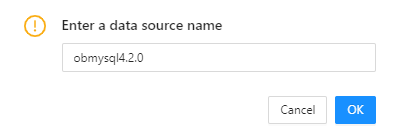
Note
- In the Create Data Source panel, click Copy Connection String in the lower-right corner to copy the current connection information as a connection string. This allows you to obtain the connection information with ease.
- If you do not want to save the current connection configuration, click Cancel. In the dialog box that appears, confirm whether to exit the data source creation page.
After the data source is created, you can view the created data source in the data source list.

Create a MySQL data source
Note
In ODC V4.2.2 and later, you can create a MySQL data source to manage the data in a MySQL database from ODC. For the limitations on features of MySQL data sources, see Limitations.
Example: Create a MySQL data source in ODC and bind the data source to the odc_4.2.0 project.
Parameter |
Example value |
|---|---|
| Project name | odc_4.2.0 |
| Data source name | mysql4.2.2 |
| Host IP address | xxx.x.x.x |
| Port | 8080 |
| Database username | odc |
| Database password | ****** |
Log on to Web ODC. In the left-side navigation pane of the project collaboration window, choose Data Sources > Create Data Source > MySQL.
In the Create Data Source panel, specify the following information.
Note
If you have obtained the connection string of the MySQL database, you can obtain the following information from the connection string or use the Intelligent Parsing tool provided on the tab to fill in the information.
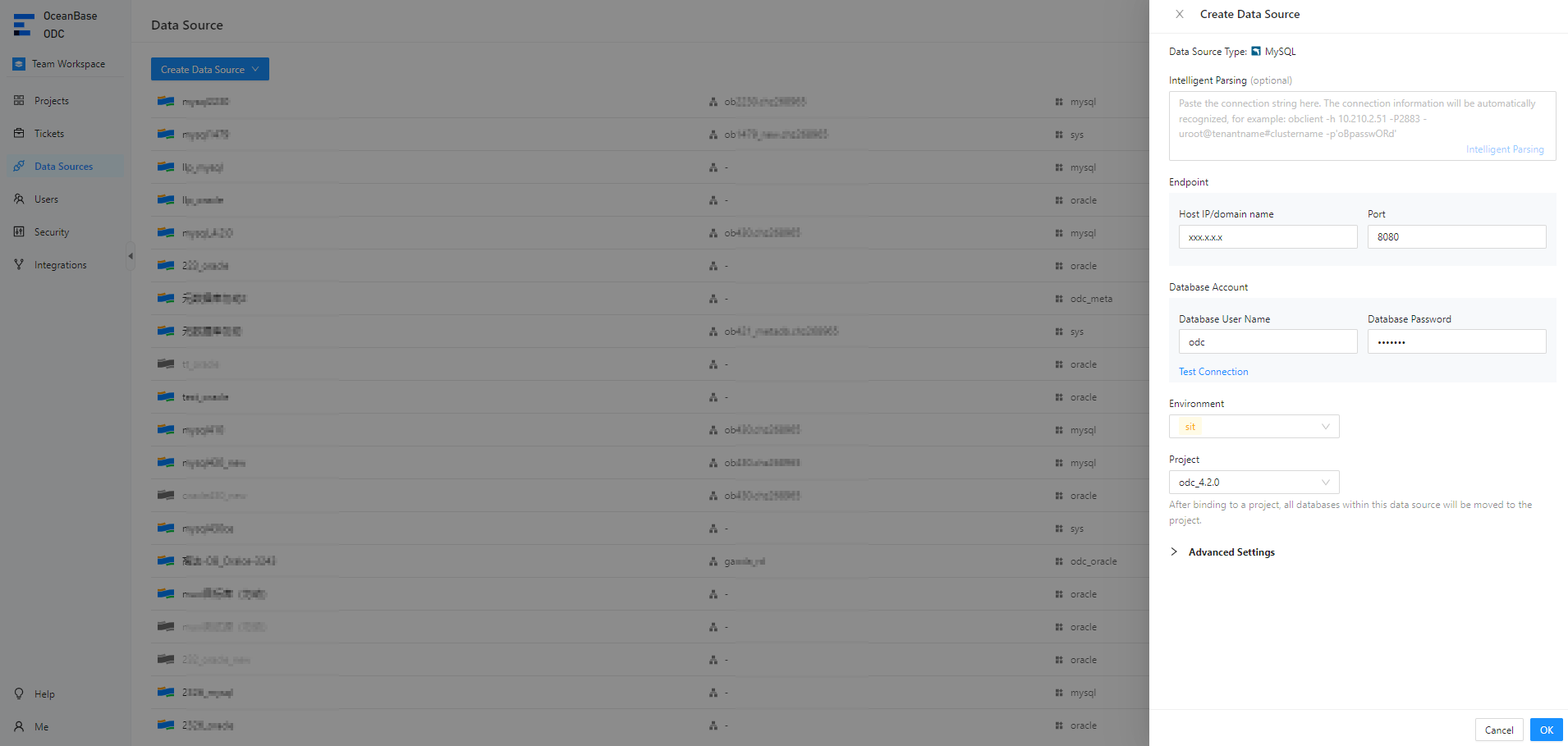 ParameterDescription
Data Source Type By default, the selected data source type is displayed. Intelligent Parsing You can paste a connection string to the field. ODC automatically identifies the string and fills in the corresponding values. Endpoint - Host IP: the IP address of the server where the target database is located.
- Port: the port number of the server where the target database is located.
Database Account - Database User Name: the username of an account created in the MySQL database.
- Database Password: the password of the account created in the MySQL database. You can click Test Connection next to the password field to test whether you can connect to the target database.
Note
- An error will be returned if the configurations such as the username, password, or network settings are invalid.
- Before you save the configurations, you can click Test Connection to test the database connection. If the database username and password are correct, the system returns a message indicating that the connection succeeded. In ODC V4.0.0 and later, you can save the connection without setting the database account and password.
Environment You can select an environment type as needed. Valid values: dev, sit, and prod. Project You can choose to bind the created data source to the specified project. After the data source is bound to the project, the databases created in the data source will be automatically moved to the project. Note
The system parameterodc.connect.database.sync.block-internal-databasespecifies whether to automatically synchronize built-in databases to the project. The default value istrue, which specifies not to automatically synchronize built-in databases to the bound project. The built-in databases identified by ODC for different data sources are as follows:- OceanBase Oracle:
SYS - OceanBase MySQL:
information_schema,mysql,test, andoceanbase - MySQL:
information_schema,mysql, andtest
Advanced Settings - Startup Script: You can configure a connection session by using an SQL statement. For example, you can execute the
set session ob_query_timeout=60000000statement to configure a connection session. - Driver: You can configure driver attributes to connect to OceanBase Database and implement specified features.
Note
When you create a MySQL data source in ODC V4.2.2, you can specify only the startup script and driver attributes.
After you specify the preceding information, click OK in the lower-right corner of the panel.
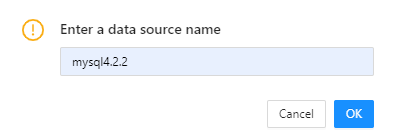
In the dialog box that appears, enter the data source name and click OK. The data source is then saved to the data source list of ODC.
Note
- In the Create Data Source panel, click Copy Connection String in the lower-right corner to copy the current connection information as a connection string. This allows you to obtain the connection information with ease.
- If you do not want to save the current connection configuration, click Cancel. In the dialog box that appears, confirm whether to exit the data source creation page.
After the data source is created, you can view the created data source in the data source list.
Create an Oracle data source
Note
In ODC V4.2.4 and later, you can create an Oracle data source to manage the data in an Oracle database from ODC. For the limitations on features of Oracle data sources, see Limitations.
Example: Create an Oracle data source in ODC.
Parameter |
Example value |
|---|---|
| Data source name | oracle4.2.4 |
| Host IP address | xxx.x.x.x |
| Port | 8080 |
| Database SID | test |
| Database username | odc |
| Database password | ****** |
Log on to Web ODC. In the left-side navigation pane of the project collaboration window, choose Data Sources > Create Data Source > MySQL.
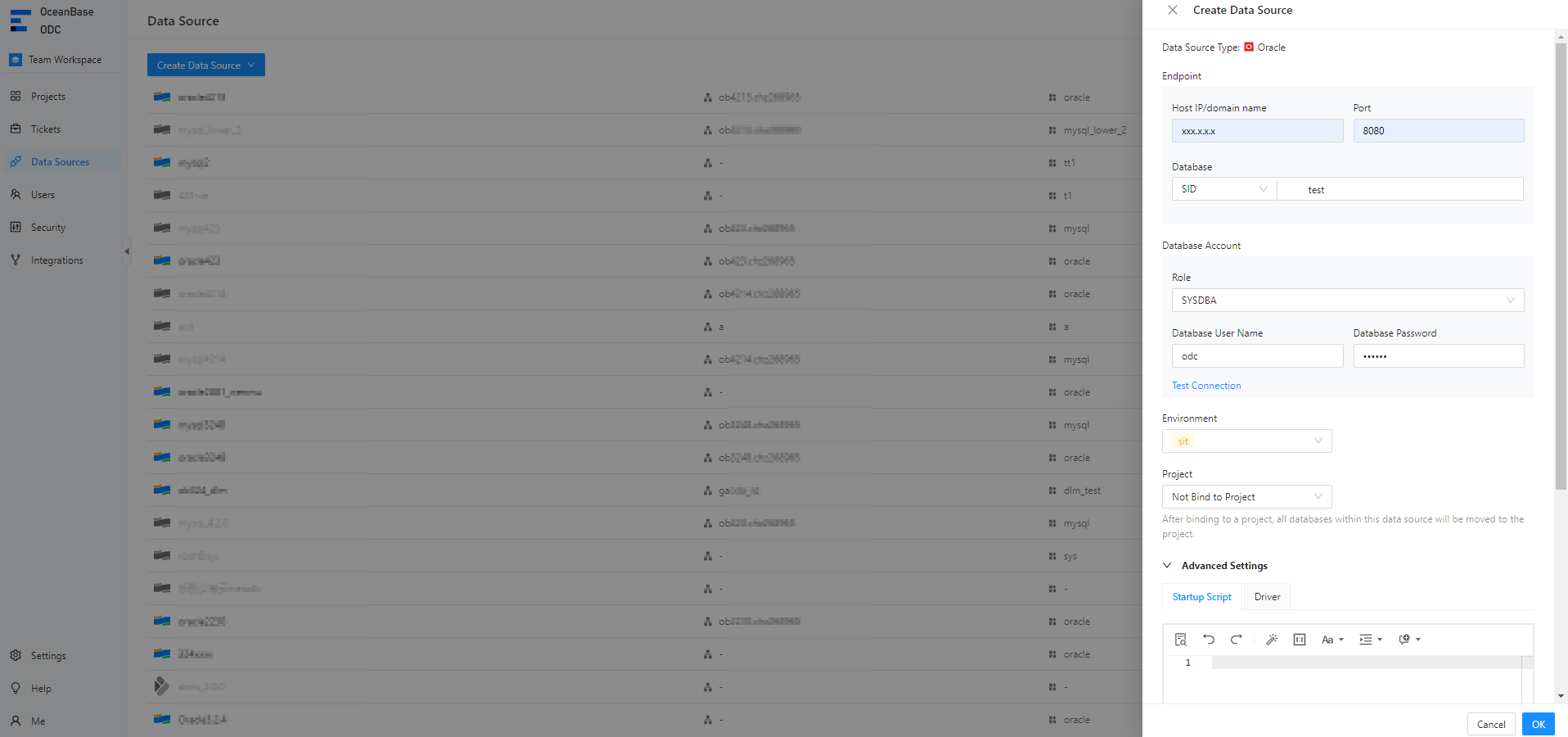
In the Create Data Source panel, specify the following information.
 ParameterDescription
Data Source Type By default, the selected data source type is displayed. Endpoint - Host IP/Domain Name: the IP address of the server where the target database is located.
- Port: the port number of the server where the target database is located.
- Database: the SID or service name.
Database Account - Role: the role of the database account. Valid values: Default, SYSDBA, and SYSOPER.
- Database User Name: the username of an account created in the MySQL database.
- Database Password: the password of the account created in the MySQL database. You can click Test Connection next to the password field to test whether you can connect to the target database.
Note
- An error will be returned if the configurations such as the username, password, or network settings are invalid.
- Before you save the configurations, you can click Test Connection to test the database connection. If the database username and password are correct, the system returns a message indicating that the connection succeeded. In ODC V4.0.0 and later, you can save the connection without setting the database account and password.
Environment You can select an environment type as needed. Valid values: dev, sit, and prod. Project You can choose to bind the created data source to the specified project. After the data source is bound to the project, the databases created in the data source will be automatically moved to the project. Advanced Settings - Startup Script: You can configure a connection session by using an SQL statement. For example, you can execute the
set session ob_query_timeout=60000000statement to configure a connection session. - Driver: You can configure driver attributes to connect to OceanBase Database and implement specified features.
After you specify the preceding information, click OK in the lower-right corner of the panel.
In the dialog box that appears, enter the data source name and click OK. The data source is then saved to the data source list of ODC.

Import data sources in batches
In ODC V4.2.0 and later, you can upload a configuration file to import data sources in batches. Perform the following steps:
On the Data Sources tab, choose Create Data Source > Batch Import.
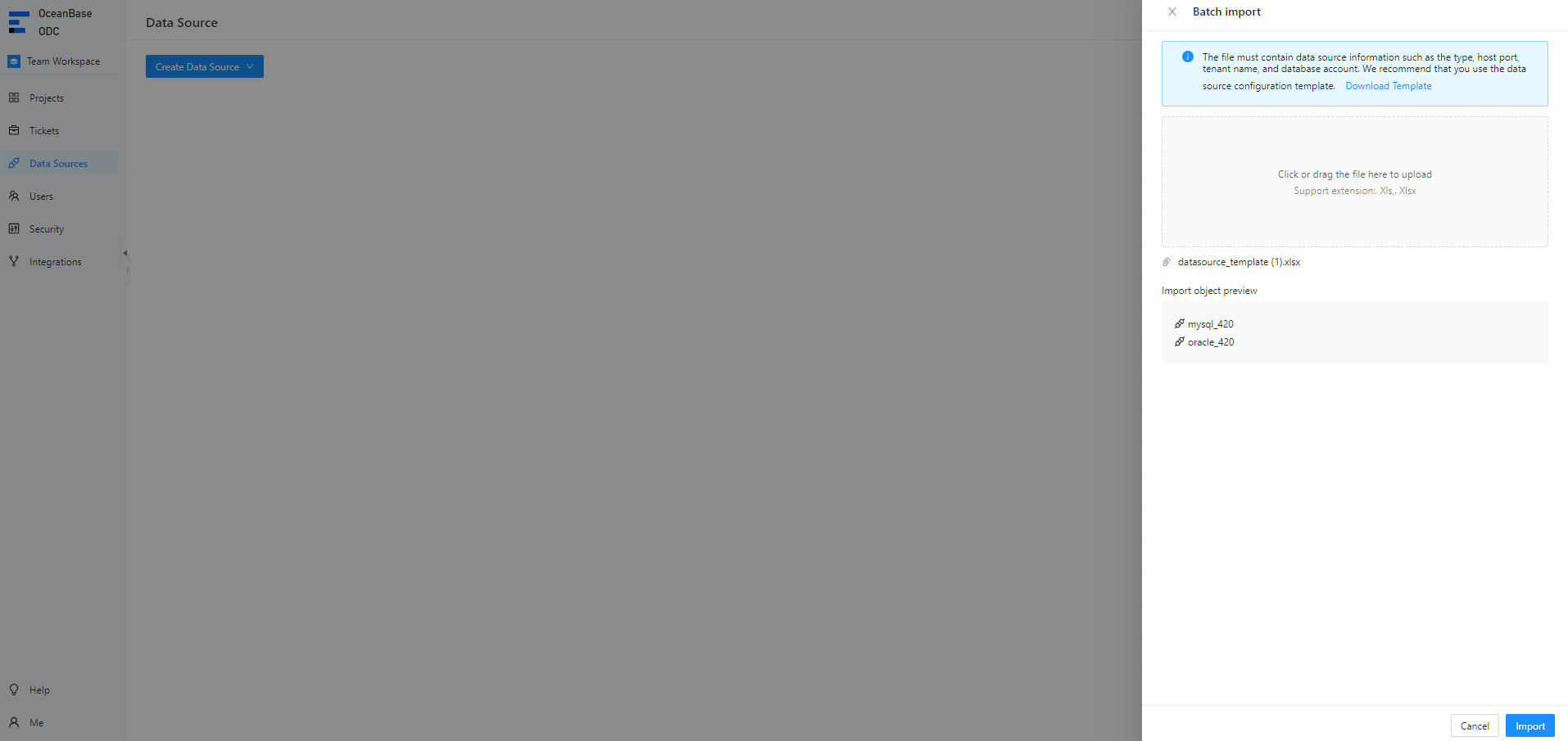
In the Batch Import panel, click Download Template and specify the information about the data sources to be imported.
 ParameterDescription
Data Source Name Required. The name of the data source. The name cannot contain spaces and must be unique. Data Source Type Required. The type of the data source. Valid values: OceanBase Oracle, OceanBase MySQL, OB Cloud Oracle, OB Cloud MySQL, and OB Sharding MySQL. Host IP Address Required. The IP address of the server where the target database is located.
You can obtain the host IP address from the details page of the tenant in which the target database is located, such as a tenant created on Alibaba Cloud or in OCP.Port Required. The port number of the server where the target database is located.
You can obtain the port number from the details page of the tenant in which the target database is located, such as a tenant created on Alibaba Cloud or in OCP.Cluster Name Optional. The name of the cluster where the target database is located. This parameter is not required for logical databases. Tenant Name Required. The name of the tenant in which the target database is located. This parameter is not required for logical databases.
The tenant name cannot contain spaces.Database User Name Required. An account created in the tenant. In MySQL mode, this account must have the permission to access the default database. Database Password The password of the account under the tenant. If the Password parameter is left unspecified, it indicates that the password is an empty string. Environment You can select an environment type as needed. Valid values: dev, sit, and prod. Sys Tenant Account Optional. The account that has the permission to query views in the sys tenant. Sys Tenant Password Optional. The password of the account. Click the file pool in the Batch Import panel to open the file explorer and select the file to be imported. You can also directly drag the file to the file pool to upload it.
Click Import to import the data sources in batches. After the import, you can view the information about imported data sources in the data source list.