







You can grant or revoke user privileges as needed.
Grant privileges by using SQL statements
You can use the GRANT statement to grant user-level, database-level, or object privileges to a user.
Prerequisites
You must have the GRANT OPTION privilege and the privileges to be granted. For example, if the user1 user wants to grant the SELECT privilege on the t1 table to the user2 user, the user1 user must have the GRANT OPTION privilege and the SELECT privilege on the t1 table.
For information about how to view your privileges, see View user privileges.
Considerations
Before you grant a privilege, take note of the following items:
When you grant a privilege to a user, the user is automatically created if the user does not exist. If
sql_mode='no_auto_create_user'is specified andIDENTIFIED BYis not used to specify a password, the system cannot create a user.When you grant multiple privileges to a user at a time, separate the privileges with commas (,).
When you grant a privilege to multiple users at a time, separate the usernames with commas (,).
After a user is granted a privilege, the privilege takes effect only after the user is reconnected to OceanBase Database.
OceanBase Database does not support the
CHANGE EFFECTIVE TENANTstatement for privilege control. Therefore, you can grant a privilege to all users in thesystenant.
Syntax for granting privileges
The syntax for granting privileges is as follows:
GRANT priv_type
    ON priv_level
    TO user_specification [, user_specification]...
     [WITH GRANT OPTION];

privilege_type:
      ALTER
    | CREATE
    | CREATE USER
    | CREATE VIEW
    | DELETE
    | DROP
    | GRANT OPTION
    | INDEX
    | INSERT
    | PROCESS
    | SELECT
    | SHOW DATABASES
    | SHOW VIEW
    | SUPER
    | UPDATE
    | USAGE
    | CREATE SYNONYM

priv_level:
      *
    | *.*
    | database_name.*
    | database_name.table_name
    | table_name
    | database_name.rountine_name

user_specification:
user_name [IDENTIFIED BY [PASSWORD] 'password']
Some notes about this:
priv_type: the type of the privilege to be granted. When you grant multiple privileges to a user at a time, separate the privileges with commas (,).priv_level: the level of the privilege to be granted. In MySQL mode, OceanBase Database provides privileges of the following levels:User level: Privileges at this level apply to all databases. You can use
GRANT ... ON *.*to grant user-level privileges.Database level: Privileges at this level apply to all objects in a specified database. You can use
GRANT ... ON db_name.*to grant database-level privileges.Table level: Privileges at this level apply to all columns in a specified table. You can use
GRANT ... ON database_name.table_nameto grant table-level privileges.
For more information about user privileges supported in MySQL mode, see Overview of user privileges.
user_specification: the user to which one or more privileges are granted. If the user does not exist, the user is automatically created.When you grant a privilege to multiple users at a time, separate the usernames with commas (,).
user_name IDENTIFIED BY 'password'anduser_name IDENTIFIED BY PASSWORD 'password': The password in theuser_name IDENTIFIED BY 'password'clause is in plaintext. The password in theuser_name IDENTIFIED BY PASSWORD 'password'clause is in ciphertext.WITH GRANT OPTION: specifies whether the privileges can be delegated or revoked.
Examples
Grant user-level privileges
User-level privileges are global privileges that apply to all databases. You can use
GRANT ... ON *.*to grant user-level privileges.To grant all privileges on all objects in all databases to the user named
user, execute the following statement:obclient> GRANT ALL ON *.* TO user;To grant the
INSERTandSELECTprivileges on all tables in all databases to the user nameduser, execute the following statement:obclient> GRANT SELECT, INSERT ON *.* TO user;
Grant database-level privileges
Database-level privileges are management privileges on all objects in a specified database. You can use
GRANT ... ON db_name.*to grant database-level privileges.To grant management privileges on all objects in the
db1database to the user nameduser, execute the following statement:obclient> GRANT ALL ON db1.* TO user;To grant the
INSERTandSELECTprivileges on all tables in thedb1database to the user nameduser, execute the following statement:obclient> GRANT SELECT, INSERT ON db1.* TO user;
Grant table-level privileges
Table-level privileges are management privileges on a specified table in a specified database. You can use
GRANT ... ON db_name.tb1_nameto grant table-level privileges.To grant the
INSERTandSELECTprivileges on thetb1_nametable in thedb1database to the user nameduser, execute the following statement:obclient> GRANT SELECT, INSERT ON db1.tb1_name TO user;To grant management privileges on the
tb1_nametable in thedb1database to the user nameduser, execute the following statement:obclient> GRANT ALL ON db1.tb1_name TO user;
For more information about the GRANT statement, see GRANT.
Revoke privileges by using SQL statements
Prerequisites
You must have the privileges to be revoked and the
GRANT OPTIONprivilege. For example, if theuser1user wants to revoke theSELECTprivilege on thet1table from theuser2user, theuser1user must have theSELECTprivilege on thet1table.To revoke the
ALL PRIVILEGESandGRANT OPTIONprivileges, you must have the globalGRANT OPTIONprivilege or theUPDATEandDELETEprivileges on the table.
Considerations
When you revoke multiple privileges from a user at a time, separate the privileges with commas (,).
When you revoke a privilege from multiple users at a time, separate the usernames with commas (,).
The revocation does not extend to dependent users. For example, if
user1has granted some privileges touser2, when the privileges ofuser1are revoked, the privileges granted touser2are not revoked.
Syntax for revoking privileges
The syntax for revoking privileges is as follows:
REVOKE priv_type
     ON priv_level
     FROM 'user_name';

priv_type:
      ALTER
    | CREATE
    | CREATE USER
    | CREATE VIEW
    | DELETE
    | DROP
    | GRANT OPTION
    | INDEX
    | INSERT
    | PROCESS
    | SELECT
    | SHOW DATABASES
    | SHOW VIEW
    | SUPER
    | UPDATE
    | USAGE

priv_level:
      *
    | *.*
    | database_name.*
    | database_name.table_name
    | table_name
    | database_name.rountine_name
Some notes about this:
priv_type: the type of the privilege to be revoked. When you revoke multiple privileges from a user at a time, separate the privileges with commas (,).priv_level: the level of the privilege to be revoked. OceanBase Database provides privileges of the following levels:User level: Privileges at this level apply to all databases. You can use
REVOKE ... ON *.*to revoke user-level privileges.Database level: Privileges at this level apply to all objects in a specified database. You can use
REVOKE ... ON db_name.*to revoke database-level privileges.Table level: Privileges at this level apply to all columns in a specified table. You can use
REVOKE ... ON database_name.table_nameto revoke table-level privileges.
For more information about user privileges supported in MySQL mode, see Overview of user privileges.
user_name: the user whose privileges are to be revoked. When you revoke one or more privileges from multiple users at a time, separate the usernames with commas (,).
Examples
Revoke user-level privileges
To revoke the
INSERTandSELECTprivileges on all tables in all databases from the user nameduser, execute the following statement:obclient> REVOKE SELECT, INSERT ON *.* FROM 'user';Revoke database-level privileges
To revoke the
INSERTandSELECTprivileges on all tables in thedb1database from the user nameduser, execute the following statement:obclient> REVOKE SELECT, INSERT ON db1 FROM 'user';Revoke table-level privileges
To revoke the
INSERTandSELECTprivileges on thetb1_nametable in thedb1database from the user nameduser, execute the following statement:obclient> REVOKE SELECT, INSERT ON db1.tb1_name FROM 'user';
For more information about the REVOKE statement, see REVOKE.
Grant or revoke privileges in the OCP console
OceanBase Cloud Platform (OCP) V2.5.0 and later support modification of user privileges in MySQL mode.
Prerequisites
Before you modify user privileges, ensure that:
The TENANT_MANAGER role is assigned to you. Otherwise, request the OCP administrator to assign the role. For more information, see "Edit a user" in the OCP User Guide of the corresponding version.
Your password box contains the
rootpassword of the tenant. For more information about the password box, see the OCP User Guide of the corresponding version.
Procedure
Log on to the OCP console.
In the left-side navigation pane, click Tenants to go to the Tenants page.
In the tenant list, select a tenant whose Tenant Mode is MySQL to go to the Overview page.
In the left-side navigation pane, click User Management.
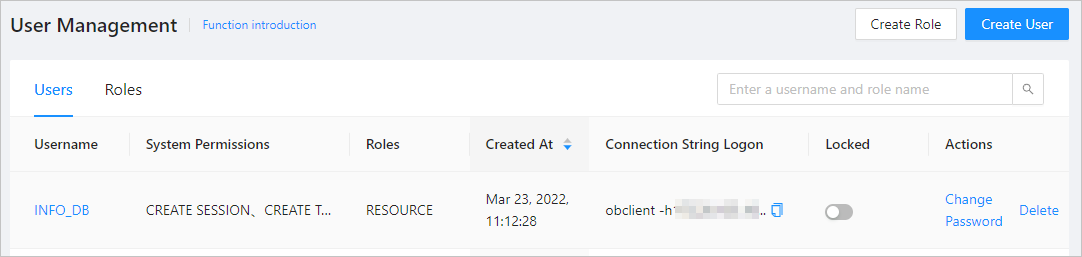
In the user list, find the target user. In the Actions column, click Modify Privileges.
In the dialog box that appears, modify the global privileges and database privileges.
The following table describes the privileges that you can specify in Global Permissions and Database Permissions.
PrivilegeDescriptionALTER The ALTER TABLE privilege. CREATE The CREATE TABLE privilege. DELETE The DELETE privilege. DROP The DROP privilege. INSERT The INSERT privilege. SELECT The SELECT privilege. UPDATE The UPDATE privilege. INDEX The CREATE INDEX and DROP INDEX privileges. CREATE VIEW The privilege to create and drop views. SHOW VIEW The SHOW CREATE VIEW privilege. CREATE USER The CREATE USER, DROPUSER, RENAME USER, and REVOKE ALLPRIVILEGES privileges. PROCESS The PROCESS privilege. SUPER The SET GLOBAL privilege for modifying global system parameters. SHOW DATABASES The global SHOW DATABASES privilege. GRANT OPTION The GRANT OPTION privilege. Click Submit.