







You can use hints in distributed execution plan management to improve SQL query performance.
The distributed execution framework of OceanBase Database supports the following hints: NO_USE_PX, PARALLEL, ORDERED, LEADING, USE_NL, USE_HASH, and USE_MERGE.
NO_USE_PX hint
If you do not want to run a query in parallel, use the NO_USE_PX hint to pull the data back and generate a local execution plan, as shown in the following example:
obclient> SELECT /*+ no_use_px parallel(8) */ * FROM(
    SELECT /*+ no_use_px parallel(8) */ no_w_id, no_d_id, MAX(no_o_id) max_no_o_id, MIN(no_o_id) min_no_o_id, COUNT(*) count_no
    FROM nord
    GROUP BY no_w_id, no_d_Id
) x
WHERE max_no_o_id - min_no_o_id+ 1!= count_no;
PARALLEL hint
The PARALLEL hint specifies the degree of parallelism (DOP) of distributed execution.
Three workers are activated to perform scanning in parallel, as shown in the following example:
obclient>SELECT /*+ PARALLEL(3) */ MAX(L_QUANTITY) FROM table_name;
Note
In complex queries, the scheduler can schedule the parallel execution of two data flow objects (DFOs). In this case, the number of activated workers is two times the DOP, which means
PARALLEL * 2.
ORDERED hint
The ORDERED hint specifies the join order in a parallel execution plan. The order of items in the FROM clause is strictly followed.
In the following example, customer is forced to be the table on the left of the JOIN, whereas orders is the table on the right, and NESTED LOOP JOIN is used:
obclient>CREATE TABLE lineitem(
    l_orderkey           NUMBER(20) NOT NULL ,
    l_linenumber         NUMBER(20) NOT NULL ,
    l_quantity           NUMBER(20) NOT NULL ,
    l_extendedprice      DECIMAL(10,2) NOT NULL ,
    l_discount           DECIMAL(10,2) NOT NULL ,
    l_tax                DECIMAL(10,2) NOT NULL ,
    l_shipdate           DATE NOT NULL,
    PRIMARY KEY(L_ORDERKEY, L_LINENUMBER));
Query OK, 1 row affected

obclient>CREATE TABLE customer(
    c_custkey            NUMBER(20) NOT NULL ,
    c_name               VARCHAR(25) DEFAULT NULL,
    c_address            VARCHAR(40) DEFAULT NULL,
    c_nationkey          NUMBER(20) DEFAULT NULL,
    c_phone              CHAR(15) DEFAULT NULL,
    c_acctbal            DECIMAL(10,2) DEFAULT NULL,
    c_mktsegment         CHAR(10) DEFAULT NULL,
    c_comment            VARCHAR(117) DEFAULT NULL,
    PRIMARY KEY(c_custkey));
Query OK, 1 row affected

obclient>CREATE TABLE orders(
    o_orderkey            NUMBER(20) NOT NULL ,
    o_custkey             NUMBER(20) NOT NULL ,
    o_orderstatus         CHAR(1) DEFAULT NULL,
    o_totalprice          DECIMAL(10,2) DEFAULT NULL,
    o_orderdate           DATE NOT NULL,
    o_orderpriority       CHAR(15) DEFAULT NULL,
    o_clerk               CHAR(15) DEFAULT NULL,
    o_shippriority        NUMBER(20) DEFAULT NULL,
    o_comment             VARCHAR(79) DEFAULT NULL,
    PRIMARY KEY(o_orderkey,o_orderdate,o_custkey));
Query OK, 1 row affected

obclient> INSERT INTO lineitem VALUES(1,2,3,6.00,0.20,0.01,'01-JUN-02');
Query OK, 1 row affected

obclient> INSERT INTO customer VALUES(1,'Leo',null,null,'13700461258',null,'BUILDING',null);
Query OK, 1 row affected

obclient> INSERT INTO orders VALUES(1,1,null,null,'01-JUN-20',10,null,8,null);
Query OK, 1 row affected

obclient>SELECT /*+ ORDERED USE_NL(orders) */o_orderdate, o_shippriority
        FROM customer, orders WHERE c_mktsegment = 'BUILDING' AND
         c_custkey = o_custkey GROUP BY o_orderdate, o_shippriority;

+-------------+----------------+
| O_ORDERDATE | O_SHIPPRIORITY |
+-------------+----------------+
| 01-JUN-20   |              8 |
+-------------+----------------+
1 row in set
The ORDERED hint is useful in writing an SQL statement. If you know the optimal order of JOIN, you can write table names in order after FROM and add the ORDERED hint.
LEADING hint
The LEADING hint specifies which tables are joined first in a parallel query plan. The order of tables in the LEADING hint is also the order of JOIN. It is more flexible than the ORDERED hint.
Note
When
ORDEREDandLEADINGhints are used at the same time, only theORDEREDhint takes effect.
PQ_DISTRIBUTE Hint
The PQ_DISTRIBUTE hint, or PQ hint, specifies how the data is distributed in a parallel query plan. It changes the data distribution mode during a distributed JOIN.
You can use the following syntax to specify a PQ hint:
PQ_DISTRIBUTE(tablespec outer_distribution inner_distribution)
Descriptions of the parameters:
tablespecspecifies the target table, which is the table on the right of theJOIN.outer_distributionspecifies the data distribution mode for the table on the left.inner_distributionspecifies the data distribution mode for the table on the right.
Data of these two tables is distributed in the following six modes:
HASH,HASHBROADCAST,NONENONE,BROADCASTPARTITION,NONENONE,PARTITIONNONE,NONE
The two modes that include the word PARTITION require partitions in the table on the left or right, and the PARTITION key serves as the JOIN key. If the requirement is not satisfied, the PQ hint is invalid.
obclient>CREATE TABLE t1(c1 INT PRIMARY KEY, c2 INT, c3 INT, c4 DATE);
Query OK, 0 rows affected

obclient>CREATE INDEX i1 ON t1(c3);
Query OK, 0 rows affected

obclient>CREATE TABLE t2(c1 INT(11) NOT NULL, c2 INT(11) NOT NULL, c3 INT(11)
       NOT NULL, PRIMARY KEY (c1, c2, c3)) PARTITION BY KEY(c2) PARTITIONS 4;
Query OK, 0 rows affected

obclient>EXPLAIN BASIC SELECT /*+USE_PX PARALLEL(3) PQ_DISTRIBUTE
        (t2 BROADCAST NONE) LEADING(t1 t2)*/ * FROM t1 JOIN t2 ON
         t1.c2 = t2.c2\G;
*************************** 1. row ***************************
Query Plan: ================================================
|ID|OPERATOR                          |NAME    |
------------------------------------------------
|0 |PX COORDINATOR                    |        |
|1 | EXCHANGE OUT DISTR               |:EX10001|
|2 |  HASH JOIN                       |        |
|3 |   EXCHANGE IN DISTR              |        |
|4 |    EXCHANGE OUT DISTR (BROADCAST)|:EX10000|
|5 |     PX BLOCK ITERATOR            |        |
|6 |      TABLE SCAN                  |t1      |
|7 |   PX BLOCK ITERATOR              |        |
|8 |    TABLE SCAN                    |t2      |
================================================
USE_NL hint
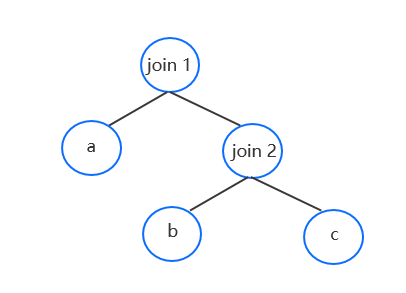
The USE_NL hint specifies to use the NESTED LOOP JOIN algorithm in a JOIN operation. The table specified in the USE_NL hint must be the table on the right of the JOIN.
To apply NESTED LOOP JOIN for join1, write the hint as: LEADING(a, (b,c)) USE_NL((b,c)).
Whenused in conjunction with the ORDERED or LEADING hint, the USE_NLJ hint is ignored if the table specified in the USE_NLJ hint is not the table on the right.
USE_HASH hint
The USE_HASH hint specifies to use HASH JOIN for a JOIN operation. The table specified in the USE_HASH hint must be the table on the right of the JOIN.
Note
If neither the
ORDEREDhint nor theLEADINGhint is used and tables specified in theJOINorder generated by the optimizer are not to be directly joined, theUSE_HASHhint is ignored.
USE_MERGE hint
The USE_MERGE hint specifies to use MERGE JOIN for a JOIN operation. The table specified in the USE_MERGE hint must be the table on the right of the JOIN.
Note
If neither the
ORDEREDhint nor theLEADINGhint is used and tables specified in the join order generated by the optimizer are not to be directlyjoined, theUSE_MERGEhint is ignored.