

OceanBase logo

OceanBase

A unified distributed database ready for your transactional, analytical, and AI workloads.

DEPLOY YOUR WAY

OceanBase Cloud

The best way to deploy and scale OceanBase

OceanBase Enterprise

Run and manage OceanBase on your infra

TRY OPEN SOURCE

OceanBase Community Edition

The free, open-source distributed database

OceanBase seekdb

Open source AI native search database

Customer Stories

Real-world success stories from enterprises across diverse industries.

View All
BY USE CASES

Mission-Critical Transactions

Global & Multicloud Application

Elastic Scaling for Peak Traffic

Real-time Analytics

Active Geo-redundancy

Database Consolidation

Resources

Comprehensive knowledge hub for OceanBase.

Blog

Live Demos

Training & Certification

Documentation

Official technical guides, tutorials, API references, and manuals for all OceanBase products.

View All
PRODUCTS

OceanBase Cloud

OceanBase Database

Tools

Connectors and Middleware

QUICK START

OceanBase Cloud

OceanBase Database

BEST PRACTICES

Practical guides for utilizing OceanBase more effectively and conveniently

Company

Learn more about OceanBase – our company, partnerships, and trust and security initiatives.

About OceanBase

Partner

Trust Center

Contact Us

International - English
中国站 - 简体中文
日本 - 日本語
Sign In
Start on Cloud

A unified distributed database ready for your transactional, analytical, and AI workloads.

DEPLOY YOUR WAY

OceanBase Cloud

The best way to deploy and scale OceanBase

OceanBase Enterprise

Run and manage OceanBase on your infra

TRY OPEN SOURCE

OceanBase Community Edition

The free, open-source distributed database

OceanBase seekdb

Open source AI native search database

Customer Stories

Real-world success stories from enterprises across diverse industries.

View All
BY USE CASES

Mission-Critical Transactions

Global & Multicloud Application

Elastic Scaling for Peak Traffic

Real-time Analytics

Active Geo-redundancy

Database Consolidation

Comprehensive knowledge hub for OceanBase.

Blog

Live Demos

Training & Certification

Documentation

Official technical guides, tutorials, API references, and manuals for all OceanBase products.

View All
PRODUCTS
OceanBase CloudOceanBase Database
ToolsConnectors and Middleware
QUICK START
OceanBase CloudOceanBase Database
BEST PRACTICES

Practical guides for utilizing OceanBase more effectively and conveniently

Learn more about OceanBase – our company, partnerships, and trust and security initiatives.

About OceanBase

Partner

Trust Center

Contact Us

Start on Cloud
编组
All Products
    • Databases
    • iconOceanBase Database
    • iconOceanBase Cloud
    • iconOceanBase Tugraph
    • iconInteractive Tutorials
    • iconOceanBase Best Practices
    • Tools
    • iconOceanBase Cloud Platform
    • iconOceanBase Migration Service
    • iconOceanBase Developer Center
    • iconOceanBase Migration Assessment
    • iconOceanBase Admin Tool
    • iconOceanBase Loader and Dumper
    • iconOceanBase Deployer
    • iconKubernetes operator for OceanBase
    • iconOceanBase Diagnostic Tool
    • iconOceanBase Binlog Service
    • Connectors and Middleware
    • iconOceanBase Database Proxy
    • iconEmbedded SQL in C for OceanBase
    • iconOceanBase Call Interface
    • iconOceanBase Connector/C
    • iconOceanBase Connector/J
    • iconOceanBase Connector/ODBC
    • iconOceanBase Connector/NET
icon

OceanBase Cloud Platform

V4.2.2

    Download PDF

    OceanBase logo

    The Unified Distributed Database for the AI Era.

    Follow Us
    Products
    OceanBase CloudOceanBase EnterpriseOceanBase Community EditionOceanBase seekdb
    Resources
    DocsBlogLive DemosTraining & Certification
    Company
    About OceanBaseTrust CenterLegalPartnerContact Us
    Follow Us

    © OceanBase 2026. All rights reserved

    Cloud Service AgreementPrivacy PolicySecurity
    Contact Us
    Document Feedback
    1. Documentation Center
    2. OceanBase Cloud Platform
    3. V4.2.2
    iconOceanBase Cloud Platform
    V 4.2.2
    • V 4.3.6
    • V 4.3.5
    • V 4.3.4
    • V 4.3.3
    • V 4.3.2
    • V 4.3.1
    • V 4.3.0
    • V 4.2.2
    • V 4.0.0 and earlier

    Diagnostics Transaction

    Last Updated:2024-03-22 09:34:34  Updated
    share
    What is on this page
    Prerequisites
    Procedure

    folded

    share

    OceanBase Cloud Platform (OCP) allows you to view basic information and associated SQL statements of large transactions. You can use the transaction diagnostics feature to identify and analyze large transactions.

    Prerequisites

    The OceanBase version is V3.2.x or later so that the Log Volume of Single Participant field is available.

    Procedure

    You can diagnostics transaction by using one of the following methods.

    • Method 1:

      1. Log on to the OceanBase Cloud Platform (OCP) console.

      2. In the left-side navigation pane, click Autonomous Services to go to the Real-time Diagnostics page.

      3. Click Transaction Diagnostics tab.

    • Method 2:

      1. Log on to the OceanBase Cloud Platform (OCP) console.

      2. To go to the O&M page of the tenant.

      3. In the left-side navigation pane, click Transaction Diagnostics to go to the Transaction Diagnostics page.

    The following takes Method 1 as an example.

    1. Log on to the OceanBase Cloud Platform (OCP) console.

    2. In the left-side navigation pane, click OceanBase Autonomy Service.

    3. In the Cluster Details section, click the name of the target cluster.

    4. On the Transaction Diagnostics tab of the Real-time Diagnostics page, select a tenant from the drop-down list to view its transaction diagnostic information.

      • By default, the system displays the transactions whose execution time is greater than 500 ms or transactions whose log volume of a single participant exceeds 0.5 MB. You can specify other execution time or log volume ranges to query transactions.

      • Turn on Auto Refresh . The transaction list on the page will be automatically refreshed based on the refresh frequency. You can set the refresh frequency to 5s, 10s, or 30s. The default refresh frequency is 10s.

      Image 103

    • View transactions.

      You can view transactions by transaction status. Transactions are divided into long-running transactions, suspended transactions, and other transactions by status. The transaction list displays information of the running large transactions. The list contains the following columns: Transaction Hash, Session ID, Transaction Type, Affected Rows, Execution Time Elapsed, and Maximum Log Volume of Single Participant. The following table describes the columns of the transaction list.

      Column Description
      Transaction Hash The unique ID of a transaction.
      Session ID The session ID. For more information, see Manage tenant sessions.
      Transaction Type The transaction type. Valid values: XA Transaction, Distributed Transaction, and Ordinary Transaction.
      Affected Rows The number of rows affected in the execution of all SQL statements.
      Execution Time Elapsed (ms) The time for which the transaction has been executed.
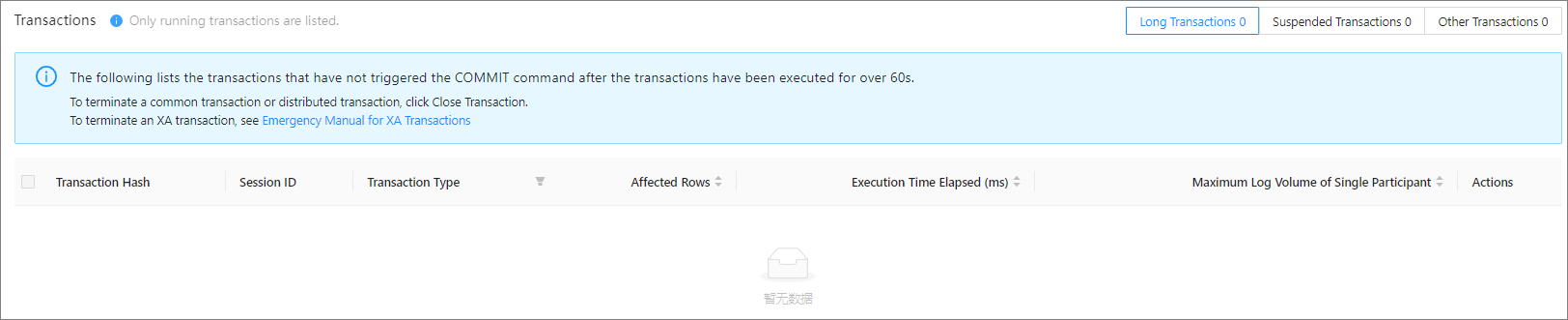
      Image 104

    • View details of a transaction.

      Click the hash of a specific transaction. The Transaction Details page appears. You can view the basic information, execution information, and details of executed SQL statements of the transaction on the page.

      • Click Close Transaction in the upper-right corner to close the session of the transaction. Only ordinary transactions and distributed transactions in the Long-running Transactions list can be closed.

      • Click the SQL text in the SQL Statement with Longest Execution Time , SQL Statement with Most Affected Rows , or Details About Executed SQL Statements field to view the details of the SQL statement.

    • Close transactions.

      On the Transactions page, select the transaction to be closed and click Close Transaction in the corresponding Actions column; or select multiple transactions and click Batch Close Transactions . In the dialog box that appears, click OK to close the session of the selected transaction or transactions. After the session of a transaction is closed, the transaction is rolled back and the session connection is also terminated.

      Notice

      Only ordinary transactions and distributed transactions in the Long Transactions list can be closed.

    Previous topic

    Overview of transaction
    Last

    Next topic

    Diagnose XA transactions and suspended transactions
    Next
    What is on this page
    Prerequisites
    Procedure