







When the data in the base tables is updated, the data in the materialized view may become inconsistent with that in the base tables. To maintain the data in the materialized view, OceanBase Database refreshes the materialized view.
OceanBase Database supports full refresh and incremental refresh for materialized views, and supports manual and automatic refresh scheduling.
Note
Refreshing a materialized view will automatically update all its indexes.
Full refresh
OceanBase Database performs a full refresh by using remote refresh. Specifically, it creates a hidden table, executes a refresh statement on the hidden table, and then switches the original table with the hidden table. Therefore, a full refresh requires additional space and will fully rebuild indexes (if any).
Considerations
- A full refresh can be a very time-consuming process, especially when a large amount of data needs to be read and processed. Therefore, you should always consider the time required for a full refresh before performing it.
- A full refresh is allowed only if the column types of the base table match those of the materialized view. Otherwise, a full refresh cannot be performed.
- If a materialized view is fully refreshed, all dependent materialized views (nested materialized views) must be fully refreshed before they can be incrementally refreshed. Otherwise, an error will be returned.
Incremental refresh
Currently, incremental refresh is supported for materialized views that use the following types of SQL statements: non-aggregated single-table statements, aggregated single-table statements, multi-table join statements, aggregated multi-table join statements, and UNION ALL statements. For other types of SQL statements, incremental refresh is not supported. For more information about the requirements for incremental refresh, see the following sections.
Notice
- The
REFRESH FASTmethod uses the records in the materialized view log to determine the content that needs to be incrementally refreshed. Therefore, when you incrementally refresh a materialized view, you must create a materialized view log (mlog) for the base table before you create the materialized view. - The columns used in the incremental refresh of the materialized view must exist in the mlog.
Non-aggregated incremental refresh for a single table
Note
For OceanBase Database V4.3.5, the incremental refresh of materialized views is supported for non-aggregated scenarios starting from V4.3.5 BP3.
Example of non-aggregated incremental refresh for a single table
Create a table named
tbl1.CREATE TABLE tbl1 (col1 NUMBER PRIMARY KEY, col2 NUMBER, col3 NUMBER, col4 NUMBER);Create a materialized view log on the
tbl1table.CREATE MATERIALIZED VIEW LOG ON tbl1 WITH SEQUENCE (col2, col3, col4) INCLUDING NEW VALUES;Create an incremental refresh materialized view
mv_tbl1based on thetbl1table.CREATE MATERIALIZED VIEW mv_tbl1 REFRESH FAST ON DEMAND AS SELECT col1, col2 FROM tbl1;
Single-table incremental refresh for aggregate views
The following conditions must be met for a single-table incremental refresh for aggregate views:
The
FROMtable must be a base table, not an inline view or a standard view.Note
Since nested materialized views do not support real-time materialized views, when the
FROMtable is a materialized view, real-time materialized views cannot be used.Only one table exists in the
FROMclause.An mlog exists on the
FROMtable, and all columns used in the view exist in the mlog.The view definition does not contain subqueries.
Window functions are not supported.
The view definition does not contain the
ROLLUP,HAVING,DISTINCT,ORDER BY,LIMIT, orFETCHclause.If the query contains the
DISTINCTkeyword, the output columns of the materialized view that can be incrementally updated must be unique. In this case, you can directly disable theDISTINCTkeyword or remove it from the query.Statements without the
GROUP BYclause must be scalar aggregations (Scalar Aggregate).For materialized views with the
GROUP BYclause, the supported aggregate functions areSUMandCOUNT, and only simple columns can be used in the aggregate functions. The requirements forGROUP BYare as follows:Aggregate functionThe SELECT clause must contain the dependent column.COUNT( expr ) N/A SUM ( expr ) COUNT( expr ) or expr is not null AVG ( expr ) SUM ( expr ),COUNT( expr ) STDDEV ( expr ) SUM ( expr ),COUNT( expr ),SUM ( expr * expr ) VARIANCE ( expr ) SUM ( expr ),COUNT( expr ),SUM ( expr * expr ) Other aggregate functions that can be split into SUM and COUNT... (The calculation method changes, which may affect the precision.) SUM (col1),COUNT(col1) MAX(expr)/MIN(expr) Note
For V4.3.5, support for
MAXandMINaggregate incremental refresh is available starting from V4.3.5 BP4.COUNT(expr) - The
GROUP BYclause must use standardGROUP BYsyntax and cannot containROLLUPorHAVINGclauses. - The
SELECTclause must contain all theGROUP BYcolumns. - The
DISTINCTkeyword cannot be used in aggregate functions. - The
SELECTclause must contain the dependent columns and theCOUNT(*)column corresponding to the aggregate functions, in addition to the columns of the aggregate functions. For example, if you use theSUM(expr)aggregate function, theSELECTclause must also contain theCOUNT(*)andCOUNT(expr)columns.
- The
Conditions for incremental refresh of MAX/MIN aggregate views:
In addition to the above conditions, the following conditions must be met when you use the MAX and MIN aggregate functions:
- The
GROUP BYcolumns and theMAXandMINparameters are base table columns. - An index exists that starts with the
GROUP BYcolumns.
Example of incremental refresh of a single table
Create a table named
test_tbl1.CREATE TABLE test_tbl1 (col1 NUMBER PRIMARY KEY, col2 NUMBER, col3 NUMBER, col4 NUMBER);Create a materialized view log on the
test_tbl1table.CREATE MATERIALIZED VIEW LOG ON test_tbl1 WITH SEQUENCE (col2, col3, col4) INCLUDING NEW VALUES;Create a materialized view that is refreshed incrementally.
Create a materialized view named
mv1_test_tbl1. Specify that the materialized view is refreshed incrementally and that you can manually trigger a refresh. The query part of the materialized view selects thecol2column from thetest_tbl1table and calculates the aggregated results ofcount(*),count(col3), andsum(col3), grouped by the values of thecol2column.CREATE MATERIALIZED VIEW mv1_test_tbl1 REFRESH FAST ON DEMAND AS SELECT col2, count(*) cnt, count(col3) cnt_col3, sum(col3) sum_col3 FROM test_tbl1 GROUP BY col2;Create a materialized view named
mv2_test_tbl1. Specify that the materialized view is refreshed incrementally and that you can manually trigger a refresh. The query part of the materialized view calculates the aggregated results ofcount(*),count(col3), andsum(col3)from thetest_tbl1table.CREATE MATERIALIZED VIEW mv2_test_tbl1 REFRESH FAST ON DEMAND AS SELECT count(*) cnt, count(col3) cnt_col3, sum(col3) sum_col3 FROM test_tbl1;Create a materialized view named
mv3_test_tbl1. Specify that the materialized view is refreshed incrementally and that you can manually trigger a refresh. The query part of the materialized view calculates the results ofcount(col3)andsum(col3)from thetest_tbl1table.CREATE MATERIALIZED VIEW mv3_test_tbl1 REFRESH FAST ON DEMAND AS SELECT count(col3) cnt_col3, sum(col3) sum_col3 FROM test_tbl1;Create a materialized view named
mv4_test_tbl1. Specify that the materialized view is refreshed incrementally and that you can manually trigger a refresh. The query part of the materialized view selects thecol2andcol3columns from thetest_tbl1table and calculates the aggregated results ofcount(*),count(col3), andsum(col3), grouped by the values of thecol2andcol3columns.CREATE MATERIALIZED VIEW mv4_test_tbl1 REFRESH FAST ON DEMAND AS SELECT col2, col3, count(*) cnt, count(col3) cnt_col3, sum(col3) sum_col3 FROM test_tbl1 GROUP BY col2, col3;Create a materialized view named
mv5_test_tbl1. Specify that the materialized view is refreshed incrementally and that you can manually trigger a refresh. The query part of the materialized view selects thecol2column from thetest_tbl1table and calculates the aggregated results ofcount(*),count(col3),sum(col3), andavg(col3), and also calculates some custom columnscalcol1andcalcol2, grouped by the values of thecol2column.CREATE MATERIALIZED VIEW mv5_test_tbl1 REFRESH FAST ON DEMAND AS SELECT col2, count(*) cnt, count(col3) cnt_col3, sum(col3) sum_col3, avg(col3) avg_col3, avg(col3) * sum(col3)/col2 calcol1, col2+sum(col3) calcol2 FROM test_tbl1 GROUP BY col2;Create a materialized view named
mv6_test_tbl1. Specify that the materialized view is refreshed incrementally and that you can manually trigger a refresh. The query part of the materialized view selects thecol2column from thetest_tbl1table and calculates the aggregated results ofcount(*),count(col3),sum(col3),count(col3*col3),sum(col3*col3), andSTDDEV(col3), grouped by the values of thecol2column.CREATE MATERIALIZED VIEW mv6_test_tbl1 REFRESH FAST ON DEMAND AS SELECT col2, count(*) cnt, count(col3) cnt_col3, sum(col3) sum_col3, count(col3*col3) cnt_col3_2, sum(col3*col3) sum_col3_2, STDDEV(col3) stddev_col3 FROM test_tbl1 GROUP BY col2;Create a materialized view by using the
MAXandMINaggregate functions.Create an index named
idx_test_tbl1on thetest_tbl1table based on thecol1andcol2columns.CREATE INDEX idx_test_tbl1 ON test_tbl1(col1, col2);Create a materialized view named
mv7_test_tbl1. Specify that the materialized view is refreshed incrementally and that you can manually trigger a refresh. The query part of the materialized view selects thecol1andcol2columns from thetest_tbl1table and calculates the aggregated results ofcount(*), the sum of the minimum value ofcol3and the maximum value ofcol4in each group, and groups the data by the combination ofcol1andcol2.CREATE MATERIALIZED VIEW mv7_test_tbl1 REFRESH FAST ON DEMAND
AS SELECT col1, col2, count(*) cnt, MIN(col3) + MAX(col4) AS min_max_val FROM test_tbl1 GROUP BY col1, col2; ```
Incremental refresh of materialized views with multiple tables joined
The following requirements must be met for incremental refresh of materialized views with multiple tables joined:
The
FROMtable cannot be an inline view.The
FROMtable must contain at least two tables.Note
In OceanBase Database V4.3.5 BP3 and later versions, the incremental refresh feature for materialized views now supports multi-table outer joins (
LEFT JOIN/RIGHT JOIN).Restrictions on using outer joins: The join tree must be a left-deep join tree where
INNER JOINcomes first andLEFT JOINcomes after.Note that if the
SELECTclause of an incrementally refreshed materialized view contains aLEFT JOINoperator, specifying a primary key (PRIMARY KEY) or a unique index (UNIQUE INDEX) during creation is prohibited to avoid refresh exceptions caused by constraint conflicts.Materialized log (mlog) must be created for each table in the
FROMclause, and all columns used in the view must exist in the mlogs.The view definition must not contain subqueries.
The view definition must not contain the following clauses:
ROLLUP,HAVING,WINDOW FUNCTION,DISTINCT,ORDER BY,LIMIT, andFETCH.The view definition must not contain expressions that generate unstable output values, such as
ROWNUM,RAND, andSYSDATE.
Notice
For OceanBase Database V4.3.5:
- Before V4.3.5 BP5, the
FROMtable must have a primary key, and the primary key must be specified in theSELECTclause. - Starting from V4.3.5 BP5, the requirement for a primary key in the base tables for incremental refresh of materialized views with multiple tables joined is removed.
Example of incremental refresh of materialized views with multiple tables joined
Create base tables
t1andt2.CREATE TABLE t1(c1 INT PRIMARY KEY, c2 INT, c3 INT);CREATE TABLE t2(c1 INT PRIMARY KEY, c4 INT, c5 INT);Create materialized view logs on tables
t1andt2.CREATE MATERIALIZED VIEW LOG ON t1 WITH PRIMARY KEY, ROWID, SEQUENCE (c2) INCLUDING NEW VALUES;CREATE MATERIALIZED VIEW LOG ON t2 WITH PRIMARY KEY, ROWID, SEQUENCE (c4) INCLUDING NEW VALUES;Create a materialized view
mv1_t1_t2for the join of tablest1andt2with incremental refresh.CREATE MATERIALIZED VIEW mv1_t1_t2 REFRESH FAST AS SELECT t1.c1 t1c1, t1.c2, t2.c1 t2c1, t2.c4 FROM t1 JOIN t2 ON t1.c1=t2.c1;
Note
- For better performance of simple join materialized views in incremental refresh and real-time materialized views, we recommend that you create indexes for the materialized view and its dependent base tables as follows:
- Create indexes on the join keys of each table to improve the join performance in incremental updates and real-time materialized views.
- Create indexes on the primary key columns of the base tables in the materialized view.
- As the number of
JOINtables in the materialized view increases, the incremental refresh performance of the materialized view and the query performance of the real-time materialized view usually decrease.
Here is an example of creating indexes for the materialized view and its dependent base tables:
(Optional) Run the following statements to drop the test data.
You can skip this step if the following database objects do not exist.
DROP MATERIALIZED VIEW LOG ON t1; DROP TABLE t1; DROP MATERIALIZED VIEW LOG ON t2; DROP TABLE t2; DROP MATERIALIZED VIEW rt_mv1;Run the following statements to create tables
t1and indexidx_t1_c2.CREATE TABLE t1(c1 INT GENERATED BY DEFAULT AS IDENTITY, c2 INT, c3 INT, c4 INT, c5 INT, PRIMARY KEY(c1)); CREATE INDEX idx_t1_c2 ON t1(c2);Run the following statements to create tables
t2and indexidx_t2_c3.CREATE TABLE t2(c1 INT GENERATED BY DEFAULT AS IDENTITY, c2 INT, c3 INT, c4 INT, c5 INT, PRIMARY KEY(c1)); CREATE INDEX idx_t2_c3 ON t2(c3);Run the following statements to create materialized view logs on
t1andt2.CREATE MATERIALIZED VIEW LOG ON t1 WITH PRIMARY KEY, ROWID, SEQUENCE (c2, c3, c4) INCLUDING NEW VALUES; CREATE MATERIALIZED VIEW LOG ON t2 WITH PRIMARY KEY, ROWID, SEQUENCE (c2, c3, c4) INCLUDING NEW VALUES;Run the following statements to create a real-time materialized view
rt_mv1.CREATE MATERIALIZED VIEW rt_mv1 NEVER REFRESH ENABLE ON QUERY COMPUTATION DISABLE QUERY REWRITE AS SELECT t1.c1 AS t1_c1, t2.c1 AS t2_c1, t1.c2 AS t1_c2, t2.c2 AS t2_c2, t1.c3 AS t1_c3, t2.c3 AS t2_c3 FROM t1, t2 WHERE t1.c2 = t2.c3;Run the following statements to create indexes on the primary key columns of the base tables in the materialized view.
CREATE INDEX idx_mv_t1_c1 ON rt_mv1(t1_c1); CREATE INDEX idx_mv_t2_c1 ON rt_mv1(t2_c1);
Incremental refresh of aggregate materialized views across multiple tables
The basic requirements for incremental refresh of aggregate materialized views across multiple tables are as follows:
The basic requirements for incremental refresh of aggregate materialized views across multiple tables are the union of those for incremental refresh of aggregate materialized views on a single table and incremental refresh of materialized views with joins.
Incremental refresh is supported for aggregate materialized views with outer joins. The limitations on outer joins apply to non-aggregate outer-joined materialized views, and the limitations on the aggregate part apply to inner-joined aggregate materialized views. However, aggregate materialized views with outer joins do not support the
MINandMAXaggregate functions, nor do they support real-time materialized views.Note
For V4.3.5, incremental refresh of aggregate materialized views with outer joins is supported starting from V4.3.5 BP5.
Example of incremental refresh of aggregate materialized views across multiple tables
Create base tables
t3andt4.CREATE TABLE t3(c1 INT, c2 INT, c3 INT, c4 INT, PRIMARY KEY(c1));CREATE TABLE t4(c1 INT, c2 INT, c3 INT, c4 INT, PRIMARY KEY(c1));Create materialized view logs on tables
t3andt4.CREATE MATERIALIZED VIEW LOG ON t3 WITH PRIMARY KEY, ROWID, SEQUENCE(c2, c3, c4) INCLUDING NEW VALUES;CREATE MATERIALIZED VIEW LOG ON t4 WITH PRIMARY KEY, ROWID, SEQUENCE(c2, c3, c4) INCLUDING NEW VALUES;Create a real-time materialized view
mv1_t3_t4for the incremental refresh of the join and aggregate operations on tablest3andt4.CREATE MATERIALIZED VIEW mv1_t3_t4 REFRESH FAST ENABLE ON QUERY COMPUTATION AS SELECT t3.c1, COUNT(*) cnt, COUNT(t4.c4) cnt_c4, SUM(t4.c4) sum_c4, AVG(t4.c4) avg_c4 FROM t3, t4 WHERE t3.c2 = t4.c3 GROUP BY t3.c1;
Incremental refresh of materialized views with set queries
Note
For OceanBase Database V4.3.5, the incremental refresh of materialized views with set queries is supported starting from V4.3.5 BP3.
A materialized view with set queries supports the use of UNION ALL in the materialized view and allows for incremental refreshes. During an incremental refresh, the materialized view can include all types of materialized views that support incremental refreshes, except for excepted join materialized views.
The following are the basic requirements for incremental refreshes of materialized views with set queries:
Materialized views with set queries do not support real-time materialized views.
The top-level query must be
UNION ALL, and the view definition must not contain subqueries or clauses such asORDER BY,LIMIT, orFETCH.The output column types at the same projection position in each branch of
UNION ALLmust be the same. You cannot forcibly convert the column types of the subbranches to a consistent type by usingCAST.For example, in a materialized view that joins multiple tables, the primary keys of each table must appear in the
SELECTclause. TheseSELECToutput columns cannot be converted to additionalCASTcolumns due toUNION ALL.If the same type or value of constants exist at the same projection position in each branch of
UNION ALL, the constants are used as identifier columns to distinguish the branches.
Example of incremental refresh of materialized views with set queries
Create the base tables
ua_tbl1andua_tbl2.CREATE TABLE ua_tbl1 (col1 INT PRIMARY KEY, col2 INT, col3 INT, col4 INT);CREATE TABLE ua_tbl2 (col1 INT PRIMARY KEY, col2 INT, col3 INT, col4 INT);Create materialized view logs on the tables
ua_tbl1andua_tbl2.CREATE MATERIALIZED VIEW LOG ON ua_tbl1 WITH PRIMARY KEY, ROWID, SEQUENCE (col2, col3, col4) INCLUDING NEW VALUES;CREATE MATERIALIZED VIEW LOG ON ua_tbl2 WITH PRIMARY KEY, ROWID, SEQUENCE (col2, col3, col4) INCLUDING NEW VALUES;Create the materialized view
mv_ua_tbl1_tbl2that supports incremental refreshes of set queries. The materialized view contains aUNION ALLclause.CREATE MATERIALIZED VIEW mv_ua_tbl1_tbl2 REFRESH FAST ON DEMAND AS SELECT a.col1 as a_c1, b.col1 as b_c1, 1 marker, a.col2 val FROM ua_tbl1 a INNER JOIN ua_tbl2 b ON a.col2 = b.col3 UNION ALL SELECT col1 a_c1, col2 b_c1, 2 marker, count(*) val FROM ua_tbl1 GROUP BY col1, col2;
Parallelism control mechanism for materialized view refresh
OceanBase Database provides a parallelism control mechanism for materialized view refresh. If you explicitly specify the parallelism for a refresh operation, the specified value is used. If you do not explicitly specify the parallelism, you can configure the system variable mview_refresh_dop to use the value of this variable in the current session for the refresh operation.
Note
The variable mview_refresh_dop was introduced in OceanBase Database V4.3.5 BP1.
Set mview_refresh_dop
mview_refresh_dop is a system variable in OceanBase Database that controls the default parallelism for materialized view refresh operations. By appropriately setting its value, you can significantly improve refresh efficiency and optimize database performance.
When mview_refresh_dop is set to 0 or 1, parallel refresh is not used. For more information about the mview_refresh_dop system variable, see mview_refresh_dop.
Here are some examples:
Set the parallelism for the current session to 5.
SET mview_refresh_dop = 5;Set the parallelism for all sessions to 5.
SET GLOBAL mview_refresh_dop = 5;Notice
Setting a global-level variable does not take effect in the current session. You must log in again to create a new session for the setting to take effect.
View the parallelism information of a materialized view
Use the DBA_MVIEWS view to query the parallelism of the background refresh of a materialized view. The following example shows how to query the parallelism of the background refresh of a materialized view.
Note
The
DBA_MVIEWSview can only view the parallelism specified for the materialized view.- If the value of the
REFRESH_DOPfield is not 0, the background refresh task of the materialized view uses the parallelism specified byREFRESH_DOP. - If the value of
REFRESH_DOPis 0, the globalmview_refresh_dopparameter is used.
Here is an example:
Create a materialized view named
mv0_t1.CREATE MATERIALIZED VIEW mv0_t1 REFRESH COMPLETE ON DEMAND START WITH current_date NEXT current_date + INTERVAL '10' SECOND AS SELECT c1, c2 FROM t1;Query the parallelism of the background refresh of the materialized view
mv0_t1.SELECT OWNER, MVIEW_NAME,REFRESH_DOP FROM SYS.DBA_MVIEWS WHERE OWNER = 'SYS' AND MVIEW_NAME = 'MV0_T1';The return result is as follows:
+-------+------------+-------------+ | OWNER | MVIEW_NAME | REFRESH_DOP | +-------+------------+-------------+ | SYS | MV0_T1 | 0 | +-------+------------+-------------+ 1 row in setSet the parallelism of the materialized view
mv0_t1to 8.ALTER MATERIALIZED VIEW mv0_t1 PARALLEL 8;Query the parallelism of the background refresh of the materialized view
mv0_t1.SELECT OWNER, MVIEW_NAME,REFRESH_DOP FROM SYS.DBA_MVIEWS WHERE OWNER = 'SYS' AND MVIEW_NAME = 'MV0_T1';The return result is as follows:
+-------+------------+-------------+ | OWNER | MVIEW_NAME | REFRESH_DOP | +-------+------------+-------------+ | SYS | MV0_T1 | 8 | +-------+------------+-------------+ 1 row in set
- If the value of the
Use the DBA_MVREF_RUN_STATS view to query the historical parallelism of a materialized view. The following example shows how to query the historical parallelism of a materialized view.
Here is an example:
SELECT REFRESH_ID, MVIEWS, PARALLELISM FROM SYS.DBA_MVREF_RUN_STATS WHERE MVIEWS = 'SYS.MV0_T1' ORDER BY REFRESH_ID;The return result is as follows:
+------------+------------+-------------+ | REFRESH_ID | MVIEWS | PARALLELISM | +------------+------------+-------------+ | 6752103 | SYS.MV0_T1 | 5 | | 6752733 | SYS.MV0_T1 | 5 | | 6753371 | SYS.MV0_T1 | 5 | | 6753985 | SYS.MV0_T1 | 8 | | 6754618 | SYS.MV0_T1 | 8 | | 6755249 | SYS.MV0_T1 | 8 | +------------+------------+-------------+ 6 rows in set
Manually refresh a materialized view
If the refresh mode of a materialized view is ON DEMAND, you can manually refresh the materialized view by using the DBMS_MVIEW package. For a materialized view defined for incremental refresh, you can specify a full refresh during manual refresh.
Note
Only the owner or tenant administrator of a materialized view can refresh it.
Refresh a materialized view by using the REFRESH function
DBMS_MVIEW.REFRESH (
list IN VARCHAR2, -- The name of the materialized view. Multiple materialized views are not supported.
method IN VARCHAR2 := NULL, -- The refresh option. Valid values: f, ?, C, c, and A. The default value is NULL. The meaning of each value is as follows:
-- f: fast refresh
-- ?: force refresh
-- C|c: complete refresh
-- A|a: always refresh, which is equivalent to C
----------- The following parameters are not supported and are provided only for Oracle compatibility. ----------------
rollback_seg IN VARCHAR2 := NULL,
push_deferred_rpc IN BOOLEAN := true,
refresh_after_errors IN BOOLEAN := false,
purge_option IN BINARY_INTEGER := 1,
parallelism IN BINARY_INTEGER := 0,
heap_size IN BINARY_INTEGER := 0,
atomic_refresh IN BOOLEAN := true,
nested IN BOOLEAN := false,
out_of_place IN BOOLEAN := false,
skip_ext_data IN BOOLEAN := false,
---------------------------------------------------------
refresh_parallel IN BINARY_INTEGER := 0); -- The refresh parallelism of the materialized view. This parameter is unique to OceanBase Database.
Here is an example:
Insert three rows of data into the
test_tbl1table.INSERT INTO test_tbl1 VALUES (1, 1, 1, 1),(2, 2, 2, 2),(3, 3, 3, 3);Query the
mv1_test_tbl1materialized view.SELECT * FROM mv1_test_tbl1;The returned result is as follows:
Empty setManually refresh the
mv1_test_tbl1materialized view.Refresh the materialized view by using the refresh option specified for the materialized view:
CALL DBMS_MVIEW.REFRESH('mv1_test_tbl1');Refresh the materialized view by specifying the refresh option:
CALL DBMS_MVIEW.REFRESH('mv1_test_tbl1', 'c');
Query the
mv1_test_tbl1materialized view again.SELECT * FROM mv1_test_tbl1;The returned result is as follows:
+------+------+----------+----------+ | COL2 | CNT | CNT_COL3 | SUM_COL3 | +------+------+----------+----------+ | 3 | 1 | 1 | 3 | | 2 | 1 | 1 | 2 | | 1 | 1 | 1 | 1 | +------+------+----------+----------+ 3 rows in set
Set the refresh parallelism of a materialized view
For a materialized view that is manually refreshed, you can set the default refresh parallelism by using the mview_refresh_dop system variable.
You can also explicitly set the refresh parallelism for the current refresh by specifying the refresh_parallel parameter when you call the DBMS_MVIEW.REFRESH function.
Notice
If you do not explicitly specify the refresh parallelism and the value of the mview_refresh_dop variable is 0 or 1, no parallel refresh is performed.
Here is an example:
Set the parallelism of the current session to 5.
SET mview_refresh_dop = 5;Manually refresh the materialized view:
Explicitly set the refresh parallelism to 8. The refresh parallelism for this refresh is 8.
CALL DBMS_MVIEW.REFRESH('mv1', 'c', 8);Do not explicitly specify the refresh parallelism. The refresh parallelism is 5, which is the value of the session variable.
CALL DBMS_MVIEW.REFRESH('mv1', 'c');
Automatic refresh of materialized views
When you create a materialized view and specify the START WITH datetime_expr and NEXT datetime_expr clauses, the system automatically creates a background refresh task for the materialized view when the conditions are met.
Parallelism of automatic refresh of materialized views
You can specify the parallelism of the automatic refresh of materialized views in the following two ways:
Note
The following parallelism settings have a priority order from high to low.
Specify the parallelism (Table DOP) when you create a materialized view.
Here is an example:
CREATE MATERIALIZED VIEW mv_t1 PARALLEL 8 REFRESH COMPLETE ON DEMAND START WITH current_date NEXT current_date + INTERVAL '10' SECOND AS SELECT c1, c2 FROM t1;Set the global session variable
mview_refresh_dopas the refresh parallelism.The automatic refresh operation is performed by an internal session. To take effect on the background session, you must set the global-level mview_refresh_dop variable.
Notice
If you do not explicitly specify the parallelism when you create a materialized view and the value of the
mview_refresh_dopvariable is 0 or 1, the background refresh task does not enable parallel refresh.Here is an example:
Set the global session parallelism to 5.
SET GLOBAL mview_refresh_dop = 5;Create a materialized view:
If you specify the parallelism as 8 when you create a materialized view, the background refresh task uses 8 as the refresh parallelism.
CREATE MATERIALIZED VIEW mv1_t1 PARALLEL 8 REFRESH COMPLETE ON DEMAND START WITH current_date NEXT current_date + INTERVAL '10' SECOND AS SELECT c1, c2 FROM t1;If you do not specify the parallelism when you create a materialized view, the background refresh task uses the value of the
mview_refresh_dopvariable, which is 5, as the refresh parallelism.CREATE MATERIALIZED VIEW mv2_t1 REFRESH COMPLETE ON DEMAND START WITH current_date NEXT current_date + INTERVAL '10' SECOND AS SELECT c1, c2 FROM t1;
Refresh a nested materialized view
Note
For OceanBase Database V4.3.5, you can create a nested materialized view based on a materialized view without a primary key, starting from V4.3.5 BP5.
Refresh rules for nested materialized views
The refresh methods supported for nested materialized views are the same as those for non-nested materialized views, including full refresh and incremental refresh. Although refreshing a nested materialized view only requires the user tables and materialized views (along with their mlogs) it directly depends on, the data consistency of the nested materialized view depends on the materialized views it is built upon. This means that to keep the data of a nested materialized view up to date through refreshes, you must first ensure that the data of the materialized views it depends on is up to date, and refresh those materialized views first.
For example, in the following diagram, materialized view mv1 is built upon tables tbl1 and tbl2, materialized view mv2 is built upon materialized view mv1 and table tbl3, and materialized view mv3 is built upon materialized views mv1 and mv2. If you refresh materialized views mv1, mv2, and mv3 in this order, you can ensure the overall data consistency of the nested materialized views. Otherwise, if you refresh materialized view mv2 first and then refresh materialized view mv1, the data of materialized view mv2 will not be the latest (it will lag behind that of materialized view mv1). Similarly, if you refresh materialized view mv3 first and then refresh materialized view mv2, the data of materialized view mv3 will not be the latest (it will lag behind that of materialized view mv2).
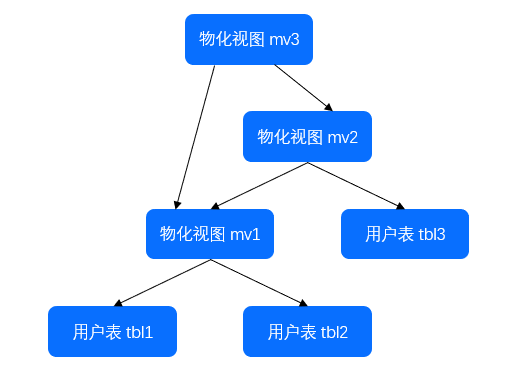
For OceanBase Database V4.3.5, cascading refresh is supported for nested materialized views starting from V4.3.5 BP3. Cascading refresh is divided into cascading inconsistent refresh and cascading consistent refresh.
Cascading inconsistent refresh: This method refreshes all materialized views that the nested materialized view depends on, starting from the bottom up. Each materialized view's refresh does not guarantee data consistency, and the data points read from the base tables are inconsistent. Cascading inconsistent refresh is suitable for batch synchronization scenarios, such as when business parties synchronize data from upstream at regular intervals. After data synchronization is completed, cascading inconsistent refresh can be used to maintain the eventual consistency of materialized views.
Cascading consistent refresh: This method ensures that, after the entire cascading refresh is completed, the data points read from all base tables that the upper-level materialized views depend on are consistent. Cascading consistent refresh is suitable for real-time data synchronization scenarios. We ensure that, after each cascading refresh, the data snapshots in the materialized views are at the same data point.
Nested materialized view refresh example
If a materialized view is fully refreshed, any dependent materialized views must be fully refreshed before they can be incrementally refreshed. Otherwise, an error will occur.
Example:
Create the
tbl1table and insert a row of data.CREATE TABLE tbl1(id INT, name VARCHAR2(30), PRIMARY KEY(id));INSERT INTO tbl1 VALUES (1, 'jack');Create the
tbl2table and insert a row of data.CREATE TABLE tbl2(id INT, age INT, PRIMARY KEY(id));INSERT INTO tbl2 VALUES (1, 21);Create materialized view logs on the
tbl1andtbl2tables.CREATE MATERIALIZED VIEW LOG ON tbl1 WITH PRIMARY KEY (name) INCLUDING NEW VALUES;CREATE MATERIALIZED VIEW LOG ON tbl2 WITH PRIMARY KEY (age) INCLUDING NEW VALUES;Create the
mv1materialized view based on thetbl1andtbl2tables.CREATE MATERIALIZED VIEW mv1 (PRIMARY KEY (id1, id2)) REFRESH FAST ON DEMAND AS SELECT tbl1.id id1, tbl2.id id2, tbl1.NAME, tbl2.AGE FROM tbl1, tbl2 WHERE tbl1.id = tbl2.id;Create a materialized view log on the
mv1materialized view.CREATE MATERIALIZED VIEW LOG ON mv1 WITH PRIMARY KEY (name, age) INCLUDING NEW VALUES;Create a materialized view (nested materialized view)
mv2based on themv1materialized view.CREATE MATERIALIZED VIEW mv2 REFRESH FAST AS SELECT COUNT(*) cnt, COUNT(AGE) age_cnt, SUM(AGE) age_sum FROM mv1;Query the data in the
mv1materialized view.SELECT * FROM mv1;The return result is as follows:
+------+------+------+------+ | ID1 | ID2 | NAME | AGE | +------+------+------+------+ | 1 | 1 | jack | 21 | +------+------+------+------+ 1 row in setQuery the data in the
mv2materialized view.SELECT * FROM mv2;The return result is as follows:
+------+---------+---------+ | CNT | AGE_CNT | AGE_SUM | +------+---------+---------+ | 1 | 1 | 21 | +------+---------+---------+ 1 row in setInsert a row of data into the
tbl1andtbl2tables.INSERT INTO tbl1 VALUES (2, 'rose');INSERT INTO tbl2 VALUES (2, 19);Incrementally refresh the
mv1materialized view.CALL dbms_mview.refresh('mv1', 'f');Query the data in the
mv1materialized view.SELECT * FROM mv1;The return result is as follows:
+------+------+------+------+ | ID1 | ID2 | NAME | AGE | +------+------+------+------+ | 1 | 1 | jack | 21 | | 2 | 2 | rose | 19 | +------+------+------+------+ 2 rows in setIncrementally refresh the
mv2materialized view.CALL dbms_mview.refresh('mv2', 'f');Query the data in the
mv2materialized view.SELECT * FROM mv2;The return result is as follows:
+------+---------+---------+ | CNT | AGE_CNT | AGE_SUM | +------+---------+---------+ | 2 | 2 | 40 | +------+---------+---------+ 1 row in setInsert a row of data into the
tbl1andtbl2tables.INSERT INTO tbl1 VALUES (3, 'mary');INSERT INTO tbl2 VALUES (3, 25);Fully refresh the
mv1materialized view.CALL dbms_mview.refresh('mv1', 'c');Query the data in the
mv1materialized view.SELECT * FROM mv1;The return result is as follows:
+------+------+------+------+ | ID1 | ID2 | NAME | AGE | +------+------+------+------+ | 1 | 1 | jack | 21 | | 2 | 2 | rose | 19 | | 3 | 3 | mary | 25 |
+------+------+------+------+ 3 rows in set ```
Incrementally refresh the materialized view
mv2again. Run the following command in the MySQL client:CALL dbms_mview.refresh('mv2', 'f');The return result is as follows:
OBE-12052: cannot fast refresh materialized view at package body oceanbase.DBMS_MVIEW.DO_REFRESH , line : 54, col : 1 at oceanbase.DBMS_MVIEW.REFRESH , line : 72, col : 1Notice
Since
mv1has been fully refreshed, an error will be returned when you incrementally refreshmv2. You must fully refreshmv2first.Query the data in the materialized view
mv2again. Run the following command in the MySQL client:SELECT * FROM mv2;The return result is as follows:
+------+---------+---------+ | CNT | AGE_CNT | AGE_SUM | +------+---------+---------+ | 2 | 2 | 40 | +------+---------+---------+ 1 row in setFully refresh the materialized view
mv2. Run the following command in the MySQL client:CALL dbms_mview.refresh('mv2', 'c');Query the data in the materialized view
mv2again. Run the following command in the MySQL client:SELECT * FROM mv2;The return result is as follows:
+------+---------+---------+ | CNT | AGE_CNT | AGE_SUM | +------+---------+---------+ | 3 | 3 | 65 | +------+---------+---------+ 1 row in set
Example of a real-time nested materialized view
If a materialized view (nested materialized view) is a real-time materialized view, you must incrementally refresh the lower-level materialized view to update the materialized log (mlog). The query results of a real-time materialized view are obtained by simulating the mlog and merging the query results of the lower-level materialized view and itself. Therefore, you must incrementally refresh the lower-level materialized view to update the mlog to ensure that the data of the real-time materialized view is up-to-date.
Note
For OceanBase Database V4.3.5, the automatic management of materialized view logs is supported starting from V4.3.5 BP4. If automatic management of mlogs is enabled, when you create a real-time materialized view, you do not need to create the mlog for the base table. OceanBase Database automatically creates the corresponding mlog or updates the existing mlog table definition to include the columns required by the newly created materialized view. For more information, see Automatic management of materialized view logs.
Here is an example:
Create a table named
tbl3.CREATE TABLE tbl3(col1 INT, col2 INT, col3 INT);Create a materialized view log on the
tbl3table.CREATE MATERIALIZED VIEW LOG ON tbl3 WITH PRIMARY KEY, ROWID, SEQUENCE (col1, col2, col3) INCLUDING NEW VALUES;Create a materialized view named
mv_tbl3_1based on thetbl3table.CREATE MATERIALIZED VIEW mv_tbl3_1 REFRESH COMPLETE ON DEMAND ENABLE ON QUERY COMPUTATION AS SELECT col1, col2, col3, COUNT(*) AS cnt FROM tbl3 GROUP BY col1, col2, col3;Create a materialized view log on the
mv_tbl3_1materialized view.CREATE MATERIALIZED VIEW LOG ON mv_tbl3_1 WITH PRIMARY KEY, ROWID, SEQUENCE (col1, col2, col3) INCLUDING NEW VALUES;Create a materialized view named
mv_tbl3_2based on themv_tbl3_1materialized view.CREATE MATERIALIZED VIEW mv_tbl3_2 REFRESH COMPLETE ON DEMAND ENABLE ON QUERY COMPUTATION AS SELECT col1, col2, col3, COUNT(*) AS cnt FROM mv_tbl3_1 GROUP BY col1, col2, col3;Create a materialized view log on the
mv_tbl3_2materialized view.CREATE MATERIALIZED VIEW LOG ON mv_tbl3_2 WITH PRIMARY KEY, ROWID, SEQUENCE (col1, col2, col3) INCLUDING NEW VALUES;Create a real-time materialized view named
mv_tbl3_3based on themv_tbl3_2materialized view.CREATE MATERIALIZED VIEW mv_tbl3_3 REFRESH COMPLETE ON DEMAND ENABLE ON QUERY COMPUTATION AS SELECT col1, col2, col3, COUNT(*) AS cnt FROM mv_tbl3_2 GROUP BY col1, col2, col3;Insert a row of data into the
tbl3table.INSERT INTO tbl3 VALUES(1, 1, 1);Query the
tbl3table.SELECT * FROM tbl3;The returned result is as follows:
+------+------+------+ | COL1 | COL2 | COL3 | +------+------+------+ | 1 | 1 | 1 | +------+------+------+ 1 row in setQuery the
mv_tbl3_1materialized view.SELECT * FROM mv_tbl3_1;The returned result is as follows:
+------+------+------+------+ | COL1 | COL2 | COL3 | CNT | +------+------+------+------+ | 1 | 1 | 1 | 1 | +------+------+------+------+ 1 row in setQuery the
mv_tbl3_2materialized view.SELECT * FROM mv_tbl3_2;The returned result is as follows:
Empty setQuery the
mv_tbl3_3materialized view.SELECT * FROM mv_tbl3_3;The returned result is as follows:
Empty setIncrementally refresh the
mv_tbl3_1materialized view.CALL dbms_mview.refresh('mv_tbl3_1','f');Query the
mv_tbl3_2materialized view again.SELECT * FROM mv_tbl3_2;The returned result is as follows:
+------+------+------+------+ | COL1 | COL2 | COL3 | CNT | +------+------+------+------+ | 1 | 1 | 1 | 1 | +------+------+------+------+ 1 row in setQuery the
mv_tbl3_3materialized view again.SELECT * FROM mv_tbl3_3;The returned result is as follows:
Empty set ```
Refresh the incremental refresh materialized view
mv_tbl3_2.CALL dbms_mview.refresh('mv_tbl3_2','f');Query the data in the materialized view
mv_tbl3_3again.SELECT * FROM mv_tbl3_3;The return result is as follows:
+------+------+------+------+ | COL1 | COL2 | COL3 | CNT | +------+------+------+------+ | 1 | 1 | 1 | 1 | +------+------+------+------+ 1 row in set
Materialized view refresh statistics
OceanBase Database can collect and save statistics about materialized view refresh operations. You can query the statistics by using specific views. The statistics of current and historical materialized view refresh operations are stored in the database. By analyzing the historical statistics of materialized view refresh operations, you can understand and analyze the performance of materialized view refresh operations in the database.
The statistics of materialized view refresh operations serve the following purposes:
Reporting: Provides an overview of current and historical statistics of materialized view refresh operations, including the actual time required for the refresh operations. This helps you track and monitor the performance of materialized view refresh operations.
Diagnosing: By analyzing the detailed current and historical statistics, you can effectively analyze the performance of materialized view refresh operations. For example, if a materialized view refresh operation takes a long time, the statistics can help you identify whether the performance degradation is caused by an increased system load or an increased amount of data changes.
Collect statistics of materialized views
You can collect statistics of materialized views by using the analyze table statement or the call dbms_stats.gather_table_stats('database_name', 'table_name') procedure.
For more information about how to collect statistics of tables and columns, see GATHER_TABLE_STATS.
For more information about how to manage the collection and retention of statistics of materialized view refresh operations, see DBMS_MVIEW_STATS overview.
View refresh information
View |
Description |
|---|---|
| ALL_MVIEWS | Displays information about materialized views. |
| DBA_MVREF_STATS_SYS_DEFAULTS | System-wide default values for the statistics attributes of materialized view refresh history. |
| DBA_MVREF_STATS_PARAMS | Displays the refresh statistics attributes associated with each materialized view. |
| DBA_MVREF_RUN_STATS | Displays information about each refresh run of a materialized view, identified by a REFRESH_ID. |
| DBA_MVREF_STATS | Displays the basic timing statistics of materialized view refreshes. |
| DBA_MVREF_CHANGE_STATS | Displays statistics related to materialized view refreshes. |
| DBA_MVREF_STMT_STATS | Displays information about refresh statements. |
| DBA_SCHEDULER_JOBS | Displays information about all scheduler jobs in the database. |