







This topic introduces how to build an application by using OceanBase Connector/J and OceanBase Database. It also covers the use of the application for fundamental database operations, including table creation, data insertion, data query, and other basic operations.
 Download the java-oceanbase-jdbc sample project
  Connect to OceanBase Database by using OceanBase Connector/J (Oracle mode)
Prerequisites
You have installed OceanBase Database.
You have installed JDK 1.8 and Maven.
You have installed Eclipse.
Note
The tool used to run the sample code in this topic is Eclipse IDE for Java Developers 2022-03. You can also choose a tool that suits your personal preference to run the sample code.
Procedure
Note
The steps outlined in this topic are for the Windows environment. If you are using a different operating system or compiler, the steps may vary slightly.
- Import the
java-oceanbase-jdbcproject into Eclipse. - Obtain the URL of OceanBase Database.
- Modify the database connection information in the
java-oceanbase-jdbcproject. - Run the
java-oceanbase-jdbcproject.
Step 1: Import the java-oceanbase-jdbc project into Eclipse
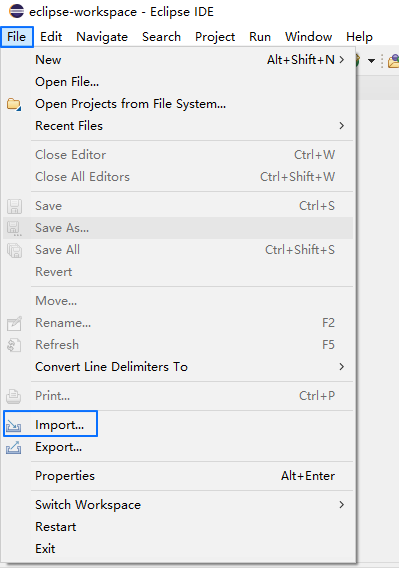
Start Eclipse and choose File > Import.
In the import window that appears, choose Maven > Existing Maven Projects and click Next.

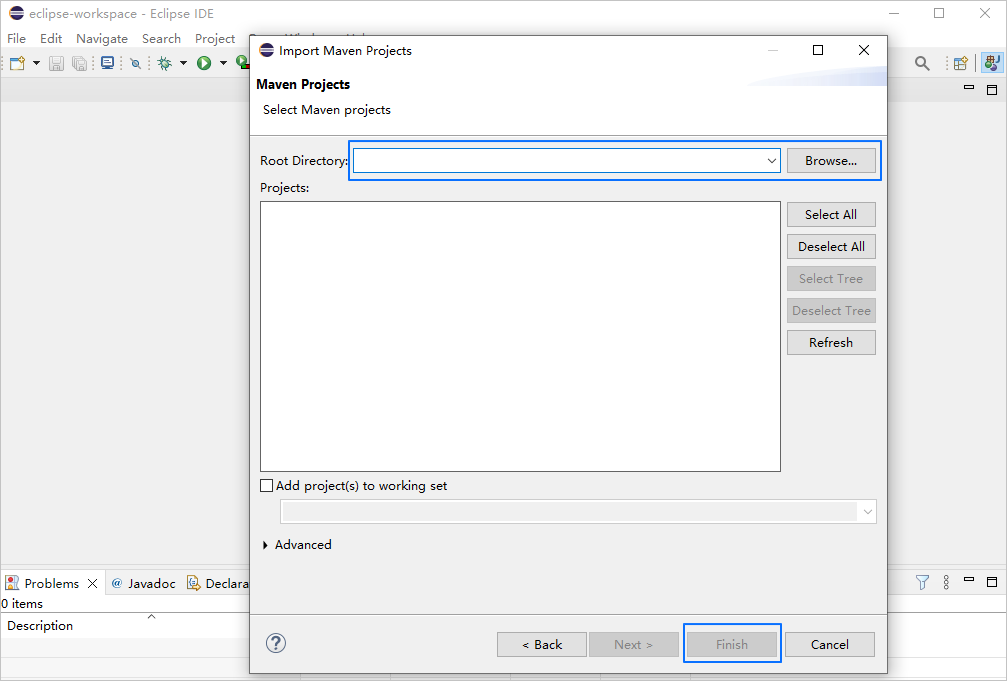
On the next page, click Browse, select the root directory of the Maven project, and then click Finish.
Eclipse automatically recognizes the
pom.xmlfile and displays all Maven projects in the Package Explorer. To view the Package Explorer view, choose Window > Show View > Package Explorer if it is not displayed on the left side of the window.Note
When you import a Maven project using Eclipse, it will automatically detect the
pom.xmlfile in the project, download the required dependency libraries based on the described dependencies in the file, and add them to the project.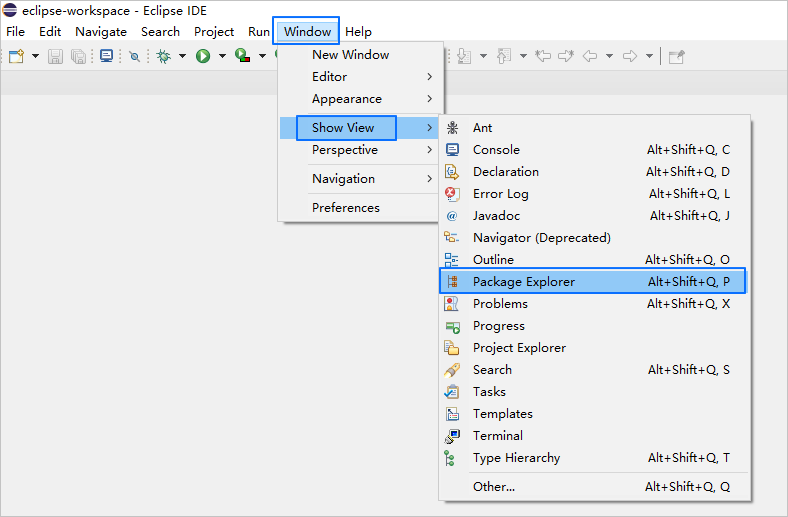
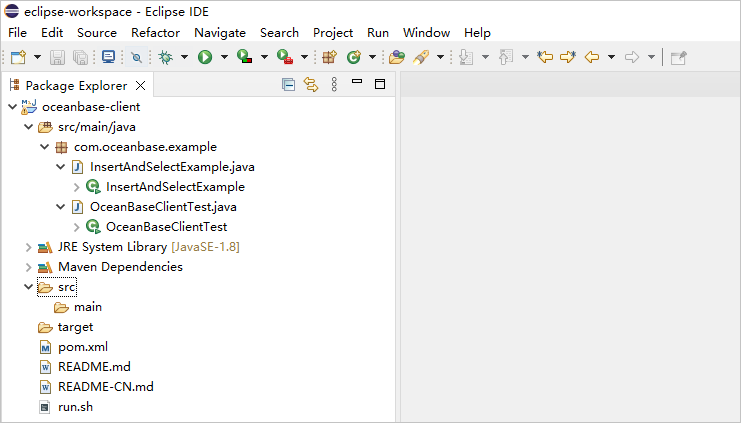
View the project.
Step 2: Obtain the URL of OceanBase Database
Contact the deployment personnel or administrator of OceanBase Database to obtain the corresponding database connection string.
Here is an example:
obclient -hxxx.xxx.xxx.xxx -P2883 -usys@oracel001#cluster_name -p******For more information about the connection string, see Connect to an OceanBase tenant by using OBClient.
Fill in the URL based on the OceanBase Database connection string.
Here is an example URL for connecting to OceanBase Database in Oracle mode:
jdbc:oceanbase://$host:$port/$schema_name?user=$user_name&password=$passwordParameter description:
$host: the IP address for connecting to OceanBase Database. For connection through ODP, use the IP address of an ODP. For direct connection, use the IP address of an OBServer node.$port: the port for connecting to OceanBase Database. For connection through ODP, the default value is2883, which can be customized when ODP is deployed. For direct connection, the default value is2881, which can be customized when OceanBase Database is deployed.$schema_name: the name of the schema to be accessed.$user_name: the tenant account. For connection through ODP, the format isusername@tenant name#cluster nameorcluster name:tenant name:username. For direct connection, the format isusername@tenant name.$password: the password of the account.
For more information about URL parameters, see Database URL.
Step 3: Modify the database connection information in the java-oceanbase-jdbc project
Modify the database connection information in the InsertAndSelectExample.java file based on the information obtained in Step 2: Obtain the URL of OceanBase Database.
Here is an example:
- The IP address of the OBServer node is
10.10.10.1. - The port is 2881.
- The name of the database to be accessed is
sys. - The tenant account is
sys@oracle001. Here,oracle001refers to a user tenant created in OceanBase Database with the Oracle mode, andsysis the username of theoracle001tenant. - The password is
******.
Sample code:
String url = "jdbc:oceanbase://10.10.10.1:2881/sys";
String user = "sys@oracle001";
String password = "******";
Step 4: Run the java-oceanbase-jdbc project
You can view the project structure in the Package Explorer.
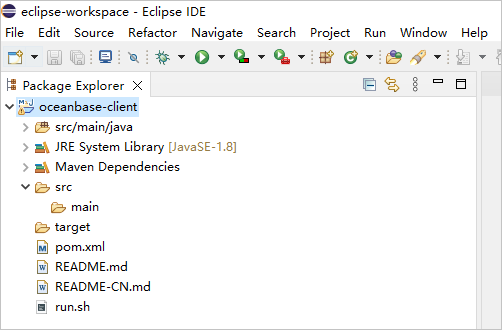
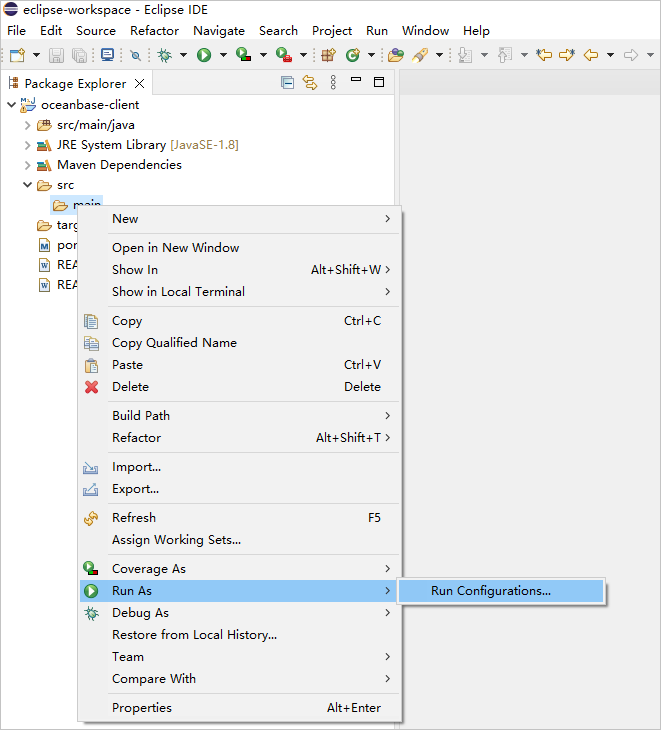
Find the Main class in the project, right-click it, choose Run As > Run Configurations... to open the Run Configurations page.
On the Run Configurations page, select Java Application > New_configuration. In the Main class field of the page that appears, select
com.oceanbase.example.InsertAndSelectExample.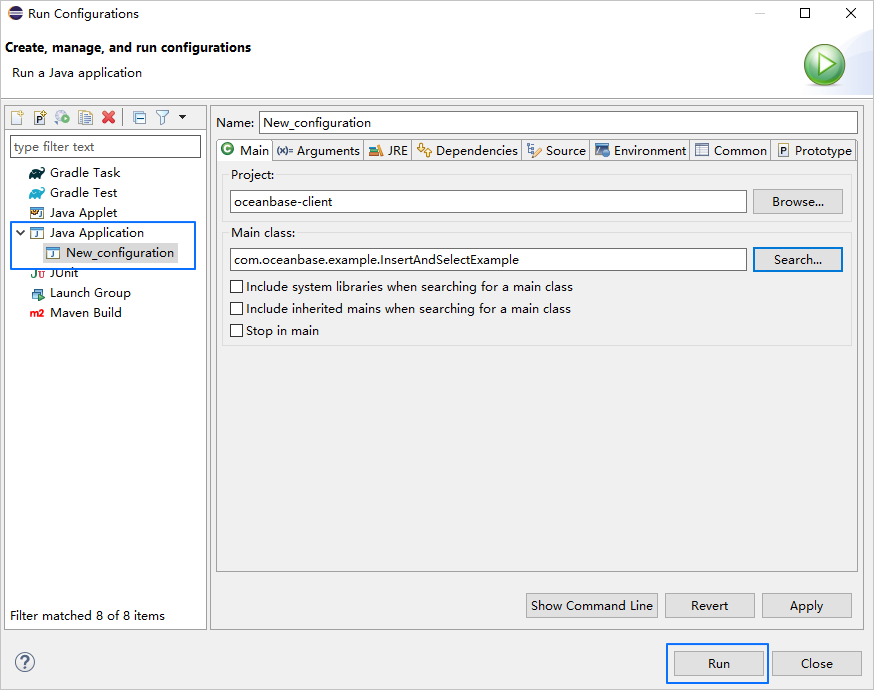
View the project logs and output results in the console of Eclipse.
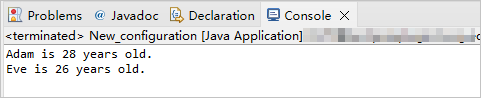
Project code introduction
Click java-oceanbase-jdbc to download the project code, which is a compressed package named java-oceanbase-jdbc.zip.
After decompressing it, you will find a folder named java-oceanbase-jdbc. The directory structure is as follows:
.
|-- README-CN.md
|-- README.md
|-- pom.xml
|-- run.sh
`-- src
`-- main
`-- java
`-- com
`-- oceanbase
`-- example
|-- InsertAndSelectExample.java
`-- OceanBaseClientTest.java
File description:
README-CN.md: the project documentation in Chinese.README.md: the project documentation in English.pom.xml: the configuration file of the Maven project, which defines the project dependencies, plugins, and build rules.run.sh: a shell script for automatically compiling and running Java applications.src: the main directory that contains the project's source code and resource files.main: a directory that contains the project's main Java source code.java: the root directory for storing the project's Java source code.com: the root directory for storing the project's Java package.oceanbase: a subpackage under thecompackage, indicating that the project is related to OceanBase Database.example: a subpackage under theoceanbasepackage, indicating that the project is an example program for demonstrating how to use the OceanBase JDBC driver to connect to and operate OceanBase Database.InsertAndSelectExample.java: a file that contains an example classInsertAndSelectExamplefor demonstrating how to insert and query data.OceanBaseClientTest.java: a file that contains an example classOceanBaseClientTestfor demonstrating how to connect to a database, execute SQL statements, and query data.
Introduction to pom.xml
The pom.xml file is the configuration file of the Maven project, which defines the dependencies, plugins, and build rules of the project. Maven is a Java project management tool that can automatically download dependencies, compile, and package the project.
The pom.xml file in this topic is divided into the following sections:
Declaration statement.
This section declares that the file is an XML file that uses XML standard
1.0and character encodingUTF-8.Sample code:
<?xml version="1.0" encoding="UTF-8"?>Configure namespaces and the POM model version.
- Use
xmlnsto set the POM namespace tohttp://maven.apache.org/POM/4.0.0. - Use
xmlns:xsito set the XML namespace tohttp://www.w3.org/2001/XMLSchema-instance. - Use
xsi:schemaLocationto set the POM namespace tohttp://maven.apache.org/POM/4.0.0, and the location of the POM XSD file tohttp://maven.apache.org/xsd/maven-4.0.0.xsd. - Use
<modelVersion>to set the POM model version used by the POM file to4.0.0.
Sample code:
<project xmlns="http://maven.apache.org/POM/4.0.0" xmlns:xsi="http://www.w3.org/2001/XMLSchema-instance" xsi:schemaLocation="http://maven.apache.org/POM/4.0.0 http://maven.apache.org/xsd/maven-4.0.0.xsd"> <modelVersion>4.0.0</modelVersion> <!-- Other configurations --> </project>- Use
Configure basic information.
- Use
<groupId>to specify the project identifier ascom.oceanbase.example. - Use
<artifactId>to specify the project dependency asoceanbase-client. - Use
<version>to specify the project version as1.0-SNAPSHOT. - Use
<name>to specify the project name asob-example-oceanbase-client.
Sample code:
<groupId>com.oceanbase.example</groupId> <artifactId>oceanbase-client</artifactId> <version>1.0-SNAPSHOT</version> <name>ob-example-oceanbase-client</name>- Use
Use
<properties>to define the properties of the project's source file.- Use
<project.build.sourceEncoding>to specify the encoding of the project's source file asUTF-8. - Use
<maven.compiler.source>to specify the Java source code version used by the Maven compiler as1.8. - Use
<maven.compiler.target>to specify the Java bytecode version generated by the Maven compiler as1.8. - Use
<exec.mainClass>to specify an example program in the project, namely,com.oceanbase.example.InsertAndSelectExample.
Sample code:
<properties> <project.build.sourceEncoding>UTF-8</project.build.sourceEncoding> <maven.compiler.source>1.8</maven.compiler.source> <maven.compiler.target>1.8</maven.compiler.target> <exec.mainClass>com.oceanbase.example.InsertAndSelectExample</exec.mainClass> </properties>- Use
Use
<dependencies>to define the components on which the project depends.Note
This section defines that the project depends on OceanBase Connector/J V2.4.2. For more information about other versions, see OceanBase Connector/J.
- Use
<dependency>to define a dependency. - Use
<groupId>to specify the dependency group ascom.oceanbase. - Use
<artifactId>to specify the dependency name asoceanbase-client. - Use
<version>to specify the dependency version as2.4.2.
Sample code:
<dependencies> <dependency> <groupId>com.oceanbase</groupId> <artifactId>oceanbase-client</artifactId> <version>2.4.2</version> </dependency> </dependencies>- Use
Introduction to InsertAndSelectExample.java
The InsertAndSelectExample.java file is part of the sample program and contains a sample class named InsertAndSelectExample for demonstrating how to insert and query data.
The InsertAndSelectExample.java file in this topic includes the following sections:
Define the package and import
java.sqlinterfaces.Declare the name of the package to which the current file belongs as
com.oceanbase.example.Introduce the following interfaces and classes in the
java.sqlpackage:Connectioninterface: represents a connection to a database.DriverManagerclass: provides a set of static methods for managing JDBC driver registration and database connection retrieval. The most commonly used method isgetConnection(), which is used to create a connection to the database.PreparedStatementinterface: represents a precompiled SQL statement.ResultSetinterface: represents a query result set.SQLExceptionexception class: represents various exceptions that may occur when using JDBC to connect to a database, such as connection failures or SQL command execution failures.Statementinterface: represents a statement in a database.
Sample code:
package com.oceanbase.example; import java.sql.Connection; import java.sql.DriverManager; import java.sql.PreparedStatement; import java.sql.ResultSet; import java.sql.SQLException; import java.sql.Statement;Define the class name and
mainmethod.Define the class name as
InsertAndSelectExample, which should be the same as the file name.Define the
mainmethod aspublic static void, indicating that it is a public static method that accepts a string arrayargsas a parameter. Usethrows ClassNotFoundException, SQLExceptionto indicate that the method may throwClassNotFoundExceptionandSQLExceptionexceptions, which need to be handled where the method is called.Sample code:
public class InsertAndSelectExample { public static void main(String[] args) throws ClassNotFoundException, SQLException { // to do: // 3.connect to your database // 4.create a table // 5.insert records // 6.fetch all records // 7.release all resources } }Connect to the database and obtain a database connection object.
Define the URL string and additional connection properties required for connecting to OceanBase Database:
jdbc:oceanbase: indicates the use of the OceanBase JDBC driver to connect to the database.host:port: indicates the IP address and port number of OceanBase Database.opt1=val1&opt2=val2...: additional connection properties, or URL parameters. For more information about URL additional connection properties, see Database URL.schema_name: indicates the name of the schema to connect to.String user = "user_name": defines the username required for logging into the database.String password = "******": defines the password required for logging into the database.
Obtain a database connection object:
- Call the
forNamemethod of theClassclass to load the driver class specified by the class namecom.oceanbase.jdbc.Driver. - Call the
getConnectionmethod of theDriverManagerclass to obtain theConnectionobjectconn.
Sample code:
String url = "jdbc:oceanbase://host:port/schema_name?[opt1=val1&opt2=val2...]"; String user = "user_name"; String password = "******"; Class.forName("com.oceanbase.jdbc.Driver"); Connection conn = DriverManager.getConnection(url, user, password);Create a table.
Create a table named
personwith two fields,nameandage. If the table already exists, it will be deleted before creation. The specific steps are as follows:- Create a
Statementobject namedstmtfor sending SQL statements to the database. - Call the
executemethod of thestmtobject and pass in the SQL statementdrop table personto delete the table namedperson. Since it is uncertain whether thepersontable already exists, use thetry-catchstructure to capture exceptions to prevent the program from crashing when deleting a non-existent table. - Call the
executemethod of thestmtobject again and pass in the SQL statementcreate table person (name varchar(50), age int)to create a table namedperson. The table contains two fields,nameandage. Thenamefield type isvarchar(50), and theagefield type isint.
Sample code:
Statement stmt = conn.createStatement(); try {stmt.execute("drop table person");} catch (Exception ignore) {} stmt.execute("create table person (name varchar(50), age int)");- Create a
Insert data into the table.
Use the
PreparedStatementinterface to insert two data records into thepersontable in the database. The specific steps are as follows:- Create a
PreparedStatementobject namedpsfor executing SQL statements. The SQL statement isinsert into person values(?, ?), where?is a placeholder for specific values. - Call the
setString()method to set the first placeholder (the first question mark) toAdam. - Call the
setInt()method to set the second placeholder (the second question mark) to28. - Perform an update operation to insert the data into the database.
- Call the
setString()method again to set the first placeholder toEve. - Call the
setInt()method again to set the second placeholder to26. - Perform an update operation again to insert the second data record into the database.
Sample code:
PreparedStatement ps = conn.prepareStatement("insert into person values(?, ?)"); ps.setString(1, "Adam"); ps.setInt(2, 28); ps.executeUpdate(); ps.setString(1, "Eve"); ps.setInt(2, 26); ps.executeUpdate();- Create a
Retrieve all records.
Query all data from the
persontable and output the results to the console. The specific steps are as follows:- Create a
PreparedStatementobject namedpsfor executing SQL statements. The SQL statement isselect * from person, which indicates that all data in thepersontable is to be queried. Use thesetFetchDirection()method to set the cursor of the result set to move forward, and use thesetConcurrency()method to set the result set to read-only. - Perform a query operation, and save the query result in a
ResultSetobject namedrs. - Use a
whileloop to traverse theResultSetobject. Use thers.next()method to move the cursor to the next row of data. If there is still data, the method returnstrue. In the loop, use thers.getString(1)method to obtain the value of the first column (i.e., thenamefield in thepersontable), and use thers.getInt(2)method to obtain the value of the second column (i.e., theagefield), and output these values to the console in the format ofname is age years old. - After the loop ends, close the
ResultSetandPreparedStatementobjects.
Sample code:
ps = conn.prepareStatement("select * from person", ResultSet.TYPE_FORWARD_ONLY, ResultSet.CONCUR_READ_ONLY); ResultSet rs = ps.executeQuery(); while (rs.next()) { System.out.println(rs.getString(1) + " is " + rs.getInt(2) + " years old."); }- Create a
Release database resources.
Close the
PreparedStatement,Statement, andConnectionobjects to release the associated database resources, thereby avoiding resource consumption and performance issues.Sample code:
ps.close(); stmt.close(); conn.close();
Complete code
<?xml version="1.0" encoding="UTF-8"?>
<project xmlns="http://maven.apache.org/POM/4.0.0" xmlns:xsi="http://www.w3.org/2001/XMLSchema-instance"
xsi:schemaLocation="http://maven.apache.org/POM/4.0.0 http://maven.apache.org/xsd/maven-4.0.0.xsd">
<modelVersion>4.0.0</modelVersion>
<groupId>com.oceanbase.example</groupId>
<artifactId>oceanbase-client</artifactId>
<version>1.0-SNAPSHOT</version>
<name>ob-example-oceanbase-client</name>
<properties>
<project.build.sourceEncoding>UTF-8</project.build.sourceEncoding>
<maven.compiler.source>1.8</maven.compiler.source>
<maven.compiler.target>1.8</maven.compiler.target>
<exec.mainClass>com.oceanbase.example.InsertAndSelectExample</exec.mainClass>
</properties>
<dependencies>
<dependency>
<groupId>com.oceanbase</groupId>
<artifactId>oceanbase-client</artifactId>
<version>2.4.2</version>
</dependency>
</dependencies>
</project>
package com.oceanbase.example;
import java.sql.Connection;
import java.sql.DriverManager;
import java.sql.PreparedStatement;
import java.sql.ResultSet;
import java.sql.SQLException;
import java.sql.Statement;
public class InsertAndSelectExample {
public static void main(String[] args) throws ClassNotFoundException, SQLException {
String url = "jdbc:oceanbase://host:port/schema_name?[opt1=val1&opt2=val2...]";
String user = "user_name";
String password = "******";
Class.forName("com.oceanbase.jdbc.Driver");
Connection conn = DriverManager.getConnection(url, user, password);
Statement stmt = conn.createStatement();
try {
stmt.execute("drop table person");
} catch (Exception ignore) {
}
stmt.execute("create table person (name varchar2(50), age int)");
PreparedStatement ps = conn.prepareStatement("insert into person values(?, ?)");
ps.setString(1, "Adam");
ps.setInt(2, 28);
ps.executeUpdate();
ps.setString(1, "Eve");
ps.setInt(2, 26);
ps.executeUpdate();
ps = conn.prepareStatement("select * from person", ResultSet.TYPE_FORWARD_ONLY, ResultSet.CONCUR_READ_ONLY);
ResultSet rs = ps.executeQuery();
while (rs.next()) {
System.out.println(rs.getString(1) + " is " + rs.getInt(2) + " years old.");
}
ps.close();
stmt.close();
conn.close();
}
}
References
For more information about OceanBase Connector/J, see OceanBase Connector/J.