







This topic introduces how to build an application by using the Spring Data JDBC framework, MySQL Connector/J, and OceanBase Database. It also covers the use of the application for fundamental database operations, including table creation, data insertion, data query, and other data operations.
 Click to download the spring-jdbc-mysql-client sample project
  Connect to OceanBase Database by using Spring JDBC (MySQL mode)
Features
- Supports basic CRUD operations.
- Provides transaction management.
- Exception handling mechanism
- Connection pool management
Scenarios
- Scenarios requiring direct use of SQL statements
- Scenarios with high performance requirements
- Simple database operation scenarios
Prerequisites
You have installed OceanBase Database and created a MySQL tenant.
You have installed JDK 1.8 and Maven.
You have installed Eclipse.
Note
The tool used to run the sample code in this topic is Eclipse IDE for Java Developers 2022-03, but you can also choose a tool of your preference to run the sample code.
Procedure
Note
The steps outlined in this topic are for the Windows environment. If you are using a different operating system or compiler, the steps may vary slightly.
- Import the
spring-jdbc-mysql-clientproject into Eclipse. - Obtain the URL of OceanBase Database.
- Modify the database connection information in the
spring-jdbc-mysql-clientproject. - Run the
spring-jdbc-mysql-clientproject.
Step 1: Import the spring-jdbc-mysql-client project into Eclipse
Start Eclipse and choose File > Open Projects from File System from the menu bar.
In the dialog box that appears, click Directory to browse and select the project, and then click Finish.
Note
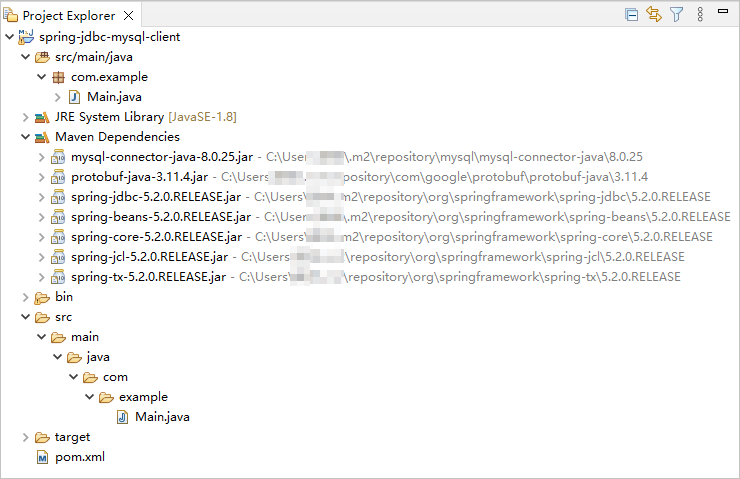
When you import a Maven project using Eclipse, it will automatically detect the
pom.xmlfile in the project, download the required dependency libraries based on the described dependencies in the file, and add them to the project.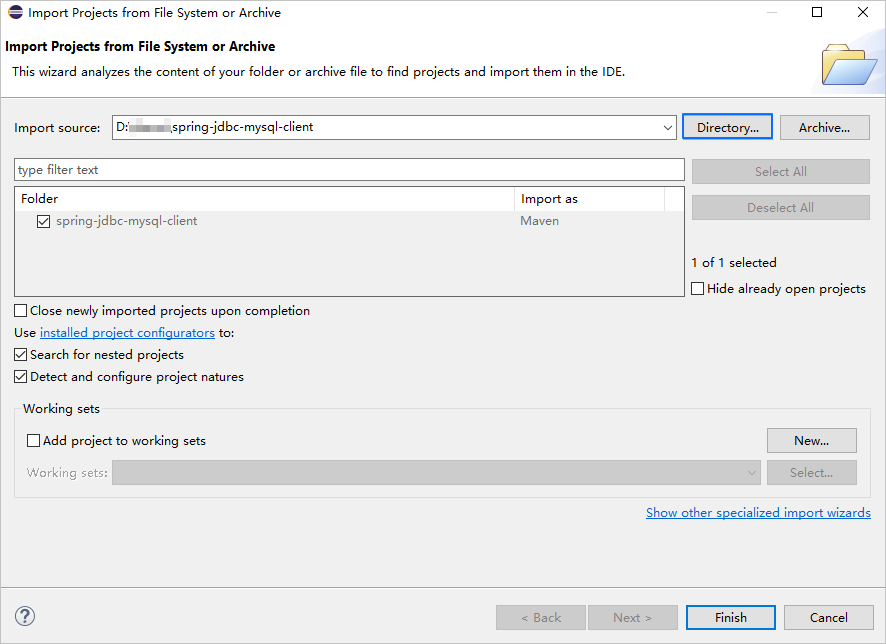
View the project status.
Step 2: Obtain the URL of OceanBase Database
Contact the deployment personnel or administrator of OceanBase Database to obtain the database connection string.
Here is an example:
obclient -hxxx.xxx.xxx.xxx -P2881 -utest_user001@mysql001 -p****** -DtestFor more information about the connection string, see Connect to an OceanBase tenant by using OBClient.
Fill in the URL below based on the OceanBase Database connection string, and specify the corresponding parameters.
jdbc:mysql://$host:$port/$database_name?user=$user_name&password=$password&useSSL=falseParameter description:
$host: the IP address for connecting to OceanBase Database. For connection through OceanBase Database Proxy (ODP), use the IP address of an ODP. For direct connection, use the IP address of an OBServer node.$port: the port for connecting to OceanBase Database. For connection through ODP, the default value is2883, which can be customized when ODP is deployed. For direct connection, the default value is2881, which can be customized when OceanBase Database is deployed.$database_name: the name of the database to be accessed.Note
The user used to connect to the tenant must have the
CREATE,INSERT,UPDATE,DELETE,SELECT, andDROPprivileges on the database. For more information about user privileges, see Privilege types in MySQL mode.$user_name: the account for connecting to the tenant. For connection through ODP, the format isusername@tenant name#cluster nameorcluster name:tenant name:username. For direct connection, the format isusername@tenant name.$password: the password of the account.
For more information about the connection properties of MySQL Connector/J, see Configuration Properties.
Here is an example:
jdbc:mysql://xxx.xxx.xxx.xxx:2881/test?user=test_user001@mysql001&password=******&useSSL=false
Step 3: Modify the database connection information in the spring-jdbc-mysql-client project
Modify the database connection information in the spring-jdbc-mysql-client/src/main/java/com/example/Main.java file based on the information obtained in Step 2: Obtain the URL of OceanBase Database.
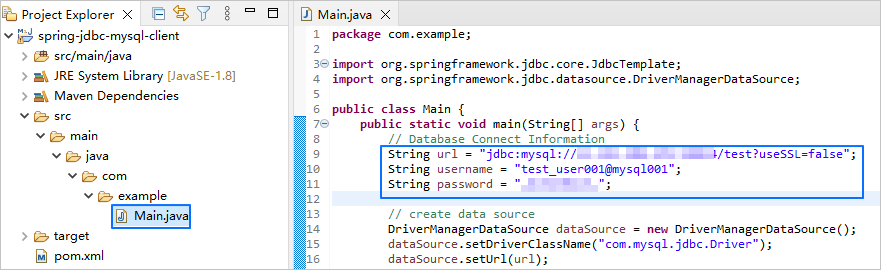
Here is an example:
- The IP address of the OBServer node is
xxx.xxx.xxx.xxx. - The access port is 2881.
- The name of the database to be accessed is
test. - The connection account for the tenant is
test_user001@mysql001. Here,mysql001refers to a user tenant created in OceanBase Database with the MySQL mode, andtest_user001is the username of the tenant. - The password is
******.
Sample code:
...
String url = "jdbc:mysql://xxx.xxx.xxx.xxx:2881/test?useSSL=false";
String username = "test_user001@mysql001";
String password = "******";
...
Step 4: Run the spring-jdbc-mysql-client project
In the project navigation view, locate and expand the src/main/java directory.
Right-click the Main.java file and choose Run As > Java Application.
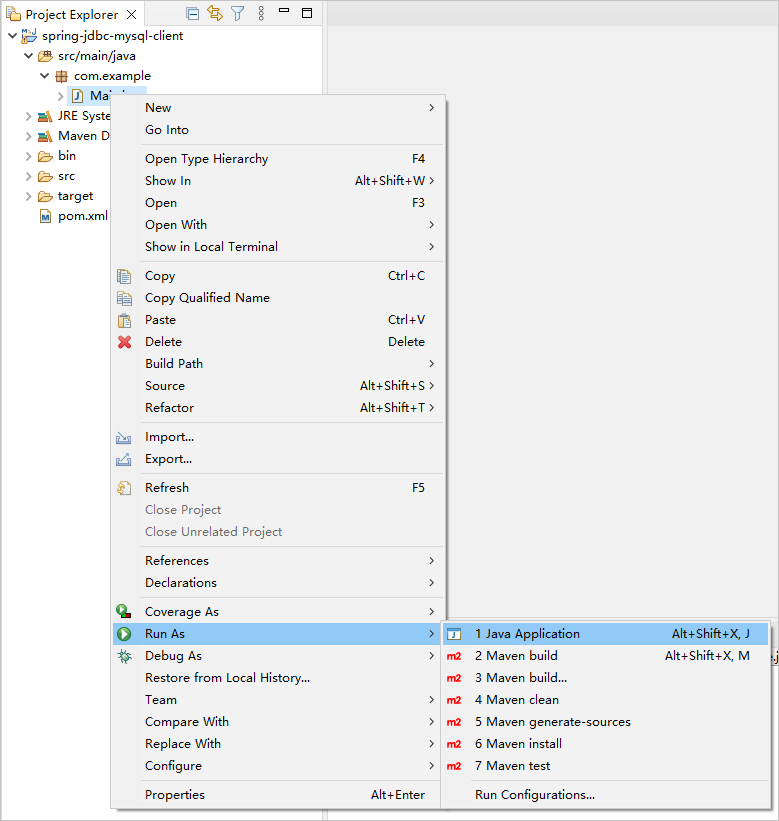
View the output in the console window of Eclipse.

FAQ
1. Connection timeout
If a connection timeout occurs, you can configure the connection timeout parameter in the JDBC URL:
jdbc:mysql://host:port/database?connectTimeout=30000&socketTimeout=60000
2. Character set issue
To ensure correct character encoding, set the character set parameter in the JDBC URL:
jdbc:mysql://host:port/database?characterEncoding=utf8&useUnicode=true
3. SSL connection
To establish an SSL connection with OceanBase Database, add the following parameter to the JDBC URL:
jdbc:mysql://host:port/database?useSSL=true&requireSSL=true
4. Special characters in account name or password
If the username or password contains special characters such as #, URL encode it:
String encodedPassword = URLEncoder.encode(password, "UTF-8");
Notice
When you use MySQL Connector/J 8.x, make sure that the account name and password do not contain the number sign (#). Otherwise, a connection error may occur.
Project code introduction
Click spring-jdbc-mysql-client to download the project code, which is a compressed package named spring-jdbc-mysql-client.zip.
After decompressing it, you will find a folder named spring-jdbc-mysql-client. The directory structure is as follows:
spring-jdbc-mysql-client
├── src
│ └── main
│ └── java
│ └── com
│ └── example
│ └── Main.java
└── pom.xml
File description:
src: the root directory for source code.main: the main code directory, containing the core logic of the application.java: the directory for storing the Java source code.com: the directory for storing the Java package.example: the directory for storing the packages of the sample project.Main.java: the main class that contains logic such as table creation and data insertion.pom.xml: the configuration file of the Maven project, used to manage project dependencies and build settings.
Introduction to pom.xml
The pom.xml file is the configuration file of the Maven project, which defines the dependencies, plugins, and build rules of the project. Maven is a Java project management tool that can automatically download dependencies, compile, and package the project.
The pom.xml file in this topic is mainly composed of the following parts:
Declaration statement.
The file is declared as an XML file that uses XML standard
1.0and character encodingUTF-8.Sample code:
<?xml version="1.0" encoding="UTF-8"?>Configure namespaces and the POM model version.
- Use
xmlnsto specify the POM namespace ashttp://maven.apache.org/POM/4.0.0. - Use
xmlns:xsito specify the XML namespace ashttp://www.w3.org/2001/XMLSchema-instance. - Use
xsi:schemaLocationto specify the POM namespace ashttp://maven.apache.org/POM/4.0.0, and the location of the corresponding XSD file ashttp://maven.apache.org/xsd/maven-4.0.0.xsd. - Use
<modelVersion>to specify the POM model version as4.0.0.
Sample code:
<project xmlns="http://maven.apache.org/POM/4.0.0" xmlns:xsi="http://www.w3.org/2001/XMLSchema-instance" xsi:schemaLocation="http://maven.apache.org/POM/4.0.0 http://maven.apache.org/xsd/maven-4.0.0.xsd"> <modelVersion>4.0.0</modelVersion> <!-- Other configurations --> </project>- Use
Configure basic information.
- Use
<groupId>to specify the project group ascom.example. - Use
<artifactId>to specify the project name asspring-jdbc-mysql-client. - Use
<version>to specify the project version as1.0-SNAPSHOT.
Sample code:
<groupId>com.example</groupId> <artifactId>spring-jdbc-mysql-client</artifactId> <version>1.0-SNAPSHOT</version>- Use
Configure the properties of the project's source file.
Specify the Maven compiler plugin as
maven-compiler-plugin, and set both the source code and target Java versions to 8. This means that the project's source code is written using Java 8 features, and the compiled bytecode will also be compatible with the Java 8 runtime environment. This setup ensures that the project can correctly handle Java 8 syntax and features during compilation and execution.Note
Java 1.8 and Java 8 are different names for the same version.
Sample code:
<build> <plugins> <plugin> <groupId>org.apache.maven.plugins</groupId> <artifactId>maven-compiler-plugin</artifactId> <configuration> <source>8</source> <target>8</target> </configuration> </plugin> </plugins> </build>Configure the components on which the project depends.
Add the
mysql-connector-javadependency library for interactions with the database, and configure the following parameters:Note
The following code defines that the project depends on MySQL Connector/J V5.1.40. For more information about other versions, see MySQL Connector/J.
- Use
<groupId>to specify the dependency group asmysql. - Use
<artifactId>to specify the dependency name asmysql-connector-java. - Use
<version>to specify the dependency version as5.1.40.
Sample code:
<dependency> <groupId>mysql</groupId> <artifactId>mysql-connector-java</artifactId> <version>5.1.40</version> </dependency>- Use
Add the
spring-jdbcdependency library, and configure the following parameters:- Use
<groupId>to specify the dependency group asorg.springframework. - Use
<artifactId>to specify the dependency name asspring-jdbc. - Use
<version>to specify the dependency version as5.2.0.RELEASE.
Sample code:
<dependency> <groupId>org.springframework</groupId> <artifactId>spring-jdbc</artifactId> <version>5.2.0.RELEASE</version> </dependency>- Use
Introduction to Main.java
The Main.java file is part of the sample application and demonstrates how to use the Spring Data JDBC framework for database operations. It first configures the database connection information, then creates a JdbcTemplate object to perform database operations. The code also includes examples of creating tables, inserting data, and querying data.
The code in this topic for the Main.java file mainly includes the following sections:
Define packages and import necessary classes.
- Declare the name of the package to which the current code belongs as
com.example. - Import the
JdbcTemplateclass, which is a core class of the Spring Data JDBC framework and is used for database operations. - Import the
DriverManagerDataSourceclass, which is a data source class that implements theDataSourceinterface and is used to configure database connection information.
Sample code:
package com.example; import org.springframework.jdbc.core.JdbcTemplate; import org.springframework.jdbc.datasource.DriverManagerDataSource;- Declare the name of the package to which the current code belongs as
Create a
Mainclass and define themainmethod.- Define a public class named
Main, which serves as the entry point of the program. The class name must be the same as the file name. - Define a public static method named
main, which serves as the starting execution point of the program. - Other database operations.
Sample code:
public class Main { public static void main(String[] args) { // Database connection information // Create a data source // Create a JdbcTemplate object // Create a table // Insert data // Update data // Delete data // Query data // Delete a table } }- Define a public class named
Define database connection information.
Specify the URL, username, and password for connecting to the database. You need to replace
$host,$port,$database_name,$user_name, and$passwordwith actual database connection information.Sample code:
String url = "jdbc:mysql://$host:$port/$database_name?useSSL=false"; String username = "$user_name"; String password = "$password";Parameter description:
$host: the IP address for connecting to OceanBase Database. For connection through ODP, use the IP address of an ODP; for direct connection, use the IP address of an OBServer node.$port: the port for connecting to OceanBase Database. For connection through ODP, the default value is2883, which can be customized when ODP is deployed; for direct connection, the default value is2881, which can be customized when OceanBase Database is deployed.$database_name: the name of the database to be accessed.$user_name: the username specified after the-uparameter, in the format of username@tenant name#cluster name or username@SERVICE:service name. When the username@tenant name#cluster name format is used, the default tenant issysand the administrator user isroot. The cluster name can be omitted when deleting a database, but is required when connecting to a database through ODP.$password: the password of the account.
Create a data source.
Create a
DriverManagerDataSourceobject and configure the database connection information, including the driver class name, database URL, username, and password. The specific steps are as follows:- Create a
DriverManagerDataSourceobject to configure the database connection information. - Set the driver class name: Call the
setDriverClassNamemethod and set the database driver class name tocom.mysql.jdbc.Driver. - Set the database URL: Call the
setUrlmethod and set the database URL. - Set the username: Call the
setUsernamemethod and set the database username. - Set the password: Call the
setPasswordmethod and set the database password.
Sample code:
DriverManagerDataSource dataSource = new DriverManagerDataSource(); dataSource.setDriverClassName("com.mysql.jdbc.Driver"); dataSource.setUrl(url); dataSource.setUsername(username); dataSource.setPassword(password);- Create a
Create a JdbcTemplate object.
Create a
JdbcTemplateobject, which is one of the core classes of the Spring Data JDBC framework. TheJdbcTemplateprovides methods for performing database operations, such as executing SQL statements, updating data, and querying data.Sample code:
JdbcTemplate jdbcTemplate = new JdbcTemplate(dataSource);Create a table.
- Define an SQL statement for creating a table. The statement specifies the table name as
test_springjdbcand defines two columns: one namedidof theINTtype and the other namednameof theVARCHAR(20)type. - Execute the SQL statement for creating a table. The
jdbcTemplateobject calls theexecutemethod to execute the preceding SQL statement. - Output a message indicating that the table has been created.
Sample code:
String createTableSql = "CREATE TABLE test_springjdbc (id INT, name VARCHAR(20))"; jdbcTemplate.execute(createTableSql); System.out.println("Create table successfully.");- Define an SQL statement for creating a table. The statement specifies the table name as
Insert data.
- Define an SQL statement for inserting data. The statement specifies the table name as
test_springjdbc, the columns asidandname, and inserts two rows of data:(1,'A1'),(2,'A2'), and(3,'A3'). - Execute the SQL statement for inserting data. The
jdbcTemplateobject calls theupdatemethod to execute the preceding SQL statement. - Output a message indicating that the data has been inserted.
Sample code:
String insertDataSql = "INSERT INTO test_springjdbc (id,name) VALUES (1,'A1'), (2,'A2'), (3,'A3')"; jdbcTemplate.update(insertDataSql); System.out.println("Insert data successfully.");- Define an SQL statement for inserting data. The statement specifies the table name as
Update data.
- Define an SQL statement for updating the
namefield of the record withidequal to1in thetest_springjdbctable toA11. - Execute the SQL statement by using the
jdbcTemplateobject to apply the update operation to the database. - Output a message indicating that the data has been updated.
Sample code:
String updateDataSql = "UPDATE test_springjdbc SET name = 'A11' WHERE id = 1"; jdbcTemplate.update(updateDataSql); System.out.println("Update data successfully.");- Define an SQL statement for updating the
Delete data.
- Define an SQL statement for deleting the record with
idequal to2from thetest_springjdbctable. - Execute the SQL statement by using the
jdbcTemplateobject to apply the delete operation to the database. - Output a message indicating that the data has been deleted.
Sample code:
String deleteDataSql = "DELETE FROM test_springjdbc WHERE id = 2"; jdbcTemplate.update(deleteDataSql); System.out.println("Delete data successfully.");- Define an SQL statement for deleting the record with
Query data.
- Define an SQL statement for querying data. The statement uses
SELECT *to select all columns from thetest_springjdbctable. - Execute the SQL statement for querying data. The
jdbcTemplateobject calls thequerymethod to execute the preceding SQL statement and passes a callback function as a parameter. - The code in the callback function uses the
ResultSetobject (rs) to obtain each row of data in the query result and process the data. The code in the callback function calls thegetIntandgetStringmethods to obtain the values in theidandnamecolumns from theResultSetobject and prints them to the console. Finally, the callback function returnsnull. - Output a message indicating that the data has been queried.
Sample code:
String selectDataSql = "SELECT * FROM test_springjdbc"; jdbcTemplate.query(selectDataSql, (rs, rowNum) -> { int id = rs.getInt("id"); String name = rs.getString("name"); System.out.println("id: " + id + ", name: " + name); return null; }); System.out.println("Query data successfully.");- Define an SQL statement for querying data. The statement uses
Delete a table.
- Define an SQL statement for deleting the
test_springjdbctable from the database. - Execute the SQL statement by using the
jdbcTemplateobject to apply the table deletion operation to the database. - Output a message indicating that the table has been deleted.
Sample code:
String deleteTableSql = "DROP TABLE test_springjdbc"; jdbcTemplate.execute(deleteTableSql); System.out.println("Table drop successfully.");- Define an SQL statement for deleting the
Complete code
<?xml version="1.0" encoding="UTF-8"?>
<project xmlns="http://maven.apache.org/POM/4.0.0"
xmlns:xsi="http://www.w3.org/2001/XMLSchema-instance"
xsi:schemaLocation="http://maven.apache.org/POM/4.0.0 http://maven.apache.org/xsd/maven-4.0.0.xsd">
<modelVersion>4.0.0</modelVersion>
<groupId>com.example</groupId>
<artifactId>spring-jdbc-mysql-client</artifactId>
<version>1.0-SNAPSHOT</version>
<build>
<plugins>
<plugin>
<groupId>org.apache.maven.plugins</groupId>
<artifactId>maven-compiler-plugin</artifactId>
<configuration>
<source>8</source>
<target>8</target>
</configuration>
</plugin>
</plugins>
</build>
<dependencies>
<dependency>
<groupId>mysql</groupId>
<artifactId>mysql-connector-java</artifactId>
<version>5.1.40</version>
</dependency>
<dependency>
<groupId>org.springframework</groupId>
<artifactId>spring-jdbc</artifactId>
<version>5.2.0.RELEASE</version>
</dependency>
</dependencies>
</project>
package com.example;
import org.springframework.jdbc.core.JdbcTemplate;
import org.springframework.jdbc.datasource.DriverManagerDataSource;
public class Main {
public static void main(String[] args) {
// Database Connect Information
String url = "jdbc:mysql://$host:$port/$database_name?useSSL=false";
String username = "$user_name";
String password = "$password";
// create data source
DriverManagerDataSource dataSource = new DriverManagerDataSource();
dataSource.setDriverClassName("com.mysql.jdbc.Driver");
dataSource.setUrl(url);
dataSource.setUsername(username);
dataSource.setPassword(password);
// Create a JdbcTemplate object
JdbcTemplate jdbcTemplate = new JdbcTemplate(dataSource);
// Create table
String createTableSql = "CREATE TABLE test_springjdbc (id INT, name VARCHAR(20))";
jdbcTemplate.execute(createTableSql);
System.out.println("Create table successfully.");
// Insert data
String insertDataSql = "INSERT INTO test_springjdbc (id,name) VALUES (1,'A1'), (2,'A2'), (3,'A3')";
jdbcTemplate.update(insertDataSql);
System.out.println("Insert data successfully.");
// Update data
String updateDataSql = "UPDATE test_springjdbc SET name = 'A11' WHERE id = 1";
jdbcTemplate.update(updateDataSql);
System.out.println("Update data successfully.");
// Delete data
String deleteDataSql = "DELETE FROM test_springjdbc WHERE id = 2";
jdbcTemplate.update(deleteDataSql);
System.out.println("Delete data successfully.");
// Query data
String selectDataSql = "SELECT * FROM test_springjdbc";
jdbcTemplate.query(selectDataSql, (rs, rowNum) -> {
int id = rs.getInt("id");
String name = rs.getString("name");
System.out.println("id: " + id + ", name: " + name);
return null;
});
System.out.println("Query data successfully.");
// Delete table
String deleteTableSql = "DROP TABLE test_springjdbc";
jdbcTemplate.execute(deleteTableSql);
System.out.println("Table drop successfully.");
}
}
Best practices
Transaction management
@Transactional
public void transferMoney(String fromAccount, String toAccount, BigDecimal amount) {
// Transaction operations
}
FAQ
1. What do I do when a connection times out?
Configure appropriate connection timeout parameters:
jdbc:mysql://host:port/database?connectTimeout=30000&socketTimeout=60000
2. How do I handle batch data processing?
Use batch processing operations:
jdbcTemplate.batchUpdate(sql, batchArgs);
3. How do I optimize query performance?
- Use a connection pool.
- Configure the fetchSize parameter appropriately.
- Do not use the SELECT * statement.
References
For more information about MySQL Connector/J, see Overview of MySQL Connector/J.