







This topic describes how to deploy an OceanBase cluster in an x86-based CentOS Linux 7.9 system through the GUI of OceanBase Deployer (obd).
Terms
OceanBase Database
OceanBase Database is a fully self-developed, enterprise-level, native distributed database. For more information, see OceanBase Database documentation.
obd
OceanBase Deployer (obd) is a tool for installing and deploying open source OceanBase software. For more information, see obd documentation.
ODP
OceanBase Database Proxy (ODP), also known as OBProxy, is a dedicated proxy server for OceanBase Database. For more information, see ODP documentation.
OBAgent
OceanBase Agent (OBAgent) is a framework for data monitoring and collection in OceanBase Database. It supports both pushing and pulling modes for data collection in different scenarios.
obconfigserver
OceanBase Configserver (obconfigserver) provides metadata registration, storage, and query services for OceanBase Database. For more information, see ob-configserver.
Grafana
Grafana is an open-source data visualization tool that enables you to visualize various metrics from data sources, helping you better understand system status and performance. For more information, see Grafana official website.
Prometheus
Prometheus is an open-source service monitoring system and time-series database. It provides a general data model as well as efficient interfaces for data collection, storage, and querying. For more information, see Prometheus official website.
Alertmanager
Alertmanager is an open-source alert management tool that processes alerts from monitoring systems such as Prometheus, offering features like deduplication, grouping, routing, and silencing. For more information, see Prometheus official website.
Prerequisites
Before you begin, make sure that the following conditions are met:
Your machine meets the software and hardware requirements. For more information, see Software and hardware requirements.
In a production environment, you need to check the environment and configurations.
To deploy only OceanBase Database, you need at least 2 vCPUs, 6 GB of memory, and 20 GB of disk space. Note that the memory limit refers to the value in the
availablecolumn of the output obtained by running thefree -gcommand.To deploy OceanBase Database and all components, you need at least 4 vCPUs, 10 GB of memory, and 25 GB of available disk space. It is recommended to have more than 16 GB of memory. Note that the memory requirement refers to the value in the
availablecolumn shown when you run thefree -gcommand.
Note
In environments with a small number of CPU cores, the minimum CPU_Count set by obd is 8 by default. Configuring too few CPU cores can negatively affect the performance of OceanBase Database.
Prepare software
You can deploy OceanBase Database through the GUI of obd either online or offline.
Online deployment: Make sure that the server where obd resides can connect to the Internet. In this deployment mode, obd obtains the installation package from a remote image repository during deployment. Therefore, you do not need to deploy and configure the installation package in advance.
Offline deployment: The server where obd resides does not need to connect to the Internet during deployment. In this deployment mode, you must upload the installation package to the local image repository of obd in advance. If you choose offline deployment, we recommend that you download the all-in-one package of the desired version.
You can select the appropriate method to prepare the software based on your specific circumstances.
Online deployment
If you choose online deployment, run the following commands to install obd on the central control server:
[admin@test001 ~]$ sudo yum install -y yum-utils
[admin@test001 ~]$ sudo yum-config-manager --add-repo https://mirrors.aliyun.com/oceanbase/OceanBase.repo
[admin@test001 ~]$ sudo yum install -y ob-deploy
[admin@test001 ~]$ source /etc/profile.d/obd.sh
Offline deployment
If you choose offline deployment, run the following commands to download and install the all-in-one package.
You can download the latest all-in-one package from OceanBase Download Center and copy it to the central control server.
[admin@test001 ~]$ tar -xzf oceanbase-all-in-one-*.tar.gz
[admin@test001 ~]$ cd oceanbase-all-in-one/bin/
[admin@test001 bin]$ ./install.sh
[admin@test001 bin]$ source ~/.oceanbase-all-in-one/bin/env.sh
Procedure
Note
The following example applies to obd V3.6.0. The operation interface may vary with different obd versions. Please refer to the actual interface. For more information about obd, see obd documentation.
Step 1: Start the GUI
Start the GUI
Run the
obd webcommand in the CLI to start the GUI, and click the displayed address to access the GUI.[admin@test001 ~]$ obd web start OBD WEB in 0.0.0.0:8680 please open http://10.10.10.1:8680Note
The GUI uses port 8680 by default. You can specify a port using the
obd web -p <PORT>command.In Alibaba Cloud or other cloud environments, the program may fail to obtain the public IP address and instead output an internal IP address. This IP is not a public address, so you need to use the correct address to access the GUI.
The
obd webcommand is bound to0.0.0.0. In a multi-network interface deployment, you can access the GUI using any accessible IP address.You can use the nohup or screen command to run the
obd webcommand in the background.
(Optional) To change the display language, click the English icon in the upper-right corner of the page and select a language as needed.
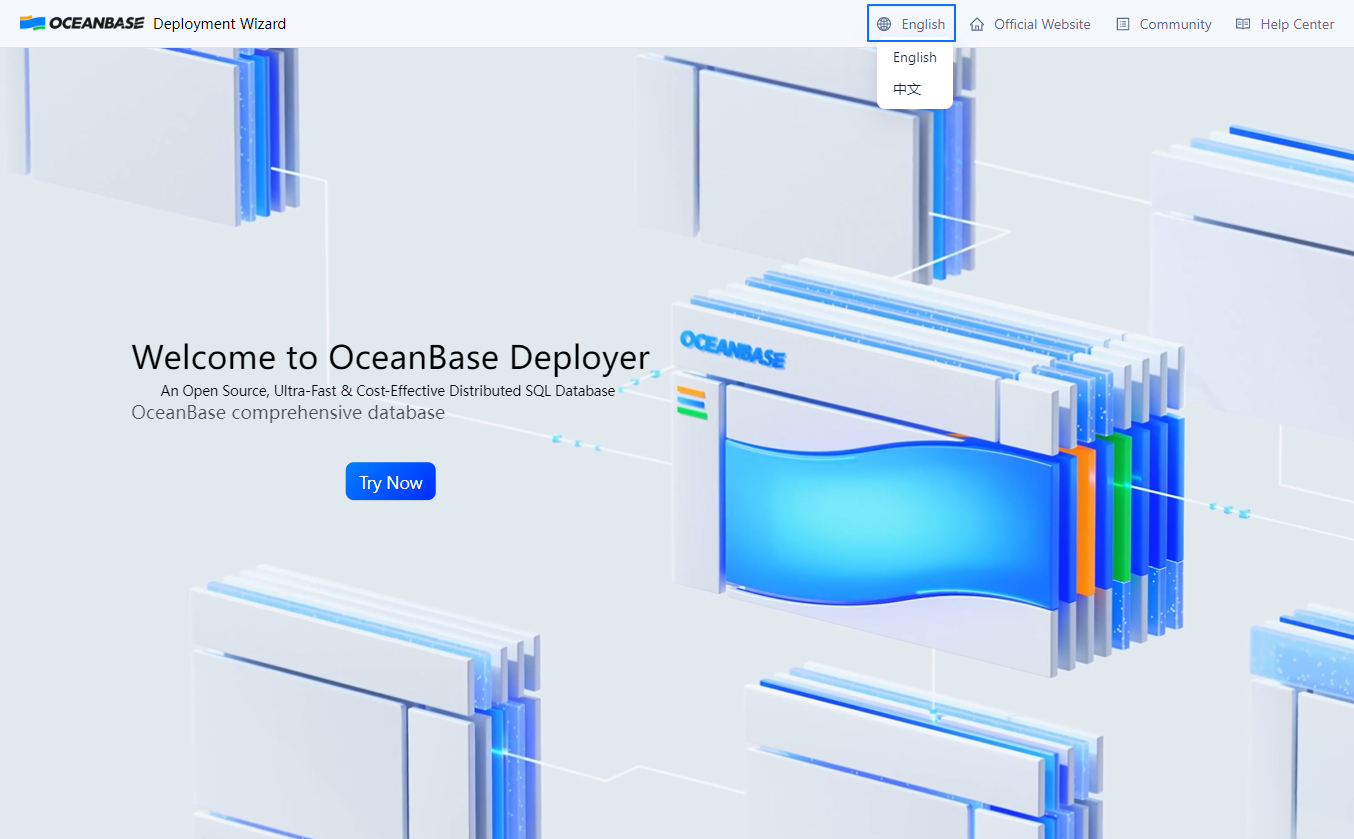
On the GUI, click Try Now to go to the Welcome to the OceanBase Deployment Wizard page. On the page that appears, select OceanBase and supporting tools and click Installation to go to the OceanBase Database deployment page.
Step 2: Configure the deployment
On the Deployment Configuration page, you can specify the cluster name, load type, and components to deploy.
Cluster configuration
SectionDescriptionDeployment Configuration The cluster name is the unique identifier for products deployed with obd. By default, it is myoceanbase, but you can customize it as long as it does not duplicate an existing deployment name. The cluster name must start with a letter, end with a letter or number, and can include letters, numbers, and underscores. Its length must be between 2 and 32 characters. You can use theobd cluster listcommand to view the clusters managed by obd.Deploy a database Click the drop-down list of Version to select the desired OceanBase Database version. Click Learn more next to the corresponding component to view its documentation. Load Type Click the drop-down list of Type to select the load type of the OceanBase cluster. Each load balancing type includes a description to help you understand its applicable scenarios. Note
This section is only displayed when the OceanBase Database version to be deployed is V4.2.5 or above.
Component selection
By default, only the ODP component is selected. You can choose whether to deploy other components by clicking the checkbox next to each component under Optional components. Component versions are fixed to the latest version. Click Learn More next to a component to view its documentation.
Note
The deployment of the Grafana and AlertManager components depends on the OBAgent and Prometheus components, while the deployment of the Prometheus component depends on the OBAgent component. Specifically, when you select the Grafana or AlertManager component, the OBAgent and Prometheus components will be automatically selected. If you deselect the OBAgent component, Grafana, AlertManager, and Prometheus will also be automatically deselected.
Click Next Step to go to the Node Configuration page.
Step 3: Configure the nodes
On the Node Configuration page, you can configure the database and component nodes, and specify the user information and software installation path.
Section |
Parameter |
Description |
|---|---|---|
| Database Node | Zone Name | Configure the zone name in OceanBase Database. The zone name must start with a letter, end with a letter or number, and can include letters, numbers, and underscores. The length must be between 2 and 32 characters. When deploying a multi-zone OceanBase cluster, at least one zone must have the same Region as the primary zone. You can add or delete a zone by clicking + Add zone or the delete icon next to the corresponding zone. |
| OBServer Node | Configure the IP address of the OBServer node in the OceanBase cluster. You can enter multiple IP addresses and press Enter to configure them.
Note
|
|
| RootServer Node | You can select an IP address from the configured OBServer nodes using the dropdown box to designate it as the RootServer node for the OceanBase cluster. For OceanBase clusters with multiple replicas, each zone must specify a RootServer. | |
| Component Node | OBProxy Node | You can configure multiple nodes by either selecting an OBServer node IP from the dropdown box or entering a new node IP. It is recommended to use IP addresses other than 127.0.0.1. After entering an IP address, press Enter to add multiple node IPs. |
| Load Balancing | Click the expand button to configure load balancing for business access to the OceanBase cluster. When deploying multiple ODP nodes, it is recommended to provide a VIP or DNS address to avoid changing the ODP access address later. If not configured, the system will use the first IP address among the configured OBProxy nodes as the connection string by default. You can select either VIP access or DNS (domain name) access from the dropdown box under Access Method:
Noticeobd does not provide load balancing deployment. If you need to set up load balancing, deploy and configure the corresponding load balancer in advance. |
|
| Prometheus Node | You can configure multiple nodes by either selecting an OBServer node IP from the dropdown box or entering a new node IP. It is recommended to use IP addresses other than 127.0.0.1. After entering an IP address, press Enter to add multiple node IPs. |
|
| Grafana Node | You can configure multiple nodes by either selecting an OBServer node IP from the dropdown box or entering a new node IP. It is recommended to use IP addresses other than 127.0.0.1. After entering an IP address, press Enter to add multiple node IPs. |
|
| AlertManager Node | You can configure only one node. We recommend that you use an IP address other than 127.0.0.1. |
|
| obconfigserver Node | You can configure multiple nodes by either selecting an OBServer node IP from the dropdown box or entering a new node IP. It is recommended to use IP addresses other than 127.0.0.1. After entering an IP address, press Enter to add multiple node IPs.
NoteWhen configuring multiple nodes for obconfigserver, you need to set up load balancing in advance and, on the Cluster Configuration page under the Component Configuration section, click the More Configurations button to configure |
|
| Deployment Connection | Username | Configure the username for deploying the OceanBase cluster. By default, it is the user that started the current process. You can also customize the username. Only letters, numbers, and dots are supported, and the length must not exceed 20 characters. Ensure that the chosen username exists on all hosts. |
| Password | The login password of the user corresponding to the Username parameter. If passwordless access is configured between nodes, you do not need to enter a password. | |
| SSH Port | The default port is 22. You can customize the SSH port. | |
| Software Path | Software Path | The default is the home directory of the deployment user, but you can customize it. It must be an absolute path starting with /, and can only contain letters, numbers, and the special characters -_:@/.. After configuration, a folder with the same name as the cluster name will be created in the specified directory. |
After you configure the nodes, click Next Step to go to the Cluster Configuration page.
Step 4: Configure the cluster
The Cluster Configuration page allows you to configure the cluster, including the password of the system tenant administrator (root@sys), data and log directories, and the ports and parameters of the database and components. This section will explain these configurations in detail.
Cluster configuration
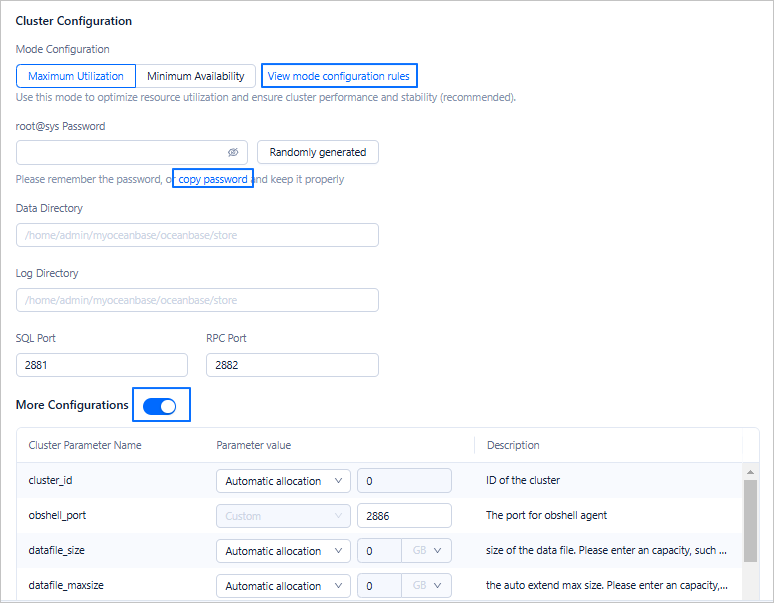 ParameterDescription
Mode Configuration Valid values include Maximum Utilization (recommended) and Minimum Availability. The Maximum Utilization mode maximizes resource utilization to ensure cluster performance and stability. In Minimum Availability mode, minimum resources required for the normal running of the cluster are configured. For more information about the two modes, see Mode configuration rules. root@sys Password You can click Randomly generated to generate a random password or enter a custom password. The password must meet the following complexity requirements: - It must be 8 to 32 characters in length.
- It must contain characters of at least three of the following types: digits (0 to 9), uppercase letters (A to Z), lowercase letters (a to z), and special characters. Supported special characters are
~!@#%^&*_-+=|(){}[]:;,.?/.
Data Directory By default, the data directory is in the software path configured on the Node Configuration page. The data directory must be an absolute path beginning with a forward slash ( /). You can change the data directory. Make sure that the specified directory is empty.Log Directory By default, the log directory is in the software path configured on the Node Configuration page. The log directory must be an absolute path beginning with a forward slash ( /). You can change the log directory. Make sure that the specified directory is empty.SQL Port The SQL port number. The default value is 2881. You can specify a custom port number ranging from1025to65535. Make sure that the specified port is not occupied.RPC Port The port number used for the remote access protocol. The default value is 2882. You can specify a custom port number ranging from1025to65535. Make sure that the specified port is not occupied.OBShell Port OceanBase Database maintenance port. The default is 2886, but you can customize it (only supports the range 1025~65535). Ensure that the specified port is not in use.More Configurations You can enable More Configurations to view more cluster parameters. You can retain the default settings or modify the settings. Note
After you enable More Configurations, you can configure the
scenarioparameter to specify a load type for the cluster. The default value of this parameter ishtap.Component configuration
ParameterDescriptionGrafana Password The login password of the Grafana administrator account. You can click Randomly generated to let obd generate a random string, or you can set a custom password. When you set a custom password, it must meet the following requirements: - It must be 8 to 32 characters long.
- It must contain at least two of the following four types of characters: digits (0~9), uppercase letters (A~Z), lowercase letters (a~z), and special characters (
~!@#%^&*_-+=|(){}[]:;,.?/`$"<>\).
Prometheus Password The login password of the Prometheus service. You can click Randomly generated to let obd generate a random string, or you can set a custom password. When you set a custom password, it must meet the following requirements: - It must be 8 to 32 characters long.
- It must contain at least two of the following four types of characters: digits (0~9), uppercase letters (A~Z), lowercase letters (a~z), and special characters (
~!@#%^&*_-+=|(){}[]:;,.?/`$"<>\).
AlertManager Password The login password of the Alertmanager service. You can click Randomly generated to let obd generate a random string, or you can set a custom password. When you set a custom password, it must meet the following requirements: - It must be 8 to 32 characters long.
- It must contain at least two of the following four types of characters: digits (0~9), uppercase letters (A~Z), lowercase letters (a~z), and special characters (
~!@#%^&*_-+=|(){}[]:;,.?/`$"<>\).
OBProxy SQL Port The ODP listening port. By default, it is set to 2883. You can specify a custom port number (1025 to 65535). The specified port must be available.OBProxy Exporter Port The Exporter port of OBProxy, which is used for Prometheus to pull OBProxy monitoring data. By default, it is set to 2884. You can specify a custom port number (1025 to 65535). The specified port must be available.OBProxy RPC Port By default, it is set to 2885. You can specify a custom port number (1025 to 65535). The specified port must be available.OBAgent Monitoring Service Port By default, it is set to 8088. You can specify a custom port number (1025 to 65535). The specified port must be available.OBAgent Management Service Port By default, it is set to 8089. You can specify a custom port number (1025 to 65535). The specified port must be available.obconfigserver Service Port The port number of the obconfigserver service. By default, it is set to 8080. You can specify a custom port number (1025 to 65535). The specified port must be available.Prometheus Service Port The port on which the Prometheus service listens. The default value is 9090. You can set a value in the range of 1025 to 65535. Make sure that the port is not occupied.Grafana Service Port The HTTP port used to access the Grafana page. The default value is 3000. You can set a value in the range of 1025 to 65535. Make sure that the port is not occupied.AlertManager Service Port The HTTP port used to access the Alertmanager page. The default value is 9093. You can set a value in the range of 1025 to 65535. Make sure that the port is not occupied.More Configurations You can click the expand icon before More Settings to view and configure the parameters of the component. You can use the automatically allocated values or customize the parameters. Note
If multiple nodes are configured in obconfigserver node of Node configuration, you must configure
vip_addressandvip_portin More configurations. Otherwise, an error will be reported during precheck.
After all parameters are configured, click Next Step to go to the Pre-check page.
Step 5: Precheck
On the Pre-check page, confirm all the configuration information. If any information is incorrect, you can click Previous Step to modify the information. After you confirm that all the information is correct, click Pre-check.
If the pre-check reports an error, and the error can be automatically fixed, you can click Automatic Repair to fix the error. You can also click Learn More to fix the reported error by referring to the error code document. After all the errors are fixed, click Re-check to perform a pre-check again.
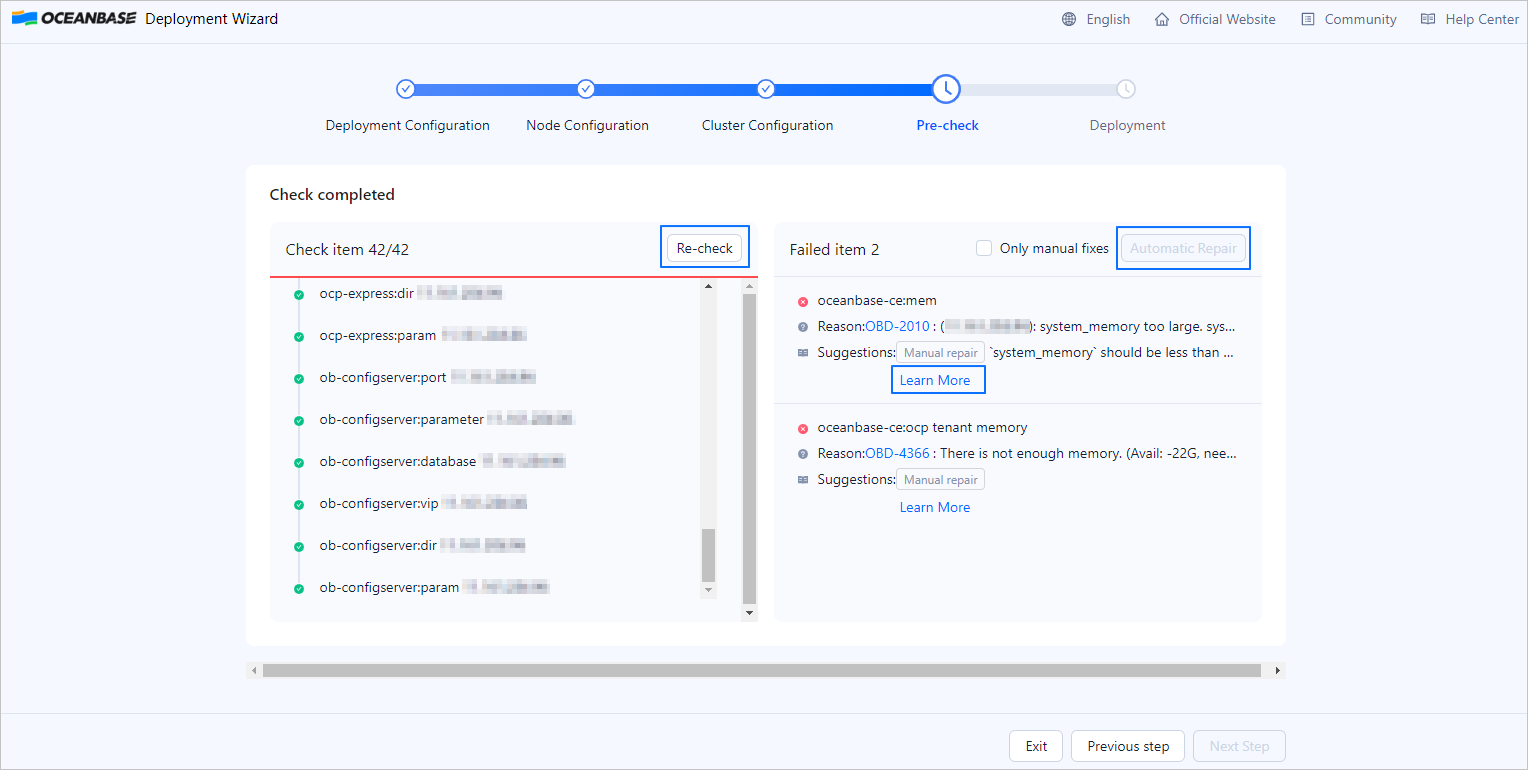
After the precheck passes, click Deploy to deploy OceanBase Database.
Step 6: Deploy
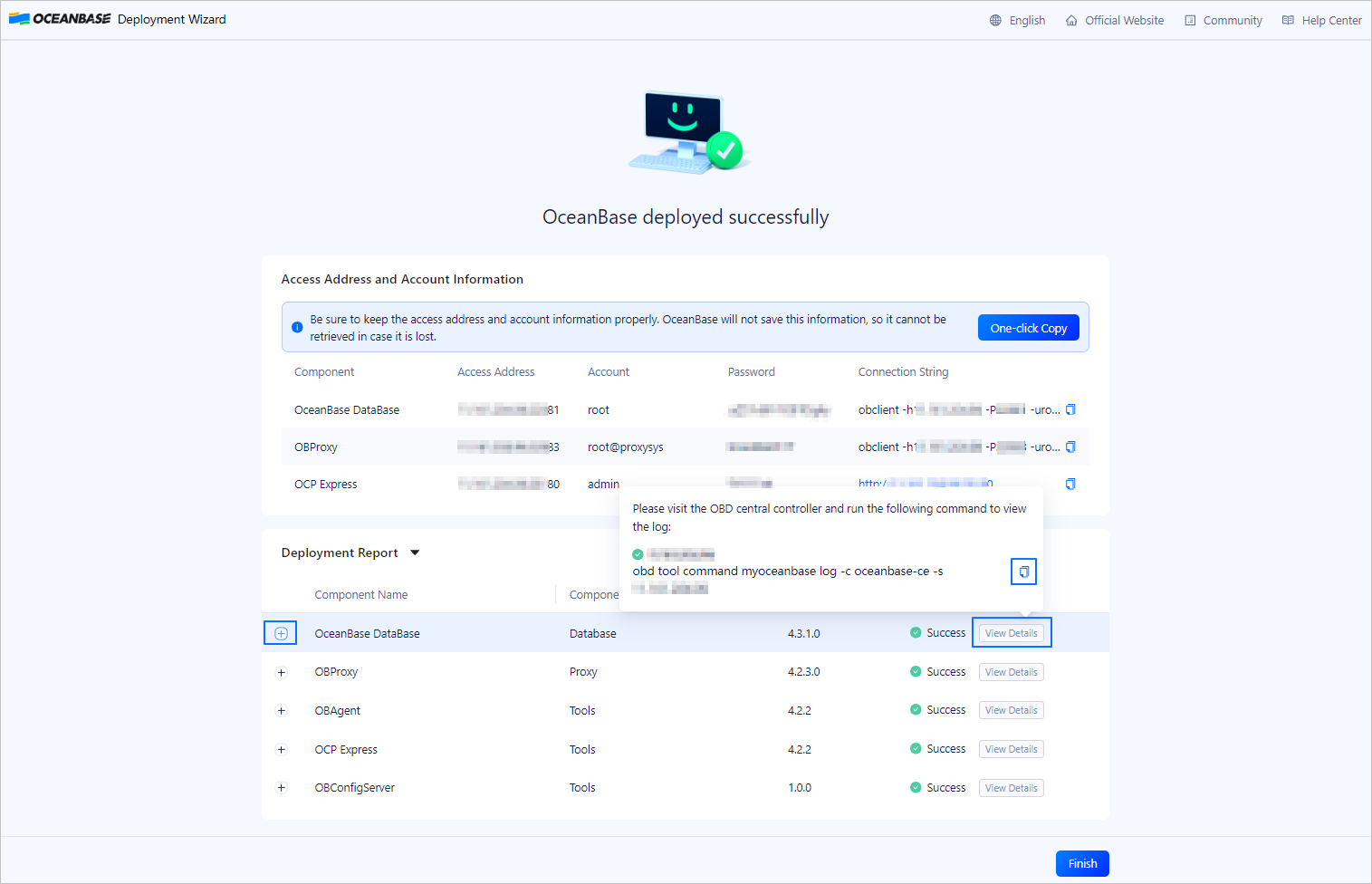
Here:
After deployment, copy the displayed connection string and connect to the corresponding component. In the terminal, the connection string executed after OceanBase Database is connected to the OceanBase cluster as the root@sys user. The connection string executed after OBProxy is connected to ODP as the root@proxysys user.
You can click the connection strings of the output Prometheus, Grafana, AlertManager, and OB-Dashboard components to jump to the login interfaces of these components. You can log in by using the account and password displayed on the deployment page.
Note
In Alibaba Cloud or other cloud environments, if the public IP cannot be retrieved, the private IP is returned, which is not the public IP. You must access the GUI by using the correct IP address.
In the Deployment Report tab, click the icon next to a component to view the deployment logs. In the list of a component, click View Details. Then, click the icon to copy the command. In the central control node, you can run the command to view the log location of the component.
Click Copy Information to copy the account and password of the OceanBase cluster. You can click Leave to exit the deployment program or click Create Business Tenant to create a business tenant in graphical mode.
Note
If you want to deploy multiple clusters, you must click Exit to end the current obd process before you can execute the
obd webcommand to deploy the next cluster.We recommend that you create a business tenant for OceanBase Database. The sys tenant is only used for cluster management. If you use it as a business tenant, system anomalies may occur.
(Optional) Step 7: Create a business tenant
After the OceanBase cluster is deployed, click Create Business Tenant in the lower-right corner of the deployment success page to enter the business tenant creation process. You can configure the tenant information based on the following table.
Parameter |
Description |
|---|---|
| Tenant Name | Specify the name of the new tenant. The tenant name must meet the following requirements:
|
| Tenant Mode | Select MySQL mode or Oracle mode from the drop-down list.
ApplicabilityOceanBase Database Community Edition does not support creating tenants in Oracle mode. |
| Root Password | You can click Randomly generated to let obd generate a random string, or you can set a custom password. If you set a custom password, it must meet the following requirements:
|
| Mode Configuration | Select Maximum Usage, Minimum Available, or Custom from the drop-down list.
|
| Business Load Type | Select the business load type of the tenant from the drop-down list. When you select a different load type, the applicable scenarios of the load type are displayed below the drop-down list.
NoteThis parameter is displayed only when the deployed OceanBase Database version is V4.2.5 or later. |
| Character Set | The default value is utf8mb4. You can select another character set from the drop-down list. |
| Collation | The default value is utf8mb4_general_ci. You can select another collation from the drop-down list. |
| Table Name Case Sensitivity | Set this parameter to 0, 1, or 2 from the drop-down list.
|
| Time Zone | The default value is (GMT+08:00) China Standard Time. You can select another time zone from the drop-down list. |
| IP Address Whitelist | You can select to allow access from all IPs or specify a custom IP. If you select to allow access from all IPs, you can set the value to %. If you select to allow access from a custom IP, you can enter the allowed client IP address in the Custom IP Address field. You can press the Enter key or enter a comma (,) to separate multiple IP addresses. When you hover the pointer over View Configuration Instructions, the instructions for configuring IP addresses are displayed.
NoteWhen you select to allow access from all IPs, you can set the value to |
After you configure the parameters, click Next: Create Business Tenant. The system creates the corresponding tenant. After the tenant is created, the business tenant information, including the tenant name, root user password, and connection string, is displayed on the page. Click Leave in the lower-left corner to exit the tenant creation process. After you exit the tenant creation process, you can click Leave on the deployment result page to exit the deployment process, or you can click Create Business Tenant to create another business tenant.
Related operations
Manage a cluster after deployment
You can run the following commands to manage a cluster deployed by using obd. For more information, see Cluster commands.
# View the cluster list.
[admin@test001 ~]$ obd cluster list
# View the status of a cluster. In this example, the cluster name is myoceanbase.
[admin@test001 ~]$ obd cluster display myoceanbase
# Stop a running cluster. In this example, the cluster name is myoceanbase.
[admin@test001 ~]$ obd cluster stop myoceanbase
# Destroy a deployed cluster. In this example, the cluster name is myoceanbase.
[admin@test001 ~]$ obd cluster destroy myoceanbase
Deploy a specific component
When you deploy OceanBase All in One, the package is based on the OceanBase Database version. If other components in the package have newer versions, you can download the latest versions of these components from OceanBase Download Center, upload them to the local image repository, and obd automatically retrieves the latest versions from the local image repository during deployment. Follow these steps:
Go to the directory where the component installation package is stored and add the installation package to the local image repository.
[admin@test001 rpm]$ obd mirror clone *.rpmView the list of installation packages in the local image repository.
[admin@test001 rpm]$ obd mirror list local