







What is OceanBase AP?
OceanBase Database is an enterprise-level, native distributed database independently developed by the OceanBase team. It provides financial-grade high availability on commodity hardware. Its groundbreaking deployment mode of "five IDCs across three regions" sets a new standard for automatic, lossless disaster recovery at the region level. OceanBase Database has also set new records in the TPC-C benchmark test, supporting more than 1,500 nodes in one cluster. It is cloud-native, highly consistent, and highly compatible with Oracle and MySQL. OceanBase Database V4.3.x focuses on optimizing analytical processing (AP) capabilities and integrates transaction processing (TP) with AP. This update leverages the log-structured merge-tree (LSM-tree) architecture of OceanBase Database to combine row-based and columnar storage. It introduces a new vectorized engine and a cost evaluation model based on columnar storage. These enhancements significantly boost the efficiency of processing wide tables, improve query performance in AP scenarios, and cater to real-time OLAP requirements such as real-time import, secondary indexes, and high-concurrency queries by primary keys.
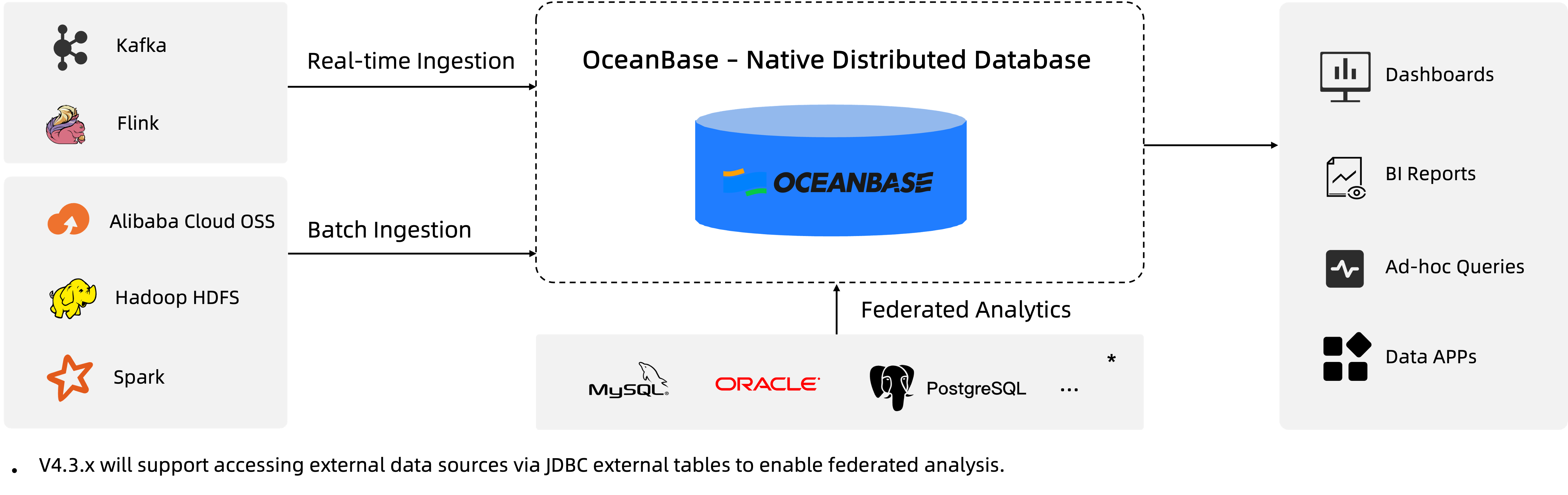
Core benefits
Stability and reliability
- OceanBase Database integrates TP and AP and provides high stability that is testified by core financial transaction systems.
- The ground-breaking deployment mode of "five IDCs across three regions" supports lossless disaster recovery at the region level. The cutting-edge automatic failover with a recovery point objective (RPO) of 0 and a recovery time objective (RTO) of less than 8 seconds ensures business continuity under harsh conditions.
High-performance analysis
- OceanBase Database supports columnar storage, hybrid row-column storage, and a variety of query optimization methods to ensure high query performance. In addition, vectorized engine 2.0 is introduced in OceanBase Database V4.3. It improves execution performance by optimizing data formats, operator implementations, and storage vectorization.
- OceanBase Database provides high ad-hoc query performance comparable to that of ClickHouse.
- OceanBase Database was ranked first in the TPC-H benchmark @ 30,000 GB results.
Low costs and ease of management
- The original TP and AP systems are replaced with one HTAP system, without database or table sharding.
Hybrid Serving/Analytical Processing (HSAP)
- Analysis results are directly provided in online data services.
Multi-model
- OceanBase Database allows you to analyze unstructured data such as text, JSON, and geographic information system (GIS) data by using SQL statements.
Scenarios
Scenario 1: Real-time reporting and risk control
In most cases, databases primarily handle online transaction processing (OLTP) workloads, with occasional periods of handling online analytical processing (OLAP) workloads. In this scenario, it is uneconomical to purchase an AP cluster for analysis. Instead, you can deploy OceanBase Database replicas that use hybrid row-column storage or create columnstore indexes on replicas that use row-based storage. TP workloads are executed based on row-based storage, and AP workloads are executed based on columnar storage. The TP workloads and AP workloads are logically isolated based on resource groups.
In a cluster that uses row-based storage, you can create columnstore indexes to achieve columnar storage capabilities for accelerating queries. Row-based storage and columnar storage in one cluster share one set of resources. Therefore, resource isolation is required. CPU and I/O resources in a tenant are isolated for TP and AP workloads based on control groups (cgroups), thus avoiding interference between the workloads.
- TP workloads are executed based on row-based storage.
- AP workloads are executed based on columnar storage to reduce storage overheads.
- TP and AP workloads are isolated based on resource groups.

Scenario 2: Lightweight real-time data warehouse
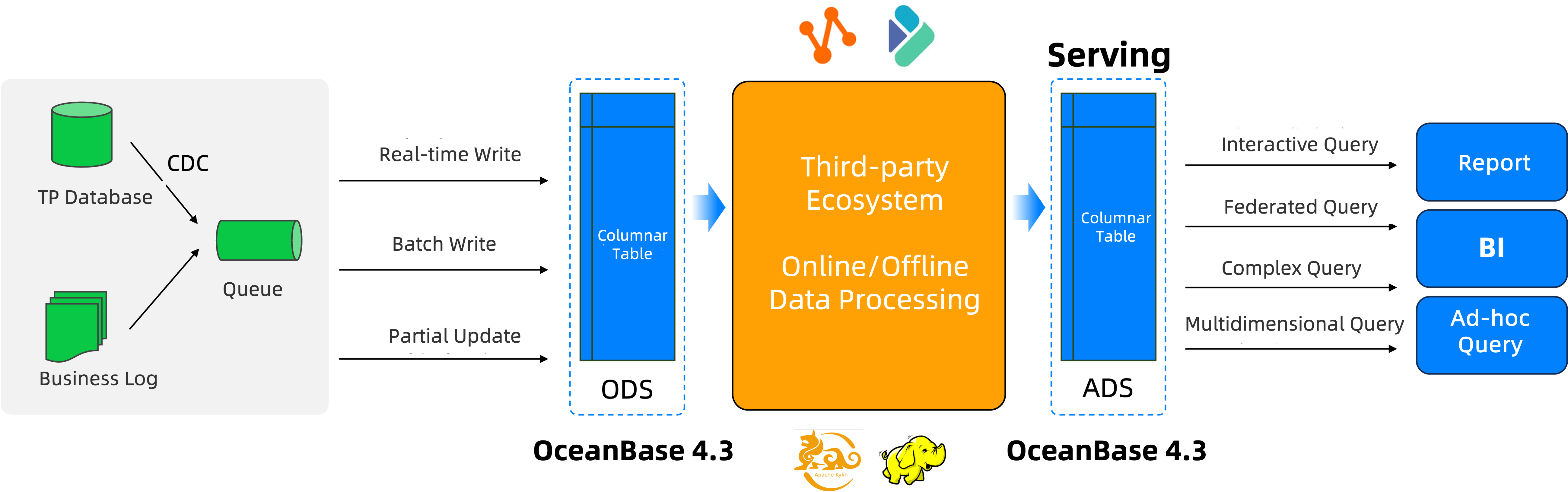
OceanBase Database can serve as a lightweight data warehouse based on its columnar storage, parallel execution engine, vectorized engine, and rewrite- and cost-based optimizer. You can use OceanBase Database in data warehouses to simplify extract-transform-load (ETL). OceanBase Database allows you to use materialized views to simplify ETL. It also supports Flink. Therefore, you can still use Flink for queries without modifications and use OceanBase Database only for storage. OceanBase Database allows you to subscribe to operational data store (ODS) logs for real-time streaming computing. Results are written to ODS for external interactive and federated queries.
- AP workloads are executed based on columnar storage.
- TP workloads are executed based on rowstore indexes to accelerate AP point queries.
- TP and AP workloads are isolated based on resource groups.


Scenario 3: Serving
Quick response and low latency of data processing and analysis are required in serving scenarios to support instant decision-making and interactive data exploration. Columnar storage is usually used to accelerate aggregation operations. Indexes are used to shorten data search time, and distributed computing frameworks can be scaled out to process large-sized datasets.
To improve serving performance, the results are usually pre-spliced into a large wide table during business operation and stored in the database. Then highly concurrent single-table aggregation operations are performed on the large wide table.
You can use OceanBase Database to replace ClickHouse in serving scenarios.
Technical architecture
- For more information about the technical architecture of OceanBase Database, see System architecture.
- For more information about the technical principles of OceanBase Database, see System principles.