

OceanBase logo

OceanBase

A unified distributed database ready for your transactional, analytical, and AI workloads.

DEPLOY YOUR WAY

OceanBase Cloud

The best way to deploy and scale OceanBase

OceanBase Enterprise

Run and manage OceanBase on your infra

TRY OPEN SOURCE

OceanBase Community Edition

The free, open-source distributed database

OceanBase seekdb

Open source AI native search database

Customer Stories

Real-world success stories from enterprises across diverse industries.

View All
BY USE CASES

Mission-Critical Transactions

Global & Multicloud Application

Elastic Scaling for Peak Traffic

Real-time Analytics

Active Geo-redundancy

Database Consolidation

Resources

Comprehensive knowledge hub for OceanBase.

Blog

Live Demos

Training & Certification

Documentation

Official technical guides, tutorials, API references, and manuals for all OceanBase products.

View All
PRODUCTS

OceanBase Cloud

OceanBase Database

Tools

Connectors and Middleware

QUICK START

OceanBase Cloud

OceanBase Database

BEST PRACTICES

Practical guides for utilizing OceanBase more effectively and conveniently

Company

Learn more about OceanBase – our company, partnerships, and trust and security initiatives.

About OceanBase

Partner

Trust Center

Contact Us

International - English
中国站 - 简体中文
日本 - 日本語
Sign In
Start on Cloud

A unified distributed database ready for your transactional, analytical, and AI workloads.

DEPLOY YOUR WAY

OceanBase Cloud

The best way to deploy and scale OceanBase

OceanBase Enterprise

Run and manage OceanBase on your infra

TRY OPEN SOURCE

OceanBase Community Edition

The free, open-source distributed database

OceanBase seekdb

Open source AI native search database

Customer Stories

Real-world success stories from enterprises across diverse industries.

View All
BY USE CASES

Mission-Critical Transactions

Global & Multicloud Application

Elastic Scaling for Peak Traffic

Real-time Analytics

Active Geo-redundancy

Database Consolidation

Comprehensive knowledge hub for OceanBase.

Blog

Live Demos

Training & Certification

Documentation

Official technical guides, tutorials, API references, and manuals for all OceanBase products.

View All
PRODUCTS
OceanBase CloudOceanBase Database
ToolsConnectors and Middleware
QUICK START
OceanBase CloudOceanBase Database
BEST PRACTICES

Practical guides for utilizing OceanBase more effectively and conveniently

Learn more about OceanBase – our company, partnerships, and trust and security initiatives.

About OceanBase

Partner

Trust Center

Contact Us

Start on Cloud
编组
All Products
    • Databases
    • iconOceanBase Database
    • iconOceanBase Cloud
    • iconOceanBase Tugraph
    • iconInteractive Tutorials
    • iconOceanBase Best Practices
    • Tools
    • iconOceanBase Cloud Platform
    • iconOceanBase Migration Service
    • iconOceanBase Developer Center
    • iconOceanBase Migration Assessment
    • iconOceanBase Admin Tool
    • iconOceanBase Loader and Dumper
    • iconOceanBase Deployer
    • iconKubernetes operator for OceanBase
    • iconOceanBase Diagnostic Tool
    • iconOceanBase Binlog Service
    • Connectors and Middleware
    • iconOceanBase Database Proxy
    • iconEmbedded SQL in C for OceanBase
    • iconOceanBase Call Interface
    • iconOceanBase Connector/C
    • iconOceanBase Connector/J
    • iconOceanBase Connector/ODBC
    • iconOceanBase Connector/NET
icon

OceanBase Database

SQL - V4.0.0

  • Document overview
  • Overview
    • Overview
    • System architecture
    • Compatibility with MySQL
    • Limits
  • Get Started
    • Quick experience
    • Hands on for OceanBase SQL
      • Before you start
      • Basic SQL operations
    • Create a sample application
      • Connect to OceanBase Database by using a Python driver
      • Connect to OceanBase Database by using Go MySQL Driver
      • Connect a Java application to OceanBase Database
      • Connect a C application to OceanBase Database
    • Experience OceanBase advanced features
      • Experience scalable OLTP
        • Run the TPC-C benchmark test on OceanBase Database
        • Experience the hot row update capability of OceanBase Database
      • Experience operational OLAP
      • Experience parallel import and data compression
      • Experience the multitenancy feature
  • Develop
    • Connect to Oceanbase Database with client
      • Overview
      • Connect to OceanBase Database by using a MySQL client
      • Connect to OceanBase Database by using OBClient
      • Connect to OceanBase Database by using ODC
      • Connect Java applications to OceanBase Database
      • Connect to OceanBase Database by using Go MySQL Driver
      • Connect to OceanBase Database by using Unix ODBC
      • C application
        • OceanBase Connector/C
        • C API functions
        • Connect C applications to OceanBase Database
      • Connect Python applications to OceanBase Database
      • SpringBoot connection example
      • SpringBatch connection example
      • SpringJDBC connection example
      • SpringJPA connection example
      • Hibernate connection example
      • MyBatis connection example
      • Example of Database connection pool configuration
        • Overview of database connection pool configuration
        • Example of configuring a Tomcat connection pool
        • Example of configuring a C3P0 connection pool
        • Example of configuring a Proxool connection pool
        • Example of configuring a HiKariCP connection pool
        • Example of configuring a DBCP connection pool
        • CommonPool configuration example
        • Example of configuring a JDBC connection pool
    • Create and manage database objects
      • About DDL statements
      • View the currently connected database
      • Change the password of a user
      • Data type
        • General data types
        • Unsupported data types
      • Create and manage tables
        • About tables
        • Create a table
        • About auto-increment columns
        • About types of column constraints
        • About table structure modification
        • About table clearing
        • About table dropping
        • Flash back a dropped table
        • About table privileges
      • Create and manage partition tables
        • About partitioned tables
        • Create a partitioned table
        • Manage a partitioned table
        • Create a subpartitioned table
        • Manage a subpartitioned table
        • Partition routing
        • Indexes on partitioned tables
        • Suggestions on using partitioned tables
      • Create and manage indexes
        • About indexes
        • Create an index
        • Drop an index
      • Create and manage views
        • About views
        • Create a view
        • Modify a view
        • Delete a view
      • Create and manage sequences
        • About sequences
        • Create a sequence
        • Modify a sequence
        • Delete a sequence
    • Query
      • About queries
      • Single-table queries
      • Conditional queries
      • ORDER BY queries
      • GROUP BY queries
      • Use the LIMIT clause in queries
      • Query data from multiple tables
        • About multi-table join queries
        • INNER JOIN queries
        • OUTER JOIN queries
        • Subqueries
      • Use operators and functions in a query
        • Use arithmetic operators in queries
        • Use numerical functions in queries
        • Use string connectors in queries
        • Use string functions in queries
        • Use datetime functions in queries
        • Use type conversion functions in queries
        • Use aggregate functions in queries
        • Use NULL-related functions in queries
        • Use the CASE conditional operator in queries
        • Use the SELECT FOR UPDATE statement to lock query results
      • Execution plan
        • View an execution plan
        • Understand an execution plan
      • Use SQL hints in queries
      • Variables of query timeout
    • DML statements and transactions
      • DML statement
        • About DML statements
        • About the INSERT statement
        • UPDATE statements
        • About the DELETE statement
        • About the REPLACE INTO statement
      • Transactions
        • About transaction control statements
        • Start a transaction
        • Transaction savepoints
        • Commit a transaction
        • Roll back a transaction
        • About transaction timeout
    • Common errors and solutions
      • About error codes
      • Database connection error
      • About timeout
        • Idle session timeout
        • Transaction timeout errors
      • About user
        • Locked user
        • Incorrect user password
      • About table
        • Table already exists
        • Table does not exist
        • Invalid use of NULL value
      • About constraint
        • Unique key conflict
        • Foreign key conflict
      • About SQL commands
        • Data truncation
  • Deploy
    • Overview
    • On-premises deployment
      • Software and hardware requirements
      • Configuration before deployment
      • Deploy OceanBase Database online
      • Deploy OceanBase Database offline
    • Deploy OceanBase Database in a Kubernetes cluster
    • High availability deployment
      • Use Alibaba Otter to implement remote active-active disaster recovery
  • Migrate
    • Data Migration Overview
    • Migrate data from MySQL Database to OceanBase
      • Use Canal to synchronize MySQL data to OceanBase Database in real time
      • Use DataX to migrate MySQL data to OceanBase Database
      • Use DBCAT to migrate MySQL table schemas to OceanBase Database
      • Migrate MySQL table schemas to OceanBase Database by using mysqldump
      • Migrate MySQL table data to OceanBase Database by using mysqldump
    • Use OBDUMPER to export data from or OBLOADER to import data to OceanBase Database
    • Migrate data from CSV-file to OceanBase
      • Use DataX to load CSV data files to OceanBase Database
      • Use the LOAD DATA statement to load CSV data files to OceanBase Database
    • Migrate data from SQL files to OceanBase Database
    • Migrate data and resource units between tables
    • Migrate data from OceanBase Database to MySQL
      • Use Canal to synchronize OceanBase Database data to MySQL in real time

Download PDF

Document overview Overview System architecture Compatibility with MySQL Limits Quick experience Before you start Basic SQL operations Connect to OceanBase Database by using a Python driver Connect to OceanBase Database by using Go MySQL Driver Connect a Java application to OceanBase Database Connect a C application to OceanBase Database Experience operational OLAP Experience parallel import and data compression Experience the multitenancy feature Overview Connect to OceanBase Database by using a MySQL client Connect to OceanBase Database by using OBClient Connect to OceanBase Database by using ODC Connect Java applications to OceanBase Database Connect to OceanBase Database by using Go MySQL Driver Connect to OceanBase Database by using Unix ODBC Connect Python applications to OceanBase Database SpringBoot connection example SpringBatch connection example SpringJDBC connection example SpringJPA connection example Hibernate connection example MyBatis connection example About DDL statements View the currently connected database Change the password of a user About queries Single-table queries Conditional queries ORDER BY queries GROUP BY queries Use the LIMIT clause in queries Use SQL hints in queries Variables of query timeout About error codes Database connection error Overview Software and hardware requirements Configuration before deployment Deploy OceanBase Database online Deploy OceanBase Database offline Deploy OceanBase Database in a Kubernetes cluster Use Alibaba Otter to implement remote active-active disaster recovery Data Migration Overview Use Canal to synchronize MySQL data to OceanBase Database in real time Use DataX to migrate MySQL data to OceanBase Database Use DBCAT to migrate MySQL table schemas to OceanBase Database Migrate MySQL table schemas to OceanBase Database by using mysqldump Migrate MySQL table data to OceanBase Database by using mysqldump Use OBDUMPER to export data from or OBLOADER to import data to OceanBase Database Use DataX to load CSV data files to OceanBase Database Use the LOAD DATA statement to load CSV data files to OceanBase Database Migrate data from SQL files to OceanBase Database Migrate data and resource units between tables Use Canal to synchronize OceanBase Database data to MySQL in real time
OceanBase logo

The Unified Distributed Database for the AI Era.

Follow Us
Products
OceanBase CloudOceanBase EnterpriseOceanBase Community EditionOceanBase seekdb
Resources
DocsBlogLive DemosTraining & Certification
Company
About OceanBaseTrust CenterLegalPartnerContact Us
Follow Us

© OceanBase 2026. All rights reserved

Cloud Service AgreementPrivacy PolicySecurity
Contact Us
Document Feedback
  1. Documentation Center
  2. OceanBase Database
  3. SQL
  4. V4.0.0
iconOceanBase Database
SQL - V 4.0.0
SQL
KV
  • V 4.4.2
  • V 4.3.5
  • V 4.3.3
  • V 4.3.1
  • V 4.3.0
  • V 4.2.5
  • V 4.2.2
  • V 4.2.1
  • V 4.2.0
  • V 4.1.0
  • V 4.0.0
  • V 3.1.4 and earlier

Connect to OceanBase Database by using ODC

Last Updated:2023-07-21 09:11:01  Updated
share
What is on this page
Prerequisites
Usage notes
Procedure
Related topics

folded

share

You can connect to OceanBase Database by using OceanBase Developer Center (ODC).

Prerequisites

  • You have installed ODC.

    To download the ODC installation package of a suitable version, visit Software Center. For more information about how to install ODC, see Install ODC.

  • You have obtained the OceanBase Database connection string from the deployment engineers.

    Information in the connection string is required when you connect to the database by using ODC.

Usage notes

When you connect to OceanBase Database by using ODC, you can connect only to the database in the current tenant.

Procedure

Note

The graphic user interface (GUI) varies with the ODC version. This topic takes ODC V3.2.0 as an example. For other ODC versions, see the ODC User Guide of the corresponding version.

  1. Log on to ODC.

    The ODC homepage appears, and the Private Connection tab is displayed on the ODC homepage.

  2. In the upper-right corner of the Private Connection tab, click Create Connection.
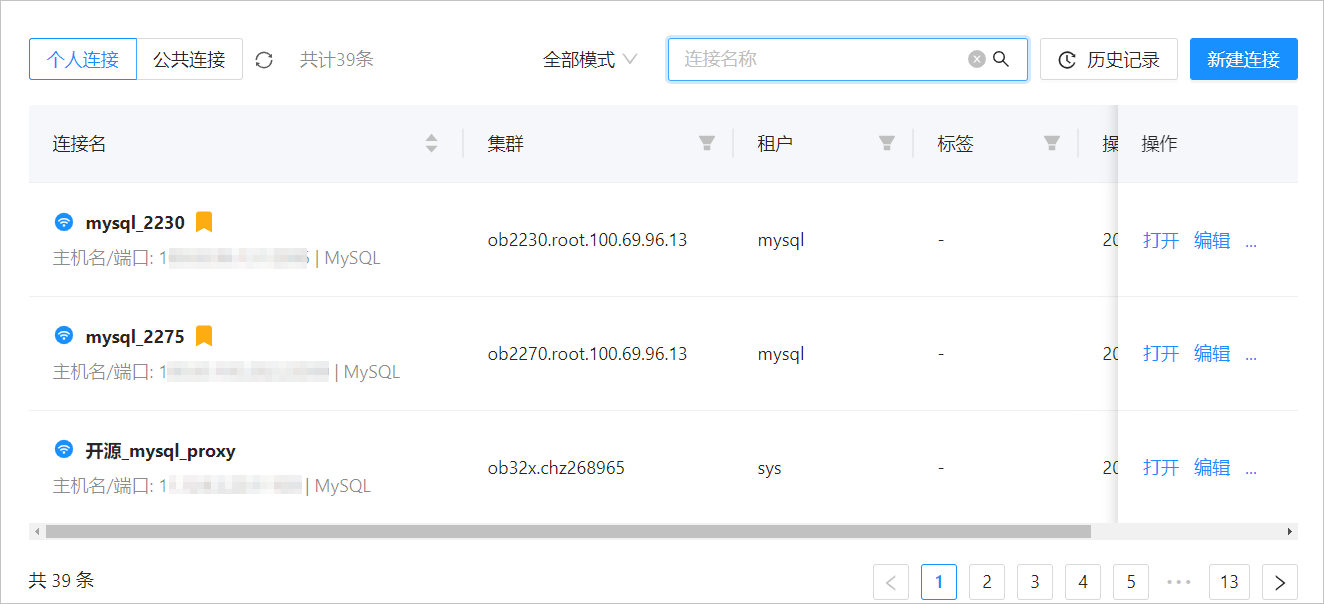
    Create a database connection

    Note

    It takes some time to load the data when you run ODC the first time.

  3. On the page that appears, specify the information about the database to be connected.
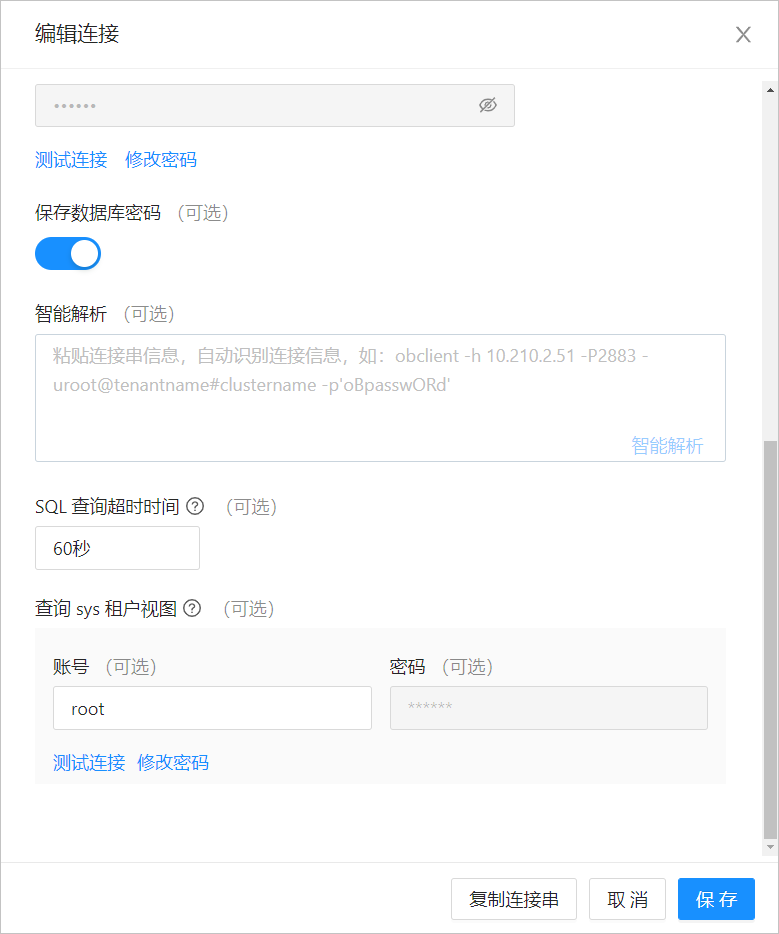
    Edit a connection

    You can specify basic configurations of a database connection in two ways:

    • Specify the information described in the following table based on the OceanBase Database connection string: mysql -h host name -P port number -u database username@tenant name#cluster name -D default database -p database password.

    • Copy the connection string to the Intelligent Parsing field. ODC automatically recognizes the connection string and populates the connection information.

    Item Description
    Region Select Public Cloud if your database instance is deployed on Alibaba Cloud, or select Independent Deployment/Apsara Stack if your database instance is deployed in your own environment.
    Connection Mode Select MySQL.
    Connection Name Specify the name of the connection.
    Set Tag Add a description for the connection. Click the Set Tag button after Connection Name to set a tag for the current connection. You can set and manage tags in the drop-down list that appears.
    • Tag setting: Select a tag from the drop-down list. Create tags first if the list is empty.
    • Tag management: Click Create Tag at the bottom of the list or the settings icon above the list to pop up the Tags window. In the Tags window, you can edit or delete created tags. You can also click the Create Tag button to set a name or color for the new tag.
    Endpoint
    • Host Name: the IP address of the server where the target database is located.
    • Port: the port number of the server where the target database is located.
    • Cluster: the name of the cluster where the target database is located.
    • Tenant: the name of the tenant in which the target database is located.
    Default Database When you connect to a MySQL tenant of OceanBase Database, you must specify the default database for the connection.
    Database Username An account in the tenant. In MySQL mode, this account must have the permission to access the default database.
    Database Password The password of the account in the tenant. You can click the Test Connection button after the password box to test whether you can connect to the target database. An error is returned if the configuration information such as the username, password, or network configuration is invalid.
    Save Database Password If you disable this option, the database password for the connection is not saved. Each time you use or test a connection, you must enter the database password in the password dialog box to use the connection. If you enable this option, the database password for the connection is saved. You do not need to enter the database password each time you use the connection.
    Intelligent Parsing You can paste a connection string to the field. ODC automatically identifies the string and fills in the corresponding fields on the page.
    SQL Query Timeout Value This option appears after you click Advanced Configuration. You can specify a timeout value for SQL queries. A query whose execution time exceeds the timeout value is automatically terminated. The default timeout value is 60 seconds.
    Query sys Tenant View This option appears after you click Advanced Configuration. When Tenant under Endpoint is set to sys, this option is automatically populated.
    • Account: an account having the privilege to check the views under the sys tenant.
    • Password: the password of the account. After you specify the account and password, you can click Test Connection next to the password field to verify whether the account information is valid.
    Note
    In ODC V2.3.0 and later versions, to use the import and export features and check the partition information, you must configure the root@sys account in this field.
  4. Click Save to save the current configuration in the ODC connection list.

  5. In the connection list, click the name of the connection that you saved or click Open in the Actions column to log on to OceanBase Database.
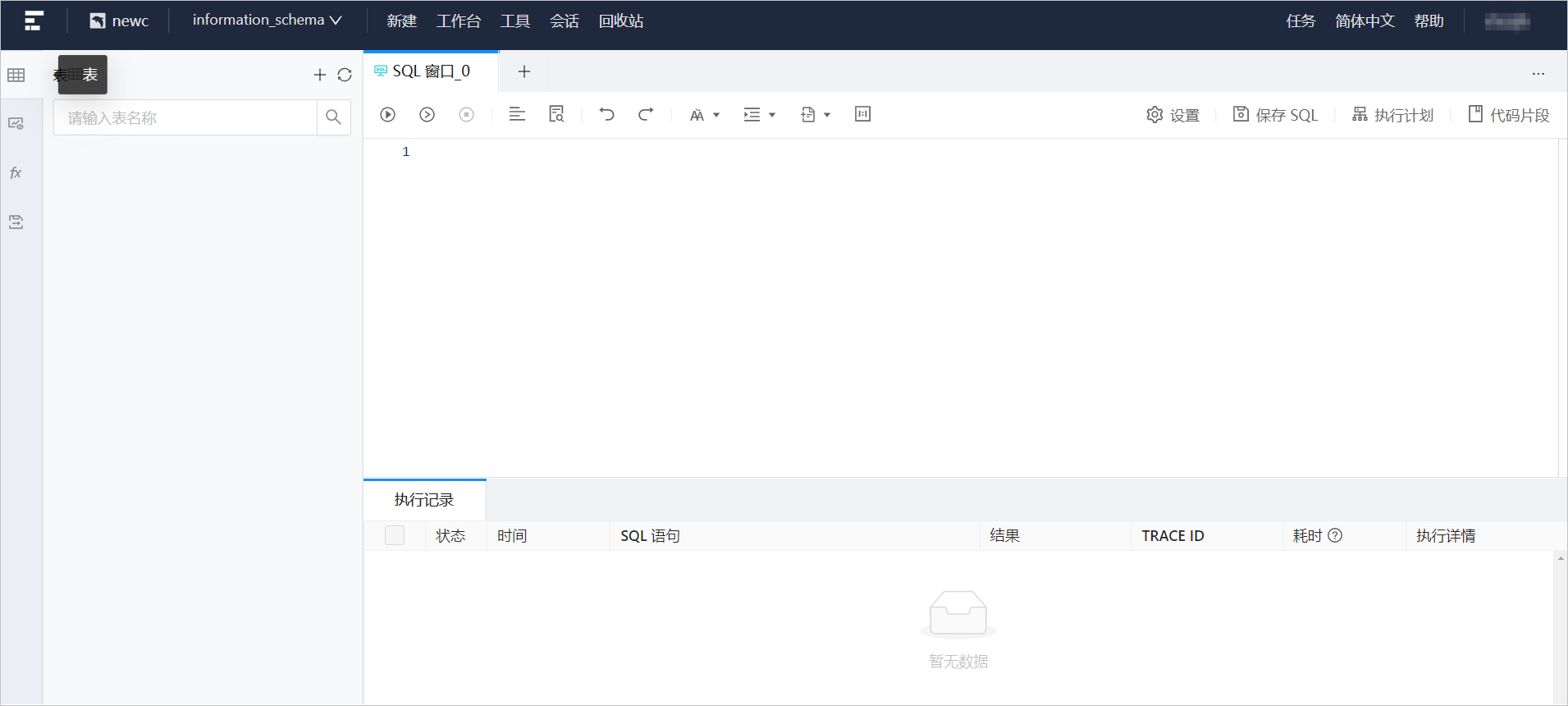
    Database connected

    The preceding page provides the following features:

    • Object management: A GUI is provided for you to create database objects. This makes the operations easier. In addition, you can edit the online table data that you are currently viewing.
    • Console: You can save and edit the content in a SQL window and reuse the scripts that you have saved. You can also format SQL scripts and display structured SQL statements. The SQL editor supports auto-complete when you write SQL statements to save your effort. You can edit and export the result set returned from SQL execution.
    • Toolkit: includes session management, recycle bin management, and import and export tools. Session management: The session management tool enables you to edit database sessions and global properties and terminate specified database sessions. Recycle bin management: The recycle bin management tool allows you to empty and restore database objects in the recycle bin. Import and export: The import and export tools enable you to import or export data of various formats in one or more tables.
    • SQL diagnostics: This feature allows you to diagnose SQL execution plans and view resource consumption during SQL execution. It can help you locate problems in SQL scripts.

Related topics

For more information about how to connect to and use OceanBase Database by using ODC, see the ODC User Guide of the corresponding version.

Previous topic

Connect to OceanBase Database by using OBClient
Last

Next topic

Connect Java applications to OceanBase Database
Next
What is on this page
Prerequisites
Usage notes
Procedure
Related topics