

OceanBase logo

OceanBase

A unified distributed database ready for your transactional, analytical, and AI workloads.

DEPLOY YOUR WAY

OceanBase Cloud

The best way to deploy and scale OceanBase

OceanBase Enterprise

Run and manage OceanBase on your infra

TRY OPEN SOURCE

OceanBase Community Edition

The free, open-source distributed database

OceanBase seekdb

Open source AI native search database

Customer Stories

Real-world success stories from enterprises across diverse industries.

View All
BY USE CASES

Mission-Critical Transactions

Global & Multicloud Application

Elastic Scaling for Peak Traffic

Real-time Analytics

Active Geo-redundancy

Database Consolidation

Resources

Comprehensive knowledge hub for OceanBase.

Blog

Live Demos

Training & Certification

Documentation

Official technical guides, tutorials, API references, and manuals for all OceanBase products.

View All
PRODUCTS

OceanBase Cloud

OceanBase Database

Tools

Connectors and Middleware

QUICK START

OceanBase Cloud

OceanBase Database

BEST PRACTICES

Practical guides for utilizing OceanBase more effectively and conveniently

Company

Learn more about OceanBase – our company, partnerships, and trust and security initiatives.

About OceanBase

Partner

Trust Center

Contact Us

International - English
中国站 - 简体中文
日本 - 日本語
Sign In
Start on Cloud

A unified distributed database ready for your transactional, analytical, and AI workloads.

DEPLOY YOUR WAY

OceanBase Cloud

The best way to deploy and scale OceanBase

OceanBase Enterprise

Run and manage OceanBase on your infra

TRY OPEN SOURCE

OceanBase Community Edition

The free, open-source distributed database

OceanBase seekdb

Open source AI native search database

Customer Stories

Real-world success stories from enterprises across diverse industries.

View All
BY USE CASES

Mission-Critical Transactions

Global & Multicloud Application

Elastic Scaling for Peak Traffic

Real-time Analytics

Active Geo-redundancy

Database Consolidation

Comprehensive knowledge hub for OceanBase.

Blog

Live Demos

Training & Certification

Documentation

Official technical guides, tutorials, API references, and manuals for all OceanBase products.

View All
PRODUCTS
OceanBase CloudOceanBase Database
ToolsConnectors and Middleware
QUICK START
OceanBase CloudOceanBase Database
BEST PRACTICES

Practical guides for utilizing OceanBase more effectively and conveniently

Learn more about OceanBase – our company, partnerships, and trust and security initiatives.

About OceanBase

Partner

Trust Center

Contact Us

Start on Cloud
编组
All Products
    • Databases
    • iconOceanBase Database
    • iconOceanBase Cloud
    • iconOceanBase Tugraph
    • iconInteractive Tutorials
    • iconOceanBase Best Practices
    • Tools
    • iconOceanBase Cloud Platform
    • iconOceanBase Migration Service
    • iconOceanBase Developer Center
    • iconOceanBase Migration Assessment
    • iconOceanBase Admin Tool
    • iconOceanBase Loader and Dumper
    • iconOceanBase Deployer
    • iconKubernetes operator for OceanBase
    • iconOceanBase Diagnostic Tool
    • iconOceanBase Binlog Service
    • Connectors and Middleware
    • iconOceanBase Database Proxy
    • iconEmbedded SQL in C for OceanBase
    • iconOceanBase Call Interface
    • iconOceanBase Connector/C
    • iconOceanBase Connector/J
    • iconOceanBase Connector/ODBC
    • iconOceanBase Connector/NET
icon

OceanBase Connector/ODBC

V2.0.7

  • Overview
  • Driver installation and configuration
    • Prepare for the installation
    • Install and configure OceanBase Connector/ODBC for Linux
    • Install and configure the OceanBase Connector/ODBC driver for Windows
  • User guide
    • Basic operations
    • Enable the logging feature
    • Obtain the REF CURSOR data type
  • Reference information
    • OceanBase Connector/ODBC API functions
    • OceanBase Connector/ODBC data types
    • OceanBase Connector/ODBC error codes
  • FAQ
    • Query timeout
    • Chinese garbled characters
  • Release
    • V2.0
      • OceanBase Connector/ODBC V2.0.7
      • OceanBase Connector/ODBC V2.0.6

Download PDF

Overview Prepare for the installation Install and configure OceanBase Connector/ODBC for Linux Install and configure the OceanBase Connector/ODBC driver for Windows Basic operations Enable the logging feature Obtain the REF CURSOR data type OceanBase Connector/ODBC API functions OceanBase Connector/ODBC data types OceanBase Connector/ODBC error codes Query timeout Chinese garbled characters OceanBase Connector/ODBC V2.0.7 OceanBase Connector/ODBC V2.0.6
OceanBase logo

The Unified Distributed Database for the AI Era.

Follow Us
Products
OceanBase CloudOceanBase EnterpriseOceanBase Community EditionOceanBase seekdb
Resources
DocsBlogLive DemosTraining & Certification
Company
About OceanBaseTrust CenterLegalPartnerContact Us
Follow Us

© OceanBase 2026. All rights reserved

Cloud Service AgreementPrivacy PolicySecurity
Contact Us
Document Feedback
  1. Documentation Center
  2. OceanBase Connector/ODBC
  3. V2.0.7
iconOceanBase Connector/ODBC
V 2.0.7
  • V 2.0.9
  • V 2.0.8
  • V 2.0.7
  • V 2.0.6

Overview

Last Updated:2026-04-09 07:12:04  Updated
share
What is on this page
Application
Driver manager
OceanBase Connector/ODBC
ODBC.INI
OBServer

folded

share

Open Database Connectivity (ODBC) is a database access interface standard based on the Windows environment. It was developed to solve the problem of data sharing among heterogeneous databases. It has now become a major part of WOSA (The Windows Open System Architecture).

ODBC provides a unified interface for accessing heterogeneous databases. It allows applications to access data managed by different database management systems (DBMSs) using SQL as the data access standard. It enables applications to manipulate data directly in the database, eliminating the need for changes when the database changes. ODBC allows access to database files on various computers and also to non-database objects such as Excel sheets and ASCII data files.

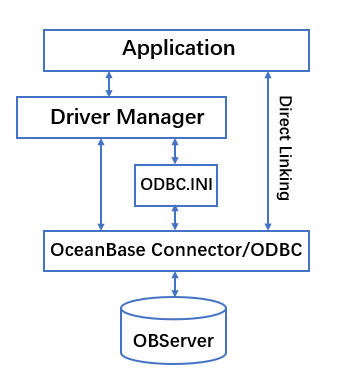
OceanBase Connector/ODBC is customized based on the MySQL ODBC driver. It allows for using the new data models provided by OceanBase Database, such as array. The following figure shows the architecture of OceanBase Connector/ODBC.
odbc-architecture.png

Application

An application accesses data on an OBServer using the standard ODBC API. The ODBC API then communicates with the driver manager. To access data, the application only needs to know the data source name (DSN) and does not need to know where the data is stored, how it is stored, or how the system is configured.

The following tasks are common to all applications that use ODBC:

  • Selecting and connecting to OBServer
  • Submitting SQL statements for execution
  • Retrieving results (if any)
  • Handling errors
  • Committing or rolling back transactions that contain SQL statements
  • Disconnecting from OBServer

Since most data access work is done using SQL, the main task of applications that use OceanBase Connector/ODBC is to submit SQL statements and retrieve the results generated by these statements.

Driver manager

The driver manager is a library used to manage communication between an application and a driver. It mainly performs the following tasks:

  • Parsing the DSN used to connect to the database. Database connection information is identified by the DSN. The DSN is a configuration string that identifies the database driver, database, database host, and optional authentication information. Any ODBC-compatible application can use the pre-configured, identical DSN to connect to the data source.
  • Loading and unloading the driver required to access the database defined in the DSN. For example, if you configure a DSN to connect to an OceanBase database, the driver manager will load the OceanBase Connector/ODBC driver so that the ODBC API can communicate with the OBServer.
  • Handling ODBC function calls or passing them to the driver.

OceanBase Connector/ODBC

OceanBase Connector/ODBC is a library used to implement the functions supported by the ODBC API. It is used to handle ODBC function calls, submit SQL requests to the OBServer, and return the results to the application. It allows for modifying application requests as needed to comply with the syntax rules of OceanBase Database.

ODBC.INI

The ODBC.INI configuration file stores the driver and database information required to connect to the OBServer. According to the DSN defined in ODBC.INI, the driver manager can determine the driver to load, and the driver can read the connection parameters.

OBServer

OBServer stores information for the OceanBase database. Query operations retrieve data from the database, while insert and update operations modify data in the database.

Next topic

Prepare for the installation
Next
What is on this page
Application
Driver manager
OceanBase Connector/ODBC
ODBC.INI
OBServer