







This topic describes how to add a server to an OAT resource pool.
Note
The steps outlined in this topic are for OAT V4.2.0. The interface of different OAT versions may vary. Please refer to the interface of your OAT version.
Prerequisites
You have installed OAT. For more information, see Deploy OAT.
Procedure
Log in to OAT.
In the left-side navigation pane, click Server to go to the Server Management page. In the upper-right corner of the page, click Add Server.
On the Add Server page, enter the basic information.
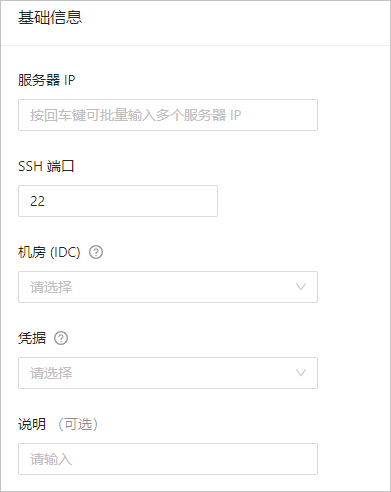
The following table describes the parameters:
ParameterDescriptionServer IP The external IP address of the network adapter of the server to be added. SSH Port The SSH port of the server to be added. IDC The IDC to which the server to be added belongs. Credentials The access credentials of the server to be added. Currently, username and password and keys are supported. Description (Optional) A comment on the server for better host management. On the Add Server page, perform initial configuration.

The following table describes the parameters:
ParameterDescriptionServer Purpose The purpose of the server to be added. OS Owner User The operating system user who installs and runs OBServer and OB services. Custom settings are supported. User Password The password corresponding to the OS owner user. User UID:GID The UID and GID of the OS owner user. Docker Root Directory The root directory of Docker. Clock Synchronization (Optional): By default, clock synchronization is disabled. If you enable clock synchronization, you need to specify the following parameters:
Notice
Server clock synchronization is required between servers hosting OceanBase clusters and servers hosting OCP.
ParameterDescriptionClock Source IP Address The IP address of the clock source. minpoll: The minimum time interval in seconds for the chrony client to request time synchronization from the clock source. maxpoll: The maximum time interval in seconds for the chrony client to request time synchronization from the clock source. maxslewrate: The maximum adjustment rate in PPM (10−6) for the chrony client clock. Allow this server to serve as a secondary clock source (Optional) After you set this parameter, the server can serve as a clock source for external clients requesting access from allowlist IP addresses while blocking access from blocklist IP addresses. Automatic Synchronization to OCP (Optional): By default, automatic synchronization is disabled. If you enable automatic synchronization, you need to select an OCP that has been installed. If no OCP is available, the option will be grayed out. After you complete the initialization setup of the server in OAT, the system automatically calls the API of the selected OCP to add the server to the OCP, which facilitates subsequent use.
Notice
- The OCPs listed here are from Product Services > Products > OCP. For more information, see Deploy OCP.
- Before you use OCP to deploy an OceanBase cluster, add the machine where you want to deploy the cluster to the OCP resource pool.
Disk Initialization (Optional): To ensure the stability of OceanBase Database and related product services, it is generally recommended to configure the service directories on an independent disk. After you select the disk to be initialized, the system will automatically use
lvmto create a correspondingvg, and a corresponding-sizedlv, and mount it to the specified mount directory.- Select Disk or Partition: The system automatically identifies the unmounted disk devices and you can select the disk devices to mount. Multiple disk devices can be selected.
- Mount Purpose: It can be Software Installation Path, Data Disk Path, Log Disk Path, or Docker Root Directory. You can select the mount purpose according to your business requirements.
- Mount Point: You can specify the mount path according to your business requirements.
- Space (GB): You can specify the space size according to your business requirements. The unit is GB.
Click OK.
If you enable the disk initialization feature, a dialog box displaying the check items will appear when you submit the request. After the check items are verified and no errors are reported, click OK to add the server.
If you disable the disk initialization feature, you can directly submit the request and perform the initialization later.
After the server is successfully submitted, you can view it in the server list. The status of the server is Initializing. On the Server Management page, you can find the added server and click Actions in the View Tasks column to view the task progress. If there are many servers, you can search for the target server by IP address at the top of the page.
If an error occurs with a subtask and the error does not affect your business, you can view the log information, manually set the subtask to success, and then continue with other subtasks.
Next steps
After the server is added, you can deploy OCP as needed:
After OCP is deployed and the server is added, you can deploy an OceanBase cluster as needed:
- Deploy an OceanBase cluster with OCP
- Deploy an OceanBase cluster with one replica using OCP
- Deploy an OceanBase cluster with three replicas using OCP
References
- For more information about how to add servers, see Add servers.
- After the server is initialized, you can perform O&M operations on it. For more information, see O&M the server.