






Log on to OceanBase Developer Center (ODC) and click the name of the target connection to go to the corresponding connection management page. You can click Table in the left-side navigation pane to get a list of tables. You can double-click the name of a table to go to the table management page, and click the Attribute button in the navigation bar on the top of the page to go to the Attribute tab.
The Attribute tab displays the following table attributes:
Basic information
Column
Index
Constraints
Partition
DDL
Basic information
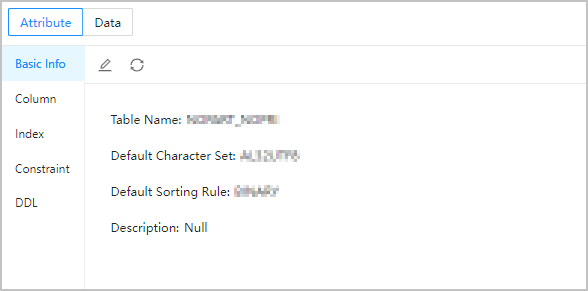
In the left-side navigation pane of the Attribute tab, click Basic Info to view the basic information about the table.
Table Name : displays the name of the table. You can modify the table name here.
Default Character Set : displays the character set that the table uses.
Default Sorting Rule : displays the sorting rule that the table uses.
Description : displays the description that you specified when you created the table. You can also modify the table description here.
Column information
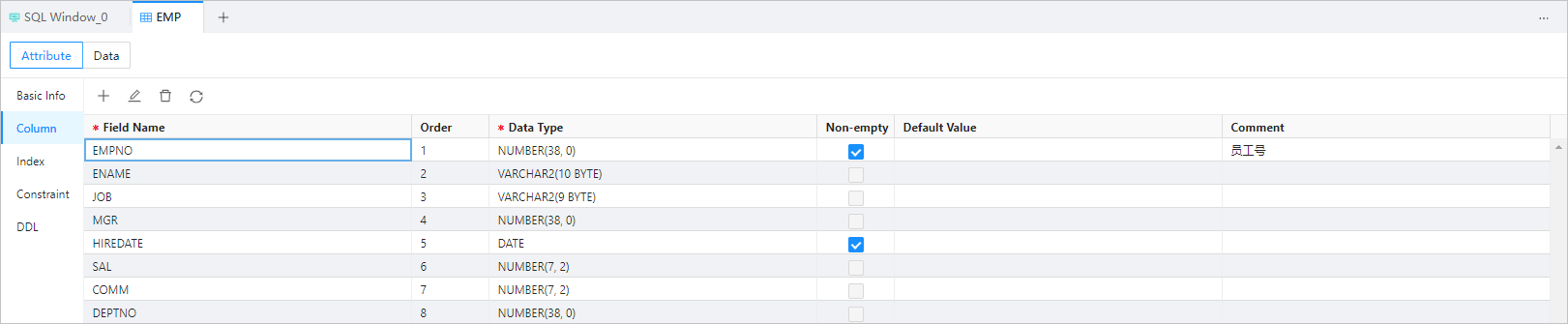
In the left-side navigation pane of the Attribute tab, click Column to view the columns in the table. The navigation bar also provides the following buttons:
Add : Click this button to add a column to the table.
Edit : Click this button to open the editing page where you can edit the selected field. You can modify Data Type , Primary Key , Non-empty , Default Value , and Comment , but cannot modify Field Name . You can also directly double-click a cell to edit it.
Delete : Click this button to delete the selected field.
Index information
In the left-side navigation pane of the Attribute tab, click Index to view the indexes in the table. The navigation bar also provides the following buttons:
Create : Click this button to create an index for the table.
Delete : Click this button to delete the selected index.
Note
An index cannot be modified after it is created.

Constraint information
In the left-side navigation pane of the Attribute tab, click Constraint to view the constraints in the table. The navigation bar also provides the following buttons:
Create : Click this button to create a constraint for the table.
Edit : Click this button to edit the selected constraint.
Delete : Click this button to delete the selected constraint.
Refresh : Click this button to refresh the constraint list.
Note
The buttons provided vary with the constraint method. If a button is dimmed out or not present in the navigation bar, it means that the constraint method does not support the corresponding action.

Partition information
In the left-side navigation pane of the Attribute tab, click Partition to view the information about the partitions in the table. The information includes Partition Name , Order , Partitioning Method , Expression , Upper limit of the range , and Enumeration Value . In Oracle mode, Expression indicates the partition key. The information displayed varies with the partitioning method. The navigation bar also provides the following buttons:
Create : Click this button to create a partition from an undefined range.
Edit : Click this button to edit the information of the selected partition.
Split : Click this button to split a partition into smaller granules.
Delete : Click this button to delete the selected partition and destroy the data in the partition.
Refresh : Click this button to refresh the partition list.

DDL information
In the left-side navigation pane of the Attribute tab, click DDL to view the DDL statements that define the table. You cannot edit these statements. Click Format in the toolbar to view the statements.