






Log on to OceanBase Developer Center (ODC) and click the name of the target connection to go to the corresponding connection management page. You can click Stored Procedure in the left-side navigation pane to get a list of stored procedures in the current database.
In the stored procedure list, you can view the structure tree of an object, or right-click the target object to perform some management actions on the object. You can also double-click the name of the stored procedure in the list to go to the stored procedure management page .
Structure tree
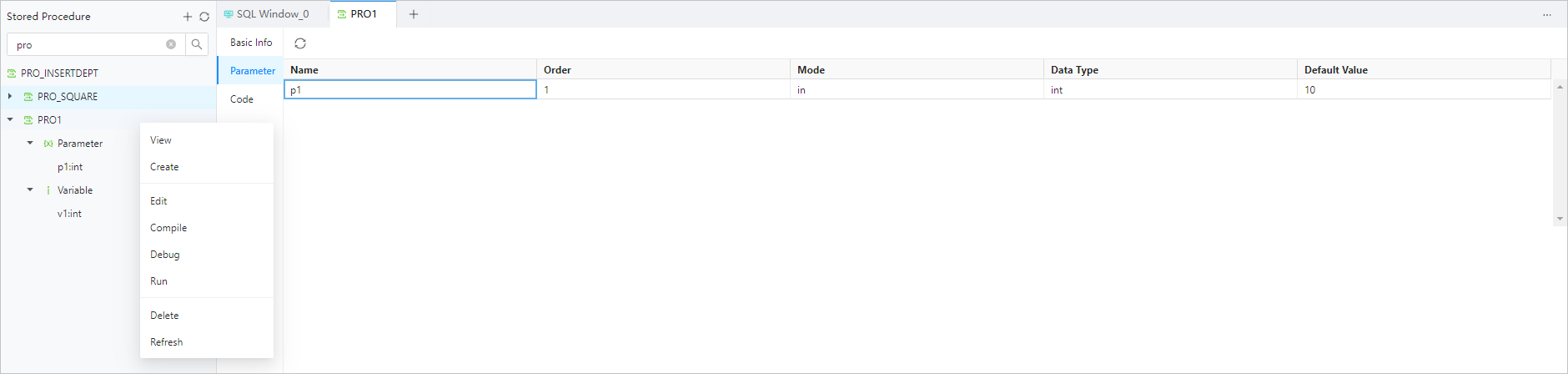
You can click the expand icon before the name of the target stored procedure in the stored procedure list, and the structure tree of the stored procedure is displayed in a drop-down list, as shown in the following figure. The structure tree of a stored procedure can have up to three levels. When you right-click an item in the tree, the shortcut menu displays some actions that you can perform on the item. For more information about these actions, see the Management actions section, where you can find the table describing the management options.
Management actions
Right-click the target object in the structure tree. A shortcut menu appears, displaying some management options provided by ODC for you to conveniently manage the target object.
The following table describes the management options.
| Option | Description |
|---|---|
| View | Click this option to go to the stored procedure management page , where you can view comprehensive information such as the basic information, parameters, and code of the stored procedure. |
| Create | Click this option to go to the Create Stored Procedure page, where you can create a stored procedure as prompted. |
| Edit | Click this option to go to the stored procedure editing page , which displays the statements that define the stored procedure and where you can continue to edit the stored procedure. |
| Compile | Click this option to compile the stored procedure. |
| Debug | Click this option to go to the debugging page , where you can debug the stored procedure. PL object debugging is supported only when OBServer V2.2.70, V3.0.00, or a later version is connected. |
| Run | Click this option to execute the stored procedure. |
| Delete | Click this option to delete the stored procedure. |
| Refresh | Click this option to refresh the structure tree after you perform management actions on the stored procedure, so that the structure tree displays the latest information. |
Stored procedure management page
The stored procedure management page displays the following information:
Basic Info : displays information about the stored procedure, such as Stored Procedure Name , Created By , Creation Time , and Last Modified At .
Parameter : displays parameter information, such as Name , Order , Mode , Data Type , and Default Value .
Code : displays the script that defines the stored procedure and provides the Edit and Find buttons. You can click Edit to go to the stored procedure editing page.

Stored procedure editing page
Right-click the target item in the stored procedure list. In the menu that appears, click Edit to go to the stored procedure editing page. In the code area of the editing page, the statements that define the stored procedure are displayed. You can edit the statements. In addition, the toolbar provides the following buttons:
| Button | Description |
|---|---|
| Confirm Modification | Click this button to apply the current modification. |
| Compile | Click this button to compile the statements on the current page. |
| Run | Click this button to execute the statements in the code area. |
| Debug | Click this button to enter the debug mode, which allows you to edit the PL/SQL object in the code area. |
| Format | Click this button to apply formatting, such as indentation, line break, and keyword highlighting, to the selected SQL statements or all the SQL statements in the current SQL window. |
| Find and Replace | You can specify search criteria in the search box to find specific content in the script and enter other content in the replacement box to replace the content found. |
| Undo | Click this button to undo the last operation. |
| Redo | Click this button to reverse an Undo operation. |
| Case Sensitivity | The system supports three configurations: All Caps , All Lowercase , and Capitalize the first letter . Click this button to convert the selected statements in the script to the corresponding capitalization format. |
| Indent | The Add Indents and Delete Indent options are provided, to allow you to add indents to or delete indents from the selected statements in the script. |
| Comment | The Add Comments and Delete Comment options are provided, which respectively allow you to convert the selected statements in the script to comments and convert comments to SQL statements. |