

OceanBase logo

OceanBase

A unified distributed database ready for your transactional, analytical, and AI workloads.

DEPLOY YOUR WAY

OceanBase Cloud

The best way to deploy and scale OceanBase

OceanBase Enterprise

Run and manage OceanBase on your infra

TRY OPEN SOURCE

OceanBase Community Edition

The free, open-source distributed database

OceanBase seekdb

Open source AI native search database

Customer Stories

Real-world success stories from enterprises across diverse industries.

View All
BY USE CASES

Mission-Critical Transactions

Global & Multicloud Application

Elastic Scaling for Peak Traffic

Real-time Analytics

Active Geo-redundancy

Database Consolidation

Resources

Comprehensive knowledge hub for OceanBase.

Blog

Live Demos

Training & Certification

Documentation

Official technical guides, tutorials, API references, and manuals for all OceanBase products.

View All
PRODUCTS

OceanBase Cloud

OceanBase Database

Tools

Connectors and Middleware

QUICK START

OceanBase Cloud

OceanBase Database

BEST PRACTICES

Practical guides for utilizing OceanBase more effectively and conveniently

Company

Learn more about OceanBase – our company, partnerships, and trust and security initiatives.

About OceanBase

Partner

Trust Center

Contact Us

International - English
中国站 - 简体中文
日本 - 日本語
Sign In
Start on Cloud

A unified distributed database ready for your transactional, analytical, and AI workloads.

DEPLOY YOUR WAY

OceanBase Cloud

The best way to deploy and scale OceanBase

OceanBase Enterprise

Run and manage OceanBase on your infra

TRY OPEN SOURCE

OceanBase Community Edition

The free, open-source distributed database

OceanBase seekdb

Open source AI native search database

Customer Stories

Real-world success stories from enterprises across diverse industries.

View All
BY USE CASES

Mission-Critical Transactions

Global & Multicloud Application

Elastic Scaling for Peak Traffic

Real-time Analytics

Active Geo-redundancy

Database Consolidation

Comprehensive knowledge hub for OceanBase.

Blog

Live Demos

Training & Certification

Documentation

Official technical guides, tutorials, API references, and manuals for all OceanBase products.

View All
PRODUCTS
OceanBase CloudOceanBase Database
ToolsConnectors and Middleware
QUICK START
OceanBase CloudOceanBase Database
BEST PRACTICES

Practical guides for utilizing OceanBase more effectively and conveniently

Learn more about OceanBase – our company, partnerships, and trust and security initiatives.

About OceanBase

Partner

Trust Center

Contact Us

Start on Cloud
编组
All Products
    • Databases
    • iconOceanBase Database
    • iconOceanBase Cloud
    • iconOceanBase Tugraph
    • iconInteractive Tutorials
    • iconOceanBase Best Practices
    • Tools
    • iconOceanBase Cloud Platform
    • iconOceanBase Migration Service
    • iconOceanBase Developer Center
    • iconOceanBase Migration Assessment
    • iconOceanBase Admin Tool
    • iconOceanBase Loader and Dumper
    • iconOceanBase Deployer
    • iconKubernetes operator for OceanBase
    • iconOceanBase Diagnostic Tool
    • iconOceanBase Binlog Service
    • Connectors and Middleware
    • iconOceanBase Database Proxy
    • iconEmbedded SQL in C for OceanBase
    • iconOceanBase Call Interface
    • iconOceanBase Connector/C
    • iconOceanBase Connector/J
    • iconOceanBase Connector/ODBC
    • iconOceanBase Connector/NET
icon

OceanBase Tugraph

V3.3.3Enterprise Edition

  • Guide
    • What is a graph
    • What is a graph database
    • TuGraph Quick Start
  • Operating
    • Introduction
    • Installation
    • Data Importing
    • Service configuration
    • Service operations
    • Tools
      • tugraph_cypher Instructions
      • TuGraph Browser
      • TuGraph DataX Instructions
      • TuGraph Explore Instructions
    • High Availability mode
    • Database Management
    • User rights Management
  • Developer Document
    • TuGraph RESTful API
    • TuGraph-Cypher
    • TuGraph Stored Procedure Guide
    • Graph Analytics Engine
      • Bootstrap program
      • OlapBase API
      • OlapOnDB API
      • OlapOnDisk API
      • TuGraph Built-in Algorithm Description
  • Client
    • TuGraph Java SDK
    • TuGraph Python SDK
    • TuGraph C++ SDK
  • Supplement
    • Update the content description
  • Community
    • TuGraph Contribution Guide
    • TuGraph community roles
    • TuGraph Open source planning
    • Ant_Group_Open_Source_Individual_CLA_English_Chinese_2021
    • Ant_Group_Open_Source_Corporate_CLA_English_Chinese_2021

Download PDF

What is a graph What is a graph database TuGraph Quick Start Introduction Installation Data Importing Service configuration Service operations tugraph_cypher Instructions TuGraph Browser TuGraph DataX Instructions TuGraph Explore Instructions High Availability mode Database Management User rights Management TuGraph RESTful API TuGraph-Cypher TuGraph Stored Procedure Guide Bootstrap program OlapBase API OlapOnDB API OlapOnDisk API TuGraph Built-in Algorithm Description TuGraph Java SDK TuGraph Python SDK TuGraph C++ SDK Update the content description TuGraph Contribution Guide TuGraph community roles TuGraph Open source planningAnt_Group_Open_Source_Individual_CLA_English_Chinese_2021Ant_Group_Open_Source_Corporate_CLA_English_Chinese_2021
OceanBase logo

The Unified Distributed Database for the AI Era.

Follow Us
Products
OceanBase CloudOceanBase EnterpriseOceanBase Community EditionOceanBase seekdb
Resources
DocsBlogLive DemosTraining & Certification
Company
About OceanBaseTrust CenterLegalPartnerContact Us
Follow Us

© OceanBase 2026. All rights reserved

Cloud Service AgreementPrivacy PolicySecurity
Contact Us
Document Feedback
  1. Documentation Center
  2. OceanBase Tugraph
  3. V3.3.3
iconOceanBase Tugraph
V 3.3.3Enterprise Edition

TuGraph Explore Instructions

Last Updated:2023-06-25 03:23:24  Updated
share
What is on this page
Introduction to TuGraph
Install TuGraph
TuGraph operation
Introduction to TuGraph Explore
Start TuGraph Explore
Connect TuGraph

folded

share

TuGraph Explore is strongly dependent on TuGraph, so before starting Explore, we need to start TuGraph first.

Introduction to TuGraph

TuGraph is a graph database independently developed by Ant Group, which provides graph database engine and graph analysis engine. Its main features are large data storage and computation, and it also supports efficient online transaction processing (OLTP) and Online analysis processing (OLAP).

Install TuGraph

Refer to the official documentation () for more information.

TuGraph needs to be installed via Docker Image, follow these steps to install it locally:

  • install local Docker environment: referenceofficial documentation;
$ sudo docker --version

If the above command can print the docker version number successfully, it indicates that the docker environment has been installed.

  • To download TuGraph images:Download TuGraph Image

Currently, TuGraph provides an image file based on Ubuntu 16.04 LTS and CenterOS 7.3. The image file is a compressed file named lgraph_x.y.z.ar, where x.y.z is the version number of TuGraph.

  • Load the TuGraph image:
// lgraph_lastest.tar.gz 是 TuGraph 镜像文件名
$ docker import lgraph_lastest.tar.gz

// After the loading is complete, a message is displayed indicating that the image has been loaded
  • Start Docker
$ docker run -d -v {host_data_dir}:/mnt -p 7090:7090 -it reg.docker.alibaba-inc.com/tugraph/tugraph:x.y.z
$ docker exec -it {container_id} bash

// host_data_dir = /Users/moyee/tugraph
// container_id = xxx
$ docker run -d -v /Users/moyee/tugraph:/mnt -p 7090:7090 -it reg.docker.alibaba-inc.com/tugraph/tugraph:3.1.1
$ docker exec -it xxx bash

Parameter Description

  • -v volume mapping
  • {host_data_dir} is a directory where the user wants to store data, such as/home/user1/workspace
  • -p The function of Docker is port mapping. The example maps Docker's port 7090 to the local port 7090
  • {container_id} is the container id of Docker, which can be obtained through docker ps

TuGraph operation

Start TuGraph Service

$ lgraph_server --license /mnt/fma.lic --config ~/demo/movie/lgraph.json
  • fma.lic is the authorization file, should be placed in {host_data_dir} folder, mapped to the /mnt directory of docker
  • lgraph.json is the configuration file for TuGraph

TuGraph Browser Query

TuGraph Browser Is a visual query tool provided by TuGraph. Users can open the browser, type {IP}:{Port}, enter the default username by 'admin', password by '73@TuGraph' to complete the login. Enter the TuGraph Query page after successful login.
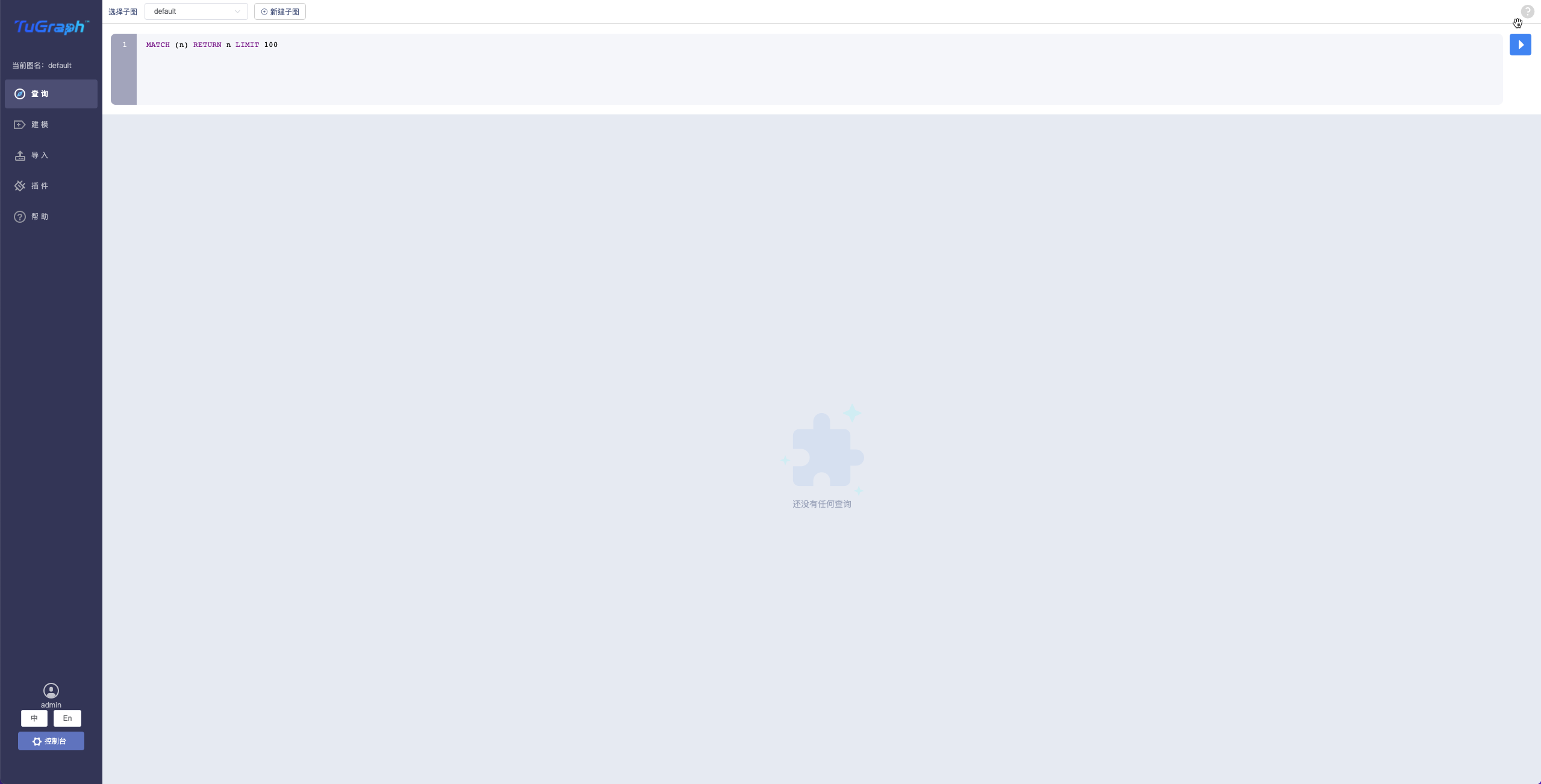
image.png

Introduction to TuGraph Explore

TuGraph Explore is a GraphInsight based visual graph analysis platform that provides complete graph exploration and analysis capabilities to help users gain valuable insights from massive graph data.

Start TuGraph Explore

Once TuGraph is installed successfully, you can start installing TuGraph Explore.

  • Load TuGraph Explore image:
// lgraph_lastest.tar.gz TuGraph image file name 
$ docker import tugraph_explore.tar.gz

// After the loading is complete, a message is displayed indicating that the image has been loaded
  • Start Docker
$ docker run -d -p 7091:7091 -it reg.docker.alibaba-inc.com/tugraph-explore:1.0.1
$ docker exec -it {container_id} bash

Parameter Description:

  • -p The function of Docker is port mapping. In this example, Docker port 7091 is mapped to local port 7091

  • {container_id} is the id of a Docker container, which can be obtained through docker ps

  • Start TuGraph Explore

$ cd /usr/src/tugraphexplore
$ npm run dev -- -p 7091

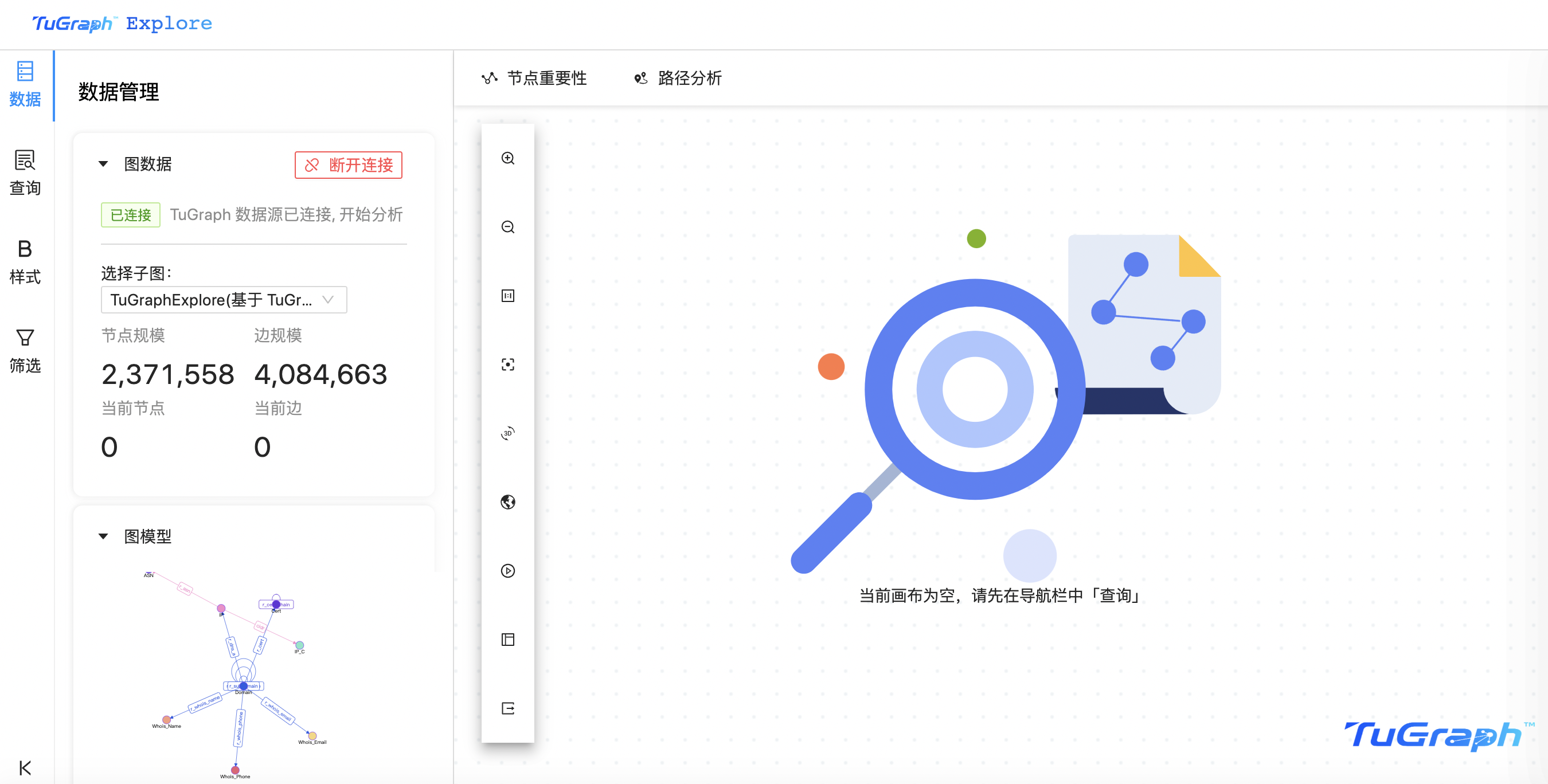
After the TuGraph Explore service started, it can be accessed through **http://localhost:7091/tugraph/explore.html** ,If everything is normal, you will see the following page.image.png
Connect TuGraph

Once TuGraph Explore is up, the first step is to connect to the TuGraph database. Click the "Connect" button to bring up the page for connecting to the Graph database, as shown in the image below. image.png

To connect to TuGraph data, we need to provide the following information:

  • Graph database account
  • Graph database password
  • Address of the graph database: The format is ip:port

The IP address needs to be the container IP address, which can be queried by running the following command。

$ docker run -d -v /Users/xx/tugraph:/mnt -p 7090:7090 -it reg.docker.alibaba-inc.com/tugraph/tugraph:3.3.0
$ docker exec -it 8408b49033bc1698(TuGraph container) bash
$ cat /etc/hosts
127.0.0.1	localhost
::1	localhost ip6-localhost ip6-loopback
fe00::0	ip6-localnet
ff00::0	ip6-mcastprefix
ff02::1	ip6-allnodes
ff02::2	ip6-allrouters
172.17.0.4	8408b543243bc69

As shown above, the address to connect the graph database should be filled in:172.17.0.4:7090。

Previous topic

TuGraph DataX Instructions
Last

Next topic

High Availability mode
Next
What is on this page
Introduction to TuGraph
Install TuGraph
TuGraph operation
Introduction to TuGraph Explore
Start TuGraph Explore
Connect TuGraph