







Locality is introduced to describe the types and distribution strategies of multiple replicas of data. The current version of OceanBase Database supports only tenant-level locality, and no longer supports table-level, database-level, or table group-level locality.
Replicas refer to the data itself, while locality refers to the container that holds the data. This means that the distribution strategies and types of containers described by locality apply to the data they contain.
The current version of OceanBase Database supports only tenant-level locality, whereas OceanBase Database V3.x supports tenant-, table-, database-, and table group-level locality.
Syntax
The syntax of locality is as follows:
replicas{count}@location
The following table describes the elements in the syntax.
Element |
Description |
|---|---|
| replicas | The type of the replica. The value of this element is the name of the replica type. Both full names and short names are supported. For more information about the valid values, see Overview. |
| location | The location of the replica. It contains a collection of values that are known to the system. The value of this element is the names of zones. You can query for the names of zones in a cluster or tenant from the oceanbase.DBA_OB_ZONES view. |
| count | The number of replicas. The value is fixed to 1, indicating only one replica. You can leave this element unspecified. |
You can query the locality of a tenant from the LOCALITY field in the oceanbase.DBA_OB_TENANTS view of the sys tenant. Here is an example:
obclient> SELECT * FROM oceanbase.DBA_OB_TENANTS limit 10;
+-----------+-------------+-------------+----------------------------+----------------------------+--------------+---------------+-------------------+--------------------+--------+---------------+--------+-------------+-------------------+------------------+---------------------+---------------------+---------------------+---------------------+--------------+----------------------------+
| TENANT_ID | TENANT_NAME | TENANT_TYPE | CREATE_TIME                | MODIFY_TIME                | PRIMARY_ZONE | LOCALITY      | PREVIOUS_LOCALITY | COMPATIBILITY_MODE | STATUS | IN_RECYCLEBIN | LOCKED | TENANT_ROLE | SWITCHOVER_STATUS | SWITCHOVER_EPOCH | SYNC_SCN            | REPLAYABLE_SCN      | READABLE_SCN        | RECOVERY_UNTIL_SCN  | LOG_MODE     | ARBITRATION_SERVICE_STATUS |
+-----------+-------------+-------------+----------------------------+----------------------------+--------------+---------------+-------------------+--------------------+--------+---------------+--------+-------------+-------------------+------------------+---------------------+---------------------+---------------------+---------------------+--------------+----------------------------+
|         1 | sys         | SYS         | 2023-05-17 18:10:19.940353 | 2023-05-17 18:10:19.940353 | RANDOM       | FULL{1}@zone1 | NULL              | MYSQL              | NORMAL | NO            | NO     | PRIMARY     | NORMAL            |                0 |                NULL |                NULL |                NULL |                NULL | NOARCHIVELOG | DISABLED                   |
|      1001 | META$1002   | META        | 2023-05-17 18:15:21.455549 | 2023-05-17 18:15:36.639479 | zone1        | FULL{1}@zone1 | NULL              | MYSQL              | NORMAL | NO            | NO     | PRIMARY     | NORMAL            |                0 |                NULL |                NULL |                NULL |                NULL | NOARCHIVELOG | DISABLED                   |
|      1002 | mysql001    | USER        | 2023-05-17 18:15:21.461276 | 2023-05-17 18:15:36.669988 | zone1        | FULL{1}@zone1 | NULL              | MYSQL              | NORMAL | NO            | NO     | PRIMARY     | NORMAL            |                0 | 1684398681521302749 | 1684398681521302749 | 1684398681345969089 | 4611686018427387903 | NOARCHIVELOG | DISABLED                   |
|      1003 | META$1004   | META        | 2023-05-17 18:18:19.927859 | 2023-05-17 18:18:36.443233 | zone1        | FULL{1}@zone1 | NULL              | MYSQL              | NORMAL | NO            | NO     | PRIMARY     | NORMAL            |                0 |                NULL |                NULL |                NULL |                NULL | NOARCHIVELOG | DISABLED                   |
|      1004 | oracle001   | USER        | 2023-05-17 18:18:19.928914 | 2023-05-17 18:18:36.471606 | zone1        | FULL{1}@zone1 | NULL              | ORACLE             | NORMAL | NO            | NO     | PRIMARY     | NORMAL            |                0 | 1684398681335427475 | 1684398681335427475 | 1684398681144712832 | 4611686018427387903 | NOARCHIVELOG | DISABLED                   |
|      1005 | META$1006   | META        | 2023-05-18 15:48:57.441320 | 2023-05-18 15:49:12.820051 | zone1        | FULL{1}@zone1 | NULL              | MYSQL              | NORMAL | NO            | NO     | PRIMARY     | NORMAL            |                0 |                NULL |                NULL |                NULL |                NULL | NOARCHIVELOG | DISABLED                   |
|      1006 | mq_t1       | USER        | 2023-05-18 15:48:57.447657 | 2023-05-18 15:49:12.857944 | zone1        | FULL{1}@zone1 | NULL              | MYSQL              | NORMAL | NO            | NO     | PRIMARY     | NORMAL            |                0 | 1684398680916392609 | 1684398680916392609 | 1684398680742451346 | 4611686018427387903 | NOARCHIVELOG | DISABLED                   |
+-----------+-------------+-------------+----------------------------+----------------------------+--------------+---------------+-------------------+--------------------+--------+---------------+--------+-------------+-------------------+------------------+---------------------+---------------------+---------------------+---------------------+--------------+----------------------------+
7 rows in set
Examples
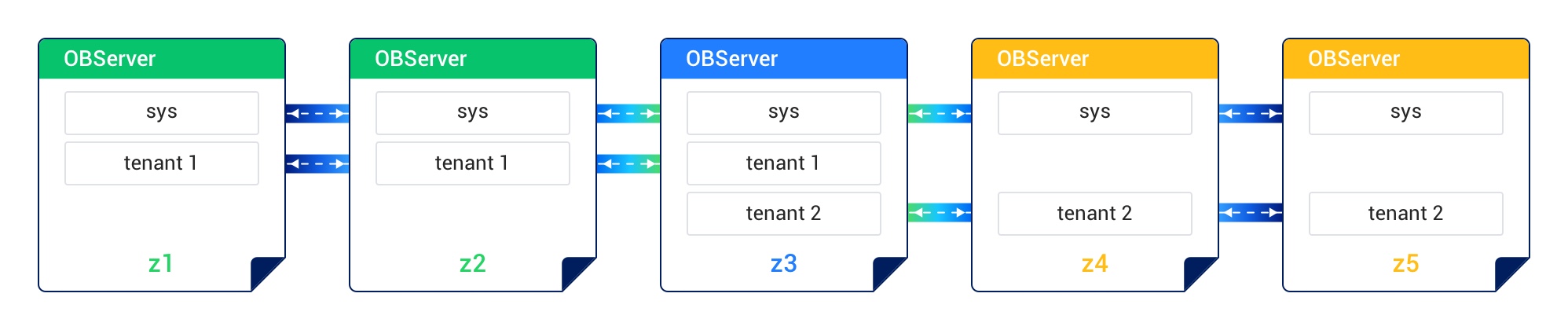
The following example describes the locality of different tenants in an OceanBase cluster that has five zones. The zones are z1 to z5.
Locality of the
systenant:F@z1,F@z2,F@z3,F@z4,F@z5.This locality indicates that the
systenant has a full-featured replica in each of zonesz1,z2,z3,z4, andz5.Locality of the
tenant1tenant:F@z1,F@z2,F@z3.This locality indicates that the
tenant1tenant has a full-featured replica in each of zonesz1,z2, andz3.Locality of the
tenant2tenant:F@z3,F@z4,F@z5.This locality indicates that the
tenant2tenant has a full-featured replica in each of zonesz3,z4, andz5.
The following figure shows an example.
Locality and high-availability architecture
The multi-replica architecture of OceanBase Database contributes to its architectural benefits against conventional databases. The multi-replica architecture is the basis for OceanBase Database to achieve lossless disaster recovery at different levels, including the server level, IDC level, and city level. OceanBase Database allows you to flexibly adjust the cluster deployment architecture to adapt to the technical evolution of business systems.
The flexible deployment architecture of OceanBase Database relies on the locality. Locality describes the replica types and the distribution strategies for replicas across zones. The region attribute of a zone describes the region to which the zone belongs. You can query the region to which a zone belongs from the REGION field in the oceanbase.DBA_OB_ZONES view. You can adjust the distribution of multiple replicas of a tenant across zones in different regions to flexibly adjust the deployment mode.
OceanBase Database supports three typical deployment modes: three IDCs in the same region, three IDCs across two regions, and five IDCs across three regions. The following table describes the locality in different deployment modes.
Deployment mode |
Locality |
Zone distribution |
|---|---|---|
| Three IDCs in the same region | F@z1,F@z2,F@z3 |
Zones z1, z2, and z3 belong to IDC 1, IDC 2, and IDC 3 in the R1 region, respectively. |
| Three IDCs across two regions | F@z1,F@z2,F@z3,F@z4,F@z5 |
Zones z1 and z2 belong to IDC 1 in the R1 region. Zones z3 and z4 belong to IDC 2 in the R1 region. The z5 zone belongs to the R2 region. |
| Five IDCs across three regions | F@z1,F@z2,F@z3,F@z4,F@z5 |
Zones z1 and z2 belong to IDC 1 and IDC 2 in the R1 region. Zones z3 and z4 belong to IDC 3 and IDC 4 in the R2 region. The z5 zone belongs to the R3 region. |