







This topic describes how to try out OceanBase Database Community Edition by deploying a demo environment, a cluster environment, and a container environment.
Notice
The methods described in this topic are for trying out OceanBase Database and do not apply to production environments. To deploy OceanBase Database in a production environment, see Deploy OceanBase Database.
Background information
OceanBase Database provides a unified all-in-one package since V4.0.0. You can use this package to install obd, OceanBase Database, ODP, OBAgent, Grafana, and Prometheus at the same time. Starting from V4.1.0, the all-in-one package also supports installing OCP Express. You can choose to install all or some components based on your needs.
Component overview
obd
OceanBase Deployer is a tool for installing and deploying OceanBase Database. It is abbreviated as obd. For more information, see obd documentation.
ODP
OceanBase Database Proxy is a dedicated proxy server for OceanBase Database. It is abbreviated as ODP (also known as OBProxy). For more information, see ODP documentation.
OCP Express
OceanBase Cloud Platform Express (OCP Express) is a web-based management tool for OceanBase Database 4.x. It is integrated into an OceanBase cluster and supports key performance metrics and basic database management features of the cluster. For more information, see OceanBase Cloud Platform Express (OCP Express).
OBAgent
OBAgent is a monitoring and data collection framework for OceanBase Database. It supports both push and pull data collection modes to meet different application scenarios.
Grafana
Grafana is an open-source data visualization tool that visualizes various metrics from data sources to help you better understand the system operation status and performance. For more information, visit the official website of Grafana.
Prometheus
Prometheus is an open-source service monitoring system and time series database. It provides a general data model and quick data collection, storage, and query interfaces. For more information, visit the official website of Prometheus.
Solution overview
To help you quickly get started with OceanBase Database, we offer three different solutions for rapid deployment of OceanBase data. You can choose the solution that best fits your environment.
Solution 1: Deploy an OceanBase demonstration environment
This solution is ideal for users with only one server, allowing them to quickly set up a functional OceanBase database environment. The deployed environment provides basic database functionality, offering a good way to understand OceanBase Database. However, it lacks distributed capabilities and high availability features, so it's not recommended for long-term use. For detailed instructions, see Solution 1: Deploy an OceanBase demonstration environment.
Solution 2: Deploy an OceanBase cluster environment
This solution is suitable for users who want to gain a deeper understanding of the distributed architecture and features of OceanBase Database. The deployed cluster provides full database capabilities and distributed high availability. To implement this solution, you need at least three servers with 4 vCPU, 10 GB of memory, and 50 GB of disk space. For detailed instructions, see Solution 2: Deploy an OceanBase cluster environment.
Solution 3: Deploy an OceanBase container environment
This solution is designed for users who want to deploy and manage OceanBase Database using containers. However, this solution has not been validated on a large scale, so it is recommended to use it with caution. For detailed instructions, see Solution 3: Deploy an OceanBase container environment.
Prerequisites
Before you install OceanBase Database based on this topic, make sure that your software and hardware environment meets the following requirements:
Item |
Description |
|---|---|
| System |
|
| CPU | Minimum of 2 cores, recommended 4 cores or more. |
| Memory | Minimum of 6 GB, recommended 16 GB to 1024 GB. |
| Disk type | Use SSDs. |
| Disk storage space | Minimum of 20 GB. |
| File system | EXT4 or XFS. If the data exceeds 16 TB, use XFS. |
| All-in-one package | The all-in-one package must be V4.1.0 or later. |
| Docker | If you deploy OceanBase Database by using Docker, install Docker and start the Docker service before you proceed. For more information, see Docker documentation.
NoteOn an x86 architecture-based Mac, only Docker V4.9.0 or earlier can be used to deploy OceanBase Database. You can click this link to download Docker. |
Note
The following information is based on the CentOS Linux 7.9 image of the x86 architecture. The information may vary for other environments.
Option 1: Deploy OceanBase Database in demo mode
If you have only one available server, you can use the obd demo command to quickly deploy OceanBase Database on a single server.
Step 1: Download and install the all-in-one package
Download the latest version of the all-in-one package from OceanBase Download Center and upload it to any directory on your server.
In the directory where the package is located, run the following commands to decompress and install the package.
[admin@test001 ~]$ tar -xzf oceanbase-all-in-one-*.tar.gz
[admin@test001 ~]$ cd oceanbase-all-in-one/bin/
[admin@test001 bin]$ ./install.sh
[admin@test001 bin]$ source ~/.oceanbase-all-in-one/bin/env.sh
Step 2: Deploy OceanBase Database on a single server
Run the following command to deploy OceanBase Database.
[admin@test001 ~]$ obd demoBy default, the
obd democommand deploys OceanBase Database and its components (ODP, OBAgent, Grafana, and Prometheus) with minimum specifications and starts them in the home directory of the current user. The name of the deployed cluster is fixed todemo. For more information about customized deployment, see Quick deployment command.You can also use obd commands to manage OceanBase Database. For more information about the commands, see Cluster commands.
Note
If you install Grafana or Prometheus, its access address is displayed in the command output. In Alibaba Cloud or other cloud environments, an intranet IP address may be displayed if the public IP address cannot be obtained. This IP address is not a public IP address. You must use the correct IP address.
Run the connection command in the output to connect to the database.
After the
obd democommand is executed, you will find the command to connect to OceanBase Database through OBClient. Here are two examples:Directly connect to the database through port 2881
[admin@test001 ~]$ obclient -h127.0.0.1 -P2881 -uroot@sys -Doceanbase -AConnect to the database through ODP
[admin@test001 ~]$ obclient -h127.0.0.1 -P2883 -uroot@sys -Doceanbase -A
For more information about how to connect to an OceanBase cluster using the OBClient client, see Connect to an OceanBase tenant by using OBClient. For more information about how to connect to OceanBase Database, see Overview of connection methods.
(Optional) Configure the password.
After you deploy OceanBase Database using the
obd democommand, you can follow the steps below to configure a password for the demo cluster.Modify the configuration file.
obd cluster edit-config demoAfter you run the above command to open the configuration file, add
root_password: xxxxunder the oceanbase-ce component in the configuration file. After the modification is completed, save the file and exit. Here is an example:oceanbase-ce: servers: - 127.0.0.1 global: home_path: /home/admin/oceanbase-ce ... # Some parameters are omitted here. log_disk_size: 13G root_password: ******Restart the cluster.
After you modify and save the configuration file, obd will output the restart command. You can directly copy and execute it. Here is an example:
[admin@test001 ~]$ obd cluster edit-config demo
Search param plugin and load ok
Search param plugin and load ok
Parameter check ok
Save deploy "demo" configuration
Use `obd cluster reload demo` to make changes take effect.
Trace ID: 29dd12fa-3d73-11ee-91bc-00163e01cd7a
If you want to view detailed obd logs, please run: obd display-trace 29dd12fa-3d73-11ee-91bc-00163e01cd7a
As you can see, after you modify the password for the root@sys user in the configuration file, you need to run the
obd cluster reload democommand to restart the demo cluster.
Solution 2: Deploy OceanBase Database in a cluster
If you have multiple servers available, you can use obd web commands to start the GUI and deploy a distributed OceanBase cluster on the GUI.
Note
This section describes only simple operations to help you quickly deploy a distributed OceanBase cluster. For more information, see Deploy an OceanBase cluster on the GUI.
Step 1: Download and install the all-in-one package
Download the latest version of the all-in-one package from OceanBase Download Center and upload it to any directory on your server.
In the directory where the package is located, run the following commands to decompress and install the package.
[admin@test001 ~]$ tar -xzf oceanbase-all-in-one-*.tar.gz
[admin@test001 ~]$ cd oceanbase-all-in-one/bin/
[admin@test001 bin]$ ./install.sh
[admin@test001 bin]$ source ~/.oceanbase-all-in-one/bin/env.sh
Step 2: Deploy OceanBase Database using the GUI
Run the
obd webcommand in the command-line interface to start the GUI. Log in to the GUI based on the address in the output and click Start Experience Tour to start the deployment.[admin@test001 ~]$ obd web start OBD WEB in 0.0.0.0:8680 please open http://172.xx.xxx.233:8680Note
The GUI uses port 8680 by default. You can run the
obd web -p <PORT>command to specify a port.In Alibaba Cloud or other cloud environments, the program may fail to obtain a public IP address and output an intranet address. This IP address is not a public IP address. You must use the correct IP address to access the GUI.
The
obd webcommand is bound to 0.0.0.0. In a multi-network card deployment scenario, you can use any accessible IP address to access the GUI.
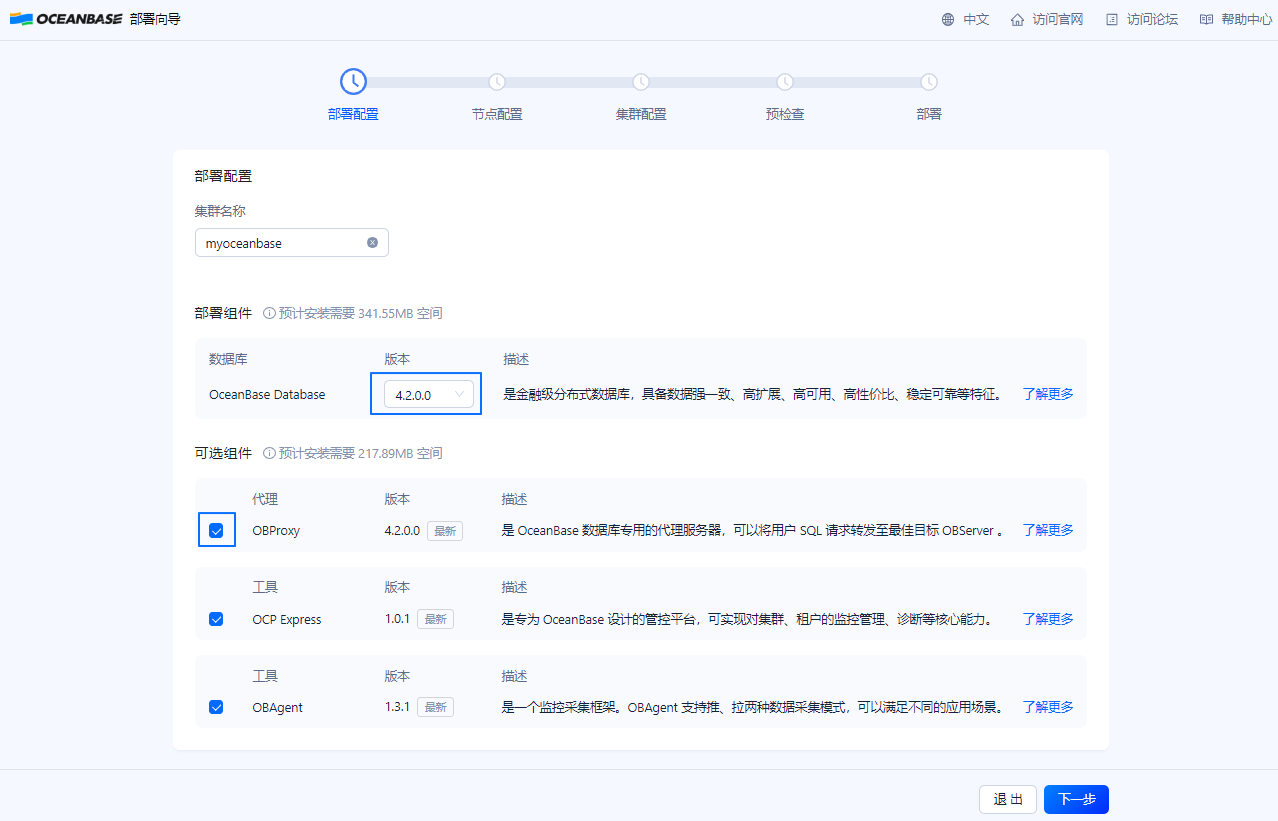
On the Deployment Configuration page, modify Cluster Name and select the components to deploy. You can also use the default configuration (deploy all components). Click Next to go to the Node Configuration page.
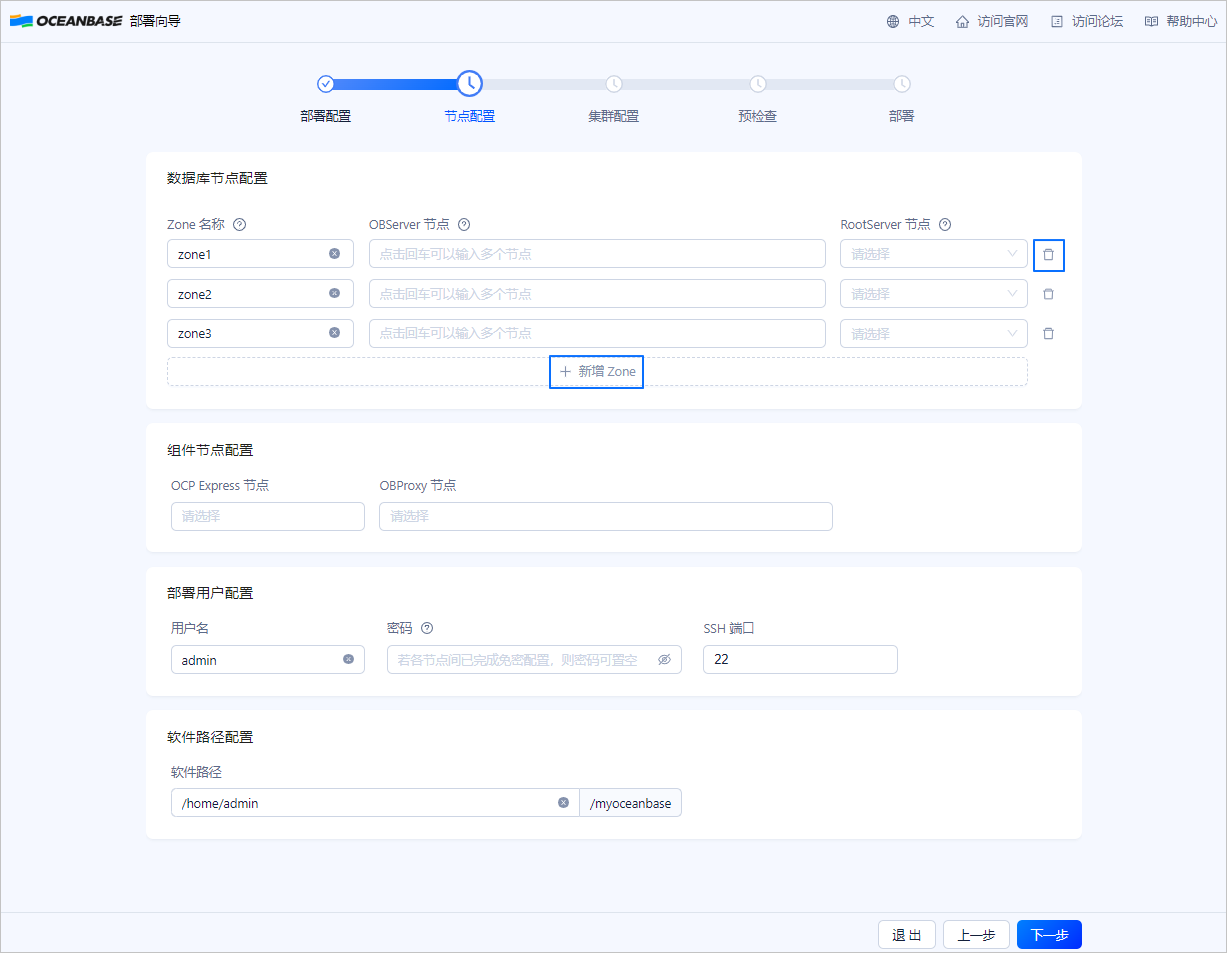
On the Node Configuration page, enter the node IP address and user password, and click Next to go to the Cluster Configuration page.
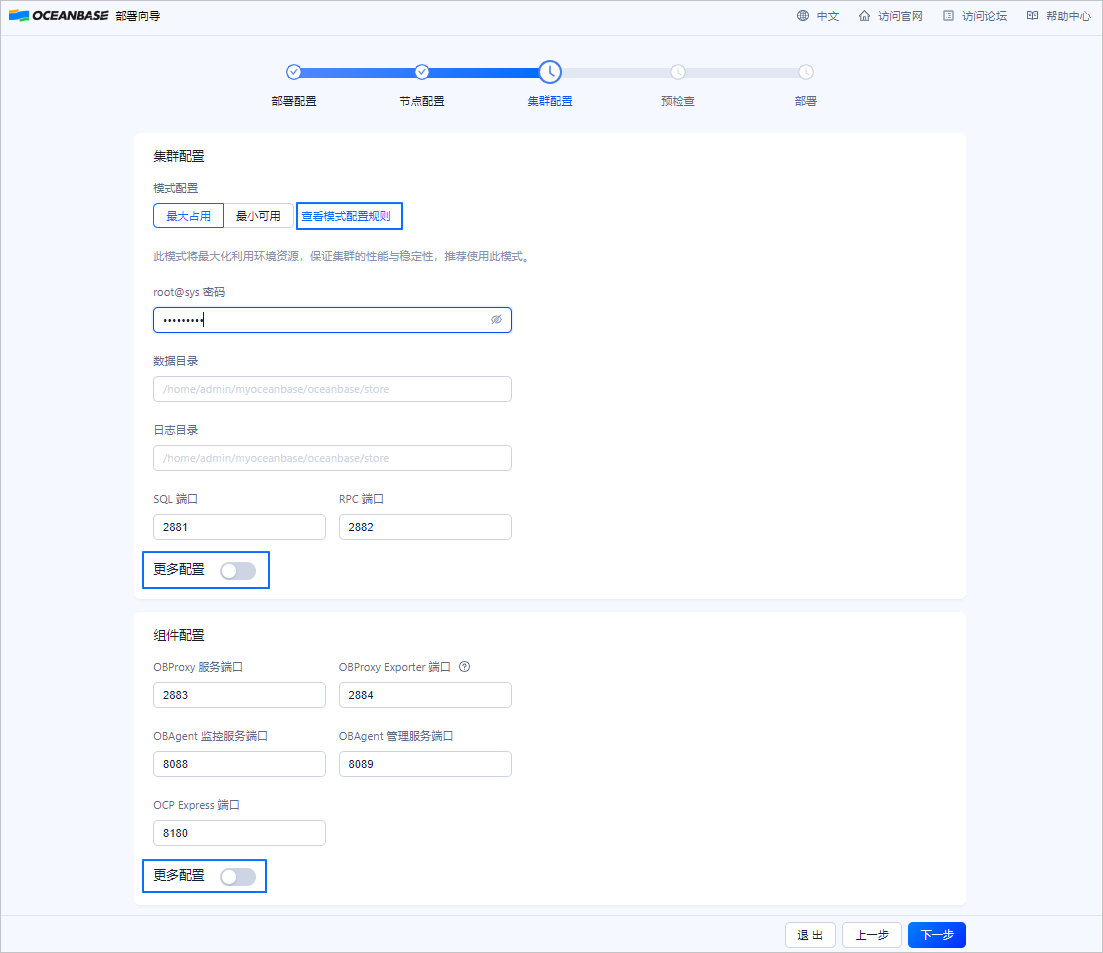
On the Cluster Configuration page, configure the deployment mode, password, directory, port, and other parameters of the cluster. You can also use the default configuration. Click Next to go to the Pre-check page.
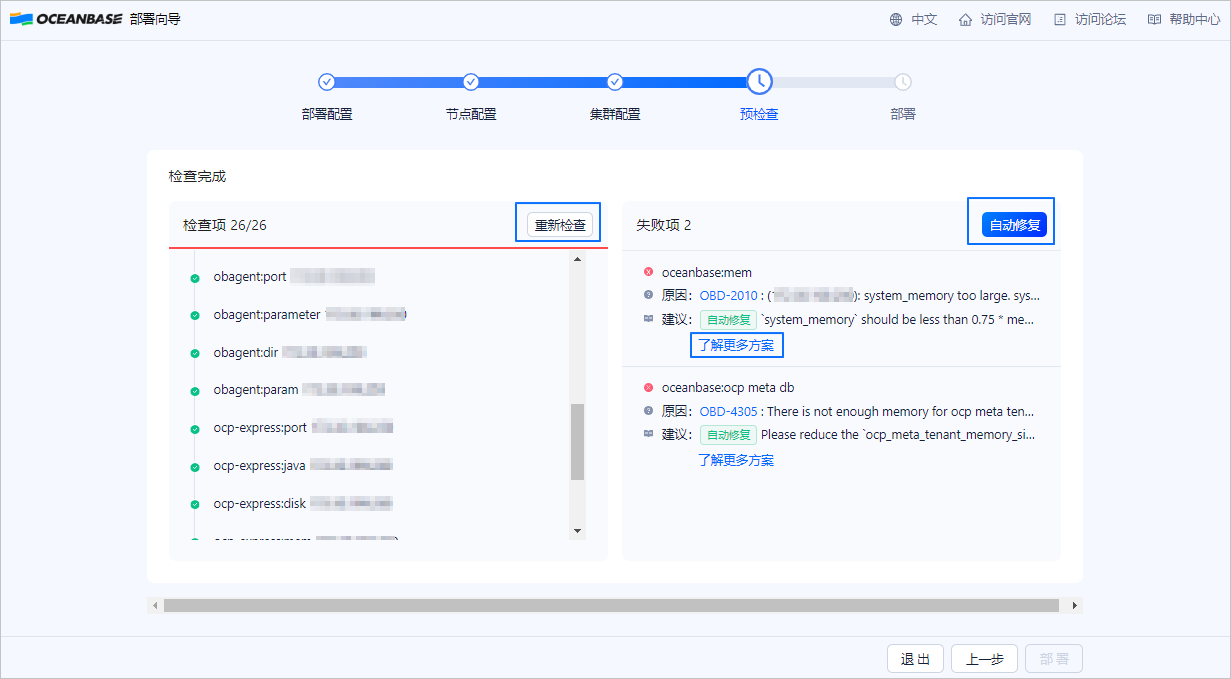
On the Pre-check page, view the configuration information and click Pre-check to perform a check. If an error is returned during the precheck, you can choose Auto Repair based on the suggestions on the page or click More Solutions to go to the error code documentation. You can modify the configurations based on the documentation. After all errors are modified, you can click Recheck to perform the precheck again.
After the precheck is passed, click Deploy to start deploying the OceanBase cluster. After the deployment is successful, you can copy the connection method of each component to access it.
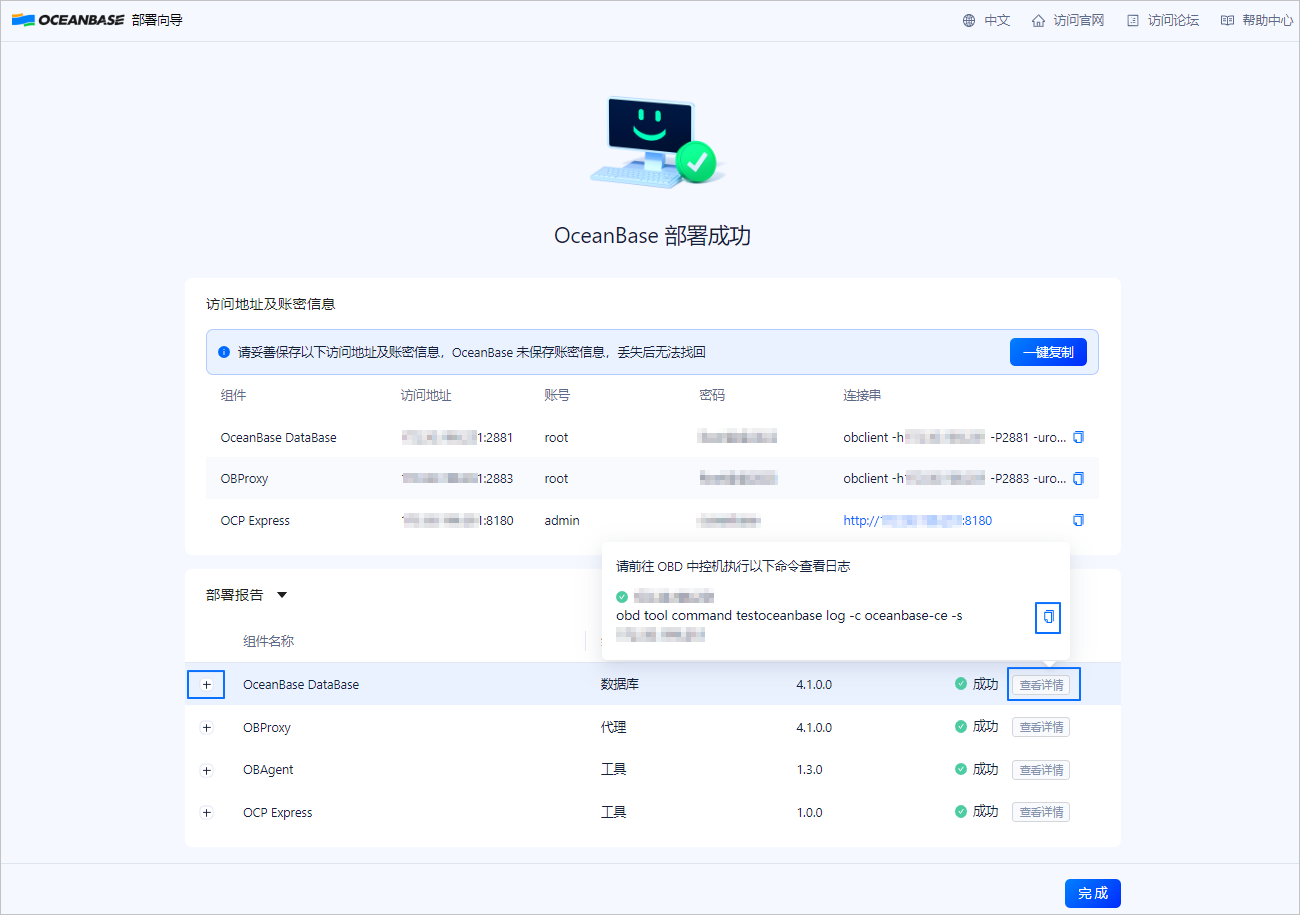
Click Complete to end the deployment process.
Connect to OceanBase Database by using OBClient or log in to the GUI of OCP Express to manage the cluster.
For more information about how to connect to an OceanBase cluster by using OBClient, see Connect to an OceanBase tenant by using OBClient. For more information about other methods of connecting to OceanBase Database, see Overview of connection methods.
Directly connect to the database through port 2881. For example, directly connect to node 10.10.10.1.
[admin@test001 ~]$ obclient -h10.10.10.1 -P2881 -uroot@sys -p -Doceanbase -AAccess the database through ODP. For example, ODP is located on node 10.10.10.1.
[admin@test001 ~]$ obclient -h10.10.10.1 -P2883 -uroot@sys -p -Doceanbase -A
Option 3: Deploy OceanBase Database in a container
You can start OceanBase Database in a Docker container based on the information in this section to learn about OceanBase Database.
(Optional) Step 1: Pull the OceanBase Database image
Run the following commands to pull the image of OceanBase Database.
Search for images related to OceanBase Database.
[admin@test001 ~]$ sudo docker search oceanbasePull the latest image of OceanBase Database.
[admin@test001 ~]$ sudo docker pull oceanbase/oceanbase-ceNote
By default, the preceding command pulls the latest version of Docker image. You can select a desired image from Docker images as needed.
Step 2: Start an OceanBase Database instance
Run the following command to start an OceanBase Database instance.
[admin@test001 ~]$ sudo docker run -p 2881:2881 -v $PWD/ob:/root/ob -v $PWD/obd/cluster:/root/.obd/cluster --name obstandalone -e MODE=NORMAL -d oceanbase/oceanbase-ce
[admin@test001 ~]$ sudo docker run -p 2881:2881 -v $PWD/ob:/root/ob -v $PWD/obd/cluster:/root/.obd/cluster --name obstandalone -e MODE=MINI -d oceanbase/oceanbase-ce
In fast startup mode, if you set environment variables related to tenants and resources, all variables except OB_TENANT_PASSWORD and OB_SYS_PASSWORD will not take effect. The name of the created user tenant will be test by default and cannot be changed.
[admin@test001 ~]$ sudo docker run -p 2881:2881 -v $PWD/ob:/root/ob -v $PWD/obd/cluster:/root/.obd/cluster --name obstandalone -e MODE=SLIM -d oceanbase/oceanbase-ce
The options in the example have the following meanings:
-pis used to map the container's port to the host's port. In the example, port2881in the container is mapped to port2881on the host.-vis used to share files or directories between the container and the host, enabling data persistence or configuration sharing. By default, OceanBase Database is deployed in the/root/obdirectory in the container, and its configuration is saved in the/root/.obd/clusterdirectory. You can use this option to persist data on the host.You can also use the
-voption to mount the SQL file you want to execute. Here is an example. You need to replace{init_sql_folder_path}with the actual path to the initialization SQL file.[admin@test001 ~]$ sudo docker run -p 2881:2881 -v {init_sql_folder_path}:/root/boot/init.d --name obstandalone -e MODE=SLIM -d oceanbase/oceanbase-ce--nameis used to set the Docker container name. In the example, a Docker container namedobstandaloneis created.-eis used to set environment variables. In the example,MODEspecifies the startup mode of OceanBase Database.
Note
By default, the enable_rich_error_msg parameter is enabled when Docker is started. If an error occurs, you can use the trace command to obtain detailed error information.
The startup is expected to take 2 to 5 minutes. Run the following command. If it returns boot success!, the startup is successful.
[admin@test001 ~]$ sudo docker logs obstandalone | tail -1
boot success!
Step 3: Connect to the OceanBase instance
The oceanbase-ce image is installed with obd (OceanBase Deployer, an OceanBase installation tool) and OBClient (an OceanBase command-line client). You can either enter the container and use obd commands and OBClient to connect to the instance, or use the local OBClient or MySQL client on the host to connect to the OceanBase instance.
Connect after entering the container
Enter the Docker container
[admin@test001 ~]$ sudo docker exec -it obstandalone bashView cluster details
# View the cluster list.
obd cluster list
# View the details of the obcluster cluster.
obd cluster display obcluster
Connect to the cluster
obclient -h127.0.0.1 -uroot@sys -A -Doceanbase -P2881 -p
Connect using the local host client
You can use the local OBClient or MySQL client on the host to connect to the OceanBase instance. Here is an example:
[admin@test001 ~]$ obclient -uroot@sys -h127.0.0.1 -P2881 -p
Note
If the password was not configured through environment variables when the OceanBase instance was started, the default password for users created in the instance is an empty string.
Upon successful connection, the terminal will display the following message:
Welcome to the OceanBase.  Commands end with ; or \g.
Your OceanBase connection id is 3221506989
Server version: 5.7.25 OceanBase_CE 4.2.1.3   (r103000032023122818-8fe69c2056b07154bbd1ebd2c26e818ee0d5c56f) (Built Dec 28 2023 19:07:26)

Copyright (c) 2000, 2018, OceanBase and/or its affiliates. All rights reserved.

Type 'help;' or '\h' for help. Type '\c' to clear the current input statement.

obclient [(none)]>
Environment variables that can be configured
Variable |
Default value |
Value description |
Description |
|---|---|---|---|
| MODE | MINI |
NoteIf |
Specifies the startup mode of the cluster. |
| EXIT_WHILE_ERROR | true |
|
Specifies whether to exit the container when OceanBase Database cannot be started. |
| OB_CLUSTER_NAME | obcluster | N/A | Specifies the name of the OceanBase cluster. |
| OB_TENANT_NAME | test | The value must be up to 63 bytes in length, and can contain only uppercase and lowercase English letters, numbers, and underscores. The value cannot be an OceanBase Database keyword. | If specified, a MySQL tenant with the same name as the value will be created in the OceanBase cluster. If not specified, a MySQL tenant named test will be created by default.
NoteIf |
| OB_MEMORY_LIMIT | 6G | [6G, +∞) | Specifies the total memory size available to the OceanBase cluster. This parameter is equivalent to the memory_limit parameter in other two methods. |
| OB_DATAFILE_SIZE | 5G | [5G, +∞) | Specifies the size of data files in the OceanBase cluster. This parameter is equivalent to the datafile_size parameter in other two methods. |
| OB_LOG_DISK_SIZE | 5G | [5G, +∞) | Specifies the size of redo log disks in the OceanBase cluster. This parameter is equivalent to the log_disk_size parameter in other two methods. |
| OB_SYS_PASSWORD | Empty by default | The value must be a string. No other requirements apply to the string. | Specifies the password of the administrator (root@sys) of the sys tenant in the OceanBase cluster. |
| OB_TENANT_PASSWORD | Empty by default | The value must be a string. No other requirements apply to the string. | Specifies the password of the administrator of the tenant specified by OB_TENANT_NAME in the OceanBase cluster. If OB_TENANT_NAME is not specified, the password of the root@test user is used. |
| OB_SYSTEM_MEMORY | 1G | [1G, +∞) | Specifies the memory size available to the tenant with the tenant ID of 500 in the OceanBase cluster. This parameter is equivalent to the system_memory parameter in other two methods. |
| OB_TENANT_MIN_CPU | N/A | N/A | Specifies the minimum CPU size available to the tenant specified by OB_TENANT_NAME. If this parameter is not specified, the tenant will use all remaining resources in the OceanBase cluster. This parameter is equivalent to the MIN_CPU field in the CREATE RESOURCE UNIT statement. For more information, see CREATE RESOURCE UNIT. |
| OB_TENANT_MEMORY_SIZE | N/A | N/A | Specifies the memory size available to the tenant specified by OB_TENANT_NAME. If this parameter is not specified, the tenant will use all remaining resources in the OceanBase cluster. This parameter is equivalent to the MEMORY_SIZE field in the CREATE RESOURCE UNIT statement. For more information, see CREATE RESOURCE UNIT. |
| OB_TENANT_LOG_DISK_SIZE | N/A | N/A | Specifies the size of the log disk space available to the tenant specified by OB_TENANT_NAME. If this parameter is not specified, the tenant will use all remaining resources in the OceanBase cluster. This parameter is equivalent to the LOG_DISK_SIZE field in the CREATE RESOURCE UNIT statement. For more information, see CREATE RESOURCE UNIT. |
| OB_CONFIGSERVER_ADDRESS | N/A | N/A | Specifies the address of obconfigserver. Example: http://10.10.10.1:8080. |
References
For more information about deploying OceanBase Database Enterprise Edition, see Deploy OceanBase Database Enterprise Edition.