
 Updated on 2026-10-30 11:37:42
Introduction: The Growing Challenge of Database Selection
The database market has never been more diverse. Enterprises can choose from traditional centralized relational databases, NoSQL databases, NewSQL platforms, and cloud-native distributed SQL databases, each designed to address different application requirements. While this diversity provides more technical options, it also makes database selection increasingly complex and can lead to duplicated technology investments.
For organizations evaluating the best SQL database for their applications, functionality alone is no longer enough. Database selection has evolved from simply asking whether a database can support a particular application to evaluating a broader combination of performance, scalability, cost, ecosystem compatibility, availability, and workload requirements.
This guide examines the key factors enterprises should consider when evaluating popular SQL databases and distributed SQL platforms, with a particular focus on modern enterprise workloads.
Key Factors for Choosing an SQL Database
Workload: From Traditional Workloads to HTAP and Multi-Model Data
One of the first questions when comparing SQL databases is whether the database architecture matches the application's workload.
The Traditional Challenge
Many enterprises separate OLTP (Online Transaction Processing) from OLAP (Online Analytical Processing). Transactional systems are optimized for high-concurrency operations, while analytical systems are designed for complex queries and large-scale data analysis.
This separation often creates several challenges:
- Data must be duplicated between transactional and analytical systems.
- ETL pipelines increase architectural complexity.
- Data synchronization introduces latency.
- Business teams may not have access to sufficiently real-time analytical data.
What to Consider
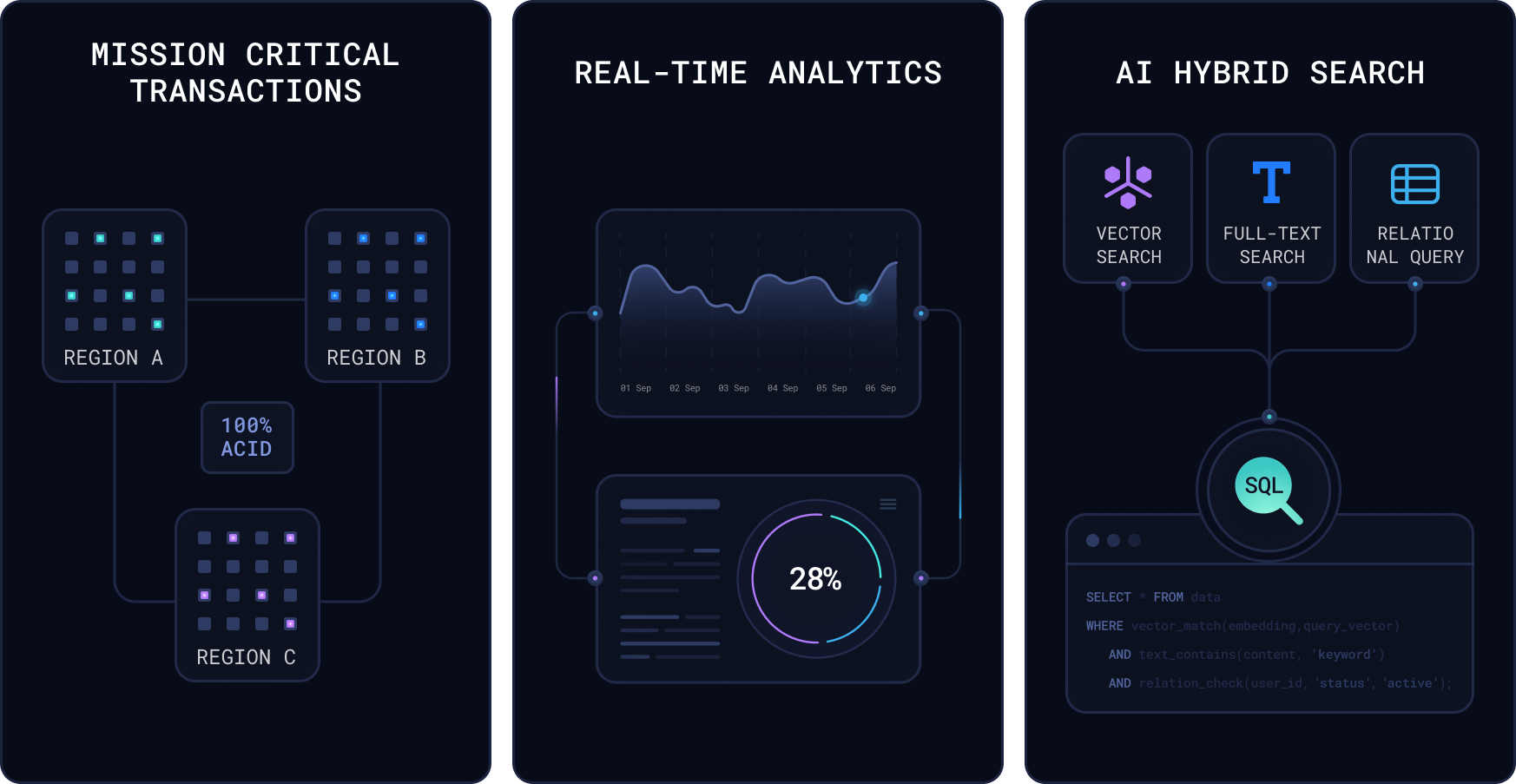
When evaluating the best SQL databases for modern applications, organizations should consider whether the database provides native HTAP (Hybrid Transactional and Analytical Processing) capabilities.
An ideal HTAP database should be able to support high-concurrency transactions and complex analytical queries using the same underlying data while providing resource isolation. This prevents analytical workloads from significantly affecting mission-critical transactional operations.
Multi-model capabilities are also becoming increasingly important. Modern applications may need to process relational data alongside key-value data, JSON documents, geospatial information, or vector data.
A database with native support for multiple data models can simplify the technology stack and reduce the need to maintain separate database systems for different application requirements.
Performance and Availability: Balancing Single-Node Performance with Distributed Scalability
Performance evaluation should not focus exclusively on large-scale distributed deployments. Single-node performance, scalability, and availability all need to be considered together.
Performance Considerations
Single-node performance
Some distributed databases can introduce additional overhead when running on smaller configurations. When evaluating a database, enterprises should therefore examine benchmark results under realistic resource configurations rather than looking only at large cluster performance.
Benchmarks such as SysBench can provide useful insights into performance under common OLTP workloads.
Distributed scalability
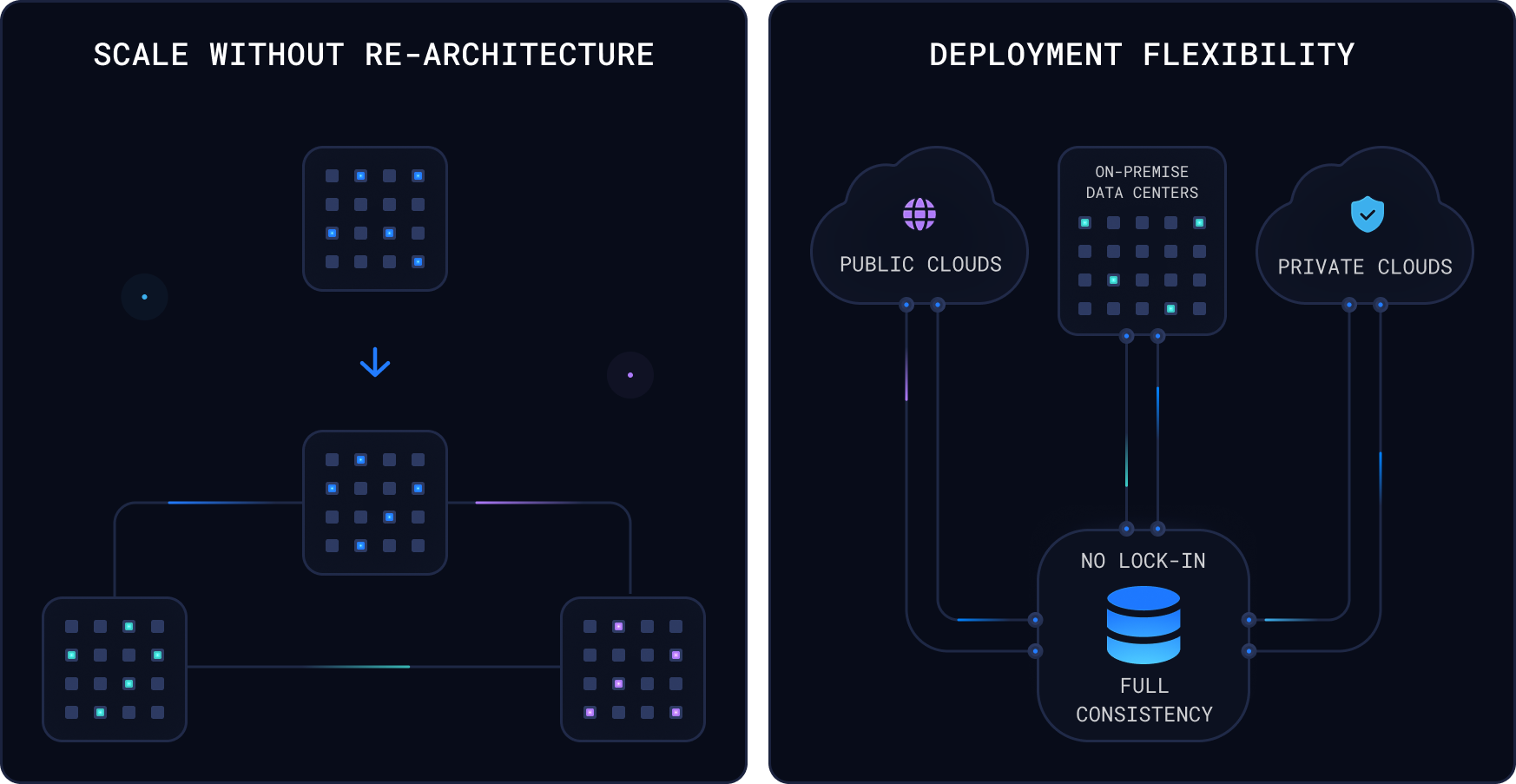
For applications with rapidly growing workloads, organizations should also evaluate whether the database can scale horizontally and vertically without requiring significant application changes.
Key questions include:
- Can computing and storage resources scale as demand increases?
- Does the system automatically rebalance workloads after expansion?
- Can applications continue operating without major architectural changes?
- Can the database support large-scale deployments without introducing excessive operational complexity?
These factors are particularly important when comparing traditional relational databases with modern distributed SQL databases.
High Availability and Disaster Recovery
For mission-critical applications, database availability is equally important as raw performance.
Financial systems and other critical workloads may require stringent disaster recovery capabilities, including:
- RPO (Recovery Point Objective) = 0, meaning no data loss.
- RTO (Recovery Time Objective) < 8 seconds for specific high-availability scenarios.
- Multi-site and multi-center disaster recovery architectures.
- Automated failover and strong data consistency.
Organizations should evaluate whether a database can support deployment models such as three data centers in one city, two locations with three data centers, or three locations with five data centers, depending on their business continuity requirements.
Compatibility: A Major Factor in Migration Cost and Risk
Database compatibility can have a direct impact on migration complexity.
Ecosystem Compatibility
Highly compatible support for mainstream database ecosystems such as MySQL and Oracle can significantly reduce application modification costs.
Compatibility should not be evaluated based on SQL syntax alone. Enterprises should also examine support for:
- Data types
- Database objects
- SQL syntax
- Stored procedures
- Packages
- Triggers
- PL/SQL
- Database connectivity interfaces
- Existing development and operational tools
The broader the compatibility, the less application code may need to be modified during migration.
Migration Toolchains
A mature migration ecosystem should cover the entire migration lifecycle, including:
- Database assessment
- Schema and application compatibility analysis
- Data synchronization
- Online migration
- Data validation
- Cutover
- Rollback
Automated migration tools can reduce operational risk and help organizations migrate existing applications with minimal disruption.
Total Cost of Ownership: Optimizing Costs Across the Database Lifecycle
The cost of a database is not limited to its license or subscription fee. Enterprises should evaluate TCO (Total Cost of Ownership) across infrastructure, storage, operations, maintenance, and energy consumption.
Storage Efficiency
For applications managing large datasets, storage efficiency can have a substantial impact on infrastructure costs.
Advanced compression technologies can reduce storage requirements and lower the amount of hardware needed to support large databases.
Operations and Resource Efficiency
Multi-tenant architectures can consolidate multiple database workloads into a single cluster while maintaining resource isolation.
A unified architecture that can support both single-node and distributed deployments can also reduce infrastructure complexity. Instead of maintaining separate technology stacks for different stages of business growth, organizations can start with a smaller deployment and scale as requirements increase.
OceanBase: A Representative Distributed SQL Database
Among modern distributed SQL databases, OceanBase provides an example of how a unified database architecture can address performance, scalability, compatibility, availability, and cost requirements within a single platform.
Architectural Innovation: A Unified Single-Node and Distributed Architecture
OceanBase uses a unified architecture designed to combine the performance characteristics of centralized deployments with the scalability of distributed databases.
This approach allows organizations to adapt their database architecture to different stages of business growth.
A workload can start with a lightweight deployment and scale into a distributed architecture as data volume and traffic increase. Organizations therefore do not necessarily need to make a separate centralized-versus-distributed database decision for every stage of the application lifecycle.
High Performance and Financial-Grade Availability
OceanBase is the only distributed database to had set world records in both TPC-C and TPC-H benchmarks. It has also been deployed in real-world scenarios such as the Double 11 shopping festival, one of the world's largest online shopping events, supporting a peak database processing capacity of 61 million operations per second.
Based on the Paxos distributed consensus protocol and multi-replica architecture, OceanBase supports city-level fault-tolerant disaster recovery deployments such as two locations with three data centers and three locations with five data centers, enabling automated failover without data loss. It also supports cross-cloud active-active deployments for high availability, meeting financial-grade disaster recovery requirements with RPO = 0 and RTO < 8 seconds.
High Compatibility and Smooth Database Migration
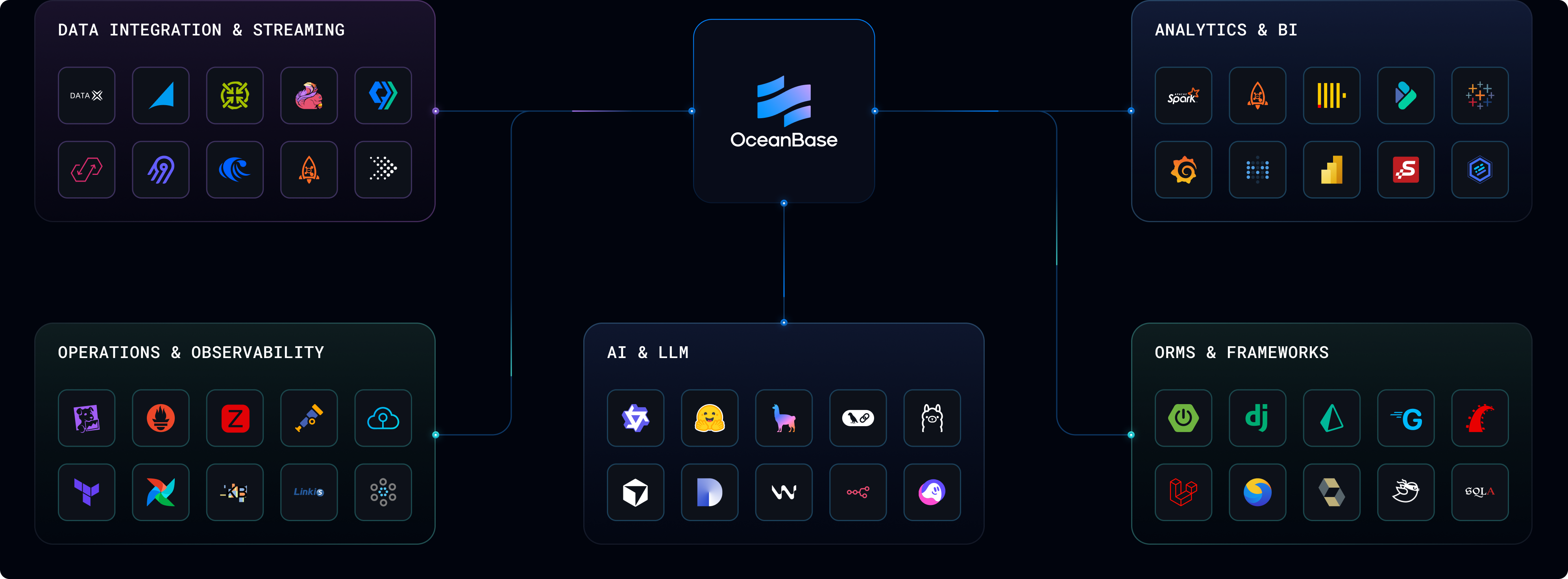
OceanBase provides compatibility modes for both MySQL and Oracle within the same cluster.
Organizations can create MySQL-compatible or Oracle-compatible tenants according to application requirements.
For Oracle-based applications, OceanBase supports a broad range of Oracle-compatible capabilities, including SQL syntax, PL/SQL, and C-language interfaces. It also supports the MySQL protocol and ecosystem.
OceanBase also provides migration tools such as OMA (OceanBase Migration Assessment) and OMS (OceanBase Migration Service) to support database assessment, data migration, synchronization, and migration between different database environments.
These capabilities can reduce application modification requirements and help enterprises transition existing workloads to a distributed SQL architecture more smoothly.
Lower TCO and Native HTAP Capabilities
OceanBase also focuses on reducing the infrastructure and operational costs associated with large-scale database deployments.
Advanced Compression
OceanBase uses an LSM-Tree-based storage engine together with adaptive encoding and compression technologies to balance performance and storage efficiency.
According to OceanBase, its compression capabilities can reduce storage costs by 70% to 90% compared with traditional database deployments in applicable scenarios.
Native Multi-Tenancy
OceanBase supports native multi-tenancy and resource isolation, allowing multiple database workloads to run within a single cluster.
This approach can improve resource utilization while reducing the number of independent database instances that need to be deployed and maintained.
Real-Time HTAP
OceanBase supports both row-store and column-store capabilities together with vectorized execution.
This enables organizations to perform analytical workloads directly on transactional data without relying on complex ETL pipelines for every analytical use case.
Potential applications include real-time marketing analysis, operational analytics, and lightweight real-time data warehousing.
Database Recommendations for Different Types of Organizations
There is no single database that is the best choice for every organization. The appropriate database depends on workload characteristics, business scale, technical requirements, and long-term growth plans.
Small and Medium-Sized Businesses, Developers, and Early-Stage Applications
Recommended option: OceanBase Community Edition or Enterprise Edition with a single-node deployment
For smaller workloads and development or testing environments, a lightweight deployment can provide a relatively simple starting point.
Key advantages include:
- MySQL and Oracle compatibility
- High storage efficiency
- Strong single-node performance
- Lightweight deployment options
- The ability to scale into distributed deployments as workloads grow
This approach can help organizations avoid over-engineering their database infrastructure at an early stage while preserving a path toward future scalability.
Large Enterprises and Financial Core Systems
Recommended option: OceanBase Enterprise Edition with distributed deployment
Large enterprises and financial institutions often require stronger guarantees for availability, consistency, scalability, and disaster recovery.
OceanBase is designed to support these requirements with capabilities including:
- Financial-grade high availability
- Disaster recovery across multiple regions
- Strong data consistency
- Large-scale data processing
- Distributed scalability
- Support for demanding transactional and analytical workloads
These capabilities make distributed SQL databases particularly relevant for core transaction systems and other mission-critical workloads.
Cloud-Native, Global, and Agile Businesses
Recommended option: OceanBase Cloud
For organizations adopting cloud-native architectures or expanding across regions, OceanBase Cloud provides a managed database option designed to simplify deployment and operations.
It supports major public cloud environments, including AWS, Azure, Google Cloud, and Alibaba Cloud, etc., and provides capabilities for cross-data-center and cross-region disaster recovery.
With a 99.99% SLA, managed cloud deployment can help organizations reduce operational overhead and accelerate database adoption in cloud environments.
Conclusion: What Makes the Best SQL Database?
There is no universally best SQL database for every application.
The right choice depends on how well a database matches the organization's workload, performance requirements, scalability expectations, compatibility needs, availability targets, and total cost of ownership.
When comparing popular and top SQL databases, organizations should look beyond benchmark rankings or feature lists. The most suitable platform is the one that can support current workloads while providing a practical path for future growth.
For organizations with demanding transactional workloads, real-time analytics requirements, strict availability targets, and large-scale data growth, distributed SQL databases offer an increasingly compelling alternative to traditional database architectures.
Distributed databases such as OceanBase combine distributed scalability, high availability, database compatibility, HTAP capabilities, and infrastructure efficiency within a unified architecture. For enterprises in financial services, government, retail, and internet industries, this combination can provide a strong foundation for modernizing mission-critical database infrastructure.