







You must configure data sources before you create a data migration project. This topic describes how to create a PostgreSQL data source in OceanBase Migration Service (OMS).
Prerequisites
You have obtained the IP address and port number of the related database.
You have created a database user for data migration.
We recommend that you create a dedicated database user for the data migration project and grant the required data operation privileges to the user. For more information, see Create a database user.
Procedure
Log on to the OMS console.
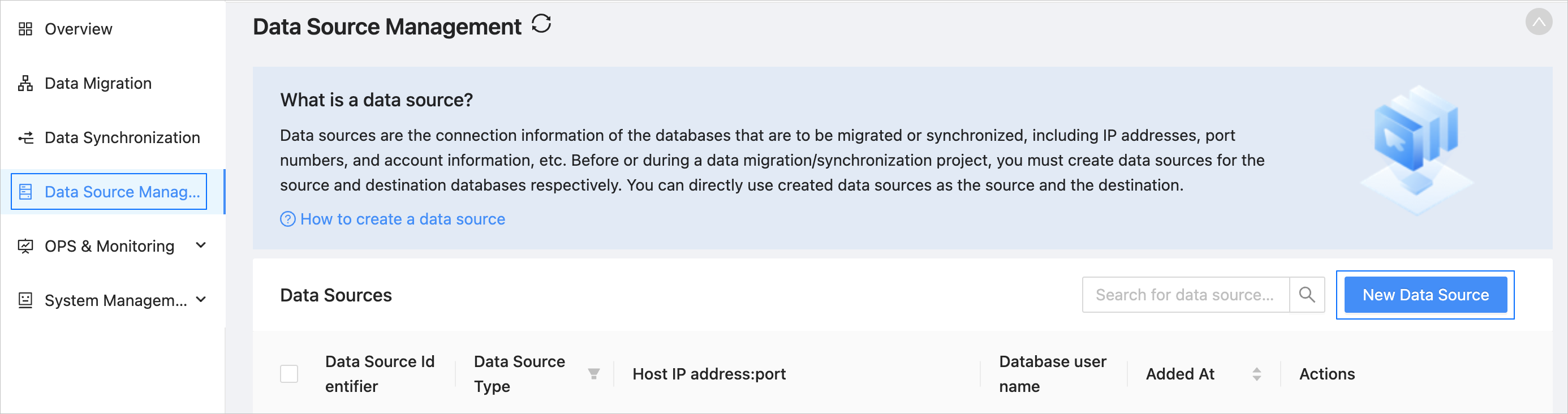
In the left-side navigation pane, click Data Source Management.
On the Data Source Management page, click New Data Source in the upper-right corner.
In the New Data Source dialog box, select PostgreSQL for Data Source Type.
Configure the following parameters.
ParameterDescriptionData Source Identifier We recommend that you set it to a combination of digits and letters. It must not contain any spaces and cannot exceed 32 characters in length.
Notice
The data source identifier must be globally unique in OMS.Region Select the region where the data source resides from the drop-down list. The region is the value that you set for the cm_regionparameter when you deploy OMS.
Notice- This parameter is displayed only when multiple regions are available.
- Make sure that the mappings between the data source and the region are consistent. Otherwise, the migration and synchronization performance can be poor.
Database Attributes Database attributes include Primary Database, Primary Database + Standby Database, and Standby Database. When you configure the primary database, you can choose whether to select the following option: Allow OMS to automatically write heartbeat data into this instance during incremental synchronization. This resolves the problem of high latency when no business data is written in the source database. - If you select this option, OMS creates the
oms_postgres_heartbeattable in the PostgreSQL database and updates the table to store the synchronization timestamps. This prevents OMS from displaying lengthy latency information when the source database is not processing business traffic.
Notice:
The user of the PostgreSQL database must have the privileges to create and write tables. For more information, see Create and update a heartbeat table. - If you do not select this option, OMS will not create the
oms_postgres_heartbeattable.
Host IP Address The IP address of the host where the database is located. Port The port number of the host where the database is located. Username The name of the PostgreSQL database user for data migration or synchronization. Password The password of the database user. DB Name The name of the PostgreSQL database.
Note
When the data source serves as the source of a data migration project, you can select only migration objects in the specified database.Schema Name (Optional) The schema name of the PostgreSQL database.
Note- If this parameter is specified, you can select only migration objects in the specified schema when the data source serves as the source of a data migration project.
- If this parameter is not specified, you can select all accessible schemas as the migration objects.
Remarks (Optional) Additional information about the data source. Click Test Connection to verify the network connection between OMS and the data source, as well as the validity of the username and password.
After the test is passed, click OK.