







This topic describes how to use OceanBase Migration Service (OMS) to migrate data from a TiDB database to a MySQL tenant of OceanBase Database, which can be a physical data source or an ApsaraDB for OceanBase data source.
Background
You can create a data migration project in the OMS console to seamlessly migrate the existing business data and incremental data from a TiDB database to a MySQL tenant of OceanBase Database through schema migration, full migration, and incremental synchronization.
TiDB is an integrated distributed database that supports hybrid transactional and analytical processing (HTAP). You must deploy a TiCDC cluster and a Kafka cluster to synchronize incremental data from a TiDB database to a MySQL tenant of OceanBase Database.
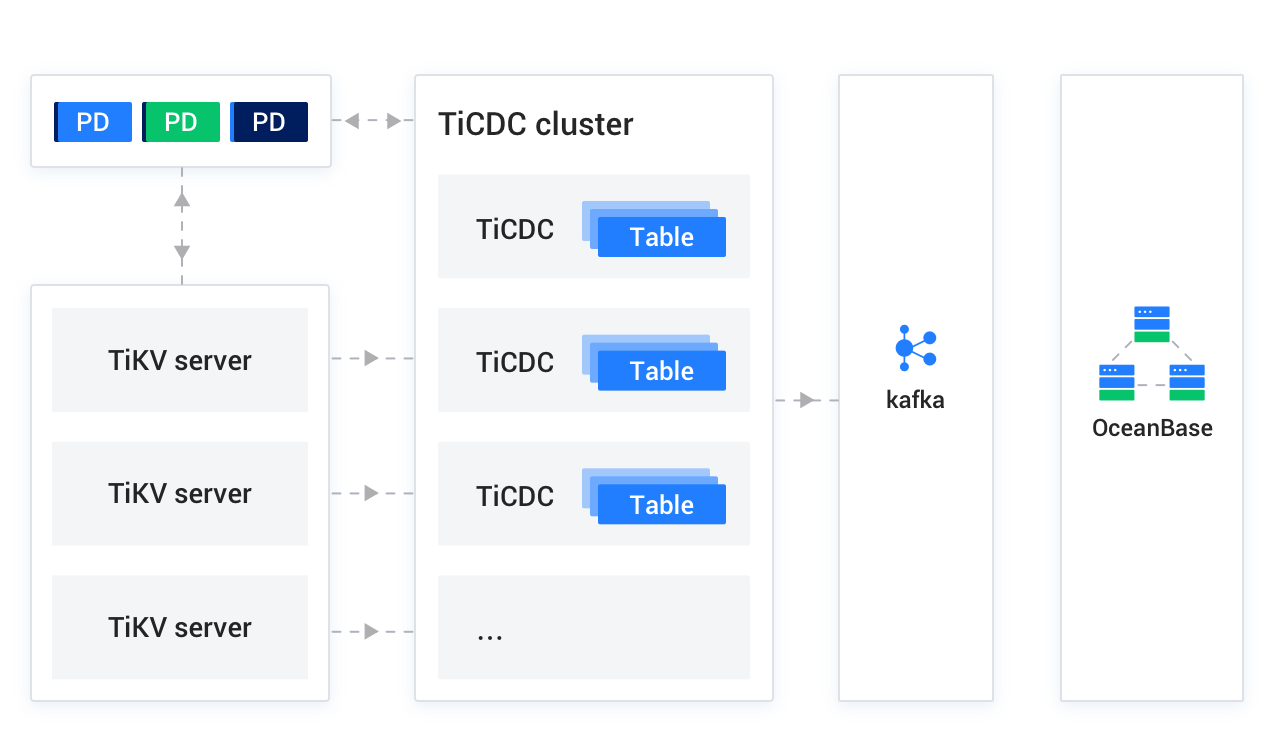
TiCDC is an incremental data synchronization tool for TiDB and provides high availability by using a placement driver (PD) cluster, which is the scheduling module of the TiDB cluster and usually consists of three PD nodes. TiKV Server is a TiKV node in the TiDB cluster. It sends data changes in change logs to the TiCDC cluster. TiCDC runs multiple TiCDC processes to obtain and process data from TiKV nodes, and then synchronizes the data to the Kafka cluster. The Kafka cluster saves the incremental logs of the TiDB database that are converted by TiCDC. During incremental data synchronization, OMS obtains the corresponding data from the Kafka cluster and migrates the data to the MySQL tenant of OceanBase Database in real time. If you create a TiDB data source without binding it to a Kafka data source, you cannot perform incremental synchronization.
Prerequisites
You have created dedicated database users for data migration in the source TiDB database and destination MySQL tenant of OceanBase Database, and granted corresponding privileges to the users. For more information, see Create a database user.
Limitations
Limitations on the source database
Do not perform DDL operations that modify database or table schemas during schema migration or full data migration. Otherwise, the data migration project may be interrupted.
At present, TiDB v4.x and v5.4 are supported.
If the destination is a database, OMS does not support triggers in the destination database. If triggers exist in the destination database, the data migration may fail.
OMS does not support the migration of tables without primary keys or data with spaces from a TiDB database to a MySQL tenant of OceanBase Database.
Data source identifiers and user accounts must be globally unique in OMS.
OMS supports the migration of only objects whose database name, table name, and column name are ASCII-encoded and do not contain special characters. The special characters are spaces, line breaks, and the following characters:
. | " ' ` ( ) = ; / & \.OMS supports only the TiCDC Open Protocol. If you use an unsupported protocol, a JDBC connector exception will occur, and an error that indicates a null pointer will be returned.
Considerations
If the source contains foreign keys with the same name, an error occurs during schema migration. In this case, you can rename the foreign keys to resume the project.
If the UTF-8 character set is used in the source, we recommend that you use a compatible character set, such as UTF-8 or UTF-16, in the destination to avoid garbled characters.
In a project for reverse incremental migration from a TiDB database to a MySQL tenant of OceanBase Database of a version earlier than V3.2.x, if the source table is a multi-partition table with a global unique index and you update the values of the partitioning key of the table, data may be lost during migration.
Do not write data to the topic synchronously used by TiCDC. Otherwise, a JDBC connector exception may occur and a null pointer error may be returned.
Check whether the migration precision of OMS for fields of data types such as DECIMAL, FLOAT, and DOUBLE is as expected. If the precision of the destination field type is lower than the precision of the source field type, the value with a higher precision may be truncated. This may result in data inconsistency between the source and destination fields.
If you change the unique index of the destination, you must restart the Incr-Sync component. Otherwise, the data may be inconsistent.
If the clocks between nodes or between the client and the server are out of synchronization, the latency may be inaccurate during incremental synchronization or reverse incremental migration.
For example, if the clock is earlier than the standard time, the latency can be negative. If the clock is later than the standard time, the latency can be positive.
Take note of the following points if you want to perform data merge migration:
We recommend that you configure the mappings between the source and destination databases by specifying matching rules.
We recommend that you manually create schemas at the destination. If you use OMS to create schemas, skip failed objects in the schema migration step.
A difference between the source and destination table schemas may result in data consistency. Some known scenarios are described as follows:
When you manually create a table schema at the destination, if the data types of any columns are not supported by OMS, implicit data type conversion may occur at the destination, which causes inconsistent column types between the source and destination.
If the length of a column at the destination is shorter than that at the source, the data of this column may be automatically truncated, which causes data inconsistency between the source and destination.
If you select only Incremental Synchronization when you create a data migration project, OMS requires that the local incremental logs in the source database be retained for more than 48 hours.
If you select Full Data Migration and Incremental Synchronization when you create a data migration project, OMS requires that the local incremental logs in the source database be retained for at least 7 days. Otherwise, the data migration project will fail or the data in the source and destination databases will be inconsistent because OMS cannot obtain incremental logs.
Data type mappings
TiDB database |
MySQL tenant of OceanBase Database |
|---|---|
| INTEGER | INTEGER |
| TINYINT | TINYINT |
| MEDIUMINT | MEDIUMINT |
| BIGINT | BIGINT |
| SMALLINT | SMALLINT |
| DECIMAL | DECIMAL |
| NUMERIC | NUMERIC |
| FLOAT | FLOAT |
| REAL | REAL |
| DOUBLE PRECISION | DOUBLE PRECISION |
| BIT | BIT |
| CHAR | CHAR |
| VARCHAR | VARCHAR |
| BINARY | BINARY |
| VARBINARY | VARBINARY |
| BLOB | BLOB |
| TEXT | TEXT |
| ENUM | ENUM |
| SET | SET |
| DATE | DATE |
| DATETIME | DATETIME |
| TIMESTAMP | TIMESTAMP |
| TIME | TIME |
| YEAR | YEAR |
Procedure
Create a data migration project.

Log on to the OMS console.
In the left-side navigation pane, click Data Migration.
On the Data Migration page, click Create Migration Project in the upper-right corner.
On the Select Source and Destination page, configure the parameters.
ParameterDescriptionMigration Project Name We recommend that you set it to a combination of digits and letters. It must not contain any spaces and cannot exceed 64 characters in length. Tag (Optional) Click the field and select a target tag from the drop-down list. You can also click Manage Tags to create, modify, and delete tags. For more information, see Use tags to manage data migration projects. Source If you have created a TiDB data source, select it from the drop-down list. If not, click New Data Source in the drop-down list and create one in the dialog box that appears on the right. For more information, see Create a TiDB data source.
Notice
If the TiDB data source is not bound to a valid Kafka data source or a topic, incremental synchronization is not supported.Destination If you have created a MySQL tenant of OceanBase Database data source, which can be a physical data source or an ApsaraDB for OceanBase data source, select it from the drop-down list. If not, click New Data Source in the drop-down list and create one in the dialog box that appears on the right. For more information about the parameters, see Create a physical OceanBase data source or Create a public cloud OceanBase data source. Click Next. In the dialog box that appears, click OK.
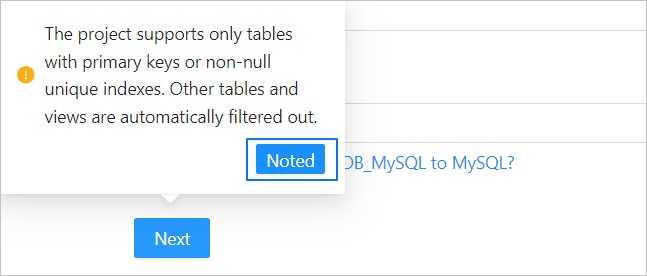
Note that this project supports only tables and views with a primary key or a non-null unique index and those without are automatically filtered out.
On the Select Migration Type page, configure the parameters.
Options for Migration Type are Schema Migration, Full Data Migration, Incremental Synchronization, Full Verification, and Reverse Increment.
Migration typeDescriptionSchema migration When a schema migration task starts, OMS migrates the definitions of data objects, such as tables, indexes, constraints, comments, and views, from the source database to the destination database. Temporary tables are automatically filtered out. Full migration When a full migration task starts, OMS migrates the existing data from tables in the source database to the corresponding tables in the destination database. If you select Full Migration, we recommend that you use the ANALYZEstatement to collect the statistics of the TiDB database before data migration.Incremental synchronization When an incremental synchronization task starts, OMS synchronizes changed data in the source database to the corresponding tables in the destination database. Data changes are data addition, modification, and deletion.
Options for DML Synchronization in the Incremental Synchronization section includeInsert,Delete, andUpdate. For more information, see DML filtering. If you create a TiDB data source without binding it to a Kafka data source, you cannot select Incremental Synchronization.Full verification After the full data migration and incremental data synchronization are completed, OMS automatically initiates a full data verification task to verify the data tables in the source and destination databases. - If you select Full Verification, we recommend that you collect the statistics of the TiDB database and the MySQL tenant of OceanBase Database before full verification. For more information about how to collect statistics of a MySQL tenant of OceanBase Database, see Manually collect statistics.
- If you have selected Incremental Synchronization but did not select all DML statements in the DML Synchronization section, OMS does not support full verification.
Reverse incremental migration When a reverse incremental migration task starts, OMS migrates the data changed in the destination database after the business switchover back to the source database in real time. You cannot select Reverse Increment in the following cases: - Data merge migration that involves multiple tables is enabled.
- Multiple source schemas map to the same destination schema.
(Optional) Click Next.
If you have selected Reverse Increment but the related parameters are not configured for the destination MySQL tenant of OceanBase Database, the More About Data Sources dialog box appears, prompting you to configure the related parameters. For more information about the parameters, see Create a physical OceanBase data source or Create a public cloud OceanBase data source.
After you configure the parameters, click Test Connection. After the test succeeds, click OK.
Click Next. On the Select Migration Objects page, specify the migration objects and migration scope.
You can select Specify Objects or Match Rules to specify the migration objects.
Select Specify Objects. Then select the objects to be migrated on the left and click > to add them to the list on the right. You can select tables and views of one or more databases as the migration objects.
Notice
The names of tables to be migrated, as well as the names of columns in the tables, must not contain Chinese characters.
If the database or table name contains a double dollar sign ($$), you cannot create the migration project.
OMS automatically filters out unsupported tables.
When you migrate data from a TiDB database to a MySQL tenant of OceanBase Database, OMS allows you to import objects through text, rename objects, and remove a single or all migration objects.
OperationDescriptionImport objects - In the list on the right of the Specify Migration Scope section, click Import Objects in the upper-right corner.
- In the dialog box that appears, click OK.
Notice
This operation will overwrite previous selections. Proceed with caution. - In the Import Objects dialog box, import the objects to be migrated.
You can import CSV files to rename databases/tables. For more information, see Download and import the settings of migration objects. - Click Validate.
- After the validation succeeds, click OK.
Rename objects OMS allows you to rename the migration objects. For more information, see Rename a migration or synchronization object. Remove one or all objects During data mapping, OMS allows you to remove one or more selected objects to be migrated or synchronized to the destination. - To remove a single migration object:
In the list on the right of the Specify Migration Scope section, move the pointer over the target object, and click Remove. - To remove all migration objects:
In the list on the right of the Specify Migration Scope section, click Remove All in the upper-right corner. In the dialog box that appears, click OK.
Select Match Rules. For more information, see Configure matching rules for migration objects.
Click Next. On the Migration Options page, configure the following parameters.
Full migration
The following parameters are displayed only if you have selected Full Data Migration on the Select Migration Type page.
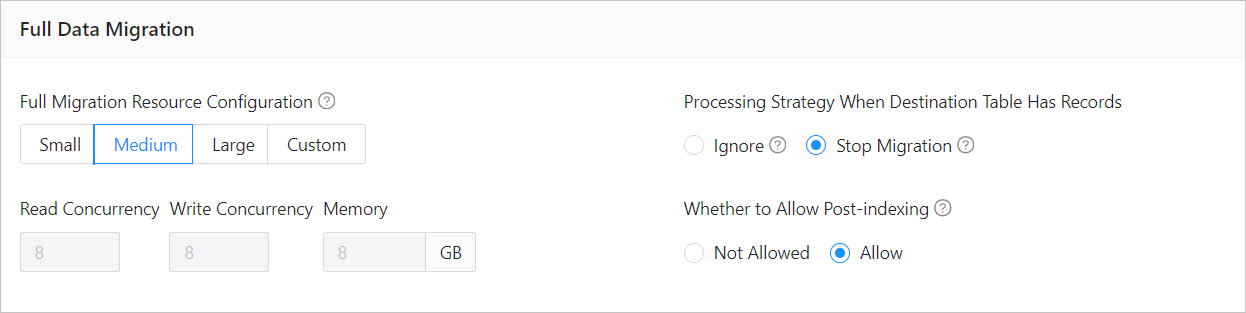 ParameterDescription
Full Migration Resource Configuration You can select Small, Medium, or Large to use the corresponding default values of Read Concurrency, Write Concurrency, and Memory. You can also customize the resource configurations for full migration. Through resource configuration for the Full-Import component, you can limit the resource consumption of a project in the full migration phase. Notice
In the case of custom configurations, the minimum value is 1, and only integers are supported.
Processing Strategy When Destination Table Has Records Valid values: Ignore and Stop Migration. - If you select Ignore, when the data to be written conflicts with the existing data of a destination table, OMS logs the conflicting data while retaining the existing data.
Notice
If you select Ignore, data is pulled in IN mode for full verification. In this case, the scenario where the destination contains more data than the source cannot be verified, and the verification efficiency will be decreased.
- If you select Stop Migration and a destination table contains records, an error is returned during full migration, indicating that the migration is not allowed. In this case, you must clear the data in the destination table before you can continue with the migration.
Notice
After an error is returned, if you click Resume in the dialog box, OMS ignores this error and continues to migrate data. Proceed with caution.
Whether to Allow Post-indexing Specifies whether to create indexes after the full migration is completed. Post-indexing can shorten the time required for full migration. For more information about the considerations on post-indexing, see the description below. Notice
This feature is supported only if you have selected both Schema Migration and Full Data Migration on the Select Migration Type page.
- Only non-unique key indexes can be created after the migration is completed.
- OceanBase Database V1.x does not support the post-indexing feature.
If post-indexing is allowed, we recommend that you adjust the parameters based on the hardware conditions of your OceanBase database and the current business traffic.
If you use OceanBase Database V4.x, adjust the following parameters of the
systenant and business tenants by using a CLI client.Adjust the parameters of the
systenant// parallel_servers_target specifies the queuing conditions for parallel queries on each server. // To maximize performance, we recommend that you set this parameter to a value greater than, for example, 1.5 times, the number of physical CPU cores. In addition, make sure that the value does not exceed 64, to prevent database kernels from contending for locks. set global parallel_servers_target = 64;Adjust the parameters of a business tenant
// Specify the limit on the file memory buffer size.
alter system set _temporary_file_io_area_size = '10' tenant = 'xxx';
// Disable throttling in V4.x.
alter system set sys_bkgd_net_percentage = 100;
If you use OceanBase Database V2.x or V3.x, adjust the following parameters of the
systenant by using a CLI client.// parallel_servers_target specifies the queuing conditions for parallel queries on each server. // To maximize performance, we recommend that you set this parameter to a value greater than, for example, 1.5 times, the number of physical CPU cores. In addition, make sure that the value does not exceed 64, to prevent database kernels from contending for locks. set global parallel_servers_target = 64; // data_copy_concurrency specifies the maximum number of concurrent data migration and replication tasks allowed in the system. alter system set data_copy_concurrency = 200;
- If you select Ignore, when the data to be written conflicts with the existing data of a destination table, OMS logs the conflicting data while retaining the existing data.
Incremental synchronization
The following parameters are displayed only if you have selected Incremental Synchronization on the Select Migration Type page.
ParameterDescriptionIncremental Data Write Resource Configuration You can select Small, Medium, or Large to use the corresponding default values of Write Concurrency and Memory. You can also customize the resource configurations for incremental data write. Through resource configuration for the Incr-Sync component, you can limit the resource consumption of a project in data writes in the incremental synchronization phase. Notice
In the case of custom configurations, the minimum value is 1, and only integers are supported.
Incremental Synchronization Start Timestamp - If you have set the migration type to Full Data Migration, this parameter is not displayed.
- If you have selected Incremental Synchronization but not Full Data Migration, specify a point in time after which the data is to be synchronized. The default value is the current system time. For more information, see Set an incremental synchronization timestamp.
Reverse incremental migration
The following parameters are displayed only if you have selected Reverse Increment on the Select Migration Type page. The parameters for reverse incremental migration are consistent with those for incremental synchronization. You can select Reuse Incremental Synchronization Configuration in the upper-right corner.
Full verification
The following parameters are displayed only if you have selected Full Verification on the Select Migration Type page.
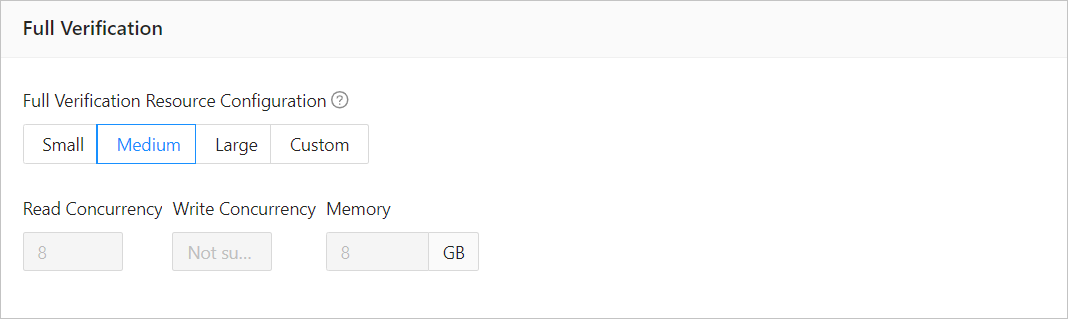 ParameterDescription
Full Verification Resource Configuration You can select Small, Medium, or Large to use the corresponding default values of Read Concurrency and Memory. You can also customize the resource configurations for full verification. Through resource configuration for the Full-Verification component, you can limit the resource consumption of a project in the full verification phase. Notice
In the case of custom configurations, the minimum value is 1, and only integers are supported.
If the parameter settings on the page cannot meet your requirements, you can click Parameter Configuration in the lower part of the page to configure more specific settings. You can also reference an existing project or component template.
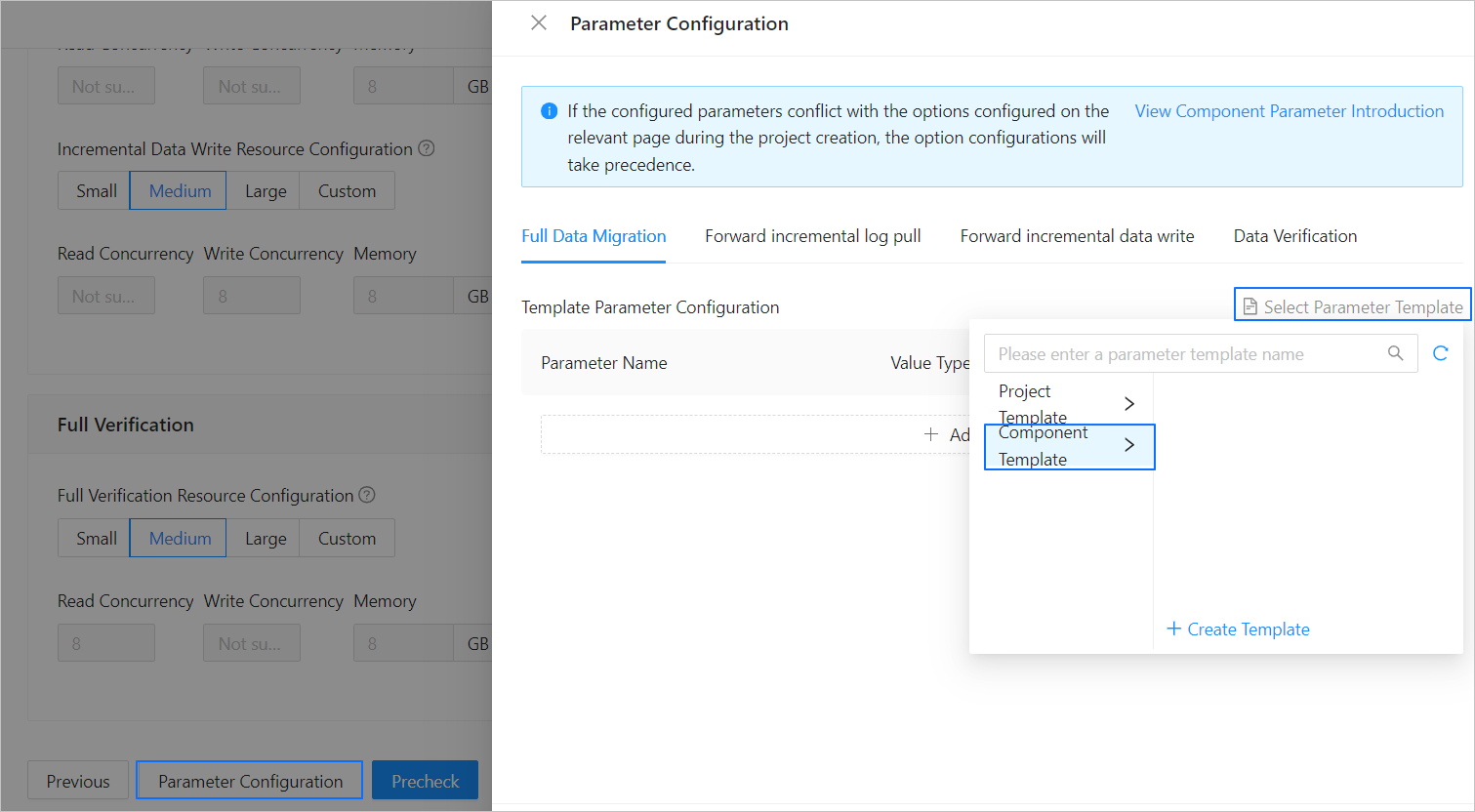
Click Precheck to start a precheck on the data migration project.
During the precheck, OMS checks the read and write privileges of the database users and the network connections of the databases. The data migration project can be started only after it passes all check items. You can perform one of the following operations if an error is returned during the precheck:
Identify and troubleshoot the problem and then perform the precheck again.
Click Skip in the Actions column of a failed precheck item. In the dialog box that appears, you can view the prompt for the consequences of the operation and click OK.
Click Start Project. If you do not need to start the project now, click Save to go to the details page of the data migration project. You can start the project later as needed.
OMS allows you to modify the migration objects when the data migration project is running. For more information, see View and modify migration objects. After a data migration project is started, the migration subtasks will be executed based on the selected migration types. For more information, see the "View migration details" section in the View details of a data migration project topic.