Sunshine Insurance`s Business System Has Run on OceanBase Database Stably for over 700 Days


Background
Founded in July 2005, Sunshine Insurance Group is one of the fastest-growing market-oriented enterprises in the world. It is now among the top eight in China's insurance industry, with a number of subsidiaries specialized in a range of fields, such as property insurance, life insurance, credit guarantee insurance, and asset management. Facing the booming trend of digital upgrade, many enterprises need to upgrade their software and hardware to meet the requirements of independent R&D. Databases, one of the three pillars of software, are no exception.
Against the backdrop of digital upgrade, Sunshine Insurance Group began working on database selection and upgrade according to our own business requirements. To begin with, we learned about distributed databases to get prepared for future business growth. Next, we thoroughly investigated and tested several products in line with the principle that the database system must meet our business requirements with minimal software and hardware costs.
At last, we settled on OceanBase Database for four reasons:
First, it ticks all key boxes for our business upgrade. OceanBase Database is a distributed database developed fully in house and its core source code was opened to the community in 2021.
Second, it is stable and reliable. The whole system has been running stably for more than 2 years with zero data loss. We have trust in it. Technically, OceanBase Database supports multi-replica disaster recovery based on the Paxos protocol. The database provides high availability with a recovery point objective (RPO) of 0 and a recovery time objective (RTO) of less than 8s when a minority of replicas fail. From the business point of view, OceanBase Database has empowered the Double 11 shopping festival for more than a decade, and has been polished up by the core systems of many financial organizations, delivering proven performance and reliability.
Third, it is highly compatible with MySQL. Compatibility was our main concern, because many of our business systems were built on MySQL infrastructure. Insufficient compatibility not only results in high migration and reconstruction costs, but also requires exhausting business modifications. Therefore, the new technologies or new products must ensure seamless and smooth migration with minimal reconstruction costs.
Fourth, it features multitenancy. We had deployed multiple MySQL instances to support our various business systems, which caused significant strain with heavy O&M workload despite the medium business traffic and data volume. The native multitenancy feature of OceanBase Database solves this problem and significantly simplifies our O&M work.
Benefits
After a break-in period, we have gradually migrated our existing business systems to OceanBase Database. Our online environment was based mainly on MySQL 5.6 and 5.7. Using OceanBase Migration Service (OMS), a dedicated data migration tool, we easily created synchronization tasks that automatically migrated data from MySQL instances to OceanBase Database without any compatibility issues. The whole migration process was quite smooth, saving a large amount of implicit migration costs.
We have deployed OceanBase Database V3.1.5 on a single server with 128 CPU cores and 768 GB of memory, and created 22 tenants to host business modules migrated from original MySQL instances. This way, each business module uses exclusive tenant resources without affecting each other. The new solution also achieves high availability and simplifies O&M management.
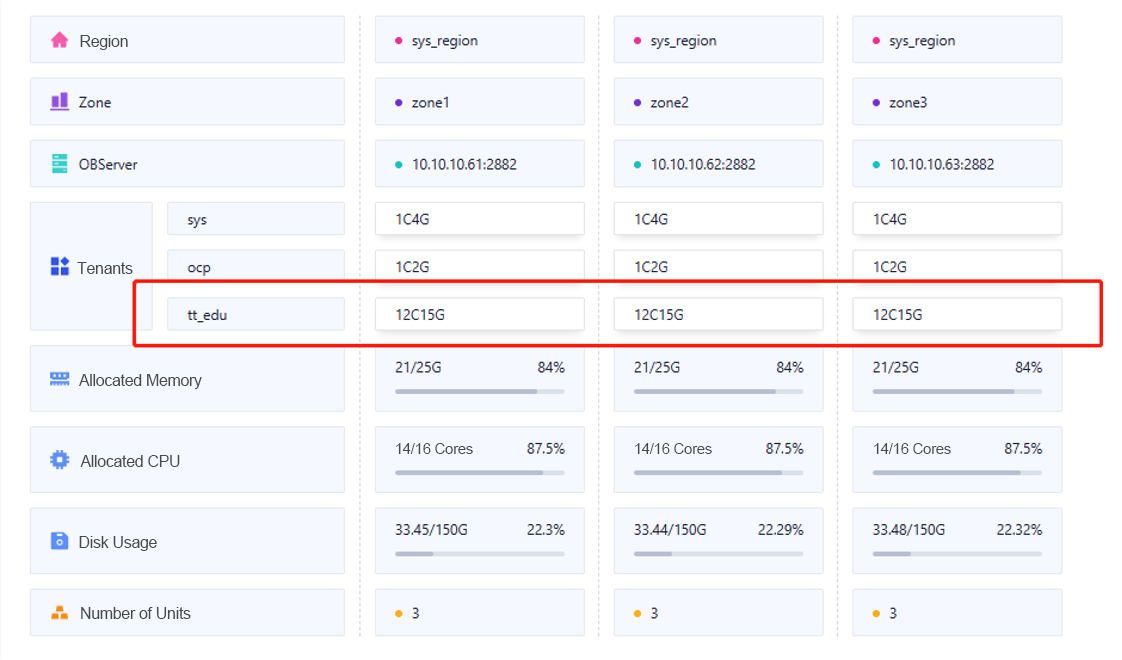
I. Multitenancy and Resource Isolation to Improve Resource Utilization and Ensure Data Security
The multitenancy feature of OceanBase Database simplifies the O&M of MySQL instances that host many small business modules. A tenant is a logical unit designed for resource isolation. The data security of tenants is guaranteed by privilege control. Tenants are critical for system O&M, especially for the O&M of cloud databases. In a sense, tenants are comparable to "instances" in a conventional database system. In OceanBase Database, tenants are totally isolated, which prevents cross-tenant access and ensures that data assets of a tenant cannot be used by other tenants. Therefore, we can migrate our business modules hosted in multiple MySQL instances to different tenants of one OceanBase cluster, without worrying about data security. In addition, resources are allocated based on tenants. We can allocate resources according to our business needs, making the most out of server resources. The following figure shows our resource allocation for tenants.