Solving DABstep's Hard Mode with Versioned Assets in OceanBase


How OceanBase implemented a Train-Free GRPO mechanism to achieve SOTA on real-world financial reasoning
We are witnessing a paradox in the LLM landscape. While models are becoming reasoning giants, their deployment in high-stakes environments—financial analysis, risk control, and DevOps—often hits an invisible wall. The model seems to "understand" the prompt, yet the SQL it generates misses subtle business logic, the Python script it writes crashes on dirty data, and its definition of metrics drifts between conversations.
This reality was quantified in February 2025 by Adyen and Hugging Face with the release of Data Agent Benchmark for Multi-step Reasoning (DABstep). Derived from 450+ real-world financial tasks, it exposes the gap between academic benchmarks and production reality. The result? Even top-tier reasoning models like o3-mini and DeepSeek-R1 hovered around 13%-16% accuracy on the "Hard" subset.
However, on the DABstep Global Leaderboard, OceanBase’s DataPilot agent has secured the top spot, maintaining a significant lead over the runner-up for a month. The secret to our SOTA results wasn't a larger model or more GPU hours. It was a fundamental shift in engineering paradigm: moving from "Prompt Engineering" to "Asset Engineering."
This post details how we built a agent platform that actually resolves the agent gap in real-world financial reasoning.
What is OceanBase DataPilot?
Before diving into the mechanics, it helps to understand the platform: DataPilot is OceanBase's intelligent NL-to-SQL and insight platform. It allows developers to build specific "analysis domains," automates the configuration of semantic layers, and provides natural language-driven analytics. DataPilot wraps these capabilities in granular permission controls and audit trails, moving beyond a simple chatbot to a governed data workspace.
The Challenge: Why "Hard Mode" is Just "Real Mode"
DABstep reveals three distinct constraints that break standard Text-to-SQL or RAG approaches in production:
- Ambiguity: The "Metric" Problem. A user asks for "domestic transactions." The database schema has
issuer_country,acquirer_country, andip_country. A standard model guesses based on probability. In finance, guessing is fatal. - Dirty Data: In the wild, an empty value isn't just
NULL. It’sNone,[],"", or"N/A". Generated Python scripts often lack the defensive programming to handle these, causingKeyErrororTypeErrorcrashes. - Performance Constraints: An
O(R * T)(R= number of rules, T= number transactions) nested loop might work on a CSV sample but times out on millions of transaction rows. - To solve this, we realized we couldn't rely on the model's intrinsic training. We needed a deterministic, external memory structure.
The Solution: From Ephemeral Context to Versioned Asset
To bridge the gap between probabilistic models and deterministic business requirements, we architected DataPilot around a strict separation of concerns: the Asset Plane and the Runtime Plane.
- The Asset Plane (Long-Term Memory): Think of this as a curated Knowledge Base & Toolbox. It stores versioned Standard Operating Procedures (SOPs), validated code templates, and historical debugging logs. It is static, governed, and searchable.
- The Runtime Plane (Execution Scope): Think of this as a Just-in-Time (JIT) Assembly Factory. It does not store knowledge; instead, it dynamically selects the right tools from the Asset Plane based on the specific incoming task, assembles a temporary execution context, and runs the job.
The Non-Negotiable Traits of a Modern AI Database
To solve this, we defined what the data infrastructure must look like for the AI era:
- Multi-Modal Native: Treats vectors, JSON, text, and scalars as a unified whole, not distinct silos.
- Uncompromising Performance: Delivers high ingestion throughput and low-latency inference with zero data lag.
- Intelligent Primitives: Moves "brain" functions (embedding, reranking, completion) inside the DB engine.
- Developer Simplicity: Developer-first, not infra-first. Lightweight, instant to start, and invisible to manage.
Meet OceanBase seekdb
seekdb is an AI-native hybrid search database open-sourced under Apache 2.0. It isn’t a patch on top of OceanBase; it’s a rethinking of the engine to solve the engineering challenges above.
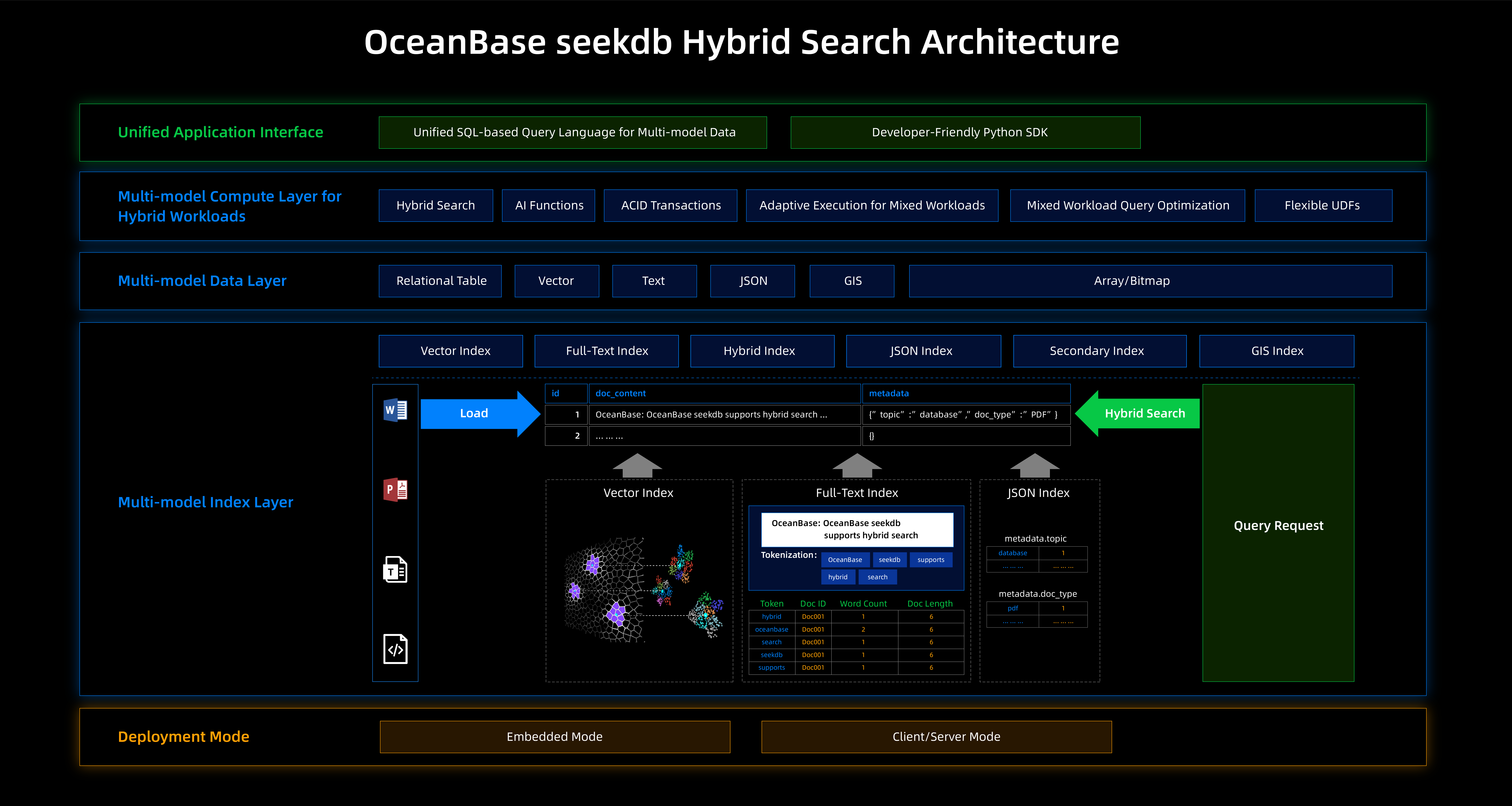
Unified Multi-Modal Storage. No More Silos
seekdb supports scalar, vector, text, JSON, and GIS data in a single engine.
Crucially, all indexes exist in the same transaction domain. When you update a row, the scalar, vector, and full-text indexes update synchronously. There is no "inconsistency window" common in architectures that rely on CDC (Change Data Capture) to sync data between a SQL DB and a Vector DB.
True Hybrid Search. Single Query
For real applications, you almost never run pure vector search or pure keyword search. You do both, plus filters. seekdb supports doing all of this in one query pipeline:
- Scalar Filtering: Narrows the scope from millions to thousands.
- Coarse Sorting: Uses Vector + Full-text search (low resource cost).
- Reranking: Applies high-precision re-scoring.
You can tune the weights via the DBMS_HYBRID_SEARCH package. If you care more about exact keyword matches, boost the full-text weight. If you need semantic understanding, boost the vector weight.
AI Inside. Document-In, Data-Out
AI is built into the database, not bolted on from the outside.
Out of the box, seekdb embeds a small model for generating vector representations. For many use cases, you can completely ignore vector management—you work with text, and the system handles the embeddings. When you need higher quality, you can easily plug in external models (like OpenAI).
We currently expose four core AI functions directly in SQL:
- AI_EMBED: Turn text into vector embeddings.
- AI_COMPLETE: Text generation with templated prompts.
- AI_RERANK: Sort text results with a reranker model.
- AI_PROMPT: Assemble prompt templates and dynamic data into JSON.
Developer Simplicity: Light, Fast, and Flexible
We designed seekdb to fit into your workflow, not disrupt it. Whether you are hacking on a laptop or deploying to a cluster, the experience should feel frictionless.
Flexible Deployment
seekdb supports two primary modes so you can start small and scale without changing databases:
- Embedded Mode: A lightweight library that lives directly inside your application via pip install. Perfect for rapid prototyping, CI/CD pipelines, or edge devices.
- Server Mode: The recommended path for production. It remains incredibly efficient—we have cleared the VectorDBBench production-grade bar running on a minimal 1C2G spec.
Hassle-Free Schemaless API
We know you don't want to write complex DDL just to test an idea. That's why we expose a Schemaless API for rapid iteration.
You simply create a collection and upsert documents. We handle the rest—automatically creating the schema, generating embeddings, and building the vector and full-text indexes in the background.
import pyseekdb

client = pyseekdb.Client()
collection = client.get_or_create_collection("products")

# Auto-vectorization and storage
collection.upsert(
    documents=[
        "Laptop Pro with 16GB RAM, high-speed processor",
        "Gaming Rig with RTX 4090 and 1TB SSD"
    ],
    metadatas=[
        {"category": "laptop", "price": 1200},
        {"category": "desktop", "price": 2500}
    ],
    ids=["1", "2"]
)

# Hybrid Search: Vector semantic + SQL filter + Keyword match
results = collection.query(
    query_texts=["powerful computer for work"], # Vector search
    where={"price": {"$lt": 2000}},             # Relational filter
    where_document={"$contains": "RAM"},        # Full-text search
    n_results=1
)
Want full control? You can always drop down to standard SQL to fine-tune schemas and indexing strategies whenever you need to.
SQL-Native, Battle-Tested Engine
seekdb inherits the core engine capabilities from OceanBase:
- Real-time writes and real-time reads.
- Strict ACID transactions.
- MySQL compatibility, so existing applications can migrate without rewriting everything.
Data Stack Comparison: Why seekdb?
We didn't build seekdb to win a feature checkbox war. We built it to eliminate the "Frankenstein" architectures that plague AI engineering teams.
Here is how the unified approach compares to the two most common patterns we see in production today.
| Feature | The "Classic" (SQL + ES/Solr) | The "Specialist" (SQL + Vector DB) | OceanBase seekdb (Unified AI-Native DB) |
| The Stack | Three Systems: Relational DB + Search Engine + Vector Store. | Two Systems: Relational DB + Dedicated Vector DB. | One System: All-in-one SQL Engine. |
| Data Consistency | Weak/Eventual. Relying on CDC pipelines introduces lag (ms to seconds). | Disconnected. No transactional guarantee between your business data and vectors. | Strict ACID. Scalars, vectors, and text indexes update atomically. Zero lag. |
| Search Capability | Siloed. Great full-text, but vector search is often an afterthought. | Lopsided. Great vector search, but full-text support is usually weak. | True Hybrid. Native Vector + Full-Text + Scalar filtering in one pipeline. |
| Dev Experience | Ops Heavy. 3x config, 3x monitoring. Debugging sync is a nightmare. | Glue Code Heavy. Complex app logic required to join and rank results. | App Focused. Logic is pushed down to the DB. You write SQL, not plumbing. |
Built for What You're Building Now
We aren't just building this in a vacuum. We are powering real scenarios:
- RAG & Knowledge Retrieval: Hybrid search is the backbone of modern knowledge bases. Our reference app, MineKB, delivers top-10 hybrid search results on 10,000 document chunks in just 15ms—80x faster than traditional stacks.
- Agentic Memory: Agents need persistent memory to remember user history across sessions. We built PowerMem on seekdb to solve this, hitting SOTA on the LOCOMO benchmark while slashing context token usage by 96%.
- AI Coding Assistants: Code search is effectively specialized RAG that requires parsing and indexing massive repositories rapidly. seekdb fits this pipeline naturally, and we are currently optimizing these high-complexity retrieval flows with major AI coding teams.
- MySQL AI Upgrades: For teams on MySQL, seekdb offers a smooth path forward without rewriting your app. You retain full SQL compatibility and transactional strength while unlocking native hybrid search and AI functions.
- Edge-to-Cloud Intelligence: Since seekdb runs as both an embedded library and a server, you can deploy the exact same code logic on edge devices and the cloud.
We Are Just Getting Started
seekdb is young. It’s not perfect, but it represents a new direction: a database that adapts to the developer, not the other way around. We have stripped away the complexity so you can focus on the intelligence of your application, not the plumbing of your data.
Our immediate roadmap focuses on:
- Lower Footprint: Optimizing to run the full VectorDBBench suite stably on a 1C1G instance.
- Mac Native: Ensuring a smooth, native experience for local development on Apple Silicon.
- Ecosystem: Deeper integration with LangChain, LlamaIndex, and JavaScript SDKs.
Try It Out
We need your feedback to make seekdb better. Break it, test it, and tell us what you need. Let’s build the data infrastructure for the AI era together.
- GitHub: github.com/oceanbase/seekdb
- Docs & Demos: www.oceanbase.ai/docs