Meet OceanBase AI Lakebase, the unified database for operational data, real-time analytics, and AI.
Meet OceanBase AI Lakebase, the unified database for operational data, real-time analytics, and AI. Explore ->
From Complex to Simple: How We Built seekdb for the AI Era

- AI applications don't need another heavy enterprise database — they need unified multi-modal storage (scalar + vector + text + JSON + GIS), true hybrid search in a single query, and built-in AI functions (embed, rerank, complete), all behind a MySQL-compatible SQL interface.
- seekdb is OceanBase's answer: an Apache 2.0 AI-native search database that eliminates the Frankenstein stack. All indexes live in the same ACID transaction domain — no CDC lag, no glue code, no inconsistency window.
- Ships in two modes: embedded (pip install, zero infra) for prototyping, and server mode (production-grade on 1C2G) for scale — same code, same API, from laptop to cluster.
Since writing the first line of code for OceanBase in 2010, we have been obsess ed with one ambitious goal: building the ultimate general-purpose relational database. Over 15 years, we added Paxos-based consistency, MySQL compatibility, HTAP capabilities, and massive distributed scalability. We built a system that is incredibly powerful, but admittedly, increasingly complex.
But in 2022, the world shifted.
The explosion of AI didn't just change user expectations; it changed how we build software. We realized that the AI era doesn't need another heavy, complex enterprise database. It needs agility. It needs flexibility.
So, we did something counter-intuitive: We started stripping the complexity away.
We went back to the drawing board to understand what an AI application actually needs from a database. Our answer is OceanBase seekdb (hereinafter referred to as seekdb).
What We Saw Developers Struggling With
As we watched the AI wave crash over the industry, we kept seeing the same problems in every architecture diagram and every post-mortem.
The Data Silo Explosion
It's not just rows and columns anymore—it's JSON, vectors, text, GIS, and more. Developers are forced to stitch together multiple specialized engines (one for metadata, one for docs, one for vectors) and hope they behave like a single system. It is fragile and complex.
The Freshness vs. Scale Trade-off
Most vector solutions force a choice: speed or consistency. You either get scale with "eventual consistency" (stale RAG results), or you get freshness but hit a low performance ceiling. OceanBase solved this for TP/AP workloads; we believed AI needed the same guarantee—vectors must be queryable the millisecond they are written, without sacrificing distributed scaling.
The "Glue Code" Tax
A typical AI stack is a Frankenstein monster: Query MySQL, query Elasticsearch, query Pinecone, then write 500 lines of Python to merge and re-rank the results. This is generic infrastructure logic masquerading as application code. It bloats your codebase and slows down development.
Operational Fatigue
MongoDB, Redis, MySQL, Vector DBs—each has its own API, connection pool, and failure modes. If building a simple AI app requires managing three distinct clusters and learning three different query languages, the infrastructure has failed the developer.
The Non-Negotiable Traits of a Modern AI Database
To solve this, we defined what the data infrastructure must look like for the AI era:
Meet OceanBase seekdb
seekdb is an AI-native hybrid search database open-sourced under Apache 2.0. It isn’t a patch on top of OceanBase; it’s a rethinking of the engine to solve the engineering challenges above.
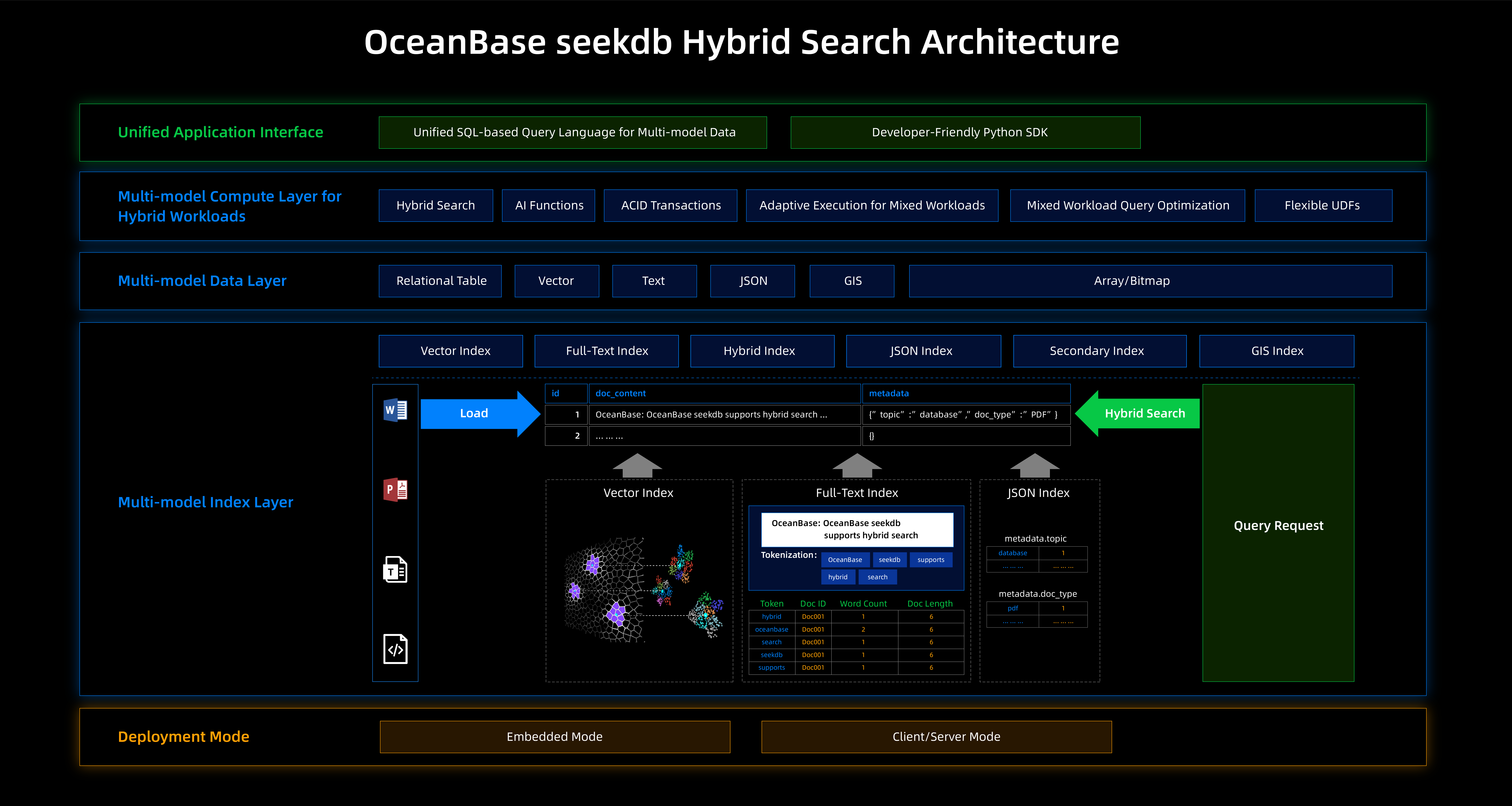
Unified Multi-Modal Storage. No More Silos
seekdb supports scalar, vector, text, JSON, and GIS data in a single engine.
Crucially, all indexes exist in the same transaction domain. When you update a row, the scalar, vector, and full-text indexes update synchronously. There is no "inconsistency window" common in architectures that rely on CDC (Change Data Capture) to sync data between a SQL DB and a Vector DB.
True Hybrid Search. Single Query
For real applications, you almost never run pure vector search or pure keyword search. You do both, plus filters. seekdb supports doing all of this in one query pipeline:
You can tune the weights via the DBMS_HYBRID_SEARCH package. If you care more about exact keyword matches, boost the full-text weight. If you need semantic understanding, boost the vector weight.
AI Inside. Document-In, Data-Out
AI is built into the database, not bolted on from the outside.
Out of the box, seekdb embeds a small model for generating vector representations. For many use cases, you can completely ignore vector management—you work with text, and the system handles the embeddings. When you need higher quality, you can easily plug in external models (like OpenAI).
We currently expose four core AI functions directly in SQL:
Developer Simplicity: Light, Fast, and Flexible
We designed seekdb to fit into your workflow, not disrupt it. Whether you are hacking on a laptop or deploying to a cluster, the experience should feel frictionless.
Flexible Deployment
seekdb supports two primary modes so you can start small and scale without changing databases:
Hassle-Free Schemaless API
We know you don't want to write complex DDL just to test an idea. That's why we expose a Schemaless API for rapid iteration.
You simply create a collection and upsert documents. We handle the rest—automatically creating the schema, generating embeddings, and building the vector and full-text indexes in the background.
import pyseekdbclient = pyseekdb.Client()collection = client.get_or_create_collection("products")# Auto-vectorization and storagecollection.upsert( documents=[ "Laptop Pro with 16GB RAM, high-speed processor", "Gaming Rig with RTX 4090 and 1TB SSD" ], metadatas=[ {"category": "laptop", "price": 1200}, {"category": "desktop", "price": 2500} ], ids=["1", "2"])# Hybrid Search: Vector semantic + SQL filter + Keyword matchresults = collection.query( query_texts=["powerful computer for work"], # Vector search where={"price": {"$lt": 2000}}, # Relational filter where_document={"$contains": "RAM"}, # Full-text search n_results=1)Want full control? You can always drop down to standard SQL to fine-tune schemas and indexing strategies whenever you need to.
SQL-Native, Battle-Tested Engine
seekdb inherits the core engine capabilities from OceanBase:
Data Stack Comparison: Why seekdb?
We didn't build seekdb to win a feature checkbox war. We built it to eliminate the "Frankenstein" architectures that plague AI engineering teams.
Here is how the unified approach compares to the two most common patterns we see in production today.
| Feature | The "Classic" (SQL + ES/Solr) | The "Specialist" (SQL + Vector DB) | OceanBase seekdb (Unified AI-Native DB) |
| The Stack | Three Systems: Relational DB + Search Engine + Vector Store. | Two Systems: Relational DB + Dedicated Vector DB. | One System: All-in-one SQL Engine. |
| Data Consistency | Weak/Eventual. Relying on CDC pipelines introduces lag (ms to seconds). | Disconnected. No transactional guarantee between your business data and vectors. | Strict ACID. Scalars, vectors, and text indexes update atomically. Zero lag. |
| Search Capability | Siloed. Great full-text, but vector search is often an afterthought. | Lopsided. Great vector search, but full-text support is usually weak. | True Hybrid. Native Vector + Full-Text + Scalar filtering in one pipeline. |
| Dev Experience | Ops Heavy. 3x config, 3x monitoring. Debugging sync is a nightmare. | Glue Code Heavy. Complex app logic required to join and rank results. | App Focused. Logic is pushed down to the DB. You write SQL, not plumbing. |
Built for What You're Building Now
We aren't just building this in a vacuum. We are powering real scenarios:
We Are Just Getting Started
seekdb is young. It’s not perfect, but it represents a new direction: a database that adapts to the developer, not the other way around. We have stripped away the complexity so you can focus on the intelligence of your application, not the plumbing of your data.
Our immediate roadmap focuses on:
Try It Out
We need your feedback to make seekdb better. Break it, test it, and tell us what you need. Let’s build the data infrastructure for the AI era together.


Keep Reading
View all posts
I Built a Knowledge Base That Thinks — Inspired by Karpathy's LLM Wiki
Inspired by Karpathy's LLM Wiki, ex-brain is an open-source personal knowledge base that compiles, links, and evolves your notes using LLMs and seekdb's hybrid search.


Beyond Fine-tuning: Solving DABstep's Hard Mode with Versioned Assets
On the DABstep Global Leaderboard, OceanBase DataPilot agent has secured the top spot, maintaining a significant lead over the runner-up for a month. The secret to our SOTA results was a fundamental shift in engineering paradigm: moving from "Prompt Engineering" to "Asset Engineering."

PowerContext: A Foundation for Human–Agent Collaboration
PowerContext is open-source context infrastructure that lets people and AI agents hand off unfinished work across sessions, models, and agent hosts.