

OceanBase logo

OceanBase

A unified distributed database ready for your transactional, analytical, and AI workloads.

DEPLOY YOUR WAY

OceanBase Cloud

The best way to deploy and scale OceanBase

OceanBase Enterprise

Run and manage OceanBase on your infra

TRY OPEN SOURCE

OceanBase Community Edition

The free, open-source distributed database

OceanBase seekdb

Open source AI native search database

Customer Stories

Real-world success stories from enterprises across diverse industries.

View All
BY USE CASES

Mission-Critical Transactions

Global & Multicloud Application

Elastic Scaling for Peak Traffic

Real-time Analytics

Active Geo-redundancy

Database Consolidation

Resources

Comprehensive knowledge hub for OceanBase.

Blog

Live Demos

Training & Certification

Documentation

Official technical guides, tutorials, API references, and manuals for all OceanBase products.

View All
PRODUCTS

OceanBase Cloud

OceanBase Database

Tools

Connectors and Middleware

QUICK START

OceanBase Cloud

OceanBase Database

BEST PRACTICES

Practical guides for utilizing OceanBase more effectively and conveniently

Company

Learn more about OceanBase – our company, partnerships, and trust and security initiatives.

About OceanBase

Partner

Trust Center

Contact Us

International - English
中国站 - 简体中文
日本 - 日本語
Sign In
Start on Cloud

A unified distributed database ready for your transactional, analytical, and AI workloads.

DEPLOY YOUR WAY

OceanBase Cloud

The best way to deploy and scale OceanBase

OceanBase Enterprise

Run and manage OceanBase on your infra

TRY OPEN SOURCE

OceanBase Community Edition

The free, open-source distributed database

OceanBase seekdb

Open source AI native search database

Customer Stories

Real-world success stories from enterprises across diverse industries.

View All
BY USE CASES

Mission-Critical Transactions

Global & Multicloud Application

Elastic Scaling for Peak Traffic

Real-time Analytics

Active Geo-redundancy

Database Consolidation

Comprehensive knowledge hub for OceanBase.

Blog

Live Demos

Training & Certification

Documentation

Official technical guides, tutorials, API references, and manuals for all OceanBase products.

View All
PRODUCTS
OceanBase CloudOceanBase Database
ToolsConnectors and Middleware
QUICK START
OceanBase CloudOceanBase Database
BEST PRACTICES

Practical guides for utilizing OceanBase more effectively and conveniently

Learn more about OceanBase – our company, partnerships, and trust and security initiatives.

About OceanBase

Partner

Trust Center

Contact Us

Start on Cloud
编组
All Products
    • Databases
    • iconOceanBase Database
    • iconOceanBase Cloud
    • iconOceanBase Tugraph
    • iconInteractive Tutorials
    • iconOceanBase Best Practices
    • Tools
    • iconOceanBase Cloud Platform
    • iconOceanBase Migration Service
    • iconOceanBase Developer Center
    • iconOceanBase Migration Assessment
    • iconOceanBase Admin Tool
    • iconOceanBase Loader and Dumper
    • iconOceanBase Deployer
    • iconKubernetes operator for OceanBase
    • iconOceanBase Diagnostic Tool
    • iconOceanBase Binlog Service
    • Connectors and Middleware
    • iconOceanBase Database Proxy
    • iconEmbedded SQL in C for OceanBase
    • iconOceanBase Call Interface
    • iconOceanBase Connector/C
    • iconOceanBase Connector/J
    • iconOceanBase Connector/ODBC
    • iconOceanBase Connector/NET
icon

OceanBase Database

KV - V4.3.5

  • OBKV overview
  • Architecture
  • OBKV-Table
    • Introduction to OBKV-Table
      • Overview
      • OBKV-Table operation types
      • Core features of OBKV-Table
      • Differences between replace and insert_or_update
      • Supported value types
      • OBKV-Table data models
    • Use the OBKV-Table Java client
      • Java development guide for OBKV-Table
      • Prepare for development with OBKV-Table
      • Use the OBKV-Table Java client to connect to a cluster
      • Set client parameters
      • Supported client interfaces
      • Use the OBKV-Table Java client
    • Use the OBKV-Table GO client
      • Use the OBKV-Table Go client to connect to a cluster
      • Overview of the Go client
      • Individual API operations
      • Batch operations
      • About queries
      • Aggregation API
      • Filters
    • FAQ
  • OBKV-HBase
    • Overview
    • OBKV-HBase core features
    • Compatibility with HBase
    • Deployment
    • Application development with OBKV-HBase
      • Overview of OBKV-HBase application development
      • Data model
      • Data model design
      • Connect to a cluster using the OBKV-HBase client
      • Migrate HBase business code to OBKV-HBase
      • Data operation examples
      • Delete expired data
    • OBKV-HBase migration guide
    • OBKV-HBase management
      • Overview
      • High availability
      • Security and permissions
      • Monitoring metrics
    • Performance test
    • OBKV-HBase integrations
      • Flink
        • Synchronize data to OBKV-HBase by using Flink
    • Views
    • FAQ

Download PDF

OBKV overview Architecture Overview OBKV-Table operation types Core features of OBKV-Table Differences between replace and insert_or_update Supported value types OBKV-Table data models Java development guide for OBKV-Table Prepare for development with OBKV-Table Use the OBKV-Table Java client to connect to a cluster Set client parameters Supported client interfaces Use the OBKV-Table Java client Use the OBKV-Table Go client to connect to a cluster Overview of the Go client Individual API operations Batch operations About queries Aggregation API Filters FAQ Overview OBKV-HBase core features Compatibility with HBase Deployment Overview of OBKV-HBase application development Data model Data model design Connect to a cluster using the OBKV-HBase client Migrate HBase business code to OBKV-HBase Data operation examples Delete expired data OBKV-HBase migration guide Overview High availability Security and permissions Monitoring metrics Performance test Views FAQ
OceanBase logo

The Unified Distributed Database for the AI Era.

Follow Us
Products
OceanBase CloudOceanBase EnterpriseOceanBase Community EditionOceanBase seekdb
Resources
DocsBlogLive DemosTraining & Certification
Company
About OceanBaseTrust CenterLegalPartnerContact Us
Follow Us

© OceanBase 2026. All rights reserved

Cloud Service AgreementPrivacy PolicySecurity
Contact Us
Document Feedback
  1. Documentation Center
  2. OceanBase Database
  3. KV
  4. V4.3.5
iconOceanBase Database
KV - V 4.3.5
SQL
KV
  • V 4.3.5

Overview

Last Updated:2025-09-08 11:41:13  Updated
share
What is on this page
Core benefits
Stable P99
Hot replica
Disaster recovery across zones
High performance
Easy O&M
Application scenarios
Massive data storage
High-performance real-time access to characteristics data in scenarios such as recommendation and risk control

folded

share

Compatible with HBase APIs, OBKV-HBase is a wide table database dedicated to the storage of massive structured or semi-structured data and high access performance.

Core benefits

Stable P99

OBKV-HBase is developed by using C++ and uses a self-developed memory management subsystem. It does not have the issue of Java garbage collection (GC) or other jitter issues caused by memory, as seen in open-source HBase. Taking advantage of TP refinement and optimization in storage access links achieved by OceanBase Database over the past decade and more, OBKV-HBase demonstrates excellent P99 stability.

Hot replica

OBKV-HBase is built based on the native high-reliability capabilities of OceanBase Database and uses the Paxos protocol to ensure strong consistency among multiple replicas. When a node fails, the failover to a hot replica is quickly performed to ensure business continuity. OceanBase Database V4.0 can achieve a recovery time objective (RTO) less than 8s. Open-source HBase is built based on a storage/computing splitting architecture, where each partition at the RegionServer layer has only one replica. When a fault occurs, business will be unavailable for several minutes due to the process of partition scheduling and fault recovery.

Disaster recovery across zones

OBKV-HBase allows you to deploy a cluster instance across multiple zones. Typical disaster recovery architectures include three IDCs across two regions and five IDCs across three regions, which provide higher disaster recovery capabilities. Generally, open-source HBase implements the primary/standby cluster mode for disaster recovery based on HLogs. However, to achieve the same disaster recovery level, open-source HBase requires more replicas, leading to higher costs.

High performance

Both OBKV-HBase and open-source HBase use a storage engine based on the log-structured merge-tree (LSM-tree). Therefore, they have the same benefit in write performance. Based on over 10 years of continuous development and optimization in TP scenarios by OceanBase Database, OBKV-HBase can achieve ultimate read performance. In scenarios with large amounts of data, OBKV-HBase can achieve read performance more than four times higher than that of open-source HBase.

Easy O&M

OBKV-HBase provides only OBServer nodes for users, who do not need to concern about the differences among roles involved in distributed implementation. OceanBase Database provides a series of easy-to-use development and O&M tools to simplify O&M. OceanBase Database is an all-in-one database. The O&M for OBKV is exactly the same as that for OceanBase Database. This reduces the workload in performing O&M on multiple databases while unifying the technical stack.

Application scenarios
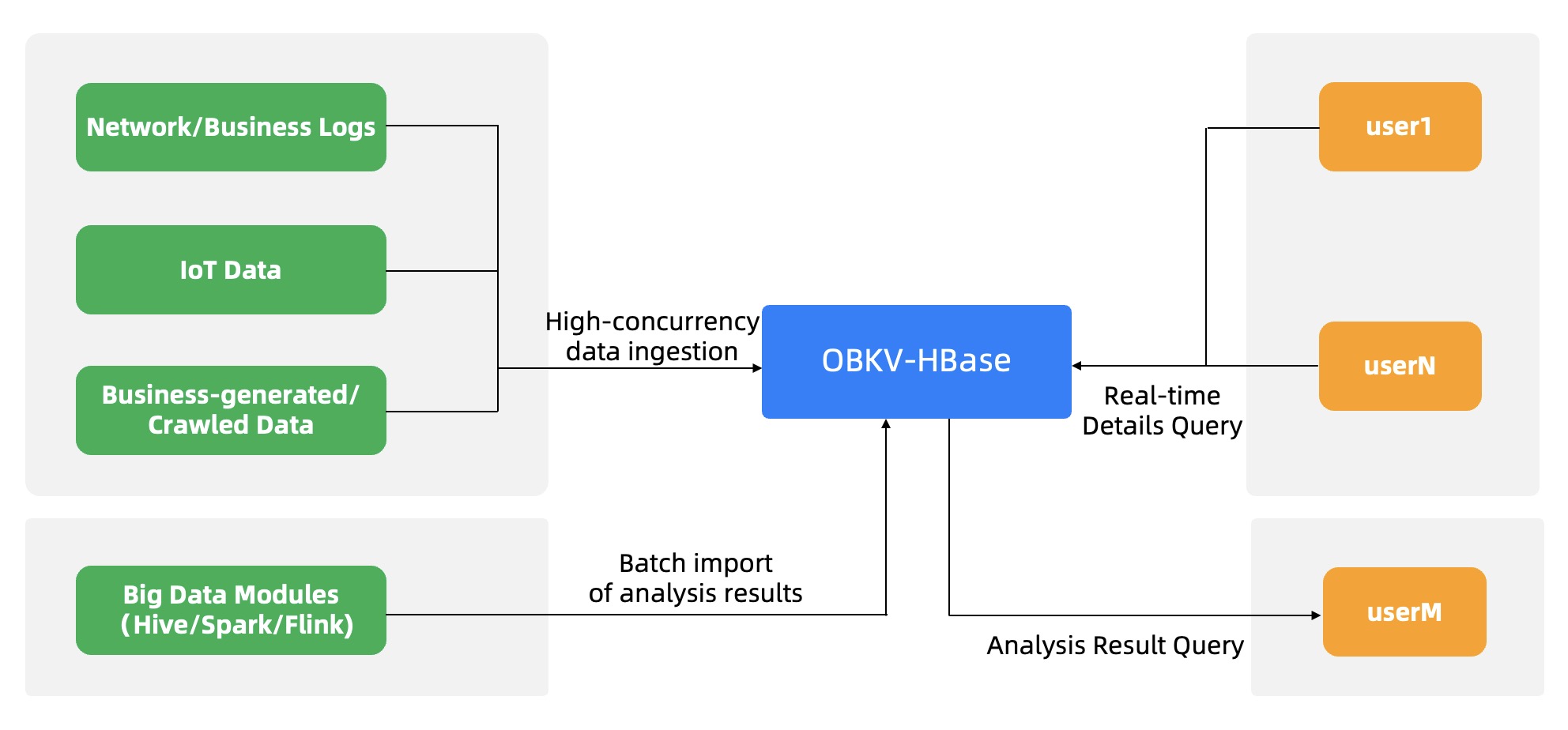
scenario

Massive data storage

OBKV-HBase is built based on the distributed storage engine of OceanBase Database to provide real-time reads and writes and low-cost storage of massive data. It supports API-based batch import and direct load.

OBKV-HBase adapts to open-source components such as DataX and Flink for efficient incremental and full data synchronization. It can integrate with Flink and other data warehousing and big data components for real-time or offline data analysis. It can also implement real-time analysis of data in a database based on the integration and real-time data warehousing capabilities of OceanBase Database. You can use OBKV-HBase to quickly store application logs, Internet of Things (IoT) data, trace data, and monitoring data in real time, and perform online or offline data analysis based on the data warehousing or big data component.

High-performance real-time access to characteristics data in scenarios such as recommendation and risk control

Based on the TP capabilities accumulated by OceanBase Database in over 10 years, OBKV-HBase can support low-latency data reads. It can also handle concurrent access at a level of 10 million or higher through horizontal scaling.

OBKV-HBase supports HBase features such as schemaless, wide tables, sparse columns, multiple data versions, and TTL. It can flexibly store characteristics data and support high-performance access to the data in scenarios such as recommendation and risk control.

Previous topic

FAQ
Last

Next topic

OBKV-HBase core features
Next
What is on this page
Core benefits
Stable P99
Hot replica
Disaster recovery across zones
High performance
Easy O&M
Application scenarios
Massive data storage
High-performance real-time access to characteristics data in scenarios such as recommendation and risk control