







Version information
Version: V4.0.1
Previous version: V4.0.0
Version release date: December 28, 2022
Supported upgrade path: For OCP versions earlier than V2.3.0, you must first upgrade to V2.3.x, then upgrade from V2.3.x to V3.3.4, and finally upgrade from V3.3.4 to the current version. For OCP versions between V2.3.x and V3.2.4, you must first upgrade to V3.3.4, and then upgrade from V3.3.4 to the current version. For OCP versions V3.2.4 and later, you can directly upgrade to the current version.
Notice
MetaDB 1479 is compatible with OCP V4.0.1. If you need to upgrade MetaDB 1479 to OCP V4.0.1, contact technical support.
Supported OceanBase Database versions
OCP V4.0.1 supports the following OceanBase Database versions:
OceanBase V1.4.x
OceanBase V2.1.x
OceanBase V2.2.x
OceanBase V3.1.x
OceanBase V3.2.x
OceanBase V4.x
New features
Overview
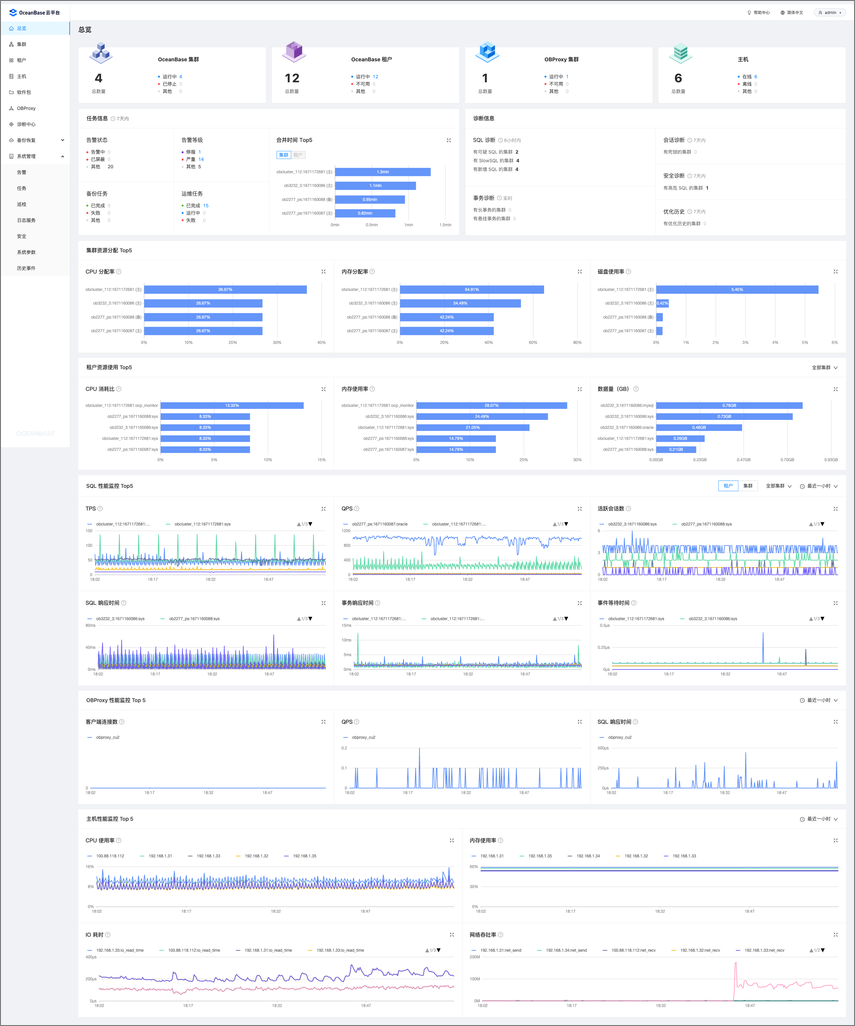
As OCP manages more objects and provides more comprehensive features, many high-frequency and important information are scattered across different modules, requiring manual aggregation and organization. To address this issue, OCP introduces the Overview module, offering a global perspective of the resources managed by OCP. After logging in to the OCP console, you can quickly access information such as the status, consumption, and performance of resources.
Status Overview
- Monitor the status of OceanBase clusters, tenants, OBProxy clusters, and hosts, and mark abnormal resources.
- Monitor the status of alerts, backups, O&M tasks, and major compactions to understand global task information.
- Statistic SQL, session, transaction, and security diagnostic information to identify performance risks.
Resource Overview
- Display the CPU, memory, and disk allocation of the top 5 clusters, highlighting clusters with high resource allocation.
- Display the CPU, memory, and data usage of the top 5 tenants, highlighting tenants with high resource consumption.
Performance Overview
- Support performance monitoring metrics for OceanBase clusters, tenants, OBProxy clusters, and hosts.
- Support viewing the top 5 performance metrics by cluster or tenant, or by all clusters or specified clusters.
Diagnostics Center
The Safety Diagnostics module now includes two new submodules: High Risk SQL and New SQL statement.
- High-Risk SQL: Helps customers identify high-risk SQL statements based on various rules, including DDL operations, updates, deletes, and queries that return excessive records. It also includes SQL statements that perform full-table updates or deletes, which can pose risks to data security and system stability.
- New SQL: Aggregates and statistically analyzes SQL statements that have not been executed in the past 7 days, enabling early detection of performance risks.
The SQL Diagnostics module now supports SQL comparison capabilities.
OCP already supports TopSQL analysis, allowing you to sort SQL statements based on various dimensions such as total execution time, number of executions, and average response time. This helps you identify the most resource-intensive and critical SQL statements within a specific period. However, during routine data maintenance, changes in SQL behavior might be worth monitoring. For example, you might want to compare SQL statements executed at the same time point within a week or between different time periods. OCP now supports comparing TopSQL statements across different time periods, displaying performance trends during the specified periods. It also highlights SQL statements that meet specific criteria, such as new TopSQL statements, high execution frequency, large number of returned rows, high failure rate, or significant changes in execution plans, to help you identify areas for optimization.


Additionally, along the Discovery > Diagnostics > Optimization > Emergency path, OCP integrates capabilities from the alerts, monitoring, diagnostics, and logs modules.
- After receiving an alert, you can log in to the OCP console, navigate to the alerts summary module on the homepage, and click the alert information to view the alert details. The system displays monitoring information for the corresponding period, and you can access the monitoring page of the specific resource for more detailed monitoring information to troubleshoot issues.
- The monitoring page of a tenant now includes a SQL Diagnostics button. Clicking this button redirects you to the SQL diagnostics page. You can select a time range and click Search to view SQL statements executed during that period and identify issues.
Tenant Backup
OCP V4.0.0 allows you to set backup strategies for tenants. You can configure different backup strategies, including backup cycles and methods, based on the importance of each tenant. Additionally, you can set backup strategies at the cluster level, which apply only to tenants without individually configured backup strategies.
- You can set backup strategies for one or multiple tenants without setting a cluster-level backup strategy.
- You can set backup strategies for specific tenants even if a cluster-level backup strategy is already configured.


Alerts
OCP's alerting capabilities are a core enterprise feature, providing timely and secure alerts for clusters and related objects. To enhance the O&M experience, simplify alert configuration, and better support delivery personnel, OCP V4.0.1 has comprehensively optimized the alerting feature. It simplifies the original alert configuration process, enhances alerting capabilities, and allows you to configure alerts through the platform.
- Enhanced Capabilities
- Added support for multi-metric alert configuration, allowing you to combine multiple metrics using "AND" or "OR" logic.
- Added alert templates, enabling you to set batch alert rules for alert objects and use default alert templates.
- Added tag-based alert suppression, allowing you to suppress alerts based on specific tags (such as SQLID or session ID) for more precise alert management.
- Added DingTalk, WeCom, Feishu, and email alert channels. These channels require minimal configuration, with only two forms needed to complete the setup.
- Optimized Configurations
- Alert Events
- Removed the original alert message module, allowing you to view alert message records directly in the alert events.
- Added support for linking SQLID in alert events to the diagnostics page.
- Alert Rules
- Added support for keyword alerts for more log types, such as OceanBase logs, OBProxy logs, and host logs.
- Added support for adjusting alert objects in default alert rule configurations.
- Alert Channels
- Added support for configuring DingTalk and WeCom alert channels to notify specific users within a group.
- Added support for configuring alert message templates in different languages and selecting the language for alert notifications.
- Added support for configuring JSON-formatted alert messages.
- Alert Push
- Renamed the original Alert Subscription feature to Alert Push, allowing you to push alert information by alert group or alert template. Alert group push supports specifying alert objects.
- Added an option to configure whether to receive alert recovery notifications when configuring alert push.
- Other Enhancements
- Added support for reverse filtering rules in alert object selection, allowing you to specify that certain objects do not receive alerts.
- Alert Events
Inspection
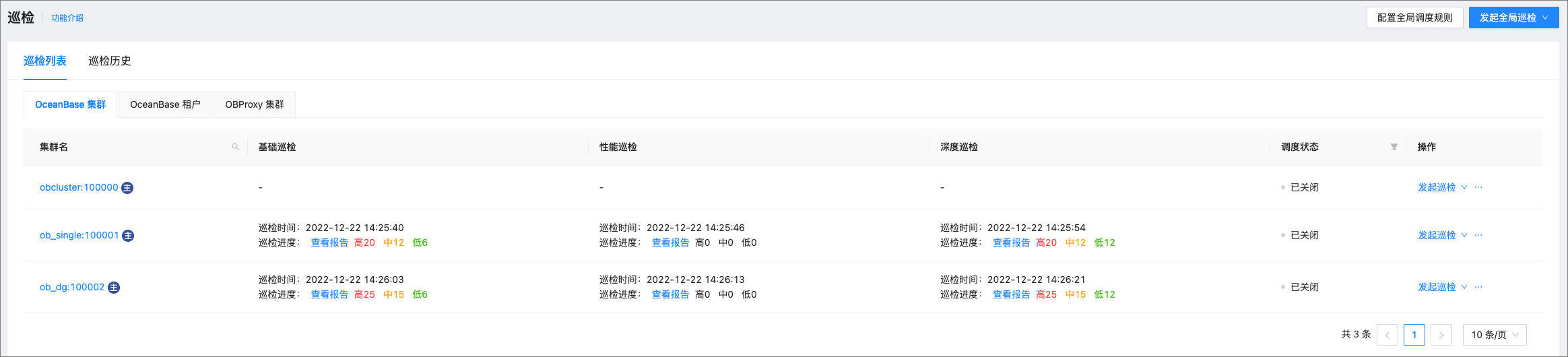
OCP V4.0.1 redesigns the inspection feature to make it easier to use and provide a more accurate understanding of the risks associated with the managed resources. It combines the original health check and inspection capabilities and adds a large number of inspection rules based on survey feedback. From the perspective of inspection objects, it supports different inspection features for different scenarios.
- Inspection Objects: The inspection operation starts with the object, making the operation more simple and clear.
- You can define inspection items for each OceanBase cluster, tenant, and OBProxy cluster.
- You can initiate an inspection for a single object or for all objects.
- Inspection Scenario: Three predefined inspection scenarios are provided, each with different inspection items.
- Basic inspection: A basic health check for resources managed by OCP. This is suitable for daily inspections.
- Performance inspection: A performance check for resources managed by OCP. This is suitable for performance analysis.
- Deep inspection: A deep check for resources managed by OCP. This is suitable for inspections before business peaks.
- Scheduling Rules: Different scheduling rules are supported for each object and corresponding inspection scenario.
- You can configure the scheduling cycle in days, weeks, or months.
- Inspection report: Each inspection task generates a detailed inspection report for you to analyze.
- The inspection report highlights low, medium, and high-risk items based on the inspection item rules.
- You can view the inspection report online or download it to your local device.
Feature enhancements
Cluster management
- When you create a cluster, you can specify the SQL port and RPC port.
- When you create a cluster of V2.2.77, you can use a recommended parameter template.
- When you create a cluster, you can check the IOPS of 16 KB I/O blocks. If the IOPS is less than 1000, an exception is thrown.
- A cluster can be deployed in heterogeneous zones. That is, an x86 zone and an ARM zone can be deployed in the same cluster.
- You can Reinstall an OBServer node. You can choose to reinstall an OBServer node in place.
- When you Replace an OBServer node, you can skip the offline host cleanup.
- When you Replace or Add an OBServer node, you can select only the same IDC.
- You can batch query the names of clusters in the cluster list.
- The primary and standby clusters in the cluster list are displayed in a flat manner.
- You can view modified parameters and filter read-only parameters in the cluster parameter management page.
Tenant management
- When you create or manage a tenant, you are prompted of the minimum resource specifications that can be used for the unit.
- When you create a tenant, you are prompted of the risks when the unit specifications and numbers are inconsistent across zones.
- The concept of overselling is removed from tenant unit management. You do not need to set the minimum and maximum values of CPU and memory.
- You can batch query the names of tenants in the tenant list.
- The Tenant ID column is added to the tenant management list.
- You can view modified parameters and filter read-only parameters in the tenant parameter management page.
- The issue where the
lower_case_table_namesparameter cannot be set when you create a MySQL tenant is fixed.
Host management
- You can batch query the IP addresses of hosts in the host list. You can also filter hosts by host type, IDC, and service.
- The host information management page displays the CPU chip name, number of CPU cores, and total memory.
- Clock offset checks are enabled by default when you add a host.
OBProxy
- You can specify the password of an OBProxy cluster.
- The status column is added to the OBProxy cluster list. The status of an OBProxy cluster is displayed in this column.
- The restriction that an OBProxy cluster cannot be upgraded if the hardware architecture is inconsistent is removed.
- The Request Analysis menu is added. You can use this menu to count the number of requests of a cluster, a tenant, or a client.
- Best practices are used as default parameters when you deploy an OBProxy cluster.
Monitoring
- The default sampling interval of OCP monitoring is changed from 1 second to 5 seconds.
- The CPU Utilization chart of a tenant is changed to the CPU Consumption of Tenant chart.
- The IO Usage and IO Queue Length charts are added to the host monitoring page. The System, User, and IOWait dimensions are added to the CPU Usage chart.
Others
- OCP supports the HTTPS authentication protocol to meet the requirements of level three of the information security protection standard.
- The Initiated By filter is added to the task list. You can also search for a task by Task Name.
- The Restart to Apply Changes column is added to the OCP system parameter management list.
- You can specify the installation directory of an Agent by using the
ocp.agent.home.path.prefixparameter. - You can modify the TopN configuration by using the
ocp.perf.workload.report.tenant-top-sql-limitparameter. - You can enable or disable automatic snapshot generation by using the
ocp.perf.snapshot.generation.enableparameter. You can also specify a cluster to generate a snapshot by using theocp.perf.snapshot.generation.white-listparameter.
Fixed issues
OCP V4.0.1 fixes the following issues:
Fixed the issue where tenant allowlists fail to synchronize when OCP is upgraded from an earlier version to V3.3.3.
Fixed the issue where the units of the io_util and io_qusize metrics in OCP alerts are incorrect.
Fixed the issue where OCP continues to use the original RS to execute the upgrade script after the RS changes in certain scenarios.
Fixed the issue where the manual refresh and automatic refresh of replica views in cluster resource management call different interfaces.
Fixed the issue where a server error "Error writing JSON output" occurs when the Trace details of SlowSQL are bound to a schema index.
Fixed the issue where the password for the proxyro@sys user in the Meta cluster stored in the password vault is incorrect when OCP is deployed by using Antman.
Fixed the issue where the agent started by using ssh cannot find the
sysctlcommand due to the limited PATH directory inherited from the parent process.Fixed the issue where an OBProxy cluster is permanently locked and cannot be maintained in certain scenarios.
Fixed the issue where the upgrade path cannot be found when OCP uploads the debuginfo package of the target version.
Known issues
Number |
Known issue |
Workaround |
|---|---|---|
| 1 | After a tenant is deleted, the backup information of the tenant cannot be displayed. | N/A. |
| 2 | In an empty OBProxy cluster, you cannot add an OBProxy server of the 4.0.0 version. | When you create an OBProxy cluster of the 4.0.0 version, add an OBProxy server at the same time. |
Limitations
Hardware requirements
OCP-Server can be installed on a physical server or in a Docker container. OCP-Server supports multi-node high-availability deployment.
The following table lists the minimum hardware requirements for OCP-Server nodes.
Hardware |
Requirement |
|---|---|
| CPU | |
| Memory | 16 GB of available memory |
| NIC | 10 GbE NIC |
OCP-Agent consumes very few resources and has no special requirements for the hardware resources of the installation node.
Operating system requirements
The following table lists the operating system requirements for installing OCP-Server (including OCP-Agent).
Server type |
Operating system |
Supported version |
|---|---|---|
| x86_64 | RHEL | 7.2 and later |
| x86_64 | CentOS | 7.2 and later |
| x86_64 | AliOS | 7.2 and later |
| x86_64 | openSUSE | 12 SP3 and later |
| ARM aarch64 | AliOS | 7.2 and later |
| ARM aarch64 | NeoKylin | 7.6 |
| ARM aarch64 | Huawei EulerOS | 2.0 SP8 |
| x86_64 | Debian | Debian GNU/Linux 11 (bullseye) |
| x86_64 | Ubuntu | Ubuntu 18.04.6 LTS |
Client requirements
General users access OCP services through a web browser. The following table lists the client requirements.
Browser |
Minimum version |
|---|---|
| Chrome | 81 |
| Firefox | 64 |
| Safari | 10 |
| Edge | 13 |
If you want to access OCP services on an iOS device, the operating system requirements are as follows.
Operating system |
Minimum version |
|---|---|
| iOS | 10 |
For the best user experience, we recommend that you use a display with a resolution of 1440 x 810 or higher.