

OceanBase logo

OceanBase

A unified distributed database ready for your transactional, analytical, and AI workloads.

DEPLOY YOUR WAY

OceanBase Cloud

The best way to deploy and scale OceanBase

OceanBase Enterprise

Run and manage OceanBase on your infra

TRY OPEN SOURCE

OceanBase Community Edition

The free, open-source distributed database

OceanBase seekdb

Open source AI native search database

Customer Stories

Real-world success stories from enterprises across diverse industries.

View All
BY USE CASES

Mission-Critical Transactions

Global & Multicloud Application

Elastic Scaling for Peak Traffic

Real-time Analytics

Active Geo-redundancy

Database Consolidation

Resources

Comprehensive knowledge hub for OceanBase.

Blog

Live Demos

Training & Certification

Documentation

Official technical guides, tutorials, API references, and manuals for all OceanBase products.

View All
PRODUCTS

OceanBase Cloud

OceanBase Database

Tools

Connectors and Middleware

QUICK START

OceanBase Cloud

OceanBase Database

BEST PRACTICES

Practical guides for utilizing OceanBase more effectively and conveniently

Company

Learn more about OceanBase – our company, partnerships, and trust and security initiatives.

About OceanBase

Partner

Trust Center

Contact Us

International - English
中国站 - 简体中文
日本 - 日本語
Sign In
Start on Cloud

A unified distributed database ready for your transactional, analytical, and AI workloads.

DEPLOY YOUR WAY

OceanBase Cloud

The best way to deploy and scale OceanBase

OceanBase Enterprise

Run and manage OceanBase on your infra

TRY OPEN SOURCE

OceanBase Community Edition

The free, open-source distributed database

OceanBase seekdb

Open source AI native search database

Customer Stories

Real-world success stories from enterprises across diverse industries.

View All
BY USE CASES

Mission-Critical Transactions

Global & Multicloud Application

Elastic Scaling for Peak Traffic

Real-time Analytics

Active Geo-redundancy

Database Consolidation

Comprehensive knowledge hub for OceanBase.

Blog

Live Demos

Training & Certification

Documentation

Official technical guides, tutorials, API references, and manuals for all OceanBase products.

View All
PRODUCTS
OceanBase CloudOceanBase Database
ToolsConnectors and Middleware
QUICK START
OceanBase CloudOceanBase Database
BEST PRACTICES

Practical guides for utilizing OceanBase more effectively and conveniently

Learn more about OceanBase – our company, partnerships, and trust and security initiatives.

About OceanBase

Partner

Trust Center

Contact Us

Start on Cloud
编组
All Products
    • Databases
    • iconOceanBase Database
    • iconOceanBase Cloud
    • iconOceanBase Tugraph
    • iconInteractive Tutorials
    • iconOceanBase Best Practices
    • Tools
    • iconOceanBase Cloud Platform
    • iconOceanBase Migration Service
    • iconOceanBase Developer Center
    • iconOceanBase Migration Assessment
    • iconOceanBase Admin Tool
    • iconOceanBase Loader and Dumper
    • iconOceanBase Deployer
    • iconKubernetes operator for OceanBase
    • iconOceanBase Diagnostic Tool
    • iconOceanBase Binlog Service
    • Connectors and Middleware
    • iconOceanBase Database Proxy
    • iconEmbedded SQL in C for OceanBase
    • iconOceanBase Call Interface
    • iconOceanBase Connector/C
    • iconOceanBase Connector/J
    • iconOceanBase Connector/ODBC
    • iconOceanBase Connector/NET
icon

OceanBase Cloud Platform

V4.3.0

    Download PDF

    OceanBase logo

    The Unified Distributed Database for the AI Era.

    Follow Us
    Products
    OceanBase CloudOceanBase EnterpriseOceanBase Community EditionOceanBase seekdb
    Resources
    DocsBlogLive DemosTraining & Certification
    Company
    About OceanBaseTrust CenterLegalPartnerContact Us
    Follow Us

    © OceanBase 2026. All rights reserved

    Cloud Service AgreementPrivacy PolicySecurity
    Contact Us
    Document Feedback
    1. Documentation Center
    2. OceanBase Cloud Platform
    3. V4.3.0
    iconOceanBase Cloud Platform
    V 4.3.0
    • V 4.3.6
    • V 4.3.5
    • V 4.3.4
    • V 4.3.3
    • V 4.3.2
    • V 4.3.1
    • V 4.3.0
    • V 4.2.2
    • V 4.0.0 and earlier

    Use OCP-Agent to pull time-series monitoring data

    Last Updated:2026-04-14 07:51:05  Updated
    share
    What is on this page
    OCP-Agent monitoring description
    Scheme for pulling time-series monitoring data

    folded

    share

    OCP-Agent can push the monitoring data to Pushgateway, which can pull monitoring data collected by OCP-Agent.

    OCP-Agent monitoring description

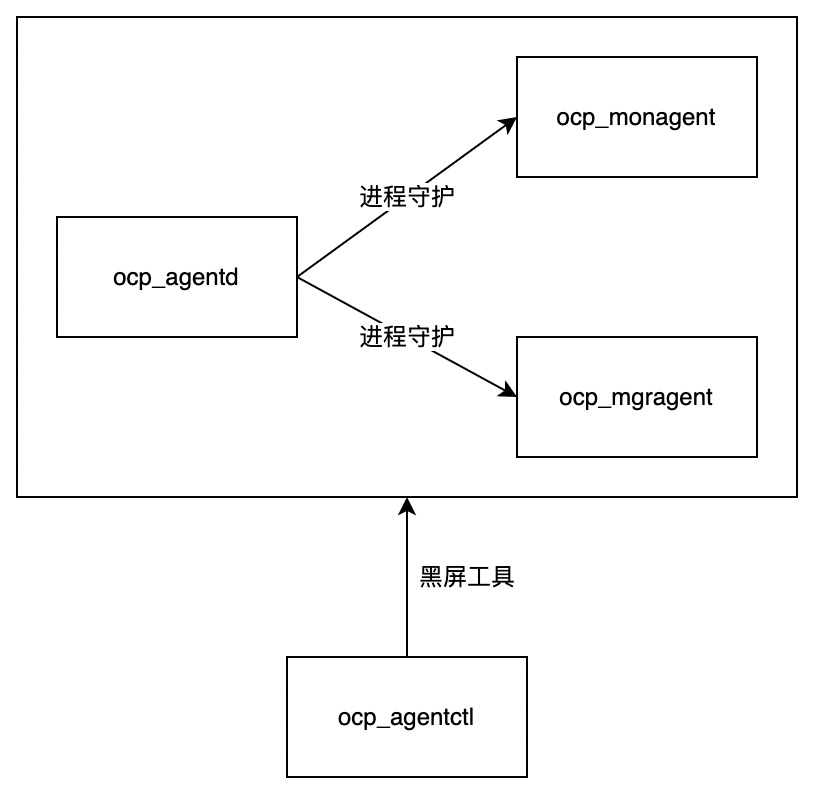
    OCP-Agent is a management and monitoring component deployed on the host. It runs with three resident processes and one command-line tool (CLI) process.

    • The ocp_mgragent process is the management process that executes O&M commands for the OceanBase database and OBProxy.

    • The ocp_monagent process is the monitoring process that collects monitoring data from the OceanBase database, OBProxy, and host.

    • The ocp_agentd process is the daemon process of ocp_mgragent and ocp_monagent.

    • The ocp_agentctl process is the process of the O&M CLI tool.
    1

    OCP-Agent generates the following two types of time-series monitoring data in the formats defined in Prometheus:

    1. Business monitoring data, such as the monitoring data of hosts, OceanBase database, clusters, and tenants.

    2. OCP-Agent self-monitoring data related to the running status of OCP-Agent, such as the resource usage by OCP-Agent and the running status of the related processes.

    Note

    In addition to the time-series data, OCP-Agent also collects SQL audit data from OceanBase Database for the diagnostic analysis of SQL statements and alert triggering. Log data is collected for analyzing fault causes. Non-time-series data is not included in this topic.

    Scheme for pulling time-series monitoring data

    In OCP V3.2.0 and later, the monitoring APIs of OCP-Agent support authentication. The authentication uses random passwords that cannot be queried. In OCP V3.3.2, you can disable the authentication. After the authentication is disabled, OCP-Agent can directly pull the monitoring data.

    The monitoring APIs are controlled by the ocp.agent.auth.metric-auth-enabled parameter. The default value is true, which indicates that the authentication is enabled. If you set the parameter to false, OCP-Agent can directly pull the monitoring data.

    The following table describes the monitoring APIs:

    Exporter Recommended collection interval Description
    http://<ip>:62889/metrics/node/host 1 to 15 seconds The host monitoring data collected by the node_exporter process.
    http://<ip>:62889/metrics/node/ob 1 to 15 seconds The host-level monitoring data after OceanBase Database is deployed, such as the availability of OceanBase services and the status of OceanBase processes.
    http://<ip>:62889/metrics/ob/basic 1 to 15 seconds The monitoring data collected from system tables of OceanBase Database.
    http://<ip>:62889/metrics/node/obproxy 1 to 15 seconds The host-level monitoring data after OBProxy is deployed, such as the status of the obproxy process.
    http://<ip>:62889/metrics/obproxy 1 to 15 seconds The monitoring data of OBProxy collected from http://localhost:2884/metrics.
    http://<ip>:62889/metrics/ob/extra 1 minute The monitoring data collected from system tables of OceanBase Database.
    http://<ip>:62888/metrics/stat 1 minute The self-monitoring data of the ocp_mgragent process, mainly about the resource usage by the process.
    http://<ip>:62889/metrics/stat 1 minute The self-monitoring data of the ocp_monagent process, mainly about the resource usage by the process and the status of monitoring collection pipeline.

    Previous topic

    FAQ about resource usage
    Last

    Next topic

    FAQ on alerts
    Next
    What is on this page
    OCP-Agent monitoring description
    Scheme for pulling time-series monitoring data