

OceanBase logo

OceanBase

A unified distributed database ready for your transactional, analytical, and AI workloads.

DEPLOY YOUR WAY

OceanBase Cloud

The best way to deploy and scale OceanBase

OceanBase Enterprise

Run and manage OceanBase on your infra

TRY OPEN SOURCE

OceanBase Community Edition

The free, open-source distributed database

OceanBase seekdb

Open source AI native search database

Customer Stories

Real-world success stories from enterprises across diverse industries.

View All
BY USE CASES

Mission-Critical Transactions

Global & Multicloud Application

Elastic Scaling for Peak Traffic

Real-time Analytics

Active Geo-redundancy

Database Consolidation

Resources

Comprehensive knowledge hub for OceanBase.

Blog

Live Demos

Training & Certification

Documentation

Official technical guides, tutorials, API references, and manuals for all OceanBase products.

View All
PRODUCTS

OceanBase Cloud

OceanBase Database

Tools

Connectors and Middleware

QUICK START

OceanBase Cloud

OceanBase Database

BEST PRACTICES

Practical guides for utilizing OceanBase more effectively and conveniently

Company

Learn more about OceanBase – our company, partnerships, and trust and security initiatives.

About OceanBase

Partner

Trust Center

Contact Us

International - English
中国站 - 简体中文
日本 - 日本語
Sign In
Start on Cloud

A unified distributed database ready for your transactional, analytical, and AI workloads.

DEPLOY YOUR WAY

OceanBase Cloud

The best way to deploy and scale OceanBase

OceanBase Enterprise

Run and manage OceanBase on your infra

TRY OPEN SOURCE

OceanBase Community Edition

The free, open-source distributed database

OceanBase seekdb

Open source AI native search database

Customer Stories

Real-world success stories from enterprises across diverse industries.

View All
BY USE CASES

Mission-Critical Transactions

Global & Multicloud Application

Elastic Scaling for Peak Traffic

Real-time Analytics

Active Geo-redundancy

Database Consolidation

Comprehensive knowledge hub for OceanBase.

Blog

Live Demos

Training & Certification

Documentation

Official technical guides, tutorials, API references, and manuals for all OceanBase products.

View All
PRODUCTS
OceanBase CloudOceanBase Database
ToolsConnectors and Middleware
QUICK START
OceanBase CloudOceanBase Database
BEST PRACTICES

Practical guides for utilizing OceanBase more effectively and conveniently

Learn more about OceanBase – our company, partnerships, and trust and security initiatives.

About OceanBase

Partner

Trust Center

Contact Us

Start on Cloud
编组
All Products
    • Databases
    • iconOceanBase Database
    • iconOceanBase Cloud
    • iconOceanBase Tugraph
    • iconInteractive Tutorials
    • iconOceanBase Best Practices
    • Tools
    • iconOceanBase Cloud Platform
    • iconOceanBase Migration Service
    • iconOceanBase Developer Center
    • iconOceanBase Migration Assessment
    • iconOceanBase Admin Tool
    • iconOceanBase Loader and Dumper
    • iconOceanBase Deployer
    • iconKubernetes operator for OceanBase
    • iconOceanBase Diagnostic Tool
    • iconOceanBase Binlog Service
    • Connectors and Middleware
    • iconOceanBase Database Proxy
    • iconEmbedded SQL in C for OceanBase
    • iconOceanBase Call Interface
    • iconOceanBase Connector/C
    • iconOceanBase Connector/J
    • iconOceanBase Connector/ODBC
    • iconOceanBase Connector/NET
icon

OceanBase Migration Service

V3.4.0Enterprise Edition

  • OMS Documentation
  • What's new
  • OMS Introduction
    • What is OMS?
    • Terms
    • Architecture
      • Overview
      • Hierarchical functional system
      • Basic components
    • Limits
  • Quick Start
    • Data migration process
    • Data synchronization process
  • Deployment Guide
    • Deployment type
    • System and network requirements
    • Memory and disk requirements
    • Prepare the environment
    • Deploy OMS on a single node
    • Deploy OMS on multiple nodes in a single region
    • Deploy OMS on multiple nodes in multiple regions
    • Scale-out and deployment
    • Check the deployment
    • Deploy a time-series database (Optional)
  • OMS console
    • Log on to the OMS console
    • Overview
    • User center
      • Configure user information
      • Change your logon password
      • Log off
  • Data migration
    • Data migration overview
    • Create a project to migrate data from a MySQL database to a MySQL tenant of OceanBase Database
    • Create a project to migrate data from a MySQL tenant of OceanBase Database to a MySQL database
    • Create a project to migrate data from an Oracle database to a MySQL tenant of OceanBase Database
    • Create a project to migrate data from an Oracle tenant of OceanBase Database to an Oracle database
    • Create a project to migrate data from an Oracle database to an Oracle tenant of OceanBase Database
    • Create a project to migrate data from a DB2 LUW database to an Oracle tenant of OceanBase Database
    • Create a project to migrate data from an Oracle tenant of OceanBase Database to a DB2 LUW database
    • Create a project to migrate data from a DB2 LUW database to an OceanBase database in MySQL tenant mode
    • Create a project to migrate data from a MySQL tenant of OceanBase Database to a DB2 LUW database
    • Migrate data within OceanBase Database
    • Create an active-active disaster recovery project in OceanBase Database
    • Create a project to migrate data from a TiDB database to an OceanBase database in MySQL tenant mode
    • Create a project to migrate data from a PostgreSQL database to a MySQL tenant of OceanBase Database
    • Manage data migration projects
      • View details of a data migration project
      • View and modify migration objects
      • Use tags to manage data migration projects
      • Download and import the settings of migration objects
      • Start, pause, and resume a data migration project
      • Release and delete a data migration project
    • Features
      • DML filtering
      • Synchronize DDL operations
      • Configure matching rules for migration objects
      • Wildcard rules
      • Rename a database table
      • Use SQL conditions to filter data
      • Create and update a heartbeat table
      • Schema migration mechanisms
      • Schema migration operations
    • Supported DDL operations in incremental migration and limits
      • Supported DDL operations in incremental migration from a MySQL database to a MySQL tenant of OceanBase Database and limits
      • Supported DDL operations in incremental migration from a MySQL tenant of OceanBase Database to a MySQL database and limits
      • Supported DDL operations in incremental migration from an Oracle database to an Oracle tenant of OceanBase Database
      • Supported DDL operations in incremental migration from an Oracle tenant of OceanBase Database to an Oracle database
      • Dynamic DDL operations during data migration between an Oracle tenant of OceanBase Database and a DB2 LUW database
      • Supported DDL operations in incremental migration from a DB2 LUW database to a MySQL tenant of OceanBase Database and limits
      • Supported DDL operations in incremental migration from a MySQL tenant of OceanBase Database to a DB2 LUW database and limits
      • Supported DDL operations in incremental migration between MySQL tenants of OceanBase Database
      • Supported DDL operations in incremental migration between Oracle tenants of OceanBase Database
  • Data synchronization
    • Data synchronization overview
    • Create a project to synchronize data from an OceanBase database to a Kafka instance
    • Create a project to synchronize data from an OceanBase database to a RocketMQ instance
    • Create a project to synchronize data from an OceanBase database to a DataHub instance
    • Create a project to synchronize data from a DBP logical table to a physical table in the MySQL tenant of OceanBase Database
    • Create a project to synchronize data from a DBP logical table to a DataHub instance
    • Create a project to synchronize data from an IDB logical table to the MySQL tenant of OceanBase Database
    • Create a project to synchronize data from an IDB logical table to a DataHub instance
    • Create a project to synchronize data from a MySQL database to a DataHub instance
    • Create a project to synchronize data from an Oracle database to a DataHub instance
    • Manage data synchronization projects
      • View details of a data synchronization project
      • View and modify synchronization objects
      • Use tags to manage data synchronization projects
      • Download and import the settings of synchronization objects
      • Start, pause, and resume a data synchronization project
      • Release and delete a data synchronization project
    • Features
      • DML filtering
      • Synchronize DDL operations
      • Rename databases and tables
      • Rename a topic
      • Use SQL conditions to filter data
      • Column filtering
      • Data formats
  • Create and manage data sources
    • Create data sources
      • Create an OceanBase data source
        • Create a physical OceanBase data source
        • Create a DBP data source
        • Create an IDB data source
      • Create a MySQL data source
      • Create an Oracle data source
      • Create a TiDB data source
      • Create a Kafka data source
      • Create a RocketMQ data source
      • Create a DataHub data source
      • Create a DB2 LUW data source
      • Create a PostgreSQL data source
    • Manage data sources
      • View data source information
      • Copy a data source
      • Edit a data source
      • Delete a data source
    • Create a database user
    • User privileges
    • Enable binlogs for the MySQL database
    • Minimum privileges required when an Oracle database serves as the source
  • OPS & Monitoring
    • O&M overview
    • Go to the overview page
    • Server
      • View server information
      • Update quotas
      • View server logs
    • Components
      • Store
        • Create a store
        • View details of a store
        • Update the configurations of a store
        • Start and pause a store
        • Destroy a store
      • Connector
        • View details of a connector
        • Start and pause a connector
        • Migrate a connector
        • Update the configurations of a connector
        • Batch O\&M
        • Delete a connector
      • JDBCWriter
        • View details of a JDBCWriter
        • Start and pause a JDBCWriter
        • Migrate a JDBCWriter
        • Update the configurations of a JDBCWriter
        • Batch O\&M
        • Delete a JDBCWriter
      • Checker
        • View the information about a checker
        • Start and pause a checker
        • Rerun and reverify a checker
        • Update the configurations of a checker
        • Delete a checker
    • O&M tickets
      • View details of an O\&M ticket
      • Skip a ticket or sub-ticket
      • Retry a ticket or sub-ticket
  • System management
    • User management
    • Alert center
      • View project alerts
      • View system alerts
      • Manage alert settings
    • Associate with OCP
    • System parameters
      • Modify system parameters
      • Modify HA configurations
    • Operation audit
  • O&M Guide
    • Manage OMS services
    • OMS logs
    • O&M operations for the Store component
    • Store parameters
      • Parameters of an Oracle store
      • Parameters of a DB2 store
      • Parameters of a MySQL store
      • Parameters of an OceanBase store
    • O&M operations for the Supervisor component
    • Parameters of the Supervisor component
    • O&M operations for the Connector component
    • Connector parameters
      • Parameters of a destination RocketMQ instance
      • Parameters of a DataflowSink instance
      • Parameters in the destination Kafka instance
      • Parameters of the source database in full migration
      • Parameters of the source database in incremental data synchronization
      • Parameters of a destination DataHub instance
      • Parameters of the source Sybase database
      • Parameters for intermediate-layer synchronization
    • Checker parameters
    • JDBCWriter parameters
    • Parameters of the CM component
  • Reference Guide
    • API Reference
      • Obtain the status of a migration project
      • Obtain the status of a synchronization project
    • OMS error codes
    • Alert Reference
      • oms_host_down
      • oms_host_down_migrate_resource
      • oms_host_threshold
      • oms_migration_failed
      • oms_migration_delay
      • oms_sync_failed
      • oms_sync_status_inconsistent
      • oms_sync_delay
  • Upgrade Guide
    • Overview
    • Upgrade OMS in single-node deployment mode
    • Upgrade OMS in multi-node deployment mode
    • FAQ
  • FAQ
    • General O&M
      • How do I modify the resource quotas of an OMS container?
      • How do I troubleshoot the OMS server down issue?
    • Project diagnostics
      • How do I troubleshoot common problems with Oracle Store?
      • How do I perform performance tuning for Oracle Store?
      • What do I do when Oracle Store reports an error at the isUpdatePK stack?
      • What do I do when a store does not have data of the timestamp requested by the downstream?
      • What do I do when OceanBase Store failed to access an OceanBase cluster through RPC?
      • How do I use LogMiner to pull data from an Oracle database?
    • OPS & monitoring
      • What are the alert rules?
    • Data synchronization
      • FAQ about synchronization to a message queue
        • What are the strategies for ensuring the message order in incremental data synchronization to Kafka
    • Data migration
      • User privileges
        • What privileges do I need to grant to a user during data migration to or from an Oracle database?
      • Full migration
        • FAQ about full migration
          • How do I query the ID of a checker?
          • How do I query log files of the Checker component of OMS?
          • How do I query the verification result files of the Checker component of OMS?
          • What do I do if the destination table does not exist?
      • Incremental synchronization
        • How do I skip DDL statements?
        • How do I update the configurations of a JDBCWriter?
        • How do I start or stop a JDBCWriter?
        • How do I update whitelists and blacklists?
        • What are the application scope and limits of ETL?
    • Installation and deployment
      • How do I upgrade Store?
  • Release Note
    • V3.4
      • OMS V3.4.0
    • V3.3
      • OMS V3.3.1
      • OMS V3.3.0
    • V3.2
      • OMS V3.2.2
      • OMS V3.2.1
    • V3.1
      • OMS V3.1.0
    • V2.1
      • OMS V2.1.2
      • OMS V2.1.0

Download PDF

OMS Documentation What's new What is OMS? Terms Overview Hierarchical functional system Basic components Limits Data migration process Data synchronization process Deployment type System and network requirements Memory and disk requirements Prepare the environment Deploy OMS on a single node Deploy OMS on multiple nodes in a single region Deploy OMS on multiple nodes in multiple regions Scale-out and deployment Check the deployment Deploy a time-series database (Optional) Log on to the OMS console Overview Configure user information Change your logon password Log off Data migration overview Create a project to migrate data from a MySQL database to a MySQL tenant of OceanBase Database Create a project to migrate data from a MySQL tenant of OceanBase Database to a MySQL database Create a project to migrate data from an Oracle database to a MySQL tenant of OceanBase Database Create a project to migrate data from an Oracle tenant of OceanBase Database to an Oracle database Create a project to migrate data from an Oracle database to an Oracle tenant of OceanBase Database Create a project to migrate data from a DB2 LUW database to an Oracle tenant of OceanBase Database Create a project to migrate data from an Oracle tenant of OceanBase Database to a DB2 LUW database Create a project to migrate data from a DB2 LUW database to an OceanBase database in MySQL tenant mode Create a project to migrate data from a MySQL tenant of OceanBase Database to a DB2 LUW database Migrate data within OceanBase Database Create an active-active disaster recovery project in OceanBase Database Create a project to migrate data from a TiDB database to an OceanBase database in MySQL tenant mode Create a project to migrate data from a PostgreSQL database to a MySQL tenant of OceanBase Database View details of a data migration project View and modify migration objects Use tags to manage data migration projects Download and import the settings of migration objects Start, pause, and resume a data migration project Release and delete a data migration project DML filtering Synchronize DDL operations Configure matching rules for migration objects Wildcard rules Rename a database table Use SQL conditions to filter data Create and update a heartbeat table Schema migration mechanisms Schema migration operations Supported DDL operations in incremental migration from a MySQL database to a MySQL tenant of OceanBase Database and limits Supported DDL operations in incremental migration from a MySQL tenant of OceanBase Database to a MySQL database and limits Supported DDL operations in incremental migration from an Oracle database to an Oracle tenant of OceanBase Database Supported DDL operations in incremental migration from an Oracle tenant of OceanBase Database to an Oracle database Dynamic DDL operations during data migration between an Oracle tenant of OceanBase Database and a DB2 LUW database Supported DDL operations in incremental migration from a DB2 LUW database to a MySQL tenant of OceanBase Database and limits Supported DDL operations in incremental migration from a MySQL tenant of OceanBase Database to a DB2 LUW database and limits Supported DDL operations in incremental migration between MySQL tenants of OceanBase Database Supported DDL operations in incremental migration between Oracle tenants of OceanBase Database Data synchronization overview Create a project to synchronize data from an OceanBase database to a Kafka instance Create a project to synchronize data from an OceanBase database to a RocketMQ instance Create a project to synchronize data from an OceanBase database to a DataHub instance Create a project to synchronize data from a DBP logical table to a physical table in the MySQL tenant of OceanBase Database Create a project to synchronize data from a DBP logical table to a DataHub instance Create a project to synchronize data from an IDB logical table to the MySQL tenant of OceanBase Database Create a project to synchronize data from an IDB logical table to a DataHub instance Create a project to synchronize data from a MySQL database to a DataHub instance Create a project to synchronize data from an Oracle database to a DataHub instance View details of a data synchronization project View and modify synchronization objects Use tags to manage data synchronization projects Download and import the settings of synchronization objects Start, pause, and resume a data synchronization project Release and delete a data synchronization project DML filtering Synchronize DDL operations Rename databases and tables Rename a topic Use SQL conditions to filter data Column filtering Data formats Create a MySQL data source Create an Oracle data source Create a TiDB data source Create a Kafka data source Create a RocketMQ data source Create a DataHub data source Create a DB2 LUW data source Create a PostgreSQL data source View data source informationCopy a data source Edit a data source Delete a data source Create a database user User privileges
OceanBase logo

The Unified Distributed Database for the AI Era.

Follow Us
Products
OceanBase CloudOceanBase EnterpriseOceanBase Community EditionOceanBase seekdb
Resources
DocsBlogLive DemosTraining & Certification
Company
About OceanBaseTrust CenterLegalPartnerContact Us
Follow Us

© OceanBase 2026. All rights reserved

Cloud Service AgreementPrivacy PolicySecurity
Contact Us
Document Feedback
  1. Documentation Center
  2. OceanBase Migration Service
  3. V3.4.0
iconOceanBase Migration Service
V 3.4.0Enterprise Edition
Enterprise Edition
  • V 4.3.2
  • V 4.3.1
  • V 4.3.0
  • V 4.2.5
  • V 4.2.4
  • V 4.2.3
  • V 4.0.2
  • V 3.4.0
Community Edition
  • V 4.2.13
  • V 4.2.12
  • V 4.2.11
  • V 4.2.10
  • V 4.2.9
  • V 4.2.8
  • V 4.2.7
  • V 4.2.6
  • V 4.2.5
  • V 4.2.4
  • V 4.2.3
  • V 4.2.1
  • V 4.2.0
  • V 4.0.0
  • V 3.3.1

What is OMS?

Last Updated:2026-04-14 07:36:28  Updated
share
What is on this page
Introduction
Features
Benefits
Application scenarios
In-service data migration
Real-time data synchronization

folded

share

Introduction

OceanBase Migration Service (OMS) is a service that supports data interaction between OceanBase Database and homogeneous or heterogeneous Relational Database Management Systems (RDBMS). It supports online data migration and real-time synchronization of incremental data.

OMS provides a visualized and centralized management platform. You can migrate data in real time with simple configurations. OMS aims to help you achieve real-time data migration and synchronization from homogeneous or heterogeneous databases to OceanBase Database at a low cost and low risk.

Features

OMS supports data migration and synchronization.

  • Data migration: Data migration is an one-off task. After the migration is completed, the project resources can be released. This feature is intended for full and incremental data migration between two relational data sources. With this feature, you can migrate both inventory data and incremental data in the source database to the destination database.

    Data migration projects are the basic unit of the data migration feature of OMS. When you create a migration project, you can specify the migration level, which ranges from table to database. For more information about the project types and migration types supported in data migration, see Data migration.

  • Data synchronization: Data synchronization is a continuous operation. After a data synchronization project is created, data will be synchronized continuously to ensure consistency between the source and destination databases as well as the real-time flow of data of key business systems. You can use the data synchronization feature to maintain real-time data synchronization between a MySQL or Oracle tenant of OceanBase Database and a Kafka, RocketMQ, or DataHub instance. It also allows you to synchronize data from DBP/IDB logical tables to physical tables of a MySQL tenant of OceanBase Database or a DataHub instance. For more information, see Data synchronization.

Benefits

  • Support for multiple sources

    OMS supports data transfer between OceanBase Database and multiple data sources, such as MySQL and Kafka. The features that OMS provides can be different depending on the types of source and destination terminals.

  • Real-time data migration without interrupting or affecting applications

    You can use OMS to seamlessly migrate data to OceanBase Database without interrupting your application. After the application is migrated to OceanBase Database, all the changed data in OceanBase Database is synchronized to the original source database in real time.

    OMS reduces the risks of business migration and helps enterprises build data architectures with high availability and reliability.

  • High-performance, secure, and reliable data migration

    OMS replicates large amounts of data between heterogeneous IT infrastructures in real time with second-level latency. Therefore, OMS can be applied to multiple scenarios, such as data migration, inter-city data backup for disaster recovery, emergency systems, real-time data synchronization, disaster recovery, and database upgrade and migration.

    OMS allows you to migrate and synchronize data without affecting or interrupting your business applications. It also ensures data integrity and transaction consistency. OMS supports full migration at a speed of 100 MB/s and delivers a transaction processing performance of 200,000 transactions per second (TPS), and a data synchronization performance of 50,000 requests per second (RPS). OMS provides a high-availability deployment architecture as well as stable and reliable transmission channels for data migration and real-time synchronization.

  • One-stop interaction

    OMS allows you to manage data migration throughout its whole lifecycle. You can create, configure, and monitor data migration tasks on the visual management page.

  • Real-time data synchronization to facilitate business decoupling

    OMS supports real-time data synchronization between OceanBase Database tenants and self-managed Kafka and RocketMQ instances. It can be applied to business scenarios such as real-time data warehouse construction, data query, and report distribution.

  • Multiple data consistency checks

    OMS provides multiple data consistency checks to ensure data quality. It displays differences in data to help you fix errors.

  • Convenient data migration to or from OceanBase

    OMS supports the features of every version of OceanBase Database. It collects and converts database objects and supports data migration without interrupting the services of the source database.

Application scenarios

This topic describes the enterprise-class data migration and synchronization scenarios of OMS.

In-service data migration
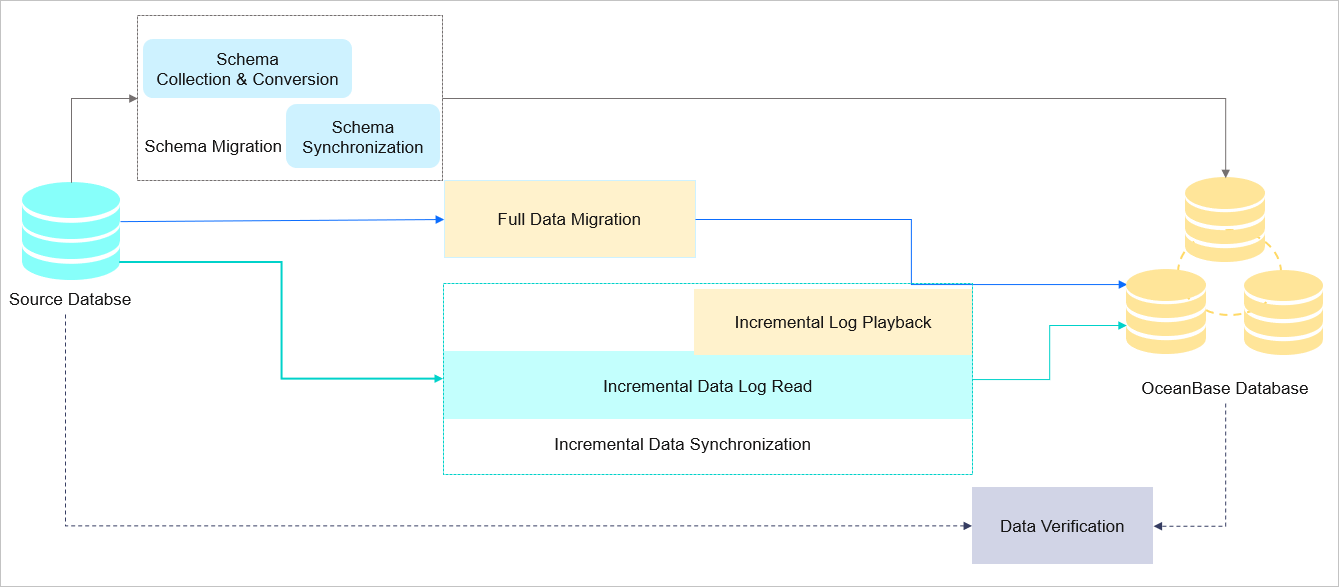
image.png

In traditional database migration solutions, data is usually migrated during downtime to ensure the migration stability and data consistency. During the downtime, data writes to the source database must be temporarily stopped. The business database can be switched only after the migration is completed and the data consistency is verified.

The downtime duration varies according to the business data volume and network conditions. In case of a massive volume of business data, the downtime may last several days, greatly affecting the business.

OMS supports in-service data migration, ensuring service continuity of the source database during the migration and minimizing the impact of data migration on the business. During schema migration, full data migration, and incremental data migration, the full data and incremental data in the source database are synchronized to the sink database in real time. After the data verification succeeds, the business can be handed over from the source database to the sink database.

Real-time data synchronization

OMS can synchronize incremental data from OceanBase Database and other databases to message queues of self-managed instances such as Kafka and RocketMQ instances in real time. This improves the message processing capability and extends the business application in monitoring data aggregation, streaming data processing, online/offline analysis, and other big data fields.

OMS enables real-time data synchronization between physical tables of OceanBase Database and data sources such as Kafka. You can use OMS in cloud BI, real-time data warehouse construction, data querying, report distribution, and other business scenarios.

Previous topic

What's new
Last

Next topic

Terms
Next
What is on this page
Introduction
Features
Benefits
Application scenarios
In-service data migration
Real-time data synchronization