







This topic describes how to perform batch operations on data synchronization projects by using OceanBase Migration Service (OMS).
Background
OMS allows you to perform operations on multiple data synchronization projects at a time on the Synchronization Projects page. Supported batch operations on data synchronization projects vary based on the project states.
Project status |
Supported batch operation |
|---|---|
| Not Started | Batch start, batch delete, and batch modify alert configuration |
| Running | Batch pause and batch modify alert configuration |
| Paused | Batch restore, batch release, and batch modify alert configuration |
| Failed | Batch restore, batch release, and batch modify alert configuration |
| Released | Batch delete |
| Releasing | N/A |
| Completed | Batch release |
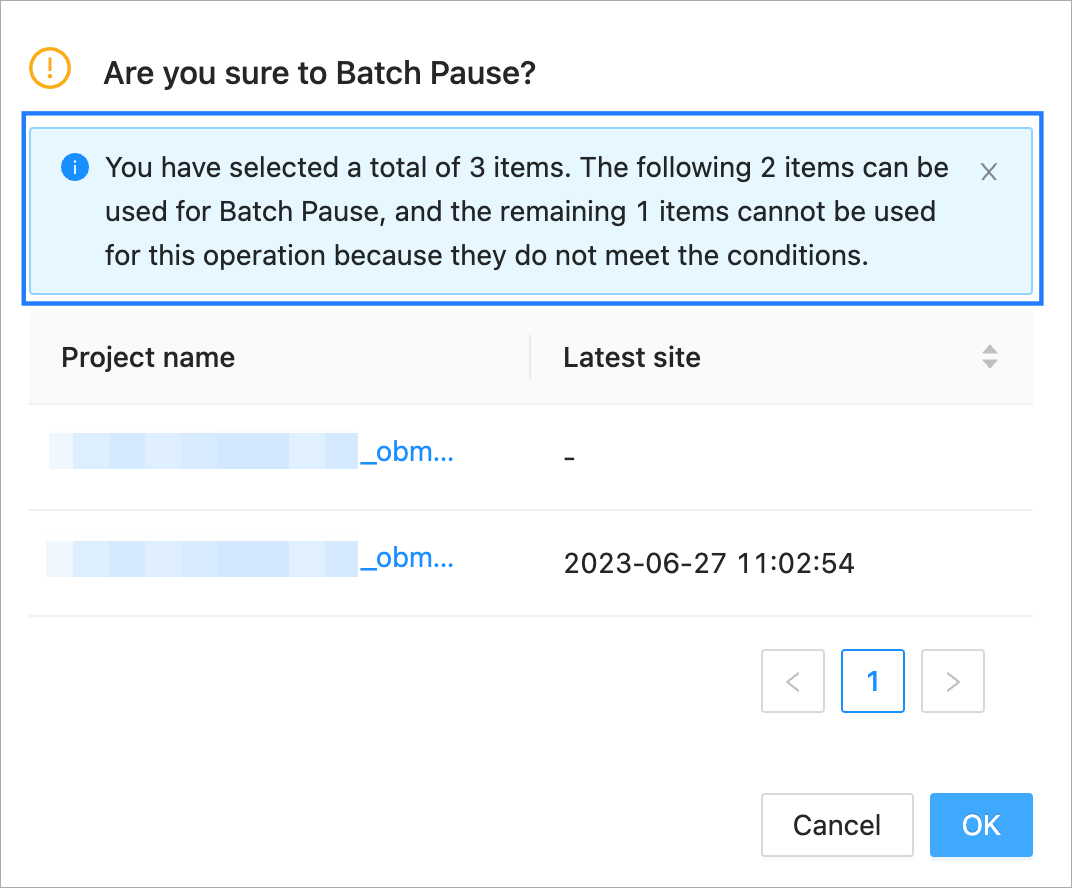
If you select multiple projects for a batch operation, but not all projects support this batch operation, a dialog box appears and displays the projects that support this batch operation.
Go to the Synchronization Projects page
Log on to the OMS console.
In the left-side navigation pane, choose Data Synchronization. The Synchronization Projects page automatically appears.
You can select data synchronization projects for a batch operation.
Batch pause
OMS allows you to batch pause data synchronization projects in the Running state.
On the Synchronization Projects page, select the data synchronization projects to be paused.
Click Batch Pause in the lower part of the page.
In the dialog box that appears, click OK.
This dialog box will display the number of projects that support batch pausing, the project names, and the latest timestamps.
After the operation succeeds, the number of projects that are successfully paused is displayed.
For any project that failed the batch operation, troubleshoot the issue as prompted.
Batch restore
OMS allows you to batch restore data synchronization projects in the Paused or Failed state.
On the Synchronization Projects page, select the data synchronization projects to be restored.
Click Batch Restore in the lower part of the page.
In the dialog box that appears, click OK.
This dialog box will display the number of projects that support batch restoration, the project names, and the latest timestamps.
After the operation succeeds, the number of projects that are successfully restored is displayed.
For any project that failed the batch operation, troubleshoot the issue as prompted.
Batch release
OMS allows you to batch release data synchronization projects in the Paused, Failed, or Completed state.
On the Synchronization Projects page, select the data synchronization projects to be released.
Click Batch Release in the lower part of the page.
In the dialog box that appears, click OK.
This dialog box will display the number of projects that support batch release, the project names, and the latest timestamps.
After the operation succeeds, the number of projects that are successfully released is displayed.
For any project that failed the batch operation, troubleshoot the issue as prompted.
Batch start
OMS allows you to batch start data synchronization projects in the Not Started state.
On the Synchronization Projects page, select the data synchronization projects for batch start.
Click Batch Start in the lower part of the page.
In the dialog box that appears, click OK.
This dialog box will display the number of projects that support batch start, the project names, and the latest timestamps.
After the operation succeeds, the number of projects that are successfully started is displayed.
For any project that failed the batch operation, troubleshoot the issue as prompted.
Batch delete
OMS allows you to batch delete data synchronization projects in the Not Started or Released state.
On the Synchronization Projects page, select the data synchronization projects for batch deletion.
Choose More Batch Operations > Batch Delete in the lower part of the page.
In the dialog box that appears, click OK.
This dialog box will display the number of projects that support batch deletion, the project names, and the latest timestamps.
After the operation succeeds, the number of projects that are successfully deleted is displayed.
For any project that failed the batch operation, troubleshoot the issue as prompted.
Batch modify alert configuration
OMS allows you to batch modify alert configuration of data synchronization projects in the Not Started, Running, Paused, or Failed state.
On the Synchronization Projects page, select the data synchronization projects whose alert settings are to be modified.
Choose More Batch Operations > Batch Modify Alert Configuration in the lower part of the page.
In the Batch Configure Alerts dialog box, specify the related parameters.
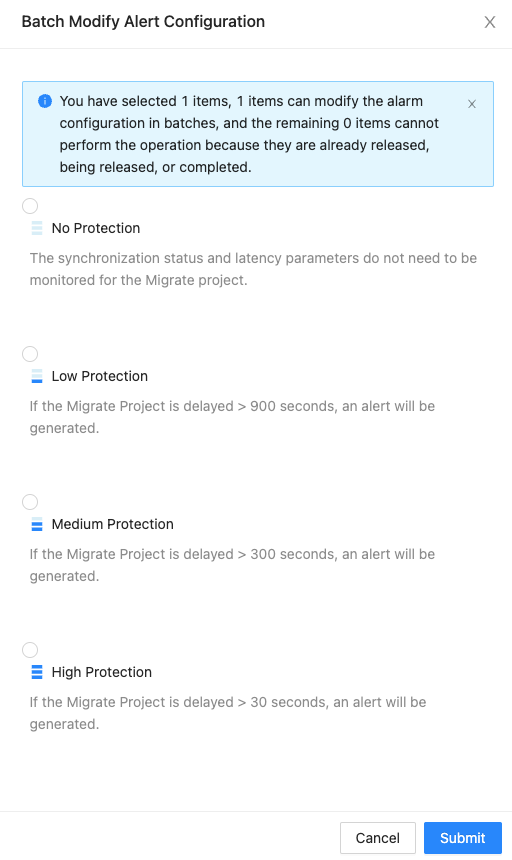
OMS supports the following alert levels: No Protection, High Protection, Medium Protection, and Low Protection. For more information, see Alert settings.
Click Submit.
To view the alerts generated for a data migration or synchronization project, see View project alerts.
After the alert settings are modified for the selected projects, a prompt is displayed on the page. For any project that failed the batch operation, troubleshoot the issue as prompted.