

OceanBase logo

OceanBase

A unified distributed database ready for your transactional, analytical, and AI workloads.

DEPLOY YOUR WAY

OceanBase Cloud

The best way to deploy and scale OceanBase

OceanBase Enterprise

Run and manage OceanBase on your infra

TRY OPEN SOURCE

OceanBase Community Edition

The free, open-source distributed database

OceanBase seekdb

Open source AI native search database

Customer Stories

Real-world success stories from enterprises across diverse industries.

View All
BY USE CASES

Mission-Critical Transactions

Global & Multicloud Application

Elastic Scaling for Peak Traffic

Real-time Analytics

Active Geo-redundancy

Database Consolidation

Resources

Comprehensive knowledge hub for OceanBase.

Blog

Live Demos

Training & Certification

Documentation

Official technical guides, tutorials, API references, and manuals for all OceanBase products.

View All
PRODUCTS

OceanBase Cloud

OceanBase Database

Tools

Connectors and Middleware

QUICK START

OceanBase Cloud

OceanBase Database

BEST PRACTICES

Practical guides for utilizing OceanBase more effectively and conveniently

Company

Learn more about OceanBase – our company, partnerships, and trust and security initiatives.

About OceanBase

Partner

Trust Center

Contact Us

International - English
中国站 - 简体中文
日本 - 日本語
Sign In
Start on Cloud

A unified distributed database ready for your transactional, analytical, and AI workloads.

DEPLOY YOUR WAY

OceanBase Cloud

The best way to deploy and scale OceanBase

OceanBase Enterprise

Run and manage OceanBase on your infra

TRY OPEN SOURCE

OceanBase Community Edition

The free, open-source distributed database

OceanBase seekdb

Open source AI native search database

Customer Stories

Real-world success stories from enterprises across diverse industries.

View All
BY USE CASES

Mission-Critical Transactions

Global & Multicloud Application

Elastic Scaling for Peak Traffic

Real-time Analytics

Active Geo-redundancy

Database Consolidation

Comprehensive knowledge hub for OceanBase.

Blog

Live Demos

Training & Certification

Documentation

Official technical guides, tutorials, API references, and manuals for all OceanBase products.

View All
PRODUCTS
OceanBase CloudOceanBase Database
ToolsConnectors and Middleware
QUICK START
OceanBase CloudOceanBase Database
BEST PRACTICES

Practical guides for utilizing OceanBase more effectively and conveniently

Learn more about OceanBase – our company, partnerships, and trust and security initiatives.

About OceanBase

Partner

Trust Center

Contact Us

Start on Cloud
编组
All Products
    • Databases
    • iconOceanBase Database
    • iconOceanBase Cloud
    • iconOceanBase Tugraph
    • iconInteractive Tutorials
    • iconOceanBase Best Practices
    • Tools
    • iconOceanBase Cloud Platform
    • iconOceanBase Migration Service
    • iconOceanBase Developer Center
    • iconOceanBase Migration Assessment
    • iconOceanBase Admin Tool
    • iconOceanBase Loader and Dumper
    • iconOceanBase Deployer
    • iconKubernetes operator for OceanBase
    • iconOceanBase Diagnostic Tool
    • iconOceanBase Binlog Service
    • Connectors and Middleware
    • iconOceanBase Database Proxy
    • iconEmbedded SQL in C for OceanBase
    • iconOceanBase Call Interface
    • iconOceanBase Connector/C
    • iconOceanBase Connector/J
    • iconOceanBase Connector/ODBC
    • iconOceanBase Connector/NET
icon

OceanBase Deployer

V3.1.0Community Edition

  • What is obd
  • Quick Start
    • Install obd
    • Quickly deploy OceanBase Database
    • Quickly deploy OCP
    • Deploy an OceanBase cluster on the GUI
  • obd Command
    • Quick deployment command
    • Cluster commands
    • Mirror and repository commands
    • Testing commands
    • Tool commands
    • obdiag commands
    • Binlog commands
    • Telemetry commands
  • User Guide
    • Configuration files
    • Deploy through GUI
      • GUI operation overview
      • Deploy OCP through the GUI
      • Modify components on the GUI
    • Deploy through CLI
      • Deploy OceanBase Database on a single server
      • Deploy OCP Express by using commands
      • Deploy and use obconfigserver
      • Deploy the binlog service
      • Deploy oblogproxy by using the CLI
      • Deploy OCP by using commands
      • Use OCP to take over a cluster deployed by obd
      • Use obd to take over a cluster
      • Add GUI-based monitoring for an existing cluster
      • Upgrade OCP Express
      • Upgrade OceanBase Database
      • Physical Standby Database
        • Deploy primary and standby tenants by using obd
        • Switch the roles of tenants and decouple a standby tenant from the primary tenant
      • Scale out a cluster and change cluster components
      • Performance test
      • Cluster diagnotistics
  • FAQ
    • FAQ
    • How do I upgrade an OBProxy to obproxy-ce 3.2.3?
  • Mode configuration rules
  • Error codes
  • Release Notes
    • Version rules
    • V3.1
      • OceanBase Deployer V3.1.2
      • OceanBase Deployer V3.1.1
      • OceanBase Deployer V3.1.0
    • V3.0
      • OceanBase Deployer V3.0.1
      • OceanBase Deployer V3.0.0
    • V2.10
      • OceanBase Deployer V2.10.1
      • OceanBase Deployer V2.10.0
    • V2.9
      • OceanBase Deployer V2.9.2
      • OceanBase Deployer V2.9.1
      • OceanBase Deployer V2.9.0
    • V2.8
      • OceanBase Deployer V2.8.0
    • V2.7
      • OceanBase Deployer V2.7.0
    • V2.6
      • OceanBase Deployer V2.6.2
      • OceanBase Deployer V2.6.1
      • OceanBase Deployer V2.6.0
    • V2.5
      • OceanBase Deployer V2.5.0
    • V2.4
      • OceanBase Deployer V2.4.0
    • V2.3
      • OceanBase Deployer V2.3.1
      • OceanBase Deployer V2.3.0
    • V2.2
      • OceanBase Deployer V2.2.0
    • V2.1
      • OceanBase Deployer V2.1.1
      • OceanBase Deployer V2.1.0
    • V2.0
      • OceanBase Deployer V2.0.1
      • OceanBase Deployer V2.0.0
    • V1.6
      • OceanBase Deployer V1.6.2
      • OceanBase Deployer V1.6.1
      • OceanBase Deployer V1.6.0
    • V1.5
      • OceanBase Deployer V1.5.0
    • V1.4
      • OceanBase Deployer V1.4.0
    • V1.3
      • OceanBase Deployer V1.3.3
      • OceanBase Deployer V1.3.2
      • OceanBase Deployer V1.3.0
    • V1.2
      • OceanBase Deployer V1.2.1
      • OceanBase Deployer V1.2.0

Download PDF

What is obd Install obd Quickly deploy OceanBase Database Quickly deploy OCP Deploy an OceanBase cluster on the GUI Quick deployment command Cluster commands Mirror and repository commands Testing commands Tool commands obdiag commands Binlog commands Telemetry commands Configuration files GUI operation overview Deploy OCP through the GUI Modify components on the GUI Deploy OceanBase Database on a single server Deploy OCP Express by using commands Deploy and use obconfigserver Deploy the binlog service Deploy oblogproxy by using the CLI Deploy OCP by using commands Use OCP to take over a cluster deployed by obd Use obd to take over a cluster Add GUI-based monitoring for an existing cluster Upgrade OCP Express Upgrade OceanBase Database Scale out a cluster and change cluster components Performance test Cluster diagnotistics FAQ How do I upgrade an OBProxy to obproxy-ce 3.2.3? Mode configuration rules Error codes Version rules OceanBase Deployer V3.1.2 OceanBase Deployer V3.1.1 OceanBase Deployer V3.1.0 OceanBase Deployer V3.0.1 OceanBase Deployer V3.0.0 OceanBase Deployer V2.10.1 OceanBase Deployer V2.10.0 OceanBase Deployer V2.9.2 OceanBase Deployer V2.9.1 OceanBase Deployer V2.9.0 OceanBase Deployer V2.8.0 OceanBase Deployer V2.7.0 OceanBase Deployer V2.6.2 OceanBase Deployer V2.6.1 OceanBase Deployer V2.6.0 OceanBase Deployer V2.5.0 OceanBase Deployer V2.4.0 OceanBase Deployer V2.3.1 OceanBase Deployer V2.3.0 OceanBase Deployer V2.2.0 OceanBase Deployer V2.1.1 OceanBase Deployer V2.1.0 OceanBase Deployer V2.0.1 OceanBase Deployer V2.0.0 OceanBase Deployer V1.6.2 OceanBase Deployer V1.6.1 OceanBase Deployer V1.6.0 OceanBase Deployer V1.5.0 OceanBase Deployer V1.4.0 OceanBase Deployer V1.3.3 OceanBase Deployer V1.3.2 OceanBase Deployer V1.3.0 OceanBase Deployer V1.2.1 OceanBase Deployer V1.2.0
OceanBase logo

The Unified Distributed Database for the Al Era.

Follow Us
Products
OceanBase CloudOceanBase EnterpriseOceanBase Community EditionOceanBase seekdb
Resources
DocsBlogLive DemosTraining & Certification
Company
About OceanBaseTrust CenterLegalPartnerContact Us
Follow Us

© OceanBase 2026. All rights reserved

Cloud Service AgreementPrivacy PolicySecurity
Contact Us
Document Feedback
  1. Documentation Center
  2. OceanBase Deployer
  3. V3.1.0
iconOceanBase Deployer
V 3.1.0Community Edition
Community Edition
  • V 3.2.1
  • V 3.2.0
  • V 3.1.0
  • V 3.0.0
  • V 2.10.1
  • V 2.10.0
  • V 2.9.0
  • V 2.8.0
  • V 2.7.0
  • V 2.6.0
  • V 2.5.0
  • V 2.4.0
  • V 2.3.1
  • V 2.3.0
  • V 2.2.0
  • V 2.1.0
  • V 2.0.0
  • V 1.6.1

Quickly deploy OCP

Last Updated:2025-03-21 08:41:19  Updated
share
What is on this page
Prerequisites
Step 1: Go to the GUI
Step 2: Configure deployment information
Step 3: Configure MetaDB information
Step 4: Configure OCP information
Step 5: Perform a pre-check
Step 6: Deploy OCP
References

folded

share

Note

This topic describes how to quickly deploy OceanBase Cloud Platform (OCP) for experience. For information about how to deploy OCP in the production environment, see Deploy OCP on the GUI.

Prerequisites

Make sure that the following conditions are met:

  • The user used for deployment must have the permission to execute sudo commands without using the password.

  • You have installed OceanBase Deployer (obd) V2.4.0 or later (latest version recommended). For more information, see Install obd.

    Note

    We recommend that you download the OceanBase All in One package for deployment. The package provides all required components (except obbinlog) of the recommended versions, and the components have passed adaptation tests.

  • At least 8 vCPUs, 26 GB of memory, and 150 GB of disk space are available on your server.

  • Ports 2881, 2882, 2883, 2884, 2886, 8080, and 8680 are not occupied. They will be used for deployment by default.

  • You have installed the clockdiff command.

  • Your server can connect to the Internet, or the local image repository of obd contains the installation packages required for deployment.

    You can run the obd mirror list local command to query the installation packages in the local image repository. If obd is installed by using the OceanBase All in One package, the local image repository contains all installation packages required for deployment by default.

Step 1: Go to the GUI

  1. Run the obd web command on the CLI, and visit the generated URL to go to the obd GUI.

    [admin@test001 ~]$ obd web
    start OBD WEB in 0.0.0.0:8680
    please open http://10.10.10.1:8680
    

    Note

    • The default port in the URL is 8680. You can use the obd web -p <PORT> command to specify a port.

    • In Alibaba Cloud or other cloud environments, the program may fail to obtain a public IP address but return an intranet IP address. You must use a correct public IP address to access the GUI.

    • The obd web command is bound to 0.0.0.0. In a deployment where multiple network interface cards (NICs) are used, you can access the GUI through any accessible IP address.

  2. On the GUI, click Try Now to go to the Welcome to the OceanBase Deployment Wizard page. On the page, select OceanBase cloud platform, move your pointer on Installation, and then select Use the new OceanBase database to go to the Deployment Wizard page.

Step 2: Configure deployment information

On the Deployment configuration page, specify the OCP cluster name, which must be different from the name of an existing cluster. You can run the obd cluster list command to query the clusters managed by obd.
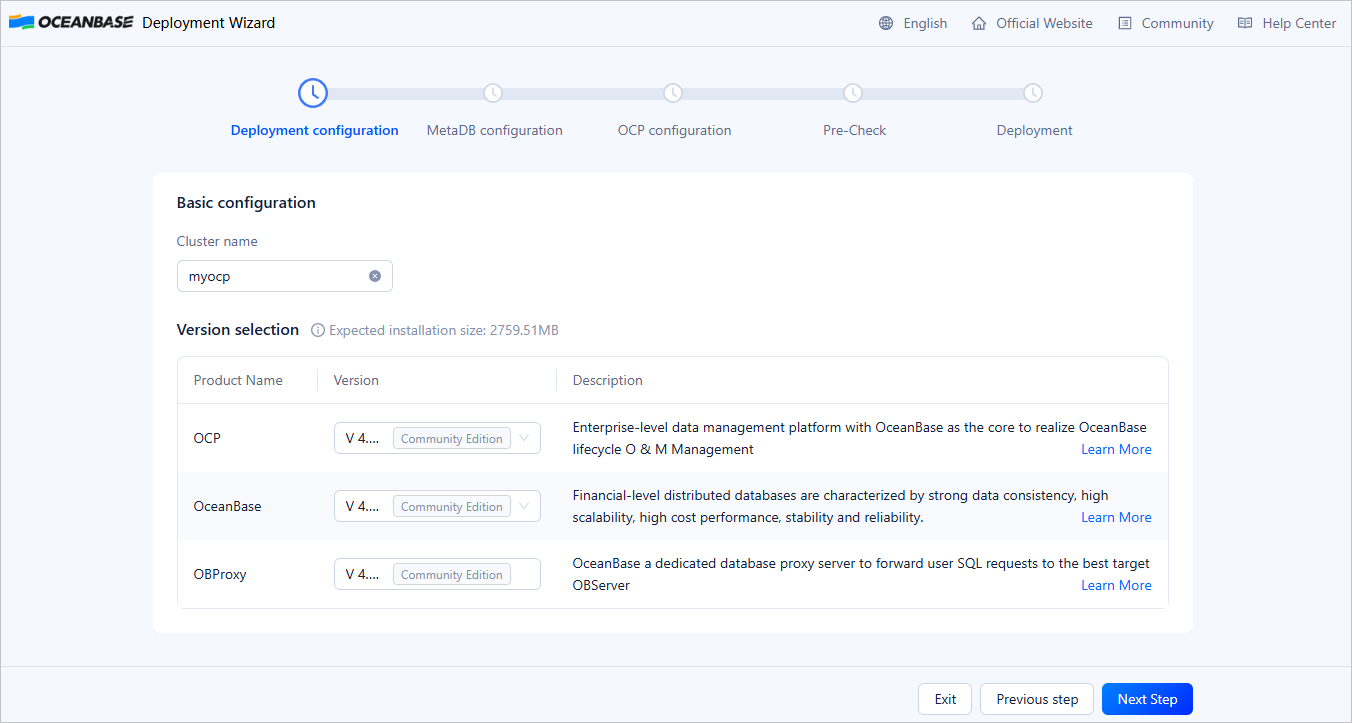
Deployment configuration

Step 3: Configure MetaDB information

On the MetaDB Configuration page, configure information about the MetaDB cluster, such as the IP addresses of OBServer nodes, port number, directory, and password.

  1. Configure deployment user information.

    In the Deployment user configuration section, configure the user information required for OCP deployment. You only need to specify Username and Password. The specified user must have the permission to execute sudo commands without using the password. If you have enabled password-free login, the password is not required.
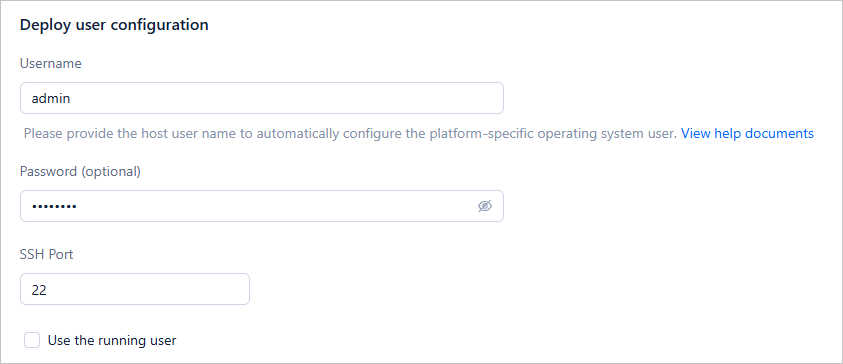
    User configuration

  2. Configure node information.

    Specify the IP address of the OCP host in the OCP node configuration section and specify the IP addresses of the OBServer nodes where MetaDB resides in the Database node configuration section.

    The IP addresses cannot be 127.0.0.1. After you specify an IP address, you can press Enter to add more IP addresses. By default, three zones are displayed. You can click + Add Zone to add a zone or the Delete icon next to a zone to remove it.

    Node configuration

  3. Configure cluster information.

    In the Cluster configuration section, specify the password of the root@sys account, directories, and port numbers required for the MetaDB.

    You can click Randomly generated to generate a random password for the root@sys account. You can modify the default paths displayed on the page. The paths must be absolute paths starting with /. Make sure that the specified paths are empty and you have the read and write permissions on them.
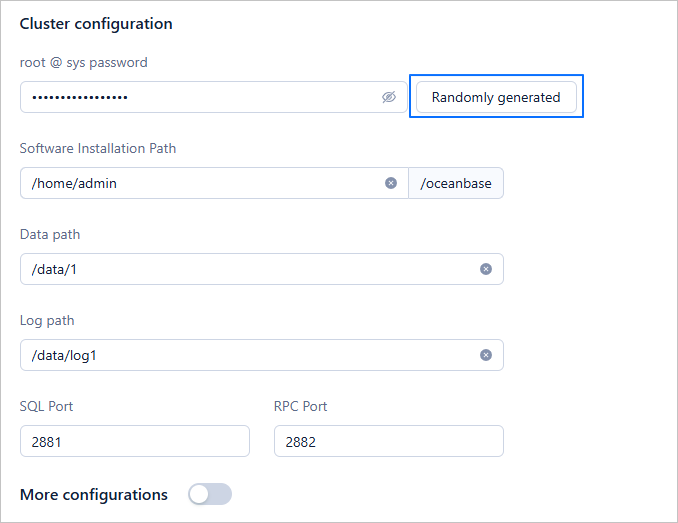
    Cluster configuration

  4. Configure OceanBase Database Proxy (ODP) information.

    In the OBProxy configuration section, specify the IP address of the ODP node, port numbers, and installation path. You can specify only one IP address for the ODP node. By default, the installation path of ODP is the obproxy directory in the home directory of the deployment user. You can specify a custom path, which must be an absolute path starting with /. You must have the read and write permissions on the specified path.
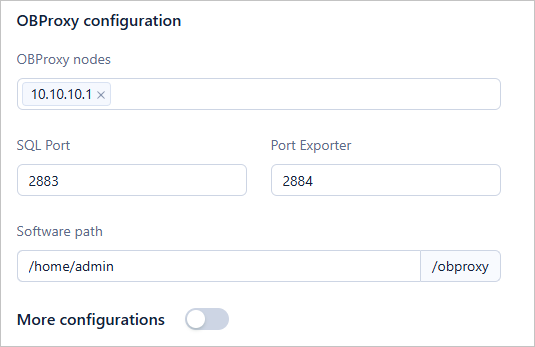
    OBProxy configuration

Click Next Step to go to the OCP Configuration page.

Step 4: Configure OCP information

On the OCP Configuration page, configure information about the OCP service and tenants.

  1. Configure service information.

    In the Service configuration section, specify the OCP login password, paths, URL, and port number. You can click Randomly generated to generate a random password for the admin account. You can modify the default paths displayed on the page. The paths must be absolute paths starting with /. Make sure that the specified paths are empty and you have the read and write permissions on them.
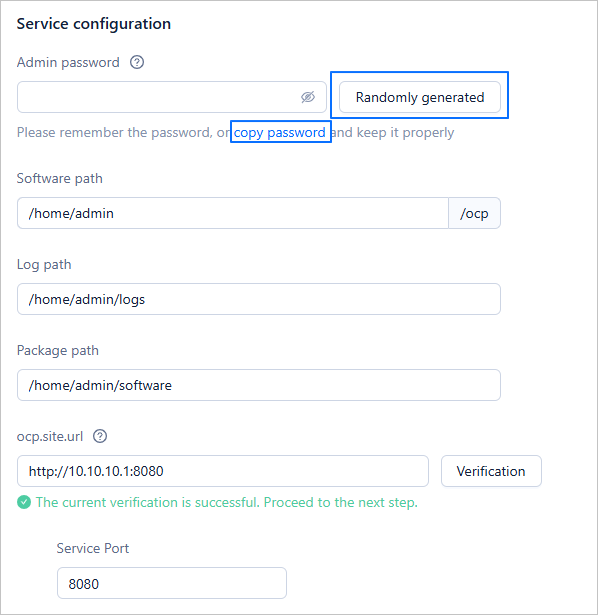
    Service configuration

  2. Plan resources.

    OCP consumes computing and storage resources to provide services. In the Resource Planning section, you can allocate resources based on the number of hosts to be managed.

    You can click Randomly generated to generate random passwords for the root users of the tenants.
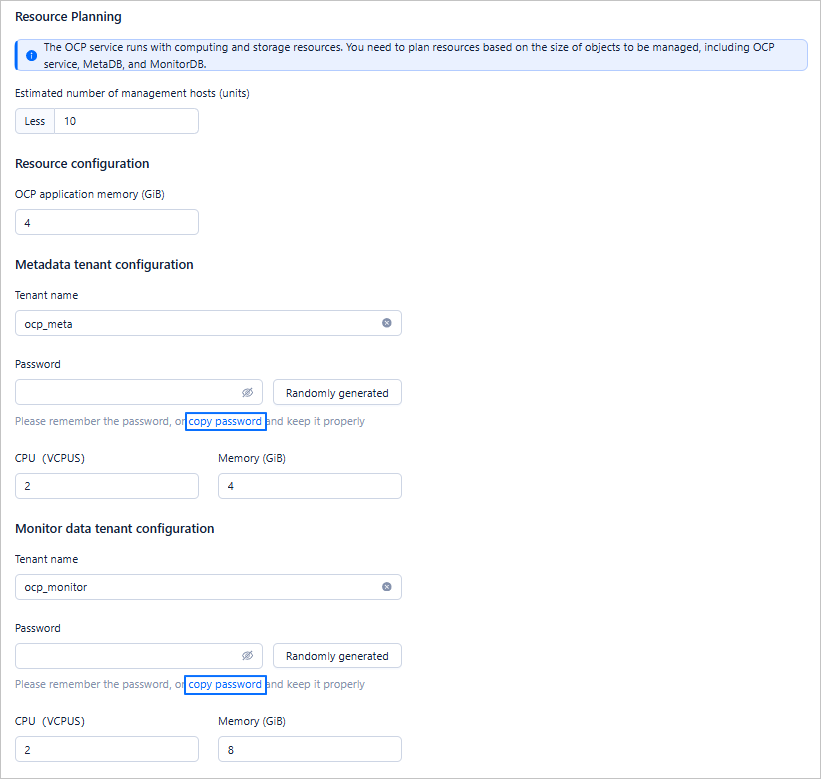
    Resource planning

Click Next Step to go to the Pre-check page.

Step 5: Perform a pre-check

On the Pre-check page, you can view all configured information. If you find an error, you can click Previous Step to fix it. After you confirm the information, click Pre-check. Then, the system checks whether your environment meets all the requirements for MetaDB and OCP installation and configuration.

If the pre-check reports an error and the error can be automatically fixed, you can click Automatic Repair to fix the error. You can also click Learn More to fix the reported error by referring to the error code document. After all the errors are fixed, click Re-check to perform a pre-check again.
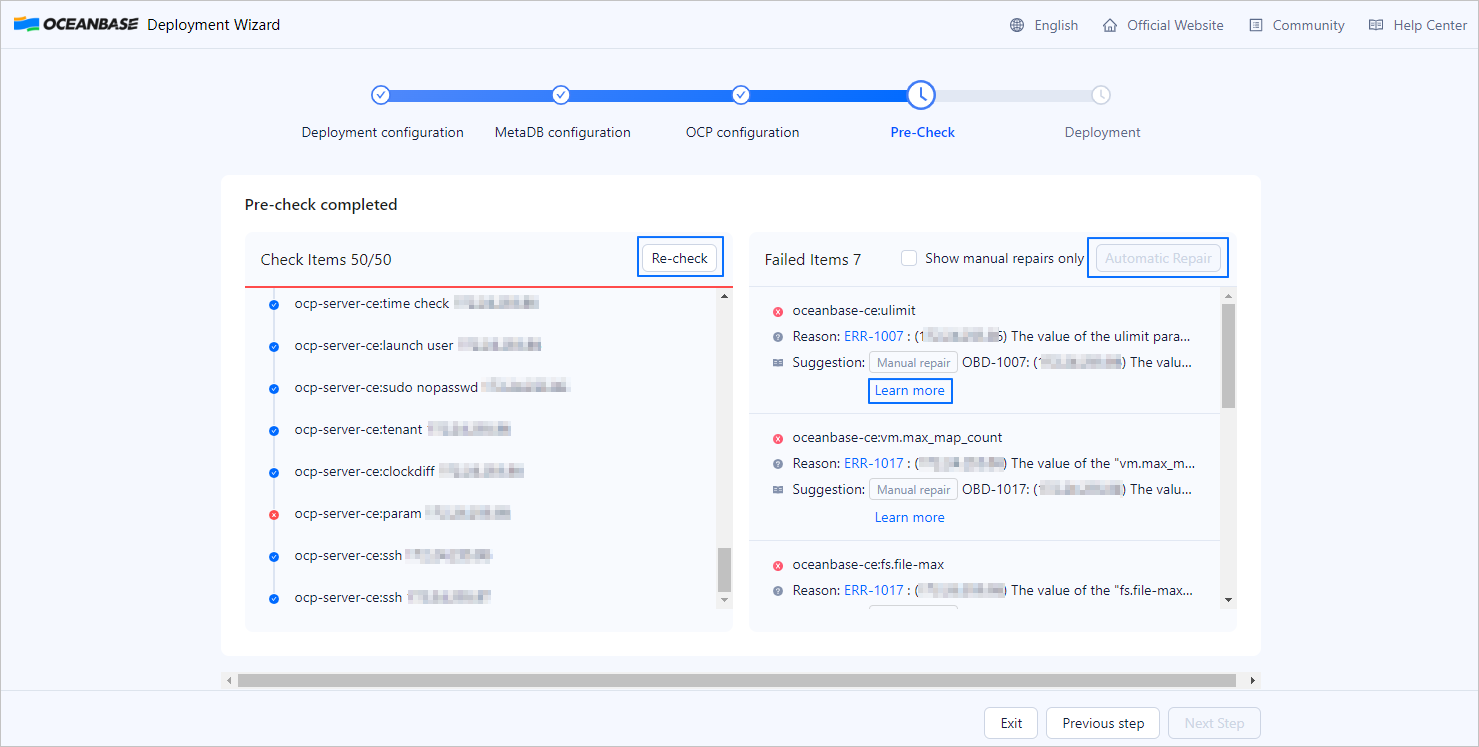
Pre-check

After the pre-check is successful, click Deployment in the lower right part of the page.

Step 6: Deploy OCP

obd displays deployment logs during the deployment. You can view detailed logs in the Deployment Logs section.

  • If the deployment fails, check the logs to identify the causes, and contact OceanBase Technical Support. You can also submit a question in the Q&A section of the OceanBase community forum, and on-duty engineers will help you fix the issue. After you identify the causes and fix the issue, click Re-deploy. In the dialog box that appears, click OK. Then, the system clears the failed OCP installation environment and re-executes the installer.

  • If the deployment succeeds, click Copy Information to save the OCP URL and login credentials. Then, click Complete to exit.
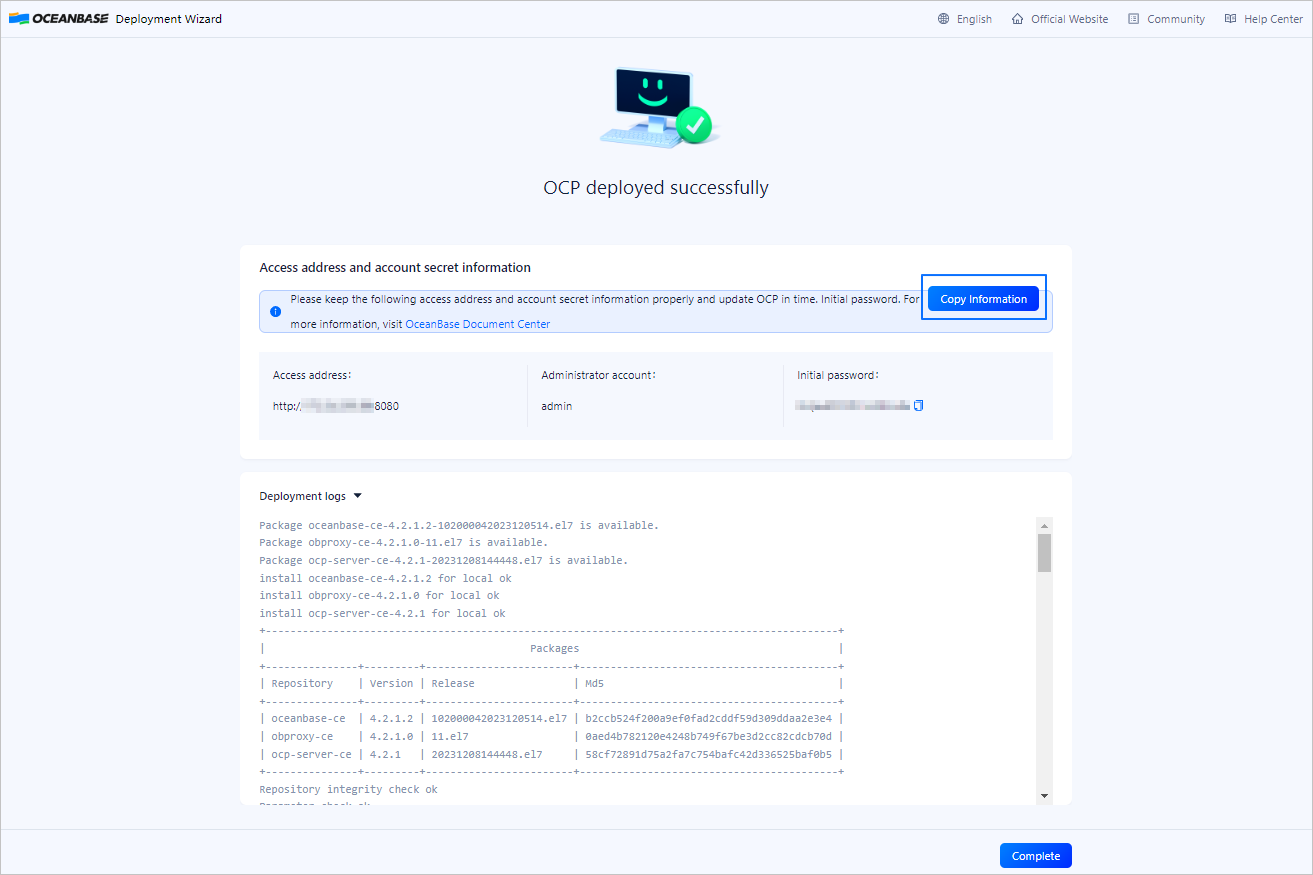
Deployment

Note

After OCP is deployed, you can check whether OCP works properly. For more information, see Post-deployment check in the OCP documentation.

References

  • Cluster commands

  • Upgrade OCP on the GUI

Previous topic

Quickly deploy OceanBase Database
Last

Next topic

Deploy an OceanBase cluster on the GUI
Next
What is on this page
Prerequisites
Step 1: Go to the GUI
Step 2: Configure deployment information
Step 3: Configure MetaDB information
Step 4: Configure OCP information
Step 5: Perform a pre-check
Step 6: Deploy OCP
References