







To deliver more cost-effective database services in multi-cloud environments, OceanBase Database adopts a shared-storage (SS) mode built on standard object storage. This enables cloud-native database services, reduces operational costs, and enhances both performance and usability.
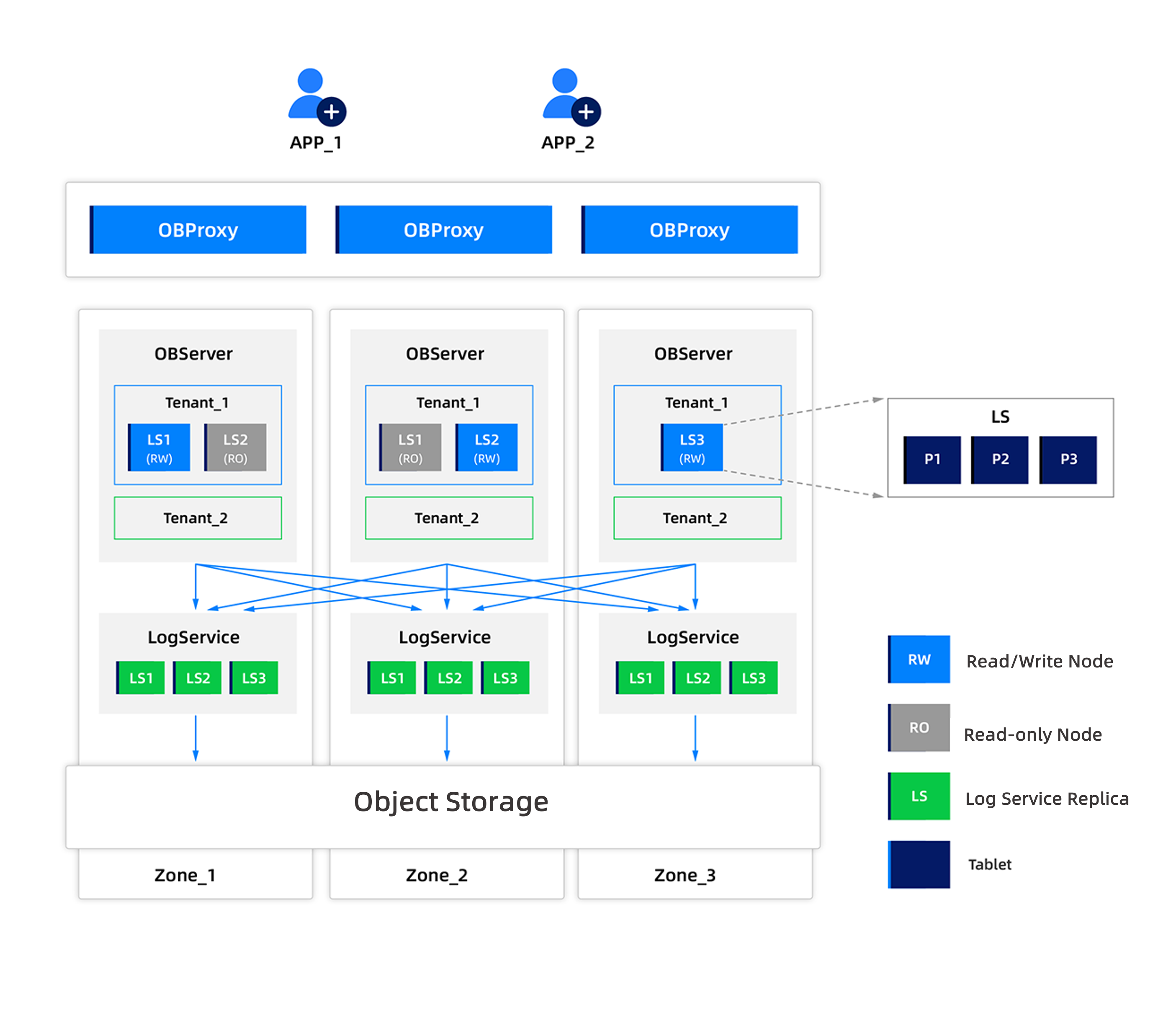
The shared-storage mode builds upon the shared-nothing mode by introducing a storage-compute separation architecture. It features a read-write node (RW) that handles both read and write operations, alongside zero or more read-only nodes (RO) dedicated to read tasks. This design allows compute nodes to scale independently, greatly improving elasticity.
Additionally, the shared-storage mode includes an upload node (SSWriter), which generates and uploads incremental and baseline data to object storage. All compute nodes share access to this stored data and automatically identify which data is "hot." Only hot data is cached locally on each compute node, optimizing for low latency and high throughput.
The shared-storage mode further separates log management from computation. The database log service is provided by a dedicated, high-performance, highly available, and strongly consistent distributed storage system that is specifically optimized for log access patterns, as illustrated by the LogService component in the diagram.
Within this architecture, logs are synchronized across log service replicas using a consensus protocol to ensure data durability. Compute nodes no longer maintain log states, eliminating the need to deploy multiple replica compute nodes and significantly reducing costs. Furthermore, read-only nodes (RO) can be added quickly without depending on logs, offering even greater elasticity.
For high availability, the read-write node (RW) uses the Paxos protocol to write logs directly to multiple log service replicas. Read-only nodes (RO) retrieve logs from the nearest log service replica and replay hot data locally, further enhancing low latency and high throughput.