

OceanBase logo

OceanBase

A unified distributed database ready for your transactional, analytical, and AI workloads.

Product Overview
DEPLOY YOUR WAY

OceanBase Cloud

The best way to deploy and scale OceanBase

OceanBase Enterprise

Run and manage OceanBase on your infra

TRY OPEN SOURCE

OceanBase Community Edition

The free, open-source distributed database

OceanBase seekdb

Open source AI native search database

Customer Stories

Real-world success stories from enterprises across diverse industries.

View All
BY USE CASES

Mission-Critical Transactions

Global & Multicloud Application

Elastic Scaling for Peak Traffic

Real-time Analytics

Active Geo-redundancy

Database Consolidation

Resources

Comprehensive knowledge hub for OceanBase.

Blog

Live Demos

Training & Certification

Documentation

Official technical guides, tutorials, API references, and manuals for all OceanBase products.

View All
PRODUCTS

OceanBase Cloud

OceanBase Database

Tools

Connectors and Middleware

QUICK START

OceanBase Cloud

OceanBase Database

BEST PRACTICES

Practical guides for utilizing OceanBase more effectively and conveniently

Company

Learn more about OceanBase – our company, partnerships, and trust and security initiatives.

About OceanBase

Partner

Trust Center

Contact Us

International - English
中国站 - 简体中文
日本 - 日本語
Sign In
Start on Cloud

OceanBase

A unified distributed database ready for your transactional, analytical, and AI workloads.

Product Overview
DEPLOY YOUR WAY

OceanBase Cloud

The best way to deploy and scale OceanBase

OceanBase Enterprise

Run and manage OceanBase on your infra

TRY OPEN SOURCE

OceanBase Community Edition

The free, open-source distributed database

OceanBase seekdb

Open source AI native search database

Customer Stories

Real-world success stories from enterprises across diverse industries.

View All
BY USE CASES

Mission-Critical Transactions

Global & Multicloud Application

Elastic Scaling for Peak Traffic

Real-time Analytics

Active Geo-redundancy

Database Consolidation

Comprehensive knowledge hub for OceanBase.

Blog

Live Demos

Training & Certification

Documentation

Official technical guides, tutorials, API references, and manuals for all OceanBase products.

View All
PRODUCTS
OceanBase CloudOceanBase Database
ToolsConnectors and Middleware
QUICK START
OceanBase CloudOceanBase Database
BEST PRACTICES

Practical guides for utilizing OceanBase more effectively and conveniently

Learn more about OceanBase – our company, partnerships, and trust and security initiatives.

About OceanBase

Partner

Trust Center

Contact Us

Start on Cloud
编组
All Products
    • Databases
    • iconOceanBase Database
    • iconOceanBase Cloud
    • iconOceanBase Tugraph
    • iconInteractive Tutorials
    • iconOceanBase Best Practices
    • Tools
    • iconOceanBase Cloud Platform
    • iconOceanBase Migration Service
    • iconOceanBase Developer Center
    • iconOceanBase Migration Assessment
    • iconOceanBase Admin Tool
    • iconOceanBase Loader and Dumper
    • iconOceanBase Deployer
    • iconKubernetes operator for OceanBase
    • iconOceanBase Diagnostic Tool
    • iconOceanBase Binlog Service
    • Connectors and Middleware
    • iconOceanBase Database Proxy
    • iconEmbedded SQL in C for OceanBase
    • iconOceanBase Call Interface
    • iconOceanBase Connector/C
    • iconOceanBase Connector/J
    • iconOceanBase Connector/ODBC
    • iconOceanBase Connector/NET
icon

OceanBase Database

SQL - V4.3.5

    Download PDF

    OceanBase logo

    The Unified Distributed Database for the AI Era.

    Follow Us
    Products
    OceanBase CloudOceanBase EnterpriseOceanBase Community EditionOceanBase seekdb
    Resources
    DocsBlogWhite PaperLive DemosTraining & CertificationTicket
    Company
    About OceanBaseTrust CenterLegalPartnerContact Us
    Follow Us

    © OceanBase 2026. All rights reserved

    Cloud Service AgreementPrivacy PolicySecurity
    Contact Us
    Document Feedback
    1. Documentation Center
    2. OceanBase Database
    3. SQL
    4. V4.3.5
    iconOceanBase Database
    SQL - V 4.3.5
    Databases
    • OceanBase Database
    • OceanBase Cloud
    • OceanBase Tugraph
    • Interactive Tutorials
    • OceanBase Best Practices
    Tools
    • OceanBase Cloud Platform
    • OceanBase Migration Service
    • OceanBase Developer Center
    • OceanBase Migration Assessment
    • OceanBase Admin Tool
    • OceanBase Loader and Dumper
    • OceanBase Deployer
    • Kubernetes operator for OceanBase
    • OceanBase Diagnostic Tool
    • OceanBase Binlog Service
    Connectors and Middleware
    • OceanBase Database Proxy
    • Embedded SQL in C for OceanBase
    • OceanBase Call Interface
    • OceanBase Connector/C
    • OceanBase Connector/J
    • OceanBase Connector/ODBC
    • OceanBase Connector/NET
    SQL
    KV
    • V 4.6.0
    • V 4.4.2
    • V 4.3.5
    • V 4.3.3
    • V 4.3.1
    • V 4.3.0
    • V 4.2.5
    • V 4.2.2
    • V 4.2.1
    • V 4.2.0
    • V 4.1.0
    • V 4.0.0
    • V 3.1.4 and earlier

    Overview

    Last Updated:2026-04-09 08:28:54  Updated
    Share
    What is on this page
    Two-level key system
    Encryption mechanism
    Supported encryption algorithms

    folded

    Share

    Data storage encryption refers to transparent data encryption (TDE) of clog files and other data stored in disks. During TDE, data is automatically encrypted before being written to a storage device and automatically decrypted when being read. The processes are transparent to users. Hackers and malicious users cannot read sensitive data from files, database backups, or disks.

    The user data and backups in OceanBase Database are ultimately stored in binary form on disks or other permanent storage. Unauthorized users may obtain these storage devices and read and decode the stored data, which leads to data leaks. Although OceanBase Database data is stored in compressed form and has a certain degree of confidentiality, there is still a risk of being cracked. To protect the security of data stored in memory and disks, OceanBase Database supports the international mainstream encryption algorithm AES, as well as China's encryption algorithm SM4.

    Two-level key system

    TDE uses a two-level key system to implement encryption and decryption. The minimum granularity for enabling encryption is a table in the database, and the table that needs to be encrypted needs to be placed in an encrypted tablespace. The encryption unit of OceanBase Database is tablespace, which is designed for Oracle compatibility and can be easily understood as a collection of tables. Each encrypted tablespace is configured with an encryption algorithm and a corresponding data key, which are used to encrypt the data in the tablespace. Each tenant has a master key for encrypting the data key in the tablespace. To prevent unauthorized decryption, the master key is usually stored in a dedicated Keystore.
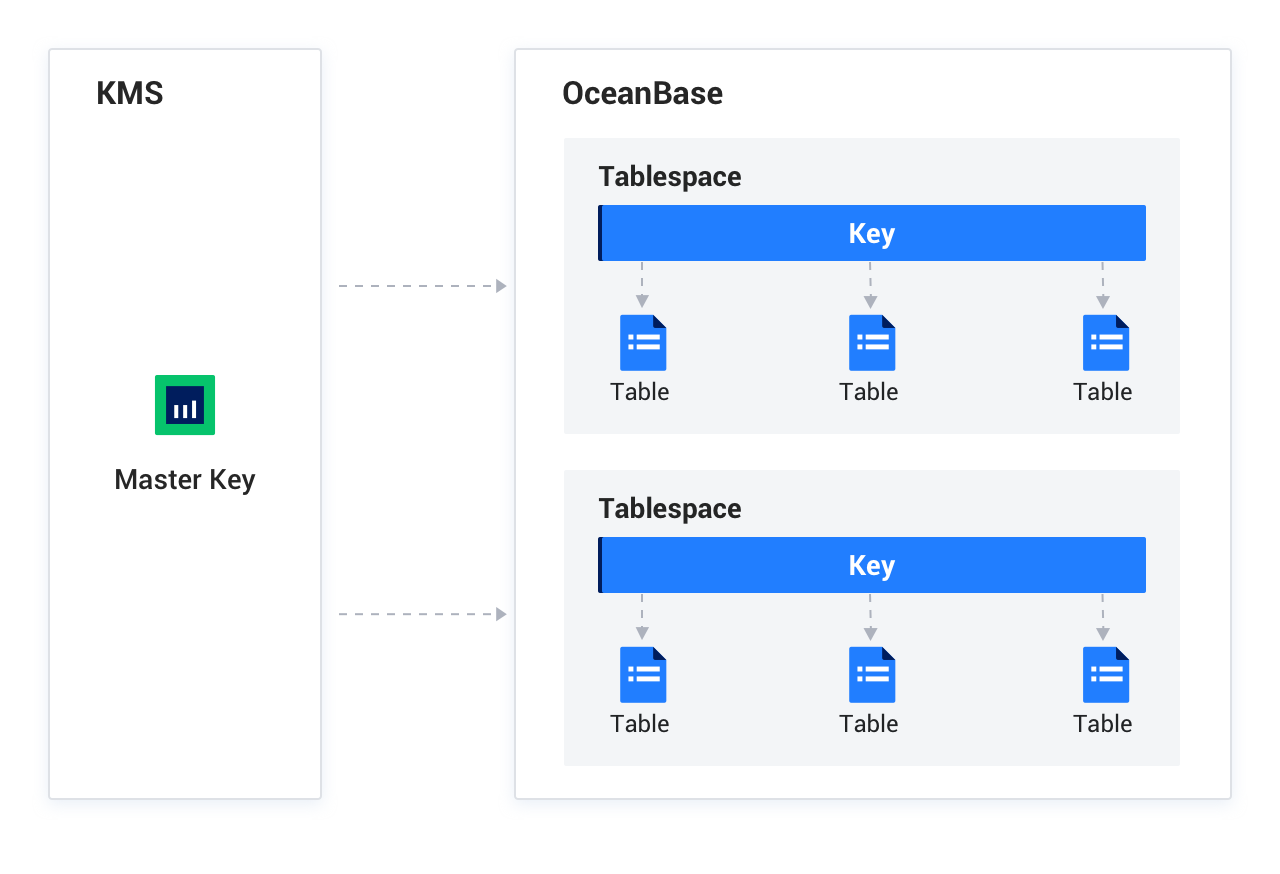
    Storage encryption

    To ensure data security, OceanBase Database does not allow users to use Keystore to view the master key or encryption key or to specify the master key or encryption key. The master key and encryption key are generated by the system and are not directly stored in plaintext on the disk, which significantly improves system security.

    Keystore is the master key management module that provides key management services (KMS). The features of Keystore are as follows:

    • Generation of the master key: The master key is generated by Keystore based on the encryption algorithm, and cannot be specified by the user, which is more secure.
    • Storage of master key-related information: Keystore obtains the master key based on relevant information. It also keeps multiple copies of information, ensures information consistency, and provides fault handling.
    • Master key management and multi-version control: Keystore is responsible for modifying and multi-version control of the master key. The multi-version control mechanism allows newly generated master keys to be gradually replaced without immediately taking effect.
    • Obtaining high availability services related to the master key.
    • Processing of Keystore commands.

    When enabling TDE, set the tde_method parameter to specify the storage method for the master key.

    tde_method value
    Description
    none Disables storage encryption.
    internal Enables storage encryption and stores the master key in an internal table.
    bkmi Enables storage encryption and stores the master key in an external BKMI system.

    Currently, OceanBase Database supports transparent tablespace encryption only in internal mode. In internal mode, the encryption information of the master key is managed in internal tables, and clogs are not encrypted to avoid circular dependency during log replay.

    When encryption is enabled, the master key is used to encrypt data keys. The ciphertext of the data keys is stored in internal tables, macroblock headers, and clog headers. The data keys are not stored in plaintext anywhere. To encrypt and decrypt data, the master key is used to decrypt the ciphertext and obtain the data keys, which are then used to encrypt or decrypt user data in macroblocks or clogs.

    Limitations

    • Encryption cannot be enabled for the sys tenant.
    • Once a tenant has TDE configured, it cannot switch to other encryption modes unless the tenant is re-created.

    Encryption mechanism

    User data stored on the disk includes two types: clog and macroblock. Encryption takes effect only when the data is actually written to the disk. The data in memory is not encrypted. If an originally unencrypted table is changed to encrypted, the previously unencrypted clog and macroblock data stored on the disk will not be encrypted, and only new data written to the disk later will be encrypted. Since each clog and each macroblock record encryption metadata, encrypted and unencrypted data can coexist.

    Because clogs are written to the disk using an append-only method, old unencrypted clogs will never become encrypted. After encryption has been enabled for a period of time, when old clogs are recycled, all clog data on the disk will become encrypted. Macroblock data is written to the disk only in minor or major compactions. You can manually trigger a full compaction to encrypt all macroblocks that are not encrypted.

    Supported encryption algorithms

    Currently, OceanBase Database supports the international mainstream encryption algorithm AES, as well as China's encryption algorithm SM4.

    Algorithm
    Key length
    Mode
    AES 128 bits, 192 bits, and 256 bits Electronic codebook (ECB) and Galois/counter mode (GCM)
    SM4 128 bits Cipher block chaining (CBC) and GCM

    Previous topic

    ODP transmission encryption
    Last

    Next topic

    Enable TDE for new tables
    Next
    What is on this page
    Two-level key system
    Encryption mechanism
    Supported encryption algorithms