OceanBase logo

OceanBase

A unified distributed database ready for your transactional, analytical, and AI workloads.

DEPLOY YOUR WAY

OceanBase Cloud

The best way to deploy and scale OceanBase

OceanBase Enterprise

Run and manage OceanBase on your infra

TRY OPEN SOURCE

OceanBase Community Edition

The free, open-source distributed database

OceanBase seekdb

Open source AI native search database

Customer Stories

Real-world success stories from enterprises across diverse industries.

View All
BY USE CASES

Mission-Critical Transactions

Global & Multicloud Application

Elastic Scaling for Peak Traffic

Real-time Analytics

Active Geo-redundancy

Database Consolidation

Resources

Comprehensive knowledge hub for OceanBase.

Blog

Live Demos

Training & Certification

Documentation

Official technical guides, tutorials, API references, and manuals for all OceanBase products.

View All
PRODUCTS

OceanBase Cloud

OceanBase Database

Tools

Connectors and Middleware

QUICK START

OceanBase Cloud

OceanBase Database

BEST PRACTICES

Practical guides for utilizing OceanBase more effectively and conveniently

Company

Learn more about OceanBase – our company, partnerships, and trust and security initiatives.

About OceanBase

Partner

Trust Center

Contact Us

International - English
中国站 - 简体中文
日本 - 日本語
Sign In
Start on Cloud

A unified distributed database ready for your transactional, analytical, and AI workloads.

DEPLOY YOUR WAY

OceanBase Cloud

The best way to deploy and scale OceanBase

OceanBase Enterprise

Run and manage OceanBase on your infra

TRY OPEN SOURCE

OceanBase Community Edition

The free, open-source distributed database

OceanBase seekdb

Open source AI native search database

Customer Stories

Real-world success stories from enterprises across diverse industries.

View All
BY USE CASES

Mission-Critical Transactions

Global & Multicloud Application

Elastic Scaling for Peak Traffic

Real-time Analytics

Active Geo-redundancy

Database Consolidation

Comprehensive knowledge hub for OceanBase.

Blog

Live Demos

Training & Certification

Documentation

Official technical guides, tutorials, API references, and manuals for all OceanBase products.

View All
PRODUCTS
OceanBase CloudOceanBase Database
ToolsConnectors and Middleware
QUICK START
OceanBase CloudOceanBase Database
BEST PRACTICES

Practical guides for utilizing OceanBase more effectively and conveniently

Learn more about OceanBase – our company, partnerships, and trust and security initiatives.

About OceanBase

Partner

Trust Center

Contact Us

Start on Cloud
编组
All Products
    • Databases
    • iconOceanBase Database
    • iconOceanBase Cloud
    • iconOceanBase Tugraph
    • iconInteractive Tutorials
    • iconOceanBase Best Practices
    • Tools
    • iconOceanBase Cloud Platform
    • iconOceanBase Migration Service
    • iconOceanBase Developer Center
    • iconOceanBase Migration Assessment
    • iconOceanBase Admin Tool
    • iconOceanBase Loader and Dumper
    • iconOceanBase Deployer
    • iconKubernetes operator for OceanBase
    • iconOceanBase Diagnostic Tool
    • iconOceanBase Binlog Service
    • Connectors and Middleware
    • iconOceanBase Database Proxy
    • iconEmbedded SQL in C for OceanBase
    • iconOceanBase Call Interface
    • iconOceanBase Connector/C
    • iconOceanBase Connector/J
    • iconOceanBase Connector/ODBC
    • iconOceanBase Connector/NET
icon

OceanBase Database

SQL - V4.3.0

  • What's New
  • What is OceanBase Database
    • Overview
    • Differences between the Enterprise Edition and the Community Edition
    • System architecture
    • Compatibility with Oracle
      • Compatibility with Oracle
      • SQL data types
      • Built-in functions
      • System views
    • Compatibility with MySQL
    • Limitations
  • Get Started
    • Video tutorials
    • Try out OceanBase Database Community Edition
    • Try out advanced features of OceanBase Database
      • Scalable OLTP
        • Run the TPC-C benchmark in OceanBase Database
        • Try out the hot row update capability of OceanBase Database
      • Try out operational OLAP
      • Try out parallel import and data compression
      • Try out the multi-tenant feature
    • Build a sample application (Oracle mode)
      • Build a Java application
      • Build a C application
    • Learn OceanBase SQL
      • Basic SQL operations (Oracle mode)
      • Basic SQL operations (MySQL mode)
      • Before you begin
    • Build a sample application (MySQL mode)
      • Build a Python application
      • Build a Java application
      • Build a C application
      • Build a Go application
  • Develop
    • Develop applications (MySQL mode)
      • Sample applications
        • Java
          • Spring Boot
          • Spring Batch
          • Spring Data JDBC
          • Spring Data JPA
          • Hibernate
          • MyBatis
          • Connector/J
          • TestContainers
        • Python
          • mysqlclient
          • PyMySQL
          • MySQL-connector-python
        • C
          • MySQL Connector/C
        • Go
          • GORM
          • Go-SQL-Driver/MySQL
        • PHP
          • EXT
          • MySQLi
          • PDO
      • Write data
        • Delete data
        • Generate test data in batches
        • Update data
        • Insert data
        • Replace data
      • Application errors
        • Common errors and troubleshooting practices
          • Table does not exist, with ERROR 1146 reported
          • Data truncated while being inserted, with ERROR 1265 reported
          • Incorrect user password, with ERROR 1045 reported
          • Transaction timed out, with ERROR 4012 reported
          • User locked, with ERROR 3118 reported
          • Idle transaction timed out, with ERROR 6002 reported
          • Table already exists, with ERROR 1050 reported
          • Duplicate data inserted, with ERROR 1062 reported
          • Disconnected from the server, with ERROR 2013 reported
          • ERROR 1215 reported in foreign key addition
        • Troubleshooting guidelines
          • About error codes
          • Error handling specifications for MySQL-compatible applications
      • Connect to OceanBase Database
        • Connect to an OceanBase tenant by using OBClient
        • Connect to an OceanBase tenant by using the mysql client
        • Connect to OceanBase Database by using ODC
        • Overview
        • Connect to OceanBase Database by using DBeaver
        • Connect to OceanBase Database by using Navicat
        • Use database connection pool
          • HikariCP
          • Proxool
          • DBCP
          • Commons Pool
          • Druid
          • Database connection pool configuration
          • Connect to OceanBase Database by using a Tomcat connection pool
          • c3p0
      • Read data
        • Use a DBLink in queries
        • Single-table queries
        • Set operations
        • Use operators and functions in queries
          • Use aggregate functions in queries
          • Use numerical functions in queries
          • Use the SELECT ... LOCK IN SHARE MODE statement to lock query results
          • Use the CASE conditional operator in queries
          • Use type conversion functions in queries
          • Use datetime functions in queries
          • Use arithmetic operators in queries
          • Use string functions in queries
          • Use string concatenation operators in queries
          • Use NULL-related functions in queries
          • Use the SELECT ... FOR UPDATE statement to lock query results
        • Join tables
          • RIGHT JOIN queries
          • Lateral derived table
          • Subqueries
          • LEFT JOIN queries
          • INNER JOIN queries
          • FULL JOIN queries
      • Plan database objects
        • Create an external table
        • Create an index
        • Create a table group
        • Create a database
        • Create a table
      • Transactions
        • Roll back a transaction
        • Commit a transaction
        • Overview
        • Start a transaction
        • Savepoints
          • Mark a savepoint
          • Release a savepoint
          • Roll back a transaction to a savepoint
    • Develop applications (Oracle mode)
      • Sample applications
        • Java
          • Spring Boot
          • MyBatis
          • JFinal
          • OceanBase Connector/J
          • Spring Data JPA
          • Spring Data JDBC
          • Hibernate
          • Spring Batch
        • C/C++
          • OceanBase Connector/C
          • OceanBase Connector/ODBC
          • SqlSugar
      • Read data
        • Set operations
        • Single-table queries
        • Use a DBLink in queries
        • Join tables
          • INNER JOIN queries
          • RIGHT JOIN queries
          • LEFT JOIN queries
          • Subqueries
          • FULL JOIN queries
        • Use operators and functions in queries
          • Use arithmetic operators in queries
          • Use type conversion functions in queries
          • Use aggregate functions in queries
          • Use numerical functions in queries
          • Use string concatenation operators in queries
          • Use CASE functions in queries
          • Use the SELECT...FOR UPDATE statement to lock query results
          • Use string functions in queries
          • Use NULL-related functions in queries
          • Use datetime functions in queries
      • Connect to OceanBase Database
        • Overview
        • Connect to OceanBase Database by using ODC
        • Connect to an OceanBase tenant by using OBClient
        • Use database connection pool
          • c3p0
          • Database connection pool configuration
          • DBCP
          • HikariCP
          • Druid
          • Proxool
          • Tomcat
          • Commons Pool
      • Application errors
        • Common errors and troubleshooting practices
          • Transaction timed out, with Error ORA-00600 reported
          • Idle transaction timed out, with Error ORA-24761 reported
          • Duplicate data inserted, with Error ORA-00001 reported
          • Table does not exist, with Error ORA-04043 reported
          • Inconsistent data types, with Error ORA-00932 reported
          • User locked, with ERROR 3118 reported
          • Table already exists, with Error ORA-00955 reported
          • Error ORA-00600 reported in foreign key addition
          • Incorrect user password, with ERROR 1045 reported
        • Troubleshooting guidelines
          • Error handling specifications for Oracle-compatible applications
          • About error codes
      • Write data
        • Insert data
        • Update data
        • Delete data
        • Replace data
        • Generate test data in batches
      • Transactions
        • Overview
        • Start a transaction
        • Savepoints
          • Mark a savepoint
          • Roll back a transaction to a savepoint
        • Commit a transaction
        • Roll back a transaction
      • Plan database objects
        • Create a table group
        • Create a table
        • Create an index
        • Create an external table
  • Deploy
    • Delete old clusters
    • Overview
    • High availability deployment solutions for OceanBase clusters
    • Deploy OceanBase Database Community Edition
      • Overview
      • Deploy locally
        • Deploy OceanBase Database in a production environment by using the command line
        • Software and hardware requirements
        • Deploy OceanBase Database by using systemd
        • Before deployment
          • (Optional) Check resources
          • (Optional) Set password-free SSH logon
          • (Optional) Configure the clock source
          • (Optional) Perform disk planning
          • (Optional) Configure limits.conf
          • (Optional) Configure sysctl.conf
          • (Optional) Disable the firewall and SELinux
          • (Optional) Create a user
        • Deploy through GUI
          • Deploy an OceanBase cluster through the GUI of OCP
          • Deploy an OceanBase cluster through the GUI of OBD
      • Deploy OceanBase Database in a Kubernetes cluster
    • Deploy OceanBase Database Enterprise Edition
      • Deployment process
      • Before deployment
        • Deploy OAT
        • Prepare the installation packages
        • Server configuration
        • Prepare servers
      • Deploy through GUI
        • (Optional) Deploy ODP
        • Deploy OceanBase clusters using OCP
          • Deploy a two-replica OceanBase cluster with the arbitration service by using OCP
          • Deploy a three-replica OceanBase cluster by using OCP
          • Deploy a single-replica OceanBase cluster by using OCP
        • Configure deployment environment using OAT
          • Add a server
        • Deploy OCP
          • Overview
          • Upload installation packages
          • Create MetaDB
          • Deploy OCP
      • Deploy through CLI
        • Configure deployment environment
          • Initialize an OBServer node using oatcli
          • (Optional) Configure the clock source
        • Deploy OceanBase clusters using CLI
          • Deploy an OceanBase cluster with two replicas and arbitration service using the CLI
          • Deploy a three-replica OceanBase cluster using the CLI
          • Deploy a single-replica OceanBase cluster using the CLI
        • (Optional) Deploy ODP
  • Migrate
    • Overview
    • Migrate from MySQL databases to OceanBase Database
      • Use Flink CDC to synchronize data from a MySQL database to OceanBase Database
      • Use OMS to migrate data from a MySQL database to a MySQL tenant of OceanBase Database
      • Use mydumper and myloader to migrate data from a MySQL database to OceanBase Database
      • Use ChunJun to migrate data from a MySQL database to OceanBase Database
      • Migrate data from a MySQL database to OceanBase Database using CloudCanal
      • Use DataX to migrate table data from a MySQL database to OceanBase Database
      • Use DBCAT to migrate schemas from a MySQL database to OceanBase Database
      • Use Canal to synchronize data from a MySQL database to OceanBase Database
    • Migrate from OceanBase Database to MySQL databases
      • Use OMS to migrate data from a MySQL tenant of OceanBase Database to a MySQL database
      • Use OMS to migrate incremental data from an Oracle tenant of OceanBase Database to a MySQL database
      • Use DBCAT to migrate schemas from OceanBase Database to a MySQL database
      • Use DataX to migrate table data from OceanBase Database to a MySQL database
      • Synchronize data from OceanBase Database to a MySQL database using Canal
      • Migrate data from a MySQL OceanBase database to a MySQL database using CloudCanal
      • Use Flink CDC to migrate data from OceanBase Database to a MySQL database
      • Migrate data from a MySQL database in OceanBase Database to a MySQL database using ChunJun
    • Migrate from Oracle databases to OceanBase Database
      • Use OMS to migrate data from an Oracle database to a MySQL tenant of OceanBase Database
      • Use OMS to migrate data from an Oracle database to an Oracle tenant of OceanBase Database
      • Use DBCAT to migrate schemas from an Oracle database to OceanBase Database
      • Use DataX to migrate table data from an Oracle database to OceanBase Database
    • Migrate from OceanBase Database to Oracle databases
      • Use DBCAT to migrate schemas from OceanBase Database to an Oracle database
      • Use DataX to migrate table data from OceanBase Database to an Oracle database
      • Use OMS to migrate data from an Oracle tenant of OceanBase Database to an Oracle database
    • Migrate from DB2 databases to OceanBase Database
      • Use OMS to migrate data from a DB2 LUW database to a MySQL tenant of OceanBase Database
      • Use OMS to migrate data from a DB2 LUW database to an Oracle tenant of OceanBase Database
      • Use DBCAT to migrate table schemas from a DB2 LUW database to OceanBase Database
    • Migrate from OceanBase Database to DB2 databases
      • Use OMS to migrate data from a MySQL tenant of OceanBase Database to a DB2 LUW database
      • Use OMS to migrate data from an Oracle tenant of OceanBase Database to a DB2 LUW database
    • Migrate from TiDB databases to OceanBase Database
      • Use OMS to migrate data from a TiDB database to a MySQL tenant of OceanBase Database
    • Migrate from PostgreSQL databases to OceanBase Database
      • Use OMS to migrate data from a PostgreSQL database to a MySQL tenant of OceanBase Database
    • Migrate from CSV files to OceanBase Database
      • Import data by using the LOAD DATA statement
      • Use DataX to migrate CSV files to OceanBase Database
    • Import data from SQL files to OceanBase Database
    • Migrate data between OceanBase Database
      • Use OBLOADER & OBDUMPER to migrate data from a MySQL tenant to an Oracle tenant in OceanBase Database
      • Use OMS to migrate data from an OceanBase tenant to another of the same type
      • Use OMS to migrate data from an OceanBase tenant to another of the same type in active-active disaster recovery scenarios
      • Use OBLOADER & OBDUMPER to migrate data between Oracle tenants in OceanBase Database
      • Use OBLOADER & OBDUMPER to migrate data between MySQL tenants in OceanBase Database
      • Use OBLOADER & OBDUMPER to migrate data from an Oracle tenant to a MySQL tenant in OceanBase Database
    • Migrate data using SQL statements
      • Export data by using OUTFILE statements
      • Migrate resource units
      • Migrate data between tables
    • Bypass import
      • Import data in bypass mode by using the INSERT INTO SELECT statement
      • Import data in bypass mode by using the LOAD DATA statement
      • Overview
  • Manage
    • Log on to an OceanBase tenant
    • Manage replicas
      • Overview
      • Replica distribution
        • Locality
        • Common locality operations
          • View locality
          • Adjust the distribution of replicas
          • Remove replicas
          • Add replicas
          • View the locality change history
          • Migrate units
          • Modify locality
      • Traffic distribution
      • Data distribution
    • Performance tuning
      • Overview
      • Identify bottlenecks on the data link
      • Identify bottlenecks within components
        • ODP performance bottlenecks
        • ODP performance analysis
        • OBServer performance bottlenecks
          • Overview
          • Non-optimal plan
            • Non-optimal plan
            • Cardinality
            • Buffer tables
          • Hard parsing
          • Capacity issues
          • Internal wait events
      • SQL tuning
        • SQL tuning system
        • Execution plan optimization
          • Order and limit optimization
            • Overview
            • Optimization in ORDER BY + LIMIT scenarios
            • SORT assignment and optimization
          • Plan management
            • Plan cache
            • Disadvantages of the plan cache and countermeasures
            • Views related to the plan cache
          • Statistical information and row estimation
            • Overview
            • Use statistical information and row estimation
            • Statistical information
              • Query statistics
              • Overview
              • Manage statistical information
                • Overview
                • Lock statistics
                • Configure statistics collection strategies
                • Query historical versions of statistics and roll back to a specified version
                • Delete and set statistics
                • Import and export statistics
              • Collect statistical information
                • Automatic statistics collection
                • Overview
                • Manually collect statistics
            • Row estimation
              • Row estimation based on the selectivity
              • Overview
              • Row estimation based on the storage layer
          • Join order and join algorithm
            • Joins
            • Join algorithm
              • Nested loop joins
              • Common business issues
              • Hash joins
              • Merge joins
            • Join types
            • Join order
          • Index selection
            • Overview
            • Reduce row reads
            • Avoid table access by index primary key
            • Avoid sorting
        • Business logic optimization
          • SQL specifications
          • Schema specifications
        • Locate and analyze slow queries I
        • Locate and analyze slow queries (II)
        • Typical scenarios and cases
    • Daily inspection
      • Deadlock detection
      • Overview
      • Check tenant resource usage
      • Check cluster parameters
      • Check cluster resource usage
      • Check the host status
      • Check the NTP offset
      • Check the OBServer node status
      • End-to-end tracing
        • Show end-to-end tracing information
        • Process
        • Methods
        • Overview
    • Manage clusters
      • Overview
      • Cluster parameters
      • Common cluster operations
        • Delete a zone
        • Isolate a zone
        • Add a zone
        • Reset a cluster parameter
        • Restart a node
        • Delete a node
        • Modify a zone
        • Modify cluster parameters
        • Isolate a node
        • View cluster parameters
        • View a zone
        • Add a node
        • Start a zone
        • View a node
        • Replace a node
      • Troubleshoot common problems
        • Failures of a minority of nodes
        • Failures of the majority of nodes
    • Security and permissions
      • Overview
      • Access control
        • Network security access control
        • Row-level access control
        • RPC connection authentication
        • Overview
        • Users and permissions
          • Overview
          • MySQL mode
            • Privilege delegation
            • Drop a user
            • Lock or unlock a user
            • Grant privileges
            • Modify user privileges
            • Query user privileges
            • Create a user
            • Privilege types in MySQL mode
          • Oracle mode
            • Privilege types in Oracle mode
            • Create a user
            • View the information of a user
            • Grant direct privileges
            • Privilege delegation
            • Manage roles
              • Overview
              • Create a role
              • Grant a role to another role
              • Grant a role to a user
              • Activate or deactivate roles for a user
              • View roles
              • Modify a role
              • Revoke a role
              • Drop a role
            • Grant indirect privileges
            • Query user privileges
            • Modify user privileges
            • Lock or unlock a user
            • Drop a user
      • Transparent data encryption
        • Overview
        • MySQL mode
          • Enable transparent data encryption for existing tables
          • Decrypt a table
          • Enable transparent data encryption for new tables
        • Oracle mode
          • Decrypt a table
          • Enable transparent data encryption for existing tables
          • Enable transparent data encryption for new tables
      • Identification and authentication
        • MySQL mode
          • Identity authentication
          • Password complexity
          • Logon failure processing
        • Oracle mode
          • Identity authentication
          • Password complexity
          • Logon failure processing
      • Security audit
        • Overview
        • Enable security audit
        • Set and view audit rules
        • View audit records
        • Audit user logon operations
        • Audit user operations
        • Audit specified database objects
      • Data transmission encryption
        • ODP transmission encryption
        • OBServer transmission encryption
        • Overview
    • Backup and restore
      • Introduction to physical backup and restore
      • Experience physical backup and restore with simplified deployment
      • Deploy NFS
      • Optimize backup and restore performance
      • Restore by table
        • Preparations
        • Parameters related to table restore
        • View the table restore result
        • Views related to table restore
        • View the table restore progress
        • Restore data by table
        • Cancel table restore
      • Clear backup data
        • Automatic cleanup of expired backups
        • Stop backup cleanup
        • Query the backup cleanup progress
        • Query the backup cleanup history
        • Backup cleanup parameter
        • Views related to backup cleanup
      • Log archive
        • Overview
        • Disable ARCHIVELOG
        • Change the log archive destination
        • View information about pieces
        • Views related to log archiving
        • View the archiving progress
        • Prepare for log archiving
        • View the archiving history
        • Suspend archiving
        • View archiving parameter settings
        • Enable ARCHIVELOG
      • Restore data
        • Replay logs to a standby tenant
        • Physical restore parameters
        • Views related to physical restore
        • Convert a standby tenant into primary tenant
        • Cancel physical restore
        • Preparations
        • Upgrade a tenant after restore
        • View the physical restore progress
        • View physical restore results
        • Perform physical restore
      • Data backup
        • Overview
        • Prepare for the backup
        • Initiate a full data backup job
        • Initiate an incremental data backup job
        • Stop a backup job
        • View the data backup progress
        • View the data backup history
        • View data backup parameter settings
        • Change the backup destination
        • Views for monitoring backup progress and results
    • Emergency response
      • Emergency response overview
      • Analysis, diagnosis, and decision-making procedure
      • Common emergency problem handling
        • Capacity issues
          • Node data disk full
          • obproxy thread exhaustion
          • Exceptions of SQL queries
          • Tenant memory full
          • Node network card overload
          • Tenant request queue backlog
          • Node disk I/O high
          • Node clog disk full
        • Hardware issues
          • Other hardware and network issues
          • Node failure
          • ODP failure
          • Network failure
        • Other cluster issues
          • Insufficiency or leakage of system memory
          • sys tenant or RootService exceptions
    • High availability
      • Flashback queries
      • High availability overview
      • Physical standby database disaster recovery
        • Overview
        • Limitations
        • Create a standby tenant
          • Preparations
          • Create an empty standby tenant
          • Create a standby tenant by using the backup and recovery feature
          • Create a standby tenant by using the BACKUP DATABASE PLUS ARCHIVELOG feature
        • Log transmission service
          • Overview
          • Configure log transmission service
            • Configure the log restore source
            • Set the log recovery endpoint
          • View log restore source information
          • View the log synchronization progress
          • Pause or resume log synchronization
          • Optimize the log synchronization performance
          • Set the log synchronization bandwidth limit
          • Set log synchronization compression
        • Log storage service
        • Switch roles
          • Switchover
          • Overview of tenant roles
          • Failover
        • Drop primary and standby tenants
      • Multi-replica disaster recovery
        • Disaster recovery architecture and levels
        • ODP high availability
        • Database-level high availability
        • Data link introduction
      • Arbitration high availability
        • Enable the arbitration service for a tenant
        • Remove the arbitration service for a cluster
        • Disable the arbitration service for a tenant
        • Query log stream upgrade/downgrade information
        • Replace the arbitration service for a cluster
        • Clear residual cluster information
        • Overview
        • Modify the log stream downgrade control time
      • Manage recycle bin
        • Overview
        • Enable or disable the recycle bin
        • View objects in the recycle bin
        • Restore objects from the recycle bin
        • Purge the recycle bin
    • Manage tenants
      • Tenant introduction
      • Tenant capacity
      • Tenant types
      • User tenant introduction
      • Tenant system variables
      • Common tenant operations
        • Create a tenant
        • Resource isolation
          • Resource isolation overview
          • Manage resource isolation (Oracle mode)
            • Configure SQL statement-level resource isolation
            • Update a resource management plan config
            • Configure cgroups
            • Delete a resource management plan
            • Configure user-level resource isolation
            • Delete a resource management plan config
            • Clear cgroup configurations
            • Calibrate the disk performance
            • Delete a resource group
          • Manage resource isolation (MySQL mode)
            • Configure cgroups
            • Calibrate the disk performance
            • Configure user-level resource isolation
            • Configure SQL statement-level resource isolation
            • Update a resource management plan config
            • Delete a resource management plan config
            • Delete a resource management plan
            • Delete a resource group
            • Clear cgroup configurations
        • View tenant and resource information
        • View and set the tenant allowlist
        • View tenant system variables
        • Modify system variables of a tenant
        • Scale in/out
          • Introduction to scaling in/out
          • Modify the unit configs for a tenant
          • Modify the number of resource units for a tenant
          • Modify the number of primary zones for a tenant
        • Modify attributes of a resource pool
        • Modify attributes of a tenant
        • Lock and unlock a tenant
        • Clone a tenant
        • Cancel tenant cloning
        • Drop a tenant
        • Recover a tenant
        • Rename a tenant
        • Manage resource pools
          • View resource pool information
          • Allocate a resource pool to a tenant
          • Remove resource pools from a tenant
          • Merge and split resource pools
          • Drop a resource pool
        • Manage unit configs
          • Query unit configs
          • Modify unit configs
          • Drop unit configs
    • Troubleshooting
      • Overview
      • Bootstrap
      • Storage
        • Migration, replication, and rebuild tasks
        • Minor compaction and major compaction
        • Memory-related errors
      • Election
        • Election
        • Leader switchover exceptions
        • Absence of the leader
      • Transaction
        • Suspended transactions
        • Long-running transactions
        • Transaction-related errors
        • Transaction rollbacks
        • Idle transactions
      • Log synchronization-related errors
      • Physical standby database
        • Switchover failures
        • Log synchronization stuck for the physical standby database
      • Backup and restore
        • Physical restore failures
        • Data backup failures
      • Troubleshoot SQL execution errors
      • Application exception -- error message does not contain OceanBase error code
      • Application exception -- error message contains an OceanBase error code
    • Monitor
      • Overview
      • Cases
      • Metrics
        • System monitoring
          • Wait events
          • Metrics
          • Latch events
          • Overview
        • SQL monitoring
          • Overview
          • SQL audit
          • Execution plans
    • Logs
      • Overview
      • Log levels
      • Log stability
      • Log control
      • Log metrics
      • View logs
        • Query the log of a previous SQL request by using the SQL Trace feature
        • Search for the logs of a specific SQL request
  • Reference
    • SQL reference
      • Reserved keywords (Oracle mode)
      • Reserved keywords (MySQL mode)
      • SQL syntax
        • System tenants
          • ALTER RESOURCE UNIT
          • CREATE RESOURCE POOL
          • SET DECRYPTION
          • DROP RESOURCE UNIT
          • CREATE TENANT
          • CREATE RESOURCE UNIT
          • SET ENCRYPTION
          • ALTER RESOURCE POOL
          • ALTER RESOURCE TENANT
          • CREATE STANDBY TENANT
          • DROP TENANT
          • ALTER TENANT
          • DROP RESOURCE POOL
          • Overview
          • ALTER SYSTEM
            • ACTIVATE STANDBY
            • SET LOG_ARCHIVE_DEST
            • SET LOG_ARCHIVE_DEST_STATE
            • ARCHIVELOG
            • NOARCHIVELOG
            • ARBITRATION
            • BOOTSTRAP
            • BACKUP KEY
            • BACKUP
            • BALANCE TASK
            • CANCEL BACKUP
            • CANCEL CLONE
            • CANCEL DELETE BACKUP
            • CANCEL MIGRATE UNIT
            • CHANGE TENANT
            • CANCEL RESTORE
            • CANCEL RECOVER TABLE
            • MAJOR and MINOR
            • MIGRATE UNIT
            • DELETE BACKUP POLICY
            • FLUSH PLAN CACHE
            • JOB
            • SET LOG_RESTORE_SOURCE
            • PARAMETER
            • RECOVER STANDBY
            • RECOVER STANDBY CANCEL
            • REFRESH
            • RESTORE
            • RECOVER TABLE
            • SET DATA_BACKUP_DEST
            • SERVER
            • SWITCHOVER
            • THROTTLE
            • WASH MEMORY FRAGMENTATION
            • ZONE
        • User tenants (MySQL mode)
          • Basic elements
            • Data types
              • SET type
              • Overview
              • ENUM type
              • Datetime types
                • TIME type
                • DATE, DATETIME, and TIMESTAMP types
                • Overview
                • YEAR type
              • Numeric types
                • Overview
                • Integer data types
                • Fixed-point data types
                • Floating-point data types
                • Bit value data type
              • Spatial data types
                • Overview
                • SRS
                • Create a spatial column
                • Create a spatial index
                • Spatial data formats
              • Large objects and text types
                • TEXT types
                • LOB type
                • Overview
                • BLOB types
              • JSON data types
                • Overview
                • Create a JSON value
                • Query and modify JSON values
                • Convert a JSON data type
              • String types
                • Overview
                • CHAR and VARCHAR
                • BINARY and VARBINARY
            • Expressions
              • Convert data types in expression evaluation
              • Expression syntax
              • Overview
            • Character set and collation
              • Overview
              • Character sets
              • Collations
              • Database-level character sets and collations
              • Table-level character sets and collations
              • Column-level character sets and collations
              • Character sets and collations for character expressions
              • Character sets and collations for client connection
            • Literals
              • Overview
              • Strings
              • NULLs
              • Boolean values
              • Bit values
              • Numbers
              • Datetime values
            • Schema object names
            • User-defined variables
            • Comments
          • Operators
            • Bitwise operators
            • Date and time operators
            • CASE conditional operator
            • Operator precedence
            • Logical operators
            • BINARY operator
            • Assignment operators
            • Arithmetic operators
            • Overview
            • Concatenation operators
            • Comparison operators
          • Sequence pseudocolumns
          • Functions
            • Overview
            • Single-row functions
              • Datetime functions
                • FROM_DAYS
                • CURRENT_TIMESTAMP
                • TIME
                • SUBTIME
                • DATE_FORMAT
                • FROM_UNIXTIME
                • UTC_DATE
                • DATE_ADD
                • LOCALTIME
                • GET_FORMAT
                • USEC_TO_TIME
                • SECOND
                • TIME_TO_SEC
                • QUARTER
                • LAST_DAY
                • TIME_FORMAT
                • SEC_TO_TIME
                • MICROSECOND
                • CURRENT_DATE
                • YEARWEEK
                • TO_SECONDS
                • MINUTE
                • MAKEDATE
                • TIMESTAMPADD
                • YEAR
                • PERIOD_DIFF
                • SUBDATE
                • DAYOFYEAR
                • SYSDATE
                • UTC_TIMESTAMP
                • HOUR
                • CURDATE
                • DAYOFWEEK
                • TIMEDIFF
                • STR_TO_DATE
                • MONTH
                • WEEK
                • EXTRACT
                • MAKETIME
                • DAY
                • UNIX_TIMESTAMP
                • WEEKDAY
                • ADDTIME
                • CURTIME
                • DAYNAME
                • DAYOFMONTH
                • DATE_SUB
                • TIMESTAMPDIFF
                • CURRENT_TIME
                • UTC_TIME
                • PERIOD_ADD
                • WEEKOFYEAR
                • NOW
                • DATEDIFF
                • TO_DAYS
                • MONTHNAME
                • CONVERT_TZ
                • ADDDATE
                • DATE
                • LOCALTIMESTAMP
                • TIMESTAMP
                • TIME_TO_USEC
              • String functions
                • UNHEX
                • RTRIM
                • UCASE
                • REPLACE
                • LOWER
                • CONCAT_WS
                • REGEXP_SUBSTR
                • OCTET_LENGTH
                • LEFT
                • REGEXP_REPLACE
                • REGEXP_LIKE
                • WEIGHT_STRING
                • CONCAT
                • IP2INT
                • LPAD
                • BIN
                • RPAD
                • SUBSTRING
                • SPACE
                • FORMAT
                • MAKE_SET
                • REPEAT
                • ASCII
                • LOCATE
                • FROM_BASE64
                • SOUNDEX
                • INSERT
                • TO_BASE64
                • OCT
                • FIELD
                • QUOTE
                • CHARACTER_LENGTH
                • HEX
                • RLIKE
                • POSITION
                • REVERSE
                • REGEXP
                • STRCMP
                • EXPORT_SET
                • INSTR
                • SUBSTR
                • SUBSTRING_INDEX
                • BIT_LENGTH
                • REGEXP_INSTR
                • MID
                • LCASE
                • UPPER
                • ORD
                • ELT
                • LENGTH
                • CHAR
                • TRIM
                • CHAR_LENGTH
                • RIGHT
                • FIND_IN_SET
                • INT2IP
                • LTRIM
              • Conversion functions
                • CAST
                • CONVERT
                • SCN_TO_TIMESTAMP
                • TIMESTAMP_TO_SCN
              • Mathematical functions
                • COS
                • GENERATOR
                • ZIPF
                • RANDOM
                • ACOS
                • CONV
                • ABS
                • LOG2
                • TAN
                • EXP
                • LOG10
                • ATAN
                • RAND
                • DEGREES
                • FLOOR
                • ATAN2
                • BIT_COUNT
                • LOG
                • POWER
                • CEIL
                • SIGN
                • PI
                • MOD
                • TRUNCATE
                • RADIANS
                • NEG
                • UNIFORM
                • NORMAL
                • SQRT
                • LN
                • ASIN
                • CRC32
                • RANDSTR
                • CEILING
                • POW
                • SIN
                • ROUND
                • COT
              • Comparison functions
                • INTERVAL
                • LEAST
                • GREATEST
                • ISNULL
              • Process control functions
                • IF
                • NULLIF
                • IFNULL
                • ORA_DECODE
                • CASE
            • Aggregate functions
              • VAR_POP
              • GROUPING
              • GROUP_CONCAT
              • STD
              • COUNT
              • VARIANCE
              • STDDEV_POP
              • MIN
              • BIT_AND
              • SUM
              • BIT_XOR
              • AVG
              • STDDEV
              • APPROX_COUNT_DISTINCT
              • VAR_SAMP
              • MAX
              • BIT_OR
              • STDDEV_SAMP
            • Analysis functions
              • APPROX_COUNT_DISTINCT
              • AVG
              • BIT_AND
              • BIT_OR
              • BIT_XOR
              • COUNT
              • CUME_DIST
              • DENSE_RANK
              • FIRST_VALUE
              • LAG
              • LAST_VALUE
              • LEAD
              • MAX
              • MIN
              • NTH_VALUE
              • NTILE
              • PERCENT_RANK
              • RANK
              • ROW_NUMBER
              • STD
              • STDDEV
              • STDDEV_POP
              • STDDEV_SAMP
              • SUM
              • VAR_POP
              • VAR_SAMP
              • VARIANCE
            • Encryption functions
              • AES_DECRYPT
              • RANDOM_BYTES
              • DES_ENCRYPT
              • COMPRESS
              • UNCOMPRESS
              • SHA1
              • SHA2
              • AES_ENCRYPT
              • DES_DECRYPT
              • ENCODE
              • UNCOMPRESSED_LENGTH
              • ENCRYPT
              • MD5
              • DECODE
              • SHA
              • VALIDATE_PASSWORD_STRENGTH
            • Information functions
              • SESSION_USER
              • SCHEMA
              • BENCHMARK
              • LAST_INSERT_ID
              • SYSTEM_USER
              • ICU_VERSION
              • CONNECTION_ID
              • COERCIBILITY
              • FOUND_ROWS
              • VERSION
              • CURRENT_USER
              • USER
              • COLLATION
              • CHARSET
              • ROW_COUNT
              • DATABASE
              • OB_VERSION
              • OB_TRANSACTION_ID
            • JSON functions
              • Overview
              • JSON_TABLE
              • Search JSON text functions
                • JSON_OVERLAPS
                • JSON_EXTRACT
                • JSON_KEYS
                • JSON_CONTAINS
                • JSON_CONTAINS_PATH
                • MEMBER OF
                • JSON_SEARCH
                • JSON_VALUE
              • Return JSON text property functions
                • JSON_DEPTH
                • JSON_LENGTH
                • JSON_TYPE
                • JSON_VALID
              • Modify JSON text functions
                • JSON_REPLACE
                • JSON_MERGE_PATCH
                • JSON_MERGE
                • JSON_SET
                • JSON_UNQUOTE
                • JSON_REMOVE
                • JSON_INSERT
                • JSON_ARRAY_INSERT
                • JSON_ARRAY_APPEND
                • JSON_MERGE_PRESERVE
              • Create JSON text functions
                • JSON_OBJECT
                • JSON_QUOTE
                • JSON_ARRAY
              • JSON aggregate functions
                • JSON_ARRAYAGG
                • JSON_OBJECTAGG
              • JSON utility functions
                • JSON_PRETTY
                • JSON_STORAGE_SIZE
            • Spatial functions
              • Spatial relation functions
              • Functions that create geometry values
              • Geometry property functions
              • Geometry format conversion functions
              • Spatial operation functions
            • Performance schema functions
              • FORMAT_BYTES
              • FORMAT_PICO_TIME
            • Other functions
              • ANY_VALUE
              • BIN_TO_UUID
              • COALESCE
              • DEFAULT
              • NAME_CONST
              • INET_ATON
              • INET_NTOA
              • INET6_ATON
              • INET6_NTOA
              • IS_IPV4
              • IS_IPV4_COMPAT
              • IS_IPV6
              • IS_UUID
              • NVL
              • UUID_TO_BIN
              • SLEEP
              • UUID
              • UUID_SHORT
              • VALUES
          • Queries and subqueries
            • Joins
            • Overview
            • Subqueries
          • SQL statements
            • General syntax
            • Common Table Expressions
            • ALTER DATABASE
            • ALTER OUTLINE
            • ALTER EXTERNAL TABLE
            • ALTER SEQUENCE
            • MAJOR and MINOR
            • ALTER TABLE
            • ALTER TABLEGROUP
            • ALTER TABLEGROUP
            • ALTER USER
            • ALTER VIEW
            • ANALYZE
            • CREATE DATABASE
            • CREATE DATABASE LINK
            • CREATE INDEX
            • CREATE EXTERNAL TABLE
            • CREATE MATERIALIZED VIEW
            • CREATE MATERIALIZED VIEW LOG
            • CREATE OUTLINE
            • CREATE RESTORE POINT
            • CREATE SEQUENCE
            • CREATE TABLE
            • CREATE TABLEGROUP
            • CREATE TABLESPACE
            • CREATE USER
            • CREATE VIEW
            • DEALLOCATE PREPARE
            • DROP DATABASE LINK
            • DELETE
            • DESCRIBE
            • DROP DATABASE
            • DROP INDEX
            • DROP MATERIALIZED VIEW
            • DROP MATERIALIZED VIEW LOG
            • DROP OUTLINE
            • DROP TABLE
            • DROP TABLEGROUP
            • DROP TABLESPACE
            • DROP SEQUENCE
            • DROP USER
            • DROP VIEW
            • EXECUTE
            • EXPLAIN
            • FLASHBACK
            • GRANT
            • HELP
            • INSERT
            • KILL
            • LOAD DATA
            • LOCK TABLES
            • MERGE
            • OPTIMIZE
            • PREPARE
            • PURGE
            • PURGE RECYCLEBIN
            • RENAME USER
            • RENAME TABLE
            • REPLACE
            • REVOKE
            • SAVEPOINT
            • SCHEMA
            • SELECT INTO
            • SELECT
              • SELECT statement
              • OVER clause
              • JOIN clause
              • UNION clause
            • SET
            • SET CHARSET
            • SET NAMES
            • SET PASSWORD
            • SET TRANSACTION
            • SHOW
            • TRANSACTION
            • TRUNCATE TABLE
            • UPDATE
            • USE
            • VALUES
          • DDL feature
            • Column type change rules
            • Generated column operations
            • Column operations
            • Foreign key operations
            • Partition operations
            • Overview
            • Online and offline DDL operations
            • Primary key operations
            • Index operations
            • Conversion rules for numeric data types
            • Table operations
        • User tenants (Oracle mode)
          • Introduction to SQL
          • Pseudo columns
            • Sequence pseudocolumns
            • Overview
            • ORA_ROWSCN pseudocolumn
            • ROWNUM pseudocolumn
            • Hierarchical query pseudocolumns
            • ROWID pseudocolumn
          • Basic elements
            • Character sets and collations
            • Built-in data types
              • Rowid data types
              • Any types
              • RAW data type
              • Overview
              • User-defined data types
              • Numeric data types
                • Precedence of numeric data types
                • NUMBER data type
                • FLOAT data type
                • Overview
                • Floating-point numbers
              • Datetime and interval data types
                • INTERVAL YEAR TO MONTH data type
                • TIMESTAMP data type
                • TIMESTAMP WITH TIME ZONE data type
                • DATE data type
                • INTERVAL DAY TO SECOND data type
                • Calculation of dates, timestamps, and intervals
                • TIMESTAMP WITH LOCAL TIME ZONE data type
                • Overview
              • Large object data types
                • CLOB data type
                • BLOB data type
                • Overview
              • JSON data types
                • Create JSON columns
                • Query JSON data
                • Overview
                • Conversion rules for JSON data types
              • Character data types
                • CHAR data type
                • Overview
                • NVARCHAR2 data type
                • NCHAR data type
                • VARCHAR2 data type
                • VARCHAR data type
              • XML data types
                • Query XMLType data
                • XML data definition
                • Convert XMLType data
                • Create an XMLType column
                • Overview
            • Database objects
              • Schema objects
              • Non-schema objects
            • Database naming conventions
              • Suggestions on schema object names
              • Overview
            • Annotations
              • Overview
              • Comments within SQL statements
              • Comments on schema and non-schema objects
              • Hints
                • Overview
                • Hint list
                  • Hints related to access path
                  • Hints related to join orders
                  • Hints related to joins
                  • Hints related to parallel execution
                  • Hints related to query strategy
                  • Hints related to query conversion
                  • Other hints
            • Database object reference methods
              • Reference an attribute or method of an object type
              • Overview
              • Reference partitioned tables and indexes
              • Reference schema objects
              • Reference objects in a remote database
                • Create a DBLink
                • Reference a DBLink
            • Literals
              • Overview
              • Text literals
              • Numeric literals
              • Datetime literals
                • Date literals
                • Timestamp literals
              • Interval literals
            • Data type comparison rules
              • Data type conversion rules
              • Date value comparison rules
              • Overview
              • Security considerations for data conversion
              • Numeric value comparison rules
              • Data type precedence
              • Character value comparison rules
            • Format model
              • Number format models
              • RR datetime format element
              • Datetime format models
              • Overview
              • String-to-date conversion rules
            • NULL value
              • Overview
              • NULLs in comparison conditions
              • NULLs in SQL functions
              • NULLs in conditional expressions
          • Operators
            • Arithmetic operators
            • Set operators
            • COLLATE operator
            • Operator precedence
            • Overview
            • Hierarchical query operators
            • Concatenation operator
          • Functions
            • Overview
            • Single-row functions
              • Numeric functions
                • ABS
                • ACOS
                • ASIN
                • ATAN
                • ATAN2
                • BITAND
                • CEIL
                • COS
                • COSH
                • EXP
                • FLOOR
                • LN
                • GENERATOR
                • LOG
                • MOD
                • NANVL
                • NORMAL
                • POWER
                • REMAINDER
                • ROUND
                • RANDOM
                • RANDSTR
                • SIGN
                • SIN
                • SINH
                • SQRT
                • TAN
                • TANH
                • TRUNC
                • UNIFORM
                • WIDTH_BUCKET
                • ZIPF
              • String functions that return a string
                • CONCAT
                • INITCAP
                • CHR
                • NLS_LOWER
                • REPLACE
                • LPAD
                • SUBSTR
                • LTRIM
                • NLSSORT
                • TRANSLATE ... USING
                • TRIM
                • UPPER
                • REGEXP_REPLACE
                • TRANSLATE
                • RTRIM
                • RPAD
                • LOWER
                • NLS_UPPER
                • REGEXP_SUBSTR
              • String functions that return numbers
                • INSTR
                • LENGTH
                • ASCII
                • REGEXP_COUNT
                • REGEXP_INSTR
              • Datetime functions
                • ADD_MONTHS
                • CURRENT_DATE
                • CURRENT_TIMESTAMP
                • DBTIMEZONE
                • EXTRACT(datetime)
                • FROM_TZ
                • LAST_DAY
                • LOCALTIMESTAMP
                • MONTHS_BETWEEN
                • NEXT_DAY
                • NUMTODSINTERVAL
                • NUMTOYMINTERVAL
                • ROUND(date)
                • SESSIONTIMEZONE
                • SYS_EXTRACT_UTC
                • SYSDATE
                • SYSTIMESTAMP
                • TO_CHAR(datetime)
                • TO_DSINTERVAL
                • TO_TIMESTAMP
                • TO_TIMESTAMP_TZ
                • TO_YMINTERVAL
                • TRUNC(date)
                • TZ_OFFSET
              • Generic comparison functions
                • GREATEST
                • LEAST
              • Conversion functions
                • ASCIISTR
                • CAST
                • CHARTOROWID
                • CONVERT
                • HEXTORAW
                • NUMTODSINTERVAL
                • NUMTOYMINTERVAL
                • RAWTOHEX
                • ROWIDTOCHAR
                • ROWIDTONCHAR
                • SCN_TO_TIMESTAMP
                • TIMESTAMP_TO_SCN
                • TO_BINARY_DOUBLE
                • TO_BINARY_FLOAT
                • TO_BLOB
                • TO_CHAR(character)
                • TO_CHAR(datetime)
                • TO_CHAR(number)
                • TO_CLOB
                • TO_DATE
                • TO_DSINTERVAL
                • TO_MULTI_BYTE
                • TO_NUMBER
                • TO_NCHAR(character)
                • TO_NCHAR(datetime)
                • TO_NCHAR(number)
                • TO_SINGLE_BYTE
                • TO_TIMESTAMP
                • TO_TIMESTAMP_TZ
                • TO_YMINTERVAL
                • UNISTR
              • Encoding and decoding functions
                • ORA_HASH
                • DECODE
                • VSIZE
                • DUMP
              • Null value related functions
                • NULLIF
                • NVL2
                • COALESCE
                • NANVL
                • NVL
                • LNNVL
              • Environment and identifier functions
                • SYS_CONTEXT
                • SYS_GUID
                • UID
                • USER
                • USERENV
                • OB_VERSION
              • Hierarchical functions
                • SYS_CONNECT_BY_PATH
              • JSON functions
                • Overview
                • Modify JSON text functions
                  • JSON_MERGEPATCH
                • Create JSON text functions
                  • JSON_ARRAY
                  • JSON_OBJECTAGG
                  • JSON_ARRAYAGG
                  • JSON_OBJECT
                • Query JSON text functions
                  • JSON_VALUE
                  • JSON_QUERY
                  • JSON_EXISTS
                  • JSON_TABLE
                • Validate JSON text functions
                  • JSON_EQUAL
              • XML functions
                • Overview
                • Construct XMLType data functions
                  • XMLAGG
                  • XMLATTRIBUTES
                  • XMLPARSE
                  • XMLELEMENT
                • Modify XMLType data functions
                  • UPDATEXML
                • Query XMLType data functions
                  • EXTRACTVALUE
                  • XMLSERIALIZE
                  • XMLCAST
                  • EXTRACT
            • Aggregate functions
              • WMSYS.WM_CONCAT/WM_CONCAT
              • GROUPING
              • COVAR_POP
              • GROUPING_ID
              • PERCENTILE_DISC
              • LISTAGG
              • ROLLUP
              • VAR_SAMP
              • GROUP_ID
              • STDDEV_POP
              • SUM
              • MAX
              • VAR_POP
              • CORR
              • AVG
              • STDDEV_SAMP
              • STDDEV
              • MIN
              • PERCENT_RANK
              • VARIANCE
              • CUME_DIST
              • PERCENTILE_CONT
              • RANK
              • REGR_(Linear Regression)
              • DENSE_RANK
              • APPROX_COUNT_DISTINCT
              • MEDIAN
              • KEEP
              • COVAR_SAMP
              • COUNT
            • Analysis functions
              • Analytic functions
              • AVG
              • CORR
              • COUNT
              • COVAR_POP
              • COVAR_SAMP
              • CUME_DIST
              • DENSE_RANK
              • FIRST_VALUE
              • KEEP
              • LAG
              • LAST_VALUE
              • LEAD
              • LISTAGG
              • MAX
              • MEDIAN
              • MIN
              • NTILE
              • NTH_VALUE
              • PERCENT_RANK
              • PERCENTILE_CONT
              • PERCENTILE_DISC
              • RANK
              • RATIO_TO_REPORT
              • REGR_(Linear Regression)
              • ROW_NUMBER
              • STDDEV
              • STDDEV_POP
              • STDDEV_SAMP
              • SUM
              • VAR_POP
              • VAR_SAMP
              • VARIANCE
              • WMSYS.WM_CONCAT/WM_CONCAT
            • Information functions
              • OB_TRANSACTION_ID
          • Expressions
            • Function expressions
            • Datetime expressions
            • Column expressions
            • Compound expressions
            • Scalar subquery expressions
            • Overview
            • Case expressions
            • Expression list
            • Interval expressions
            • CURSOR expressions
            • Type constructor expressions
            • Simple expressions
          • Conditions
            • Overview
            • Condition precedence
            • Comparison conditions
            • Floating-point conditions
            • Logical conditions
            • Pattern-matching conditions
            • NULL conditions
            • Compound conditions
            • BETWEEN condition
            • EXISTS condition
            • IN condition
          • Queries and subqueries
            • DUAL table query
            • Simple query
            • Hierarchical query
            • Subquery
            • Join query
            • Compound query
            • Overview
          • SQL statements
            • DDL
              • ALTER EXTERNAL TABLE
              • ALTER INDEX
              • ALTER KEYSTORE
              • ALTER OUTLINE
              • ALTER PROFILE
              • ALTER ROLE
              • ALTER SEQUENCE
              • ALTER SESSION
              • ALTER SYSTEM FLUSH PLAN CACHE
              • ALTER SYSTEM PARAMETER
              • ALTER TABLE
              • ALTER TABLEGROUP
              • ALTER USER
              • CREATE CONTEXT
              • CREATE DIRECTORY
              • CREATE DATABASE LINK
              • CREATE EXTERNAL TABLE
              • CREATE INDEX
              • CREATE KEYSTORE
              • CREATE MATERIALIZED VIEW
              • CREATE MATERIALIZED VIEW LOG
              • CREATE OUTLINE
              • CREATE PROFILE
              • CREATE ROLE
              • CREATE SEQUENCE
              • CREATE SYNONYM
              • CREATE TABLE
              • CREATE TABLEGROUP
              • CREATE TABLESPACE
              • CREATE USER
              • CREATE VIEW
              • DROP CONTEXT
              • DROP DATABASE LINK
              • DROP DIRECTORY
              • DROP INDEX
              • DROP MATERIALIZED VIEW
              • DROP MATERIALIZED VIEW LOG
              • DROP OUTLINE
              • DROP PROFILE
              • DROP ROLE
              • DROP SEQUENCE
              • DROP SYNONYM
              • DROP TABLE
              • DROP TABLEGROUP
              • DROP TABLESPACE
              • DROP USER
              • DROP VIEW
              • RENAME
              • TRUNCATE TABLE
              • MAJOR and MINOR
            • DML
              • UPDATE
              • MERGE
              • PURGE
              • EXPLAIN
              • INSERT
              • DELETE
              • SELECT
                • Set-based SELECT
                • SIMPLE SELECT
                • WITH clause
            • DCL
              • SET PASSWORD
              • TRANSACTION
              • GRANT
              • SHRINK
              • SET VARIABLE
              • SET NAMES
              • AUDIT
              • ANALYZE
              • FLASHBACK TABLE BEFORE DROP
              • ALTER SYSTEM KILL SESSION
              • LOAD DATA
              • LOCK TABLE
              • COMMENT
              • COMMIT
              • REVOKE
              • SAVEPOINT
              • KILL
              • ROLLBACK
              • SHOW
              • SET ROLE
          • DDL feature
            • Overview
            • Online and offline DDL operations
            • Index operations
            • Primary key operations
            • Column operations
            • Generated column operations
            • Foreign key operations
            • Table operations
            • Partition operations
            • Column type change rules
            • Conversion rules for numeric data types
      • PL reference
        • PL reference (Oracle mode)
          • Reserved PL keywords
          • DDL operations on stored PL units
            • Overview
            • DROP FUNCTION
            • CREATE PACKAGE BODY
            • CREATE TRIGGER
            • DROP TYPE BODY
            • CREATE FUNCTION
            • CREATE PACKAGE
            • CREATE PROCEDURE
            • DROP TYPE
            • DROP PROCEDURE
            • DROP TRIGGER
            • ALTER PACKAGE
            • CREATE TYPE
            • DROP PACKAGE
            • ALTER TRIGGER
            • ALTER PROCEDURE
            • CREATE TYPE BODY
            • ALTER TYPE
            • ALTER FUNCTION
          • PL static SQL
            • Transaction processing and control
            • Overview
            • Cursors
              • Overview
              • Cursor attributes
              • Implicit cursors
              • Explicit cursors
              • Cursor variables
              • Traverse cursor data by using the FOR loop
              • Modify and drop a cursor
            • Autonomous transactions
              • Call autonomous functions from SQL statements
              • Autonomous triggers
              • Control autonomous transactions
              • Overview
          • PL stored procedures and functions
            • Overview
            • Create a stored procedure
            • Create a function
            • Manage stored procedures and functions
            • Privilege control
            • Pipeline functions
              • Overview
              • Application
              • Create a pipelined table function
            • User-defined functions
              • Use user-defined aggregate functions
              • Overview
              • Interface for user-defined aggregate functions
              • Create user-defined aggregate functions
            • Collection of stored procedure information and its impact on parallel execution of SQL statements
            • PL DBLinks
          • PL system package (Oracle mode)
            • Overview
            • DBMS_APPLICATION_INFO
              • Overview
              • READ_CLIENT_INFO
              • READ_MODULE
              • SET_ACTION
              • SET_CLIENT_INFO
              • SET_MODULE
            • DBMS_AUDIT_MGMT
              • CLEAN_AUDIT_TRAIL
              • SET_LAST_ARCHIVE_TIMESTAMP
              • SET_PURGE_JOB_STATUS
              • Overview
              • CREATE_PURGE_JOB
              • DROP_PURGE_JOB
            • DBMS_CRYPTO
              • Overview
              • ENCRYPT
              • DECRYPT
              • HASH
            • DBMS_DEBUG
              • Overview
              • ATTACH_SESSION
              • CONTINUE
              • DEBUG_ON
              • DEBUG_OFF
              • DETACH_SESSION
              • DELETE_BREAKPOINT
              • DISABLE_BREAKPOINT
              • ENABLE_BREAKPOINT
              • GET_VALUE
              • GET_VALUES
              • GET_RUNTIME_INFO
              • GET_TIMEOUT_BEHAVIOUR
              • INITIALIZE
              • PROBE_VERSION
              • PRINT_BACKTRACE
              • SET_TIMEOUT
              • SET_TIMEOUT_BEHAVIOUR
              • SET_BREAKPOINT
              • SHOW_BREAKPOINTS
            • DBMS_DESCRIBE
              • Overview
              • DESCRIBE_PROCEDURE
            • DBMS_JOB
              • RUN
              • Overview
              • SUBMIT
              • INTERVAL
              • BROKEN
              • ZONE
              • WHAT
              • USER_EXPORT
              • REMOVE
              • NEXT_DATE
              • CHANGE
            • DBMS_LOB
              • Overview
              • APPEND
              • CLOSE
              • COPY
              • CREATETEMPORARY
              • ERASE
              • FREETEMPORARY
              • GETLENGTH
              • ISOPEN
              • INSTR
              • ISTEMPORARY
              • OPEN
              • READ
              • SUBSTR
              • TRIM
              • WRITE
              • WRITEAPPEND
            • DBMS_LOCK
              • REQUEST
              • SLEEP
              • ALLOCATE_UNIQUE
              • ALLOCATE_UNIQUE_AUTONOMOUS
              • Overview
            • DBMS_METADATA
              • Overview
              • GET_DDL
            • DBMS_MVIEW
              • Overview
              • PURGE_LOG
              • REFRESH
            • DBMS_MONITOR
              • Overview
              • OB_SESSION_TRACE_ENABLE
              • OB_SESSION_TRACE_DISABLE
              • OB_CLIENT_ID_TRACE_ENABLE
              • OB_CLIENT_ID_TRACE_DISABLE
              • OB_MOD_ACT_TRACE_ENABLE
              • OB_MOD_ACT_TRACE_DISABLE
              • OB_TENANT_TRACE_ENABLE
              • OB_TENANT_TRACE_DISABLE
            • DBMS_MVIEW_STAT
              • Overview
              • PURGE_REFRESH_STATS
              • SET_MVREF_STATS_PARAMS
              • SET_SYSTEM_DEFAULT
            • DBMS_OUTPUT
              • Overview
              • DISABLE
              • ENABLE
              • GET_LINE
              • GET_LINES
              • NEW_LINE
              • PUT
              • PUT_LINE
            • DBMS_PLAN_CACHE
              • PURGE
              • Overview
            • DBMS_RANDOM
              • TERMINATE
              • STRING
              • Overview
              • RANDOM
              • NORMAL
              • SEED
              • INITIALIZE
              • VALUE
            • DBMS_RESOURCE_MANAGER
              • CREATE_PLAN
              • CREATE_PLAN_DIRECTIVE
              • DELETE_CONSUMER_GROUP
              • DELETE_PLAN
              • Overview
              • UPDATE_PLAN_DIRECTIVE
              • CREATE_CONSUMER_GROUP
              • DELETE_PLAN_DIRECTIVE
              • SET_CONSUMER_GROUP_MAPPING
            • DBMS_SCHEDULER
              • Overview
              • SET_ATTRIBUTE
              • DROP_JOB
              • DISABLE
              • SET_JOB_ARGUMENT_VALUE
              • GENERATE_JOB_NAME
              • ENABLE
              • RUN_JOB
              • DROP_PROGRAM
              • CREATE_PROGRAM
              • DEFINE_PROGRAM_ARGUMENT
              • CREATE_JOB
            • DBMS_SESSION
              • SET_CONTEXT
              • CLEAR_CONTEXT
              • SET_IDENTIFIER
              • CLEAR_IDENTIFIER
              • CLEAR_ALL_CONTEXT
              • Overview
              • RESET_PACKAGE
            • DBMS_SQL
              • DEFINE_ARRAY
              • EXECUTE_AND_FETCH
              • DESCRIBE_COLUMNS
              • Overview
              • BIND_VARIABLE
              • OPEN_CURSOR
              • EXECUTE
              • COLUMN_VALUE
              • CLOSE_CURSOR
              • LAST_ERROR_POSITION
              • IS_OPEN
              • DEFINE_COLUMN
              • PARSE
              • FETCH_ROWS
              • VARIABLE_VALUE
            • DBMS_STATS
              • GET_PARAM
              • LOCK_SCHEMA_STATS
              • LOCK_PARTITION_STATS
              • RESET_PARAM_DEFAULTS
              • UNLOCK_PARTITION_STATS
              • IMPORT_COLUMN_STATS
              • CREATE_STAT_TABLE
              • EXPORT_INDEX_STATS
              • EXPORT_SCHEMA_STATS
              • SET_SYSTEM_STATS
              • GATHER_INDEX_STATS
              • SET_GLOBAL_PREFS
              • GATHER_SCHEMA_STATS
              • COPY_TABLE_STATS
              • EXPORT_TABLE_STATS
              • RESET_GLOBAL_PREF_DEFAULTS
              • SET_PARAM
              • GATHER_SYSTEM_STATS
              • FLUSH_DATABASE_MONITORING_INFO
              • IMPORT_TABLE_STATS
              • UNLOCK_TABLE_STATS
              • IMPORT_SCHEMA_STATS
              • EXPORT_COLUMN_STATS
              • RESTORE_TABLE_STATS
              • GATHER_TABLE_STATS
              • PURGE_STATS
              • DELETE_SCHEMA_STATS
              • DELETE_TABLE_STATS
              • DELETE_TABLE_PREFS
              • GET_PREFS
              • SET_INDEX_STATS
              • DELETE_INDEX_STATS
              • DELETE_COLUMN_STATS
              • UNLOCK_SCHEMA_STATS
              • SET_TABLE_STATS
              • SET_TABLE_PREFS
              • ALTER_STATS_HISTORY_RETENTION
              • DELETE_SCHEMA_PREFS
              • RESTORE_SCHEMA_STATS
              • SET_COLUMN_STATS
              • DELETE_SYSTEM_STATS
              • Overview
              • DROP_STAT_TABLE
              • SET_SCHEMA_PREFS
              • GET_STATS_HISTORY_AVAILABILITY
              • LOCK_TABLE_STATS
              • GET_STATS_HISTORY_RETENTION
              • IMPORT_INDEX_STATS
            • DBMS_UDR
              • DISABLE_RULE
              • ENABLE_RULE
              • REMOVE_RULE
              • Overview
              • CREATE_RULE
            • DBMS_UTILITY
              • IS_CLUSTER_DATABASE
              • OLD_CURRENT_SCHEMA
              • GET_SQL_HASH
              • FORMAT_ERROR_BACKTRACE
              • DB_VERSION
              • FORMAT_ERROR_STACK
              • GET_ENDIANNESS
              • ACTIVE_INSTANCES
              • Overview
              • GET_HASH_VALUE
              • GET_PARAMETER_VALUE
              • PORT_STRING
              • TABLE_TO_COMMA
              • NAME_RESOLVE
              • GET_TIME
              • IS_BIT_SET
              • OLD_CURRENT_USER
              • FORMAT_CALL_STACK
              • NAME_TOKENIZE
              • CURRENT_INSTANCE
            • DBMS_WORKLOAD_REPOSITORY
              • Overview
              • ASH_REPORT
            • DBMS_XA
              • DBMS_XA_XID object type
              • XA_RECOVER
              • DBMS_XA constants
              • XA_PREPARE
              • XA_SETTIMEOUT
              • XA_GETLASTOER
              • XA_START
              • XA_END
              • XA_ROLLBACK
              • XA_FORGET
              • Overview
              • DIST_TXN_SYNC
              • XA_COMMIT
            • DBMS_XMLGEN
              • Overview
              • CONVERT
            • DBMS_XPLAN
              • Overview
              • DISPLAY_ACTIVE_SESSION_PLAN
              • DISPLAY_CURSOR
              • DISPLAY
              • DISABLE_OPT_TRACE
              • DISPLAY_SQL_PLAN_BASELINE
              • ENABLE_OPT_TRACE
              • SET_OPT_TRACE_PARAMETER
            • ODCIConst
              • ODCIStatsOptions.Options
              • ODCIIndexInfo.IndexParaDegree
              • ODCIEnv.CallProperty
              • Overview
              • ODCIIndexInfo.IndexInfoFlags
              • ODCIIndexAlter
              • ODCIStatsOptions.Flags
              • ScnFlg
              • ODCIIndexAlter parameter alter_option
              • ODCIArgDesc.ArgType
              • ODCIPredInfo.Flags
              • ODCIQueryInfo.Flags
              • Return Status
              • ODCIEnv.Envflags
            • UTL_ENCODE
              • Overview
              • BASE64_DECODE
              • BASE64_ENCODE
            • UTL_FILE
              • Overview
              • FCLOSE
              • FFLUSH
              • FOPEN
              • FGETPOS
              • FREMOVE
              • FRENAME
              • FSEEK
              • NEW_LINE
              • GET_LINE
              • PUT
              • PUT_LINE
            • UTL_I18N
              • Overview
              • RAW_TO_CHAR
              • STRING_TO_RAW
            • UTL_RAW
              • BIT_AND
              • CAST_TO_VARCHAR2
              • CAST_TO_BINARY_FLOAT
              • Overview
              • CAST_TO_RAW
              • CAST_FROM_BINARY_DOUBLE
              • BIT_OR
              • REVERSE
              • CAST_FROM_BINARY_FLOAT
              • CAST_TO_BINARY_DOUBLE
              • COMPARE
              • CONCAT
              • CAST_FROM_BINARY_INTEGER
              • BIT_XOR
              • CAST_FROM_NUMBER
              • CAST_TO_BINARY_INTEGER
              • SUBSTR
              • BIT_COMPLEMENT
              • COPIES
              • LENGTH
              • CAST_TO_NUMBER
            • ANYDATA TYPE
              • ENDCREATE member procedure
              • SET* member procedures
              • GETTYPE member function
              • Overview
              • GET* member functions
              • PIECEWISE member procedure
              • BEGINCREATE static procedure
              • GETTYPENAME member function
            • XMLType
              • CREATEXML
              • XMLTYPE
              • GETSTRINGVAL
              • Overview
              • TRANSFORM
              • GETCLOBVAL
          • PL triggers
            • Query trigger information
            • INSTEAD OF DML trigger
            • Create a DML trigger
            • Overview
            • Disable or enable a trigger
            • Modify and drop a trigger
            • Compound DML trigger
          • PL label security package
            • Overview
            • SA_SESSION session management package
              • Overview
              • SA_SESSION.LABEL
              • SA_SESSION.RESTORE_DEFAULT_LABELS
              • SA_SESSION.ROW_LABEL
              • SA_SESSION.SET_LABEL
              • SA_SESSION.SET_ROW_LABEL
            • SA_LABEL_ADMIN label management package
              • SA_LABEL_ADMIN.ALTER_LABEL
              • SA_LABEL_ADMIN.CREATE_LABEL
              • SA_LABEL_ADMIN.DROP_LABEL
              • Overview
            • SA_POLICY_ADMIN policy management package
              • Overview
              • SA_POLICY_ADMIN.APPLY_TABLE_POLICY
              • SA_POLICY_ADMIN.DISABLE_TABLE_POLICY
              • SA_POLICY_ADMIN.REMOVE_TABLE_POLICY
              • SA_POLICY_ADMIN.ENABLE_TABLE_POLICY
            • SA_USER_ADMIN user label management package
              • SA_USER_ADMIN.SET_LEVELS
              • Overview
            • SA_SYSDBA policy management package
              • Overview
              • SA_SYSDBA.ALTER_POLICY
              • SA_SYSDBA.DROP_POLICY
              • SA_SYSDBA.CREATE_POLICY
            • SA_COMPONENTS label component package
              • Overview
              • SA_COMPONENTS.ALTER_LEVEL
              • SA_COMPONENTS.CREATE_LEVEL
              • SA_COMPONENTS.DROP_LEVEL
          • PL collections and records
            • Overview
            • Collections
            • Associative arrays
            • Varrays
            • Nested tables
            • Collection constructor function
            • Collection methods
              • COUNT method
              • EXISTS method
              • EXTEND method
              • FIRST and LAST methods
              • Overview
              • DELETE method
              • TRIM method
              • LIMIT method
              • PRIOR and NEXT methods
            • Records
            • Insert records into a table and update a table by using records
            • Create and call a subprogram with record type parameters
          • PL data types
            • Overview
            • SQL data types
            • LOB data types
            • BOOLEAN type
            • User-defined subtypes
            • PLS_INTEGER and BINARY_INTEGER
            • Arrays
            • PL JSON data types
          • PL language basics
            • Subprograms
            • Scope and visibility of identifiers
            • Lexical units
            • Error-reporting functions
            • Character sets
            • Declare
            • Expressions
            • PL blocks
            • Reference identifiers
            • Assign values
          • PL exception handling
            • Exception handling processes
            • Exception types
            • Overview
            • Compile-Time alerts
          • PL process control
            • Overview
            • Sequential control
            • Loop control
            • Conditional control
          • PL dynamic SQL
            • DBMS_SQL system package
            • Execute dynamic SQL statements
            • Overview
          • PL packages
            • Create a program package
            • Manage program packages
            • Definition of the PL environment by the STANDARD package
            • Overview
            • Overloaded programs in a package
        • PL reference (MySQL mode)
          • Syntax of PL stored programs
          • PL stored procedures
            • Overview
            • Variables in stored programs
            • Stored procedures
            • Stored functions
            • Trigger
            • Limitations on stored programs
          • PL cursors
            • Overview
            • Cursor execution process
            • Limitations on server cursors
          • PL conditional control statements
            • CASE
            • IF
            • ITERATE
            • LEAVE
            • LOOP
            • REPEAT
            • RETURN
            • WHILE
          • PL data manipulation statements
            • CALL
            • DO
          • PL data definition statements
            • ALTER FUNCTION
            • ALTER PROCEDURE
            • CREATE FUNCTION
            • CREATE PROCEDURE
            • CREATE TRIGGER
            • DROP FUNCTION
            • DROP PROCEDURE
            • DROP TRIGGER
          • PL database management statements
            • SHOW TRIGGERS
            • SHOW CREATE TRIGGER
            • SHOW FUNCTION STATUS
            • SHOW CREATE FUNCTION
            • SHOW PROCEDURE STATUS
            • SHOW CREATE PROCEDURE
          • PL related dictionary views
            • INFORMATION_SCHEMA ROUTINES
            • INFORMATION_SCHEMA PARAMETERS
            • INFORMATION_SCHEMA TRIGGERS
          • PL exception handling
            • Exception handling and OUT/INOUT parameters
            • DECLARE ... CONDITION
            • Limitations on exception handling
            • DECLARE ... HANDLER
            • RESIGNAL
            • Diagnostics area
            • GET DIAGNOSTICS
            • Overview
            • Effective scope of an exception handler
            • SIGNAL
          • PL system packages
            • Overview
            • DBMS_RESOURCE_MANAGER
              • CREATE_PLAN
              • DELETE_PLAN_DIRECTIVE
              • DELETE_CONSUMER_GROUP
              • SET_CONSUMER_GROUP_MAPPING
              • CREATE_CONSUMER_GROUP
              • DELETE_PLAN
              • Overview
              • CREATE_PLAN_DIRECTIVE
              • UPDATE_PLAN_DIRECTIVE
            • DBMS_STATS
              • GET_PREFS
              • GATHER_INDEX_STATS
              • DROP_STAT_TABLE
              • GET_STATS_HISTORY_AVAILABILITY
              • CREATE_STAT_TABLE
              • SET_TABLE_STATS
              • GATHER_SCHEMA_STATS
              • DELETE_SYSTEM_STATS
              • DELETE_COLUMN_STATS
              • UNLOCK_SCHEMA_STATS
              • SET_PARAM
              • IMPORT_SCHEMA_STATS
              • RESET_PARAM_DEFAULTS
              • GET_PARAM
              • SET_TABLE_PREFS
              • GET_STATS_HISTORY_RETENTION
              • DELETE_TABLE_STATS
              • DELETE_INDEX_STATS
              • LOCK_PARTITION_STATS
              • FLUSH_DATABASE_MONITORING_INFO
              • EXPORT_INDEX_STATS
              • UNLOCK_PARTITION_STATS
              • UNLOCK_TABLE_STATS
              • SET_GLOBAL_PREFS
              • DELETE_TABLE_PREFS
              • ALTER_STATS_HISTORY_RETENTION
              • SET_COLUMN_STATS
              • SET_INDEX_STATS
              • SET_SYSTEM_STATS
              • IMPORT_TABLE_STATS
              • EXPORT_TABLE_STATS
              • IMPORT_COLUMN_STATS
              • DELETE_SCHEMA_PREFS
              • IMPORT_INDEX_STATS
              • LOCK_TABLE_STATS
              • SET_SCHEMA_PREFS
              • GATHER_SYSTEM_STATS
              • RESET_GLOBAL_PREF_DEFAULTS
              • EXPORT_COLUMN_STATS
              • LOCK_SCHEMA_STATS
              • RESTORE_SCHEMA_STATS
              • EXPORT_SCHEMA_STATS
              • PURGE_STATS
              • GATHER_TABLE_STATS
              • DELETE_SCHEMA_STATS
              • Overview
              • RESTORE_TABLE_STATS
            • DBMS_XPLAN
              • DISPLAY_ACTIVE_SESSION_PLAN
              • DISABLE_OPT_TRACE
              • DISPLAY
              • DISPLAY_CURSOR
              • ENABLE_OPT_TRACE
              • SET_OPT_TRACE_PARAMETER
              • Overview
              • DISPLAY_SQL_PLAN_BASELINE
            • DBMS_UDR
              • CREATE_RULE
              • DISABLE_RULE
              • Overview
              • ENABLE_RULE
              • REMOVE_RULE
            • DBMS_MVIEW_STAT
              • Overview
              • SET_SYSTEM_DEFAULT
              • SET_MVREF_STATS_PARAMS
              • PURGE_REFRESH_STATS
            • DBMS_WORKLOAD_REPOSITORY
              • Overview
              • ASH_REPORT
              • CREATE_SNAPSHOT
              • DROP_SNAPSHOT_RANGE
              • MODIFY_SNAPSHOT_SETTINGS
            • DBMS_MVIEW
              • PURGE_LOG
              • REFRESH
              • Overview
            • DBMS_TRUSTED_CERTIFICATE_MANAGER
              • DELETE_TRUSTED_CERTIFICATE
              • Overview
              • ADD_TRUSTED_CERTIFICATE
              • UPDATE_TRUSTED_CERTIFICATE
          • Reserved and non-reserved PL keywords
        • What is PL
          • PL architecture
          • Overview
          • Main features of PL
      • SQL specifications and practices
        • Limitations on writing SQL statements
        • SQL writing specifications
          • Transactions
          • Table scan
          • SELECT statements
          • Multi-table join specifications
          • Cache
          • Hint
          • DML statements
          • Others
        • SQL statement examples
          • Implicit data type conversion
          • Join tables
          • Weak consistency read
          • Pagination queries
    • System views
      • Overview of system views
      • Changes in views in OceanBase Database V3.x and V4.x
      • Common statistical events
      • General wait events
      • Overview
      • SYS tenant views
        • Dictionary views
          • information_schema.CHARACTER_SETS
          • information_schema.CHECK_CONSTRAINTS
          • information_schema.COLUMNS
          • information_schema.CONNECTION_CONTROL_FAILED_LOGIN_ATTEMPTS
          • information_schema.ENGINES
          • information_schema.GLOBAL_STATUS
          • information_schema.PARTITIONS
          • information_schema.SCHEMA_PRIVILEGES
          • information_schema.SESSION_VARIABLES
          • information_schema.TABLES
          • information_schema.TABLE_PRIVILEGES
          • information_schema.USER_PRIVILEGES
          • mysql.db
          • mysql.help_category
          • mysql.help_keyword
          • mysql.help_relation
          • mysql.help_topic
          • mysql.time_zone_name
          • mysql.time_zone_transition
          • mysql.user
          • oceanbase.DBA_OB_SERVER_JOBS
          • oceanbase.DBA_OB_SERVERS
          • oceanbase.DBA_OB_TABLEGROUP_PARTITIONS
          • oceanbase.DBA_OB_TABLEGROUP_SUBPARTITIONS
          • oceanbase.DBA_OB_TABLEGROUP_TABLES
          • oceanbase.DBA_OB_TABLEGROUPS
          • oceanbase.DBA_OB_TENANTS
          • oceanbase.DBA_OB_ZONE_MAJOR_COMPACTION
          • oceanbase.DBA_OBJECTS
          • oceanbase.DBA_PART_INDEXES
          • oceanbase.DBA_PART_TABLES
          • oceanbase.DBA_SUBPART_KEY_COLUMNS
          • oceanbase.DBA_SUBPARTITION_TEMPLATES
          • oceanbase.CDB_IND_PARTITIONS
          • oceanbase.DBA_IND_PARTITIONS
          • oceanbase.DBA_IND_SUBPARTITIONS
          • oceanbase.DBA_OB_LS_LOCATIONS
          • oceanbase.DBA_OB_RESOURCE_POOLS
          • oceanbase.DBA_OB_ROOTSERVICE_EVENT_HISTORY
          • oceanbase.CDB_OB_ARCHIVELOG_PIECE_FILES
          • oceanbase.CDB_OB_DATABASES
          • oceanbase.CDB_OB_LS_LOCATIONS
          • oceanbase.CDB_OB_RESTORE_HISTORY
          • oceanbase.CDB_OB_TABLEGROUP_PARTITIONS
          • oceanbase.CDB_OB_TABLEGROUP_TABLES
          • oceanbase.CDB_OB_TABLET_REPLICAS
          • oceanbase.CDB_OB_TABLET_TO_LS
          • oceanbase.CDB_PART_KEY_COLUMNS
          • oceanbase.CDB_TAB_COLS_V$
          • oceanbase.CDB_TABLES
          • oceanbase.CDB_OB_BACKUP_JOBS
          • oceanbase.CDB_OB_BACKUP_JOB_HISTORY
          • oceanbase.CDB_OB_BACKUP_TASK_HISTORY
          • oceanbase.DBA_OB_RESTORE_PROGRESS
          • oceanbase.DBA_OB_RESTORE_HISTORY
          • oceanbase.CDB_OB_ARCHIVE_DEST
          • oceanbase.DBA_OB_ARCHIVELOG_SUMMARY
          • oceanbase.CDB_OB_BACKUP_PARAMETER
          • oceanbase.DBA_OB_OUTLINE_CONCURRENT_HISTORY
          • oceanbase.DBA_OB_CONCURRENT_LIMIT_SQL
          • oceanbase.CDB_OB_BACKUP_DELETE_JOBS
          • oceanbase.CDB_OB_BACKUP_DELETE_TASK_HISTORY
          • oceanbase.CDB_OB_BACKUP_STORAGE_INFO_HISTORY
          • oceanbase.CDB_OB_BACKUP_DELETE_POLICY
          • oceanbase.CDB_OB_DEADLOCK_EVENT_HISTORY
          • oceanbase.DBA_OB_DEADLOCK_EVENT_HISTORY
          • oceanbase.CDB_OB_COLUMN_CHECKSUM_ERROR_INFO
          • oceanbase.CDB_OB_TABLET_CHECKSUM_ERROR_INFO
          • oceanbase.DBA_TAB_STATISTICS
          • oceanbase.DBA_TAB_COL_STATISTICS
          • oceanbase.DBA_PART_COL_STATISTICS
          • oceanbase.DBA_SUBPART_COL_STATISTICS
          • oceanbase.DBA_TAB_STATS_HISTORY
          • oceanbase.DBA_TAB_MODIFICATIONS
          • oceanbase.CDB_OB_LS
          • oceanbase.DBA_OB_LS
          • oceanbase.CDB_OB_TABLE_LOCATIONS
          • oceanbase.DBA_OB_FREEZE_INFO
          • oceanbase.DBA_OB_LS_REPLICA_TASKS
          • oceanbase.DBA_OB_AUTO_INCREMENT
          • oceanbase.CDB_OB_AUTO_INCREMENT
          • oceanbase.DBA_SEQUENCES
          • oceanbase.DBA_SCHEDULER_WINDOWS
          • oceanbase.DBA_OB_USERS
          • oceanbase.CDB_OB_USERS
          • oceanbase.DBA_OB_DATABASE_PRIVILEGE
          • oceanbase.CDB_OB_DATABASE_PRIVILEGE
          • oceanbase.DBA_OB_USER_DEFINED_RULES
          • oceanbase.DBA_OB_LS_LOG_ARCHIVE_PROGRESS
          • oceanbase.CDB_OB_LS_ARB_REPLICA_TASKS
          • oceanbase.DBA_OB_LS_ARB_REPLICA_TASKS
          • oceanbase.CDB_OB_LS_ARB_REPLICA_TASK_HISTORY
          • oceanbase.DBA_OB_CLUSTER_EVENT_HISTORY
          • oceanbase.DBA_RSRC_PLAN_DIRECTIVES
          • oceanbase.DBA_RSRC_GROUP_MAPPINGS
          • oceanbase.DBA_RSRC_CONSUMER_GROUPS
          • oceanbase.DBA_OB_TASK_OPT_STAT_GATHER_HISTORY
          • oceanbase.DBA_OB_TABLE_STAT_STALE_INFO
          • oceanbase.DBA_OB_EXTERNAL_TABLE_FILES
          • oceanbase.CDB_OB_BALANCE_JOBS
          • oceanbase.DBA_OB_BALANCE_JOB_HISTORY
          • oceanbase.CDB_OB_BALANCE_JOB_HISTORY
          • oceanbase.DBA_OB_BALANCE_TASKS
          • oceanbase.DBA_OB_BALANCE_TASK_HISTORY
          • oceanbase.CDB_OB_BALANCE_TASKS
          • oceanbase.CDB_OB_BALANCE_TASK_HISTORY
          • oceanbase.DBA_OB_TRANSFER_TASKS
          • oceanbase.DBA_OB_TRANSFER_TASK_HISTORY
          • oceanbase.CDB_OB_TRANSFER_TASK_HISTORY
          • oceanbase.DBA_OB_ACCESS_POINT
          • oceanbase.DBA_DB_LINKS
          • oceanbase.CDB_OB_TENANT_EVENT_HISTORY
          • oceanbase.DBA_OB_TENANT_EVENT_HISTORY
          • oceanbase.DBA_WR_SNAPSHOT
          • oceanbase.DBA_WR_ACTIVE_SESSION_HISTORY
          • oceanbase.CDB_WR_ACTIVE_SESSION_HISTORY
          • oceanbase.DBA_WR_STATNAME
          • oceanbase.DBA_WR_CONTROL
          • oceanbase.CDB_WR_CONTROL
          • oceanbase.CDB_OB_RECOVER_TABLE_JOBS
          • oceanbase.CDB_OB_IMPORT_TABLE_TASKS
          • oceanbase.DBA_OB_IMPORT_TABLE_JOB_HISTORY
          • oceanbase.CDB_OB_IMPORT_TABLE_TASK_HISTORY
          • oceanbase.DBA_OB_IMPORT_TABLE_TASK_HISTORY
          • oceanbase.CDB_OB_KV_TTL_TASKS
          • oceanbase.DBA_OB_KV_TTL_TASK_HISTORY
          • oceanbase.CDB_OB_TRANSFER_PARTITION_TASKS
          • oceanbase.DBA_OB_TRANSFER_PARTITION_TASK_HISTORY
          • DBA_OB_CLONE_PROGRESS
          • DBA_OB_CLONE_HISTORY
          • oceanbase.DBA_WR_SYSTEM_EVENT
          • oceanbase.CDB_WR_SYS_TIME_MODEL
          • oceanbase.CDB_WR_SQLTEXT
          • oceanbase.DBA_WR_SQLTEXT
          • CDB_MVIEWS
          • CDB_MVREF_STATS_SYS_DEFAULTS
          • CDB_MVREF_STATS_PARAMS
          • CDB_MVREF_STMT_STATS
          • DBA_MVREF_STATS_SYS_DEFAULTS
          • DBA_MVREF_CHANGE_STATS
          • DBA_MVREF_STMT_STATS
          • DBA_INDEX_USAGE
          • CDB_OB_AUX_STATISTICS
          • DBA_OB_AUX_STATISTICS
          • information_schema.ROUTINES
          • information_schema.SCHEMATA
          • information_schema.VIEWS
          • oceanbase.DBA_OB_TABLET_TO_LS
          • oceanbase.DBA_OB_UNIT_JOBS
          • oceanbase.DBA_OB_UNITS
          • oceanbase.DBA_OB_ZONES
          • oceanbase.DBA_OB_SEQUENCE_OBJECTS
          • oceanbase.DBA_TAB_PARTITIONS
          • oceanbase.CDB_OB_RESTORE_PROGRESS
          • oceanbase.CDB_OB_TABLEGROUPS
          • oceanbase.CDB_OB_ZONE_MAJOR_COMPACTION
          • oceanbase.CDB_SUBPART_KEY_COLUMNS
          • oceanbase.CDB_OB_ARCHIVELOG
          • oceanbase.CDB_OB_ARCHIVELOG_SUMMARY
          • oceanbase.CDB_OB_SYS_VARIABLES
          • oceanbase.DBA_OB_BACKUP_DELETE_TASKS
          • oceanbase.DBA_OB_BACKUP_DELETE_TASK_HISTORY
          • oceanbase.CDB_OB_BACKUP_STORAGE_INFO
          • oceanbase.DBA_TAB_HISTOGRAMS
          • oceanbase.DBA_SUBPART_HISTOGRAMS
          • oceanbase.DBA_SQL_PLAN_BASELINES
          • information_schema.QUERY_RESPONSE_TIME
          • oceanbase.CDB_OB_FREEZE_INFO
          • oceanbase.CDB_OB_LS_LOG_ARCHIVE_PROGRESS
          • oceanbase.DBA_OB_BACKUP_DELETE_TASK_HISTORY
          • oceanbase.CDB_OB_BACKUP_STORAGE_INFO
          • oceanbase.CDB_OB_FREEZE_INFO
          • oceanbase.CDB_OB_LS_LOG_ARCHIVE_PROGRESS
          • oceanbase.DBA_OB_ARBITRATION_SERVICE
          • oceanbase.DBA_OB_DATA_DICTIONARY_IN_LOG
          • oceanbase.DBA_OB_RECOVER_TABLE_JOBS
          • oceanbase.DBA_OB_IMPORT_TABLE_TASKS
          • oceanbase.CDB_WR_EVENT_NAME
          • CDB_MVREF_STATS
          • CDB_MVREF_CHANGE_STATS
          • oceanbase.CDB_OB_BACKUP_SET_FILES
          • oceanbase.CDB_OB_TRANSFER_TASKS
          • oceanbase.DBA_OB_BACKUP_TASKS
          • oceanbase.CDB_TAB_PARTITIONS
          • oceanbase.DBA_SQL_MANAGEMENT_CONFIG
          • oceanbase.DBA_OB_ARCHIVELOG
          • oceanbase.CDB_INDEXES
          • oceanbase.CDB_WR_SYSSTAT
          • information_schema.COLLATIONS
          • oceanbase.DBA_OB_BACKUP_STORAGE_INFO
          • oceanbase.CDB_OB_TRANSFER_PARTITION_TASK_HISTORY
          • oceanbase.DBA_WR_SYS_TIME_MODEL
          • oceanbase.DBA_OB_BACKUP_DELETE_JOBS
          • oceanbase.DBA_OB_BACKUP_DELETE_POLICY
          • information_schema.REFERENTIAL_CONSTRAINTS
          • mysql.time_zone_transition_type
          • oceanbase.CDB_OB_IMPORT_TABLE_JOB_HISTORY
          • oceanbase.CDB_PART_TABLES
          • information_schema.KEY_COLUMN_USAGE
          • CDB_MVREF_RUN_STATS
          • oceanbase.DBA_PART_KEY_COLUMNS
          • DBA_MVIEWS
          • mysql.time_zone
          • oceanbase.DBA_OB_TABLET_REPLICAS
          • information_schema.PARAMETERS
          • DBA_MVREF_STATS
          • oceanbase.CDB_TAB_COLS
          • oceanbase.CDB_IND_COLUMNS
          • oceanbase.DBA_OB_TABLE_LOCATIONS
          • oceanbase.CDB_OB_LOG_RESTORE_SOURCE
          • oceanbase.DBA_OB_TENANT_JOBS
          • oceanbase.DBA_OB_BACKUP_JOBS
          • oceanbase.DBA_OB_BACKUP_TASK_HISTORY
          • information_schema.COLUMN_PRIVILEGES
          • oceanbase.CDB_SUBPARTITION_TEMPLATES
          • oceanbase.DBA_OB_UNIT_CONFIGS
          • oceanbase.CDB_TAB_SUBPARTITIONS
          • oceanbase.CDB_IND_SUBPARTITIONS
          • oceanbase.CDB_OB_RECOVER_TABLE_JOB_HISTORY
          • oceanbase.DBA_OB_BALANCE_JOBS
          • CDB_MVIEW_LOGS
          • information_schema.SESSION_STATUS
          • oceanbase.DBA_OB_IMPORT_TABLE_JOBS
          • oceanbase.DBA_OB_OUTLINES
          • oceanbase.DBA_WR_SYSSTAT
          • CDB_INDEX_USAGE
          • oceanbase.DBA_OB_TRANSFER_PARTITION_TASKS
          • oceanbase.DBA_OB_ARCHIVE_DEST
          • oceanbase.CDB_OB_KV_TTL_TASK_HISTORY
          • oceanbase.DBA_RSRC_PLANS
          • oceanbase.DBA_OB_MAJOR_COMPACTION
          • oceanbase.DBA_OB_RECOVER_TABLE_JOB_HISTORY
          • oceanbase.CDB_OB_TABLEGROUP_SUBPARTITIONS
          • information_schema.STATISTICS
          • oceanbase.CDB_OBJECTS
          • oceanbase.CDB_OB_IMPORT_TABLE_JOBS
          • oceanbase.DBA_OB_BACKUP_SET_FILES
          • oceanbase.DBA_OB_TABLE_OPT_STAT_GATHER_HISTORY
          • oceanbase.DBA_IND_STATISTICS
          • oceanbase.CDB_OB_DATA_DICTIONARY_IN_LOG
          • oceanbase.CDB_WR_SYSTEM_EVENT
          • DBA_OB_TRUSTED_ROOT_CERTIFICATE
          • oceanbase.CDB_OB_LS_HISTORY
          • oceanbase.CDB_PART_INDEXES
          • oceanbase.CDB_OB_LS_REPLICA_TASKS
          • oceanbase.CDB_OB_ACCESS_POINT
          • oceanbase.DBA_WR_EVENT_NAME
          • information_schema.GLOBAL_VARIABLES
          • oceanbase.CDB_OB_BACKUP_DELETE_TASKS
          • oceanbase.DBA_OB_LS_ARB_REPLICA_TASK_HISTORY
          • information_schema.PROCESSLIST
          • oceanbase.DBA_OB_ARCHIVELOG_PIECE_FILES
          • oceanbase.CDB_OB_EXTERNAL_TABLE_FILES
          • information_schema.TABLE_CONSTRAINTS
          • mysql.proc
          • oceanbase.DBA_OB_DATABASES
          • oceanbase.DBA_SCHEDULER_JOBS
          • oceanbase.DBA_OB_BACKUP_JOB_HISTORY
          • oceanbase.CDB_OB_BACKUP_TASKS
          • oceanbase.DBA_TAB_SUBPARTITIONS
          • oceanbase.CDB_TAB_COL_STATISTICS
          • oceanbase.CDB_WR_SNAPSHOT
          • oceanbase.DBA_OB_BACKUP_STORAGE_INFO_HISTORY
          • oceanbase.DBA_OB_BACKUP_PARAMETER
          • oceanbase.DBA_OB_BACKUP_DELETE_JOB_HISTORY
          • oceanbase.DBA_OB_SERVER_EVENT_HISTORY
          • oceanbase.CDB_OB_BACKUP_DELETE_JOB_HISTORY
          • oceanbase.CDB_OB_MAJOR_COMPACTION
          • oceanbase.DBA_OB_LS_HISTORY
          • oceanbase.ALL_OB_EXTERNAL_TABLE_FILES
          • DBA_MVREF_RUN_STATS
          • information_schema.VIEW_TABLE_USAGE
          • oceanbase.CDB_WR_SQLSTAT
          • oceanbase.DBA_OB_LOG_RESTORE_SOURCE
          • oceanbase.DBA_OB_KV_TTL_TASKS
          • oceanbase.DBA_PART_HISTOGRAMS
          • information_schema.COLLATION_CHARACTER_SET_APPLICABILITY
          • oceanbase.CDB_WR_STATNAME
        • Performance views
          • GV$OB_LOCKS
          • GV$OB_UNITS
          • GV$ACTIVE_SESSION_HISTORY
          • GV$OB_PARAMETERS
          • GV$OB_COMPACTION_SUGGESTIONS
          • GV$OB_MEMORY
          • GV$OB_IO_BENCHMARK
          • V$OB_ENCRYPTED_TABLES
          • V$OB_RPC_OUTGOING
          • GV$OB_RPC_INCOMING
          • GV$OB_SYS_TIME_MODEL
          • GV$OB_SQL_AUDIT
          • V$OB_TENANT_MEMORY
          • V$SYSSTAT
          • GV$OB_COMPACTION_PROGRESS
          • GV$OB_PLAN_CACHE_STAT
          • V$OB_SQL_WORKAREA_MEMORY_INFO
          • V$SESSION_WAIT_HISTORY
          • V$OB_PLAN_CACHE_PLAN_STAT
          • V$OB_IO_BENCHMARK
          • V$OB_TABLET_COMPACTION_HISTORY
          • GV$LATCH
          • V$OB_SSTABLES
          • V$OB_IO_CALIBRATION_STATUS
          • GV$OB_TRANSACTION_PARTICIPANTS
          • GV$OB_PX_WORKER_STAT
          • V$OB_ARBITRATION_SERVICE_STATUS
          • V$OB_LOCKS
          • V$OB_TENANT_RUNTIME_INFO
          • GV$OB_LS_SNAPSHOTS
          • V$SESSTAT
          • V$OB_ARBITRATION_MEMBER_INFO
          • V$OB_PLAN_CACHE_PLAN_EXPLAIN
          • GV$OB_MEMSTORE_INFO
          • V$OB_TRANSACTION_PARTICIPANTS
          • GV$OB_PX_P2P_DATAHUB
          • GV$OB_PLAN_CACHE_PLAN_STAT
          • V$STATNAME
          • V$OB_SQL_PLAN
          • V$OB_PX_TARGET_MONITOR
          • GV$OB_KVCACHE
          • V$OB_RPC_INCOMING
          • V$OB_DTL_INTERM_RESULT_MONITOR
          • GV$OB_ACTIVE_SESSION_HISTORY
          • GV$OB_PX_TARGET_MONITOR
          • GV$OB_IO_CALIBRATION_STATUS
          • GV$OB_OPT_STAT_GATHER_MONITOR
          • GV$SESSION_EVENT
          • V$OB_SERVERS
          • V$OB_MERGE_INFO
          • GV$OB_ARBITRATION_MEMBER_INFO
          • GV$OB_PS_ITEM_INFO
          • GV$SQL_WORKAREA
          • GV$OB_MEMSTORE
          • GV$OB_SQL_WORKAREA_MEMORY_INFO
          • GV$OB_TENANT_RUNTIME_INFO
          • V$OB_SESS_TIME_MODEL
          • V$OB_SQLSTAT
          • V$LATCH
          • V$OB_PS_STAT
          • V$OB_PX_P2P_DATAHUB
          • V$OB_SESSION
          • V$SQL_WORKAREA_HISTOGRAM
          • V$OB_COMPACTION_SUGGESTIONS
          • GV$OB_COMPACTION_DIAGNOSE_INFO
          • GV$SQL_PLAN_MONITOR
          • GV$SQL_WORKAREA_HISTOGRAM
          • GV$OB_DTL_INTERM_RESULT_MONITOR
          • V$OB_PLAN_CACHE_STAT
          • GV$OB_PLAN_CACHE_PLAN_EXPLAIN
          • V$SQL_WORKAREA_ACTIVE
          • V$SESSION_WAIT
          • GV$OB_LOG_STAT
          • V$OB_TABLET_COMPACTION_PROGRESS
          • V$OB_SERVER_SCHEMA_INFO
          • V$OB_OPT_STAT_GATHER_MONITOR
          • V$OB_SYS_TIME_MODEL
          • V$OB_PARAMETERS
          • V$OB_COMPACTION_DIAGNOSE_INFO
          • GV$OB_SQL_PLAN
          • V$RSRC_PLAN
          • V$OB_LOG_STAT
          • V$OB_ARCHIVE_DEST_STATUS
          • GV$SESSTAT
          • GV$OB_SQLSTAT
          • GV$OB_TABLET_COMPACTION_HISTORY
          • V$EVENT_NAME
          • GV$OB_SSTABLES
          • GV$DML_STATS
          • V$SESSION_EVENT
          • GV$OB_PROCESSLIST
          • V$DML_STATS
          • GV$OB_TABLET_COMPACTION_PROGRESS
          • V$OB_LS_LOG_RESTORE_STATUS
          • GV$OB_THREAD
          • V$OB_ACTIVE_SESSION_HISTORY
          • GV$OB_RPC_OUTGOING
          • GV$SQL_WORKAREA_ACTIVE
          • V$OB_LS_SNAPSHOTS
          • V$OB_PS_ITEM_INFO
          • GV$OB_TENANT_MEMORY
          • GV$SYSTEM_EVENT
          • V$OB_COMPACTION_PROGRESS
          • V$OB_THREAD
          • GV$OB_SESSION
          • GV$OB_SERVER_SCHEMA_INFO
          • V$OB_UNITS
          • V$OB_LS_REPLICA_TASK_PLAN
          • GV$OB_SERVERS
          • GV$OB_FLT_TRACE_CONFIG
          • V$OB_KVCACHE
          • GV$SESSION_WAIT
          • V$OB_MEMSTORE_INFO
          • V$OB_TIMESTAMP_SERVICE
          • GV$OB_SESS_TIME_MODEL
          • V$SESSION_LONGOPS
          • GV$SESSION_WAIT_HISTORY
          • GV$OB_PS_STAT
          • V$ENCRYPTED_TABLESPACES
          • V$SYSTEM_EVENT
          • V$SQL_JOIN_FILTER
          • V$ACTIVE_SESSION_HISTORY
          • V$OB_MEMSTORE
          • V$SQL_MONITOR_STATNAME
          • GV$OB_ARBITRATION_SERVICE_STATUS
          • V$OB_PROCESSLIST
          • GV$OB_MERGE_INFO
          • V$OB_PX_WORKER_STAT
          • V$OB_MEMORY
          • GV$SYSSTAT
          • GV$SQL_JOIN_FILTER
          • GV$SESSION_LONGOPS
          • V$SQL_PLAN_MONITOR
          • V$OB_SQL_AUDIT
          • V$SQL_WORKAREA
      • MySQL tenant views
        • Dictionary views
          • oceanbase.DBA_TAB_STATS_HISTORY
          • DBA_INDEX_USAGE
          • oceanbase.DBA_OB_LS_HISTORY
          • DBA_MVREF_STMT_STATS
          • mysql.time_zone_name
          • information_schema.GLOBAL_STATUS
          • information_schema.PARAMETERS
          • oceanbase.DBA_OB_ZONE_MAJOR_COMPACTION
          • oceanbase.DBA_OB_TASK_OPT_STAT_GATHER_HISTORY
          • oceanbase.DBA_IND_SUBPARTITIONS
          • DBA_MVIEW_LOGS
          • mysql.user
          • oceanbase.DBA_OB_TABLEGROUP_SUBPARTITIONS
          • information_schema.VIEWS
          • oceanbase.DBA_OB_BACKUP_DELETE_TASKS
          • oceanbase.DBA_OB_BALANCE_JOB_HISTORY
          • information_schema.COLUMN_PRIVILEGES
          • oceanbase.DBA_OB_BACKUP_JOB_HISTORY
          • oceanbase.DBA_OB_TENANTS
          • oceanbase.DBA_DB_LINKS
          • oceanbase.DBA_OB_TRANSFER_TASKS
          • oceanbase.DBA_OB_LS_ARB_REPLICA_TASK_HISTORY
          • oceanbase.DBA_OB_ARCHIVELOG_SUMMARY
          • oceanbase.DBA_OB_LS
          • mysql.proc
          • oceanbase.DBA_OB_TABLEGROUPS
          • oceanbase.DBA_OB_LS_LOG_ARCHIVE_PROGRESS
          • mysql.db
          • oceanbase.DBA_RSRC_CONSUMER_GROUPS
          • oceanbase.DBA_OB_LOG_RESTORE_SOURCE
          • information_schema.PARTITIONS
          • oceanbase.DBA_OB_BACKUP_SET_FILES
          • oceanbase.DBA_WR_CONTROL
          • oceanbase.DBA_IND_PARTITIONS
          • oceanbase.DBA_OB_TRANSFER_PARTITION_TASK_HISTORY
          • oceanbase.DBA_PART_HISTOGRAMS
          • oceanbase.DBA_OB_LS_REPLICA_TASKS
          • oceanbase.DBA_OB_BALANCE_TASK_HISTORY
          • oceanbase.DBA_OB_EXTERNAL_TABLE_FILES
          • oceanbase.DBA_OB_TRANSFER_PARTITION_TASKS
          • information_schema.CHARACTER_SETS
          • DBA_MVREF_STATS_SYS_DEFAULTS
          • mysql.time_zone
          • information_schema.VIEW_TABLE_USAGE
          • oceanbase.DBA_OB_RECOVER_TABLE_JOB_HISTORY
          • oceanbase.DBA_WR_SYS_TIME_MODEL
          • oceanbase.DBA_OB_DATABASES
          • oceanbase.DBA_RSRC_PLAN_DIRECTIVES
          • information_schema.QUERY_RESPONSE_TIME
          • information_schema.ST_GEOMETRY_COLUMNS
          • oceanbase.DBA_OB_FREEZE_INFO
          • oceanbase.DBA_OB_BACKUP_JOBS
          • oceanbase.DBA_SCHEDULER_JOBS
          • information_schema.COLLATION_CHARACTER_SET_APPLICABILITY
          • oceanbase.DBA_OB_DEADLOCK_EVENT_HISTORY
          • oceanbase.DBA_OB_BACKUP_PARAMETER
          • oceanbase.DBA_OB_OUTLINES
          • oceanbase.DBA_OB_DATA_DICTIONARY_IN_LOG
          • DBA_MVREF_STATS
          • oceanbase.DBA_OB_KV_TTL_TASKS
          • mysql.time_zone_transition_type
          • information_schema.TABLE_CONSTRAINTS
          • oceanbase.DBA_OB_MAJOR_COMPACTION
          • oceanbase.DBA_SUBPART_HISTOGRAMS
          • oceanbase.DBA_TAB_PARTITIONS
          • oceanbase.DBA_OB_USER_DEFINED_RULES
          • information_schema.PROCESSLIST
          • information_schema.CHECK_CONSTRAINTS
          • oceanbase.DBA_OB_RECOVER_TABLE_JOBS
          • oceanbase.DBA_WR_EVENT_NAME
          • DBA_MVIEWS
          • oceanbase.DBA_OB_BACKUP_DELETE_TASK_HISTORY
          • oceanbase.DBA_SQL_MANAGEMENT_CONFIG
          • oceanbase.DBA_PART_COL_STATISTICS
          • oceanbase.DBA_SQL_PLAN_BASELINES
          • oceanbase.DBA_OB_IMPORT_TABLE_JOB_HISTORY
          • oceanbase.DBA_OB_ARCHIVELOG_PIECE_FILES
          • information_schema.ST_SPATIAL_REFERENCE_SYSTEMS
          • oceanbase.DBA_WR_ACTIVE_SESSION_HISTORY
          • oceanbase.DBA_SUBPART_COL_STATISTICS
          • oceanbase.DBA_OB_TABLE_OPT_STAT_GATHER_HISTORY
          • information_schema.STATISTICS
          • oceanbase.DBA_WR_STATNAME
          • oceanbase.DBA_WR_SNAPSHOT
          • DBA_MVREF_CHANGE_STATS
          • information_schema.ROUTINES
          • information_schema.GLOBAL_VARIABLES
          • oceanbase.DBA_OB_AUTO_INCREMENT
          • information_schema.TABLES
          • oceanbase.DBA_OB_BACKUP_TASK_HISTORY
          • information_schema.REFERENTIAL_CONSTRAINTS
          • oceanbase.DBA_OB_USERS
          • information_schema.COLUMNS
          • oceanbase.DBA_OB_BALANCE_TASKS
          • oceanbase.DBA_IND_STATISTICS
          • oceanbase.DBA_TAB_MODIFICATIONS
          • oceanbase.DBA_OB_BACKUP_DELETE_JOB_HISTORY
          • oceanbase.DBA_OB_ARCHIVE_DEST
          • oceanbase.DBA_OB_ARCHIVELOG
          • oceanbase.DBA_OB_BALANCE_JOBS
          • oceanbase.DBA_OB_TABLET_REPLICAS
          • oceanbase.DBA_OBJECTS
          • oceanbase.DBA_TAB_SUBPARTITIONS
          • oceanbase.DBA_SCHEDULER_WINDOWS
          • DBA_MVREF_STATS_PARAMS
          • oceanbase.DBA_OB_IMPORT_TABLE_TASKS
          • information_schema.COLLATIONS
          • oceanbase.DBA_SUBPART_KEY_COLUMNS
          • information_schema.ENGINES
          • oceanbase.DBA_OB_TENANT_EVENT_HISTORY
          • oceanbase.DBA_WR_SQLSTAT
          • oceanbase.DBA_OB_KV_TTL_TASK_HISTORY
          • DBA_OB_AUX_STATISTICS
          • oceanbase.DBA_SUBPARTITION_TEMPLATES
          • information_schema.KEY_COLUMN_USAGE
          • oceanbase.DBA_PART_KEY_COLUMNS
          • oceanbase.DBA_WR_SYSSTAT
          • information_schema.TABLE_PRIVILEGES
          • information_schema.USER_PRIVILEGES
          • oceanbase.DBA_OB_BACKUP_STORAGE_INFO_HISTORY
          • oceanbase.DBA_OB_TABLE_STAT_STALE_INFO
          • oceanbase.DBA_OB_TABLEGROUP_TABLES
          • oceanbase.DBA_OB_IMPORT_TABLE_TASK_HISTORY
          • oceanbase.DBA_SEQUENCES
          • oceanbase.DBA_OB_RESTORE_PROGRESS
          • oceanbase.DBA_OB_RESTORE_HISTORY
          • DBA_MVREF_RUN_STATS
          • oceanbase.DBA_RSRC_GROUP_MAPPINGS
          • information_schema.SESSION_VARIABLES
          • information_schema.SCHEMA_PRIVILEGES
          • mysql.help_category
          • oceanbase.DBA_TAB_HISTOGRAMS
          • oceanbase.DBA_RSRC_PLANS
          • information_schema.CONNECTION_CONTROL_FAILED_LOGIN_ATTEMPTS
          • oceanbase.DBA_PART_TABLES
          • oceanbase.DBA_OB_DATABASE_PRIVILEGE
          • oceanbase.DBA_OB_BACKUP_DELETE_JOBS
          • mysql.help_keyword
          • oceanbase.DBA_OB_TABLEGROUP_PARTITIONS
          • mysql.time_zone_transition
          • oceanbase.DBA_OB_TRANSFER_TASK_HISTORY
          • oceanbase.DBA_OB_LS_ARB_REPLICA_TASKS
          • mysql.help_topic
          • oceanbase.DBA_PART_INDEXES
          • information_schema.SESSION_STATUS
          • oceanbase.DBA_WR_SYSTEM_EVENT
          • oceanbase.DBA_TAB_STATISTICS
          • oceanbase.DBA_OB_LS_LOCATIONS
          • oceanbase.DBA_WR_SQLTEXT
          • oceanbase.DBA_OB_TABLET_TO_LS
          • oceanbase.DBA_OB_BACKUP_TASKS
          • oceanbase.DBA_TAB_COL_STATISTICS
          • information_schema.SCHEMATA
          • oceanbase.DBA_OB_OUTLINE_CONCURRENT_HISTORY
          • oceanbase.ALL_OB_EXTERNAL_TABLE_FILES
          • oceanbase.DBA_OB_RSRC_IO_DIRECTIVES
          • oceanbase.DBA_OB_SEQUENCE_OBJECTS
          • mysql.help_relation
          • oceanbase.DBA_OB_IMPORT_TABLE_JOBS
          • oceanbase.DBA_OB_CONCURRENT_LIMIT_SQL
          • oceanbase.DBA_OB_BACKUP_STORAGE_INFO
          • oceanbase.DBA_OB_BACKUP_DELETE_POLICY
          • oceanbase.DBA_OB_ACCESS_POINT
          • oceanbase.DBA_OB_TABLE_LOCATIONS
        • Performance views
          • V$SESSION_WAIT_HISTORY
          • GV$ACTIVE_SESSION_HISTORY
          • V$SESSION_EVENT
          • V$OB_MEMORY
          • V$OB_COMPACTION_PROGRESS
          • GV$OB_PX_WORKER_STAT
          • GV$OB_PLAN_CACHE_PLAN_STAT
          • V$OB_DTL_INTERM_RESULT_MONITOR
          • GV$SESSTAT
          • GV$OB_SESSION
          • V$OB_SQL_PLAN
          • GV$SQL_WORKAREA_ACTIVE
          • GV$OB_RPC_OUTGOING
          • V$SQL_JOIN_FILTER
          • GV$OB_PS_ITEM_INFO
          • V$OB_LOCKS
          • V$OB_PX_P2P_DATAHUB
          • V$OB_ARCHIVE_DEST_STATUS
          • V$OB_MERGE_INFO
          • V$OB_KVCACHE
          • V$OB_ENCRYPTED_TABLES
          • GV$SYSTEM_EVENT
          • GV$OB_COMPACTION_SUGGESTIONS
          • V$SESSION_LONGOPS
          • GV$SESSION_WAIT_HISTORY
          • GV$OB_LS_SNAPSHOTS
          • V$SQL_WORKAREA_HISTOGRAM
          • V$OB_TRANSACTION_PARTICIPANTS
          • V$SQL_WORKAREA_ACTIVE
          • GV$LATCH
          • V$RSRC_PLAN
          • V$SQL_MONITOR_STATNAME
          • V$OB_SESS_TIME_MODEL
          • GV$OB_PROCESSLIST
          • GV$OB_SQL_AUDIT
          • GV$OB_COMPACTION_PROGRESS
          • V$OB_PX_WORKER_STAT
          • GV$SQL_JOIN_FILTER
          • GV$OB_PLAN_CACHE_PLAN_EXPLAIN
          • V$OB_SQL_AUDIT
          • GV$OB_SERVER_SCHEMA_INFO
          • GV$SESSION_EVENT
          • GV$OB_SERVERS
          • GV$OB_PARAMETERS
          • V$OB_THREAD
          • V$OB_LS_REPLICA_TASK_PLAN
          • V$OB_PROCESSLIST
          • V$OB_PX_TARGET_MONITOR
          • GV$OB_FLT_TRACE_CONFIG
          • GV$OB_PX_TARGET_MONITOR
          • V$STATNAME
          • GV$OB_SQL_WORKAREA_MEMORY_INFO
          • GV$OB_MEMSTORE
          • V$SQL_PLAN_MONITOR
          • GV$SYSSTAT
          • GV$OB_PS_STAT
          • V$OB_SQL_WORKAREA_MEMORY_INFO
          • V$OB_MEMSTORE
          • GV$SESSION_WAIT
          • GV$OB_SESS_TIME_MODEL
          • V$OB_UNITS
          • V$OB_SYS_TIME_MODEL
          • V$OB_PLAN_CACHE_PLAN_EXPLAIN
          • V$OB_MEMSTORE_INFO
          • V$OB_ARBITRATION_SERVICE_STATUS
          • V$OB_TABLET_COMPACTION_PROGRESS
          • V$OB_SESSION
          • V$ENCRYPTED_TABLESPACES
          • V$OB_LOG_STAT
          • V$LATCH
          • V$OB_RPC_INCOMING
          • GV$OB_SQL_PLAN
          • V$OB_PARAMETERS
          • V$OB_RPC_OUTGOING
          • V$EVENT_NAME
          • GV$OB_ARBITRATION_SERVICE_STATUS
          • V$OB_COMPACTION_DIAGNOSE_INFO
          • V$SESSTAT
          • V$SQL_WORKAREA
          • V$OB_OPT_STAT_GATHER_MONITOR
          • GV$SQL_WORKAREA
          • GV$OB_LOG_STAT
          • GV$SQL_PLAN_MONITOR
          • GV$OB_SYS_TIME_MODEL
          • GV$SESSION_LONGOPS
          • V$OB_SERVERS
          • GV$OB_THREAD
          • GV$OB_COMPACTION_DIAGNOSE_INFO
          • GV$OB_MEMORY
          • V$OB_SERVER_SCHEMA_INFO
          • V$OB_TIMESTAMP_SERVICE
          • V$OB_TENANT_MEMORY
          • V$SESSION_WAIT
          • GV$OB_TABLET_COMPACTION_HISTORY
          • GV$SQL_WORKAREA_HISTOGRAM
          • V$DML_STATS
          • V$OB_ACTIVE_SESSION_HISTORY
          • V$OB_SQLSTAT
          • V$SYSTEM_EVENT
          • GV$OB_UNITS
          • GV$OB_SSTABLES
          • V$OB_PLAN_CACHE_PLAN_STAT
          • GV$OB_TENANT_MEMORY
          • GV$OB_TABLET_COMPACTION_PROGRESS
          • GV$OB_TRANSACTION_PARTICIPANTS
          • GV$OB_KVCACHE
          • V$OB_LS_SNAPSHOTS
          • V$SYSSTAT
          • V$OB_PLAN_CACHE_STAT
          • V$OB_TABLET_COMPACTION_HISTORY
          • V$OB_SSTABLES
          • V$OB_PS_STAT
          • GV$OB_ARBITRATION_MEMBER_INFO
          • GV$OB_PX_P2P_DATAHUB
          • GV$OB_PLAN_CACHE_STAT
          • GV$DML_STATS
          • GV$OB_SQLSTAT
          • GV$OB_MEMSTORE_INFO
          • GV$OB_OPT_STAT_GATHER_MONITOR
          • V$OB_ARBITRATION_MEMBER_INFO
          • V$OB_LS_LOG_RESTORE_STATUS
          • GV$OB_ACTIVE_SESSION_HISTORY
          • V$ACTIVE_SESSION_HISTORY
          • GV$OB_RPC_INCOMING
          • V$OB_PS_ITEM_INFO
          • GV$OB_LOCKS
          • GV$OB_MERGE_INFO
          • V$OB_COMPACTION_SUGGESTIONS
          • GV$OB_DTL_INTERM_RESULT_MONITOR
      • Oracle tenant views
        • Dictionary views
          • USER_COL_PRIVS
          • DBA_INDEXES
          • ALL_PART_INDEXES
          • USER_IND_PARTITIONS
          • DBA_OB_TABLE_OPT_STAT_GATHER_HISTORY
          • DBA_OB_TRANSFER_TASK_HISTORY
          • DBA_OB_BACKUP_DELETE_TASKS
          • DBA_OB_FREEZE_INFO
          • USER_TRIGGERS
          • ALL_SCHEDULER_JOB_ARGS
          • DBA_SYS_PRIVS
          • DBA_OB_TENANT_EVENT_HISTORY
          • ALL_DB_LINKS
          • USER_DB_LINKS
          • DBA_RSRC_PLANS
          • DBA_RSRC_CONSUMER_GROUPS
          • DBA_SCHEDULER_WINDOWS
          • DBA_CONTEXT
          • ALL_POLICY_CONTEXTS
          • DBA_OB_IMPORT_TABLE_TASKS
          • DBA_OB_RECOVER_TABLE_JOBS
          • USER_TAB_COMMENTS
          • USER_OBJECTS
          • DBA_METHOD_PARAMS
          • DBA_OB_TABLET_REPLICAS
          • DBA_OBJ_AUDIT_OPTS
          • ALL_PART_TABLES
          • DBA_MVREF_STATS
          • USER_PROCEDURES
          • ALL_TYPE_METHODS
          • ALL_CONS_COLUMNS
          • NLS_SESSION_PARAMETERS
          • ALL_SUBPART_COL_STATISTICS
          • ALL_METHOD_PARAMS
          • DBA_TABLESPACES
          • DBA_PART_TABLES
          • USER_SEC_RELEVANT_COLS
          • USER_TABLES
          • ROLE_SYS_PRIVS
          • ALL_TRIGGER_ORDERING
          • USER_RECYCLEBIN
          • USER_AUDIT_TRAIL
          • ALL_SUBPART_HISTOGRAMS
          • USER_POLICY_CONTEXTS
          • USER_ERRORS
          • DBA_RSRC_PLAN_DIRECTIVES
          • DBA_TYPE_METHODS
          • DBA_OB_DATA_DICTIONARY_IN_LOG
          • USER_TAB_MODIFICATIONS
          • DBA_OB_TABLE_LOCATIONS
          • USER_MVIEWS
          • DBA_OB_CONCURRENT_LIMIT_SQL
          • DBA_USERS
          • ALL_CONSTRAINTS
          • USER_POLICY_GROUPS
          • DBA_IND_STATISTICS
          • USER_MVIEW_LOGS
          • DBA_OB_EXTERNAL_TABLE_FILES
          • DBA_SCHEDULER_PROGRAM
          • DBA_PART_INDEXES
          • DBA_TYPES
          • DBA_SQL_MANAGEMENT_CONFIG
          • DBA_OB_BACKUP_DELETE_TASK_HISTORY
          • DBA_OB_LOG_RESTORE_SOURCE
          • DBA_SUBPARTITION_TEMPLATES
          • DBA_TYPE_ATTRS
          • USER_TAB_STATS_HISTORY
          • USER_COL_COMMENTS
          • USER_TAB_PARTITIONS
          • DBA_MVREF_CHANGE_STATS
          • ALL_PART_COL_STATISTICS
          • USER_TYPE_METHODS
          • DBA_OB_LS_REPLICA_TASKS
          • DBA_DB_LINKS
          • DBA_OB_TRANSFER_PARTITION_TASK_HISTORY
          • DBA_OB_MAJOR_COMPACTION
          • USER_DEPENDENCIES
          • STMT_AUDIT_OPTION_MAP
          • ALL_TAB_COLS
          • DBA_OB_BALANCE_TASKS
          • DBA_IND_SUBPARTITIONS
          • ALL_ALL_TABLES
          • DBA_POLICIES
          • USER_SCHEDULER_JOB_ARGS
          • DBA_OB_ACCESS_POINT
          • DBA_AUDIT_STATEMENT
          • DBA_IND_EXPRESSIONS
          • DBA_AUDIT_SESSION
          • DBA_IND_PARTITIONS
          • DBA_OB_BACKUP_DELETE_JOBS
          • ALL_TAB_HISTOGRAMS
          • DBA_PART_KEY_COLUMNS
          • DBA_OB_ARCHIVELOG_PIECE_FILES
          • USER_AUDIT_OBJECT
          • DBA_OB_IMPORT_TABLE_TASK_HISTORY
          • ALL_POLICY_GROUPS
          • USER_SYNONYMS
          • ALL_OB_EXTERNAL_TABLE_FILES
          • DBA_WR_SYSSTAT
          • DBA_AUDIT_TRAIL
          • DBA_OB_ARCHIVE_DEST
          • ALL_POLICIES
          • DBA_OB_BACKUP_DELETE_JOB_HISTORY
          • ALL_TRIGGERS
          • DBA_SUBPART_KEY_COLUMNS
          • ALL_PROCEDURES
          • DBA_OB_OUTLINES
          • DBA_SUBPART_COL_STATISTICS
          • DBA_MVREF_STMT_STATS
          • DBA_TRIGGERS
          • DBA_SQL_PLAN_BASELINES
          • DBA_OB_OUTLINE_CONCURRENT_HISTORY
          • DBA_SCHEDULER_PROGRAM_ARGS
          • DBA_ROLES
          • USER_SEQUENCES
          • ALL_IND_COLUMNS
          • DICT
          • USER_SYS_PRIVS
          • USER_INDEXES
          • DBA_OB_TABLEGROUP_TABLES
          • ALL_TYPES
          • DBA_OB_TASK_OPT_STAT_GATHER_HISTORY
          • DBA_OB_LS_LOG_ARCHIVE_PROGRESS
          • USER_PART_HISTOGRAMS
          • USER_ROLE_PRIVS
          • DBA_AUDIT_EXISTS
          • DBA_TAB_COLUMNS
          • TENANT_VIRTUAL_SESSION_VARIABLE
          • DBA_OB_LS_ARB_REPLICA_TASK_HISTORY
          • USER_PART_COL_STATISTICS
          • DBA_MVREF_STATS_PARAMS
          • DBA_STMT_AUDIT_OPTS
          • ALL_TYPE_ATTRS
          • DBA_OB_DEADLOCK_EVENT_HISTORY
          • DBA_OB_RSRC_IO_DIRECTIVES
          • DBA_DEPENDENCIES
          • DBA_CONS_COLUMNS
          • USER_SUBPART_KEY_COLUMNS
          • DBA_TAB_MODIFICATIONS
          • DBA_POLICY_CONTEXTS
          • DBA_OB_BACKUP_TASK_HISTORY
          • DBA_OB_BACKUP_STORAGE_INFO_HISTORY
          • USER_SUBPART_COL_STATISTICS
          • USER_AUDIT_STATEMENT
          • USER_MVREF_STATS_PARAMS
          • DBA_RSRC_GROUP_MAPPINGS
          • DBA_VIEWS
          • ALL_OBJECTS
          • ALL_PART_HISTOGRAMS
          • ROLE_TAB_PRIVS
          • DBA_SEQUENCES
          • USER_TAB_COL_STATISTICS
          • USER_SOURCE
          • ALL_PART_KEY_COLUMNS
          • DBA_OB_BACKUP_TASKS
          • USER_TRIGGER_ORDERING
          • ALL_IND_SUBPARTITIONS
          • DBA_TAB_COL_STATISTICS
          • DBA_SUBPART_HISTOGRAMS
          • DBA_WR_ACTIVE_SESSION_HISTORY
          • DBA_OB_USER_DEFINED_RULES
          • DBA_TAB_PRIVS
          • USER_TYPES
          • USER_TAB_SUBPARTITIONS
          • ALL_MVIEWS
          • ALL_IND_PARTITIONS
          • ALL_TAB_PRIVS
          • ALL_TAB_COL_STATISTICS
          • ALL_MVIEW_LOGS
          • DBA_CONSTRAINTS
          • DBA_WR_SYS_TIME_MODEL
          • DBA_COLL_TYPES
          • DBA_TAB_STATS_HISTORY
          • ALL_SOURCE
          • USER_TYPE_ATTRS
          • ALL_TAB_SUBPARTITIONS
          • DBA_MVIEW_LOGS
          • DBA_OB_ARCHIVELOG_SUMMARY
          • USER_SUBPART_HISTOGRAMS
          • ALL_SCHEDULER_PROGRAM_ARGS
          • DBA_JOBS_RUNNING
          • USER_MVREF_STATS_SYS_DEFAULTS
          • USER_IND_COLUMNS
          • DBA_SYNONYMS
          • DBA_TAB_STATISTICS
          • ALL_TAB_MODIFICATIONS
          • DBA_TAB_COMMENTS
          • ALL_TAB_COMMENTS
          • DBA_TAB_SUBPARTITIONS
          • ROLE_ROLE_PRIVS
          • USER_TAB_COLUMNS
          • DBA_WR_SNAPSHOT
          • USER_TAB_STATISTICS
          • DBA_OB_BALANCE_JOBS
          • ALL_TAB_STATS_HISTORY
          • DBA_OB_TABLEGROUP_SUBPARTITIONS
          • USER_JOBS
          • DBA_OB_DATABASES
          • DBA_TAB_HISTOGRAMS
          • DBA_OB_TABLEGROUPS
          • USER_MVREF_STMT_STATS
          • DBA_OB_TABLET_TO_LS
          • DBA_RECYCLEBIN
          • ALL_INDEXES
          • USER_TAB_COLS
          • USER_TAB_HISTOGRAMS
          • DBA_PROCEDURES
          • USER_PART_KEY_COLUMNS
          • DBA_OBJECTS
          • DBA_WR_STATNAME
          • DBA_OB_BACKUP_STORAGE_INFO
          • DBA_PROFILES
          • DBA_OB_BALANCE_TASK_HISTORY
          • DBA_ALL_TABLES
          • ALL_DIRECTORIES
          • DBA_IND_COLUMNS
          • DBA_ARGUMENTS
          • DBA_OB_RESTORE_HISTORY
          • USER_USERS
          • ALL_SUBPARTITION_TEMPLATES
          • DICTIONARY
          • DBA_PART_COL_STATISTICS
          • DBA_OB_LS_HISTORY
          • ALL_TAB_COLUMNS
          • ALL_COL_PRIVS
          • DBA_ROLE_PRIVS
          • DBA_MVREF_RUN_STATS
          • DBA_OB_ZONE_MAJOR_COMPACTION
          • USER_SEGMENTS
          • USER_POLICIES
          • USER_CONSTRAINTS
          • DBA_OB_BALANCE_JOB_HISTORY
          • DBA_OB_BACKUP_DELETE_POLICY
          • DBA_OB_RECOVER_TABLE_JOB_HISTORY
          • DBA_MVIEWS
          • ALL_DEPENDENCIES
          • USER_PROFILES
          • DBA_OB_IMPORT_TABLE_JOBS
          • DBA_SEC_RELEVANT_COLS
          • DBMS_LOCK_ALLOCATED
          • USER_MVREF_RUN_STATS
          • DBA_INDEX_USAGE
          • DBA_TAB_COLS
          • ALL_COLL_TYPES
          • DBA_AUDIT_OBJECT
          • ALL_USERS
          • USER_AUDIT_SESSION
          • DBA_OB_AUX_STATISTICS
          • DBA_WR_SQLTEXT
          • ALL_PROFILES
          • ALL_SEC_RELEVANT_COLS
          • DBA_OB_IMPORT_TABLE_JOB_HISTORY
          • USER_IND_EXPRESSIONS
          • ALL_TAB_PARTITIONS
          • DBA_OB_LS_LOCATIONS
          • DBA_ERRORS
          • USER_PART_TABLES
          • DBA_OB_LS
          • USER_IND_SUBPARTITIONS
          • DBA_TAB_PARTITIONS
          • DBA_WR_SYSTEM_EVENT
          • DBA_WR_CONTROL
          • DBA_OB_TRANSFER_TASKS
          • DBA_OB_TRANSFER_PARTITION_TASKS
          • DBA_WR_EVENT_NAME
          • USER_TABLESPACES
          • USER_ALL_TABLES
          • AUDIT_ACTIONS
          • DBA_SEGMENTS
          • USER_TAB_PRIVS
          • ALL_SCHEDULER_WINDOWS
          • ALL_IND_EXPRESSIONS
          • DBA_OB_TABLEGROUP_PARTITIONS
          • ALL_SEQUENCES
          • DBA_PART_HISTOGRAMS
          • NLS_DATABASE_PARAMETERS
          • DBA_OB_ARCHIVELOG
          • USER_VIEWS
          • USER_IND_STATISTICS
          • ALL_TAB_STATISTICS
          • USER_ARGUMENTS
          • DBA_COL_COMMENTS
          • ALL_SYNONYMS
          • DBA_SOURCE
          • DBA_OB_BACKUP_JOBS
          • USER_MVREF_CHANGE_STATS
          • DBA_OB_TABLE_STAT_STALE_INFO
          • USER_CONS_COLUMNS
          • DBA_OB_LS_ARB_REPLICA_TASKS
          • DBA_OB_BACKUP_PARAMETER
          • DBA_TABLES
          • ALL_DEF_AUDIT_OPTS
          • DBA_SCHEDULER_JOB_RUN_DETAILS
          • TENANT_VIRTUAL_GLOBAL_VARIABLE
          • DBA_MVREF_STATS_SYS_DEFAULTS
          • ALL_ERRORS
          • DBA_OB_TENANTS
          • DBA_OB_DATABASE_PRIVILEGE
          • DBA_SCHEDULER_JOB_ARGS
          • DBA_WR_SQLSTAT
          • ALL_VIEWS
          • DBA_TRIGGER_ORDERING
          • USER_COLL_TYPES
          • ALL_SUBPART_KEY_COLUMNS
          • NLS_INSTANCE_PARAMETERS
          • ALL_IND_STATISTICS
          • ALL_TABLES
          • DBA_OB_BACKUP_JOB_HISTORY
          • DBA_SCHEDULER_JOBS
          • USER_SCHEDULER_PROGRAM_ARGS
          • DBA_JOBS
          • ALL_ARGUMENTS
          • DBA_OB_RESTORE_PROGRESS
          • USER_MVREF_STATS
          • ALL_COL_COMMENTS
          • USER_PART_INDEXES
          • DBA_DIRECTORIES
          • DBA_OB_BACKUP_SET_FILES
          • DBA_POLICY_GROUPS
          • USER_SUBPARTITION_TEMPLATES
          • DBA_COL_PRIVS
        • Performance views
          • GV$SESSION_WAIT_HISTORY
          • V$DBLINK
          • GV$OB_SYS_TIME_MODEL
          • GV$OB_PX_P2P_DATAHUB
          • GV$SQL_JOIN_FILTER
          • GV$OB_UNITS
          • V$OB_LS_REPLICA_TASK_PLAN
          • GV$OB_SESSION
          • GV$OB_MEMORY
          • V$ENCRYPTED_TABLESPACES
          • V$OPEN_CURSOR
          • GV$OB_THREAD
          • GV$SYSSTAT
          • GV$OB_SSTABLES
          • GV$OB_ACTIVE_SESSION_HISTORY
          • V$OB_PARAMETERS
          • V$SYSTEM_EVENT
          • V$OB_TENANT_MEMORY
          • GV$SESSION_WAIT
          • V$OB_TABLET_COMPACTION_PROGRESS
          • GV$OB_TENANT_MEMORY
          • GV$OB_SESS_TIME_MODEL
          • V$OB_SQL_AUDIT
          • GV$OB_LOCKS
          • GV$OB_TABLET_COMPACTION_PROGRESS
          • V$SQL_PLAN_MONITOR
          • V$OB_ACTIVE_SESSION_HISTORY
          • GV$OB_FLT_TRACE_CONFIG
          • GV$OPEN_CURSOR
          • V$OB_MEMSTORE_INFO
          • GV$OB_LS_SNAPSHOTS
          • GV$OB_SERVER_SCHEMA_INFO
          • GV$OB_COMPACTION_PROGRESS
          • V$OB_PLAN_CACHE_PLAN_STAT
          • V$OB_PX_WORKER_STAT
          • V$OB_LOCKS
          • GV$DBLINK
          • V$SYSSTAT
          • V$OB_COMPACTION_DIAGNOSE_INFO
          • V$OB_MEMORY
          • GV$OB_KVCACHE
          • GV$OB_MEMSTORE_INFO
          • V$OB_TRANSACTION_PARTICIPANTS
          • V$OB_SERVER_SCHEMA_INFO
          • GV$SESSTAT
          • GV$OB_GLOBAL_TRANSACTION
          • V$OB_PX_TARGET_MONITOR
          • GV$DML_STATS
          • GV$SQL_WORKAREA_HISTOGRAM
          • GV$SQL_PLAN_MONITOR
          • V$OB_SESSION
          • V$OB_PROCESSLIST
          • V$OB_COMPACTION_PROGRESS
          • V$SESSION_WAIT_HISTORY
          • V$OB_SYS_TIME_MODEL
          • GV$OB_SQL_PLAN
          • V$OB_SSTABLES
          • GV$OB_COMPACTION_DIAGNOSE_INFO
          • GV$ACTIVE_SESSION_HISTORY
          • V$SQL_WORKAREA_HISTOGRAM
          • GV$OB_PARAMETERS
          • GV$GLOBAL_TRANSACTION
          • V$VERSION
          • V$OB_LOG_STAT
          • V$OB_SQLSTAT
          • GV$SQL_WORKAREA
          • GV$OB_PROCESSLIST
          • GV$OB_PX_WORKER_STAT
          • GV$OB_TABLET_COMPACTION_HISTORY
          • V$OB_PS_ITEM_INFO
          • V$OB_TABLET_COMPACTION_HISTORY
          • GV$OB_PLAN_CACHE_PLAN_STAT
          • V$TIMEZONE_NAMES
          • V$OB_PLAN_CACHE_PLAN_EXPLAIN
          • V$OB_OPT_STAT_GATHER_MONITOR
          • GV$OB_LOG_STAT
          • GV$OB_SQL_WORKAREA_MEMORY_INFO
          • V$OB_SESS_TIME_MODEL
          • V$STATNAME
          • GV$SQL_WORKAREA_ACTIVE
          • V$OB_UNITS
          • GV$OB_PS_STAT
          • GV$INSTANCE
          • GV$OB_PS_ITEM_INFO
          • V$OB_COMPACTION_SUGGESTIONS
          • GV$OB_PLAN_CACHE_PLAN_EXPLAIN
          • GV$SYSTEM_EVENT
          • V$SESSTAT
          • V$SQL_MONITOR_STATNAME
          • V$NLS_PARAMETERS
          • V$OB_LS_LOG_RESTORE_STATUS
          • V$OB_TIMESTAMP_SERVICE
          • V$OB_SQL_WORKAREA_MEMORY_INFO
          • GV$OB_TRANSACTION_PARTICIPANTS
          • V$GLOBAL_TRANSACTION
          • V$OB_ARCHIVE_DEST_STATUS
          • V$OB_MEMSTORE
          • V$INSTANCE
          • GV$OB_OPT_STAT_GATHER_MONITOR
          • V$OB_DTL_INTERM_RESULT_MONITOR
          • V$SQL_WORKAREA_ACTIVE
          • V$OB_SQL_PLAN
          • V$SESSION_WAIT
          • V$OB_PX_P2P_DATAHUB
          • V$OB_ENCRYPTED_TABLES
          • V$RSRC_PLAN
          • GV$OB_ARBITRATION_MEMBER_INFO
          • GV$OB_SQLSTAT
          • GV$OB_ARBITRATION_SERVICE_STATUS
          • GV$OB_MEMSTORE
          • GV$OB_PLAN_CACHE_STAT
          • GV$OB_COMPACTION_SUGGESTIONS
          • V$OB_PS_STAT
          • V$EVENT_NAME
          • V$OB_THREAD
          • V$DML_STATS
          • GV$OB_PX_TARGET_MONITOR
          • V$GLOBALCONTEXT
          • GV$OB_DTL_INTERM_RESULT_MONITOR
          • V$OB_PLAN_CACHE_STAT
          • V$OB_KVCACHE
          • V$SQL_JOIN_FILTER
          • V$ACTIVE_SESSION_HISTORY
          • V$OB_ARBITRATION_SERVICE_STATUS
          • V$SQL_WORKAREA
          • V$OB_ARBITRATION_MEMBER_INFO
          • V$OB_GLOBAL_TRANSACTION
          • GV$OB_SQL_AUDIT
          • V$OB_LS_SNAPSHOTS
    • Platforms
      • OMA
      • OMS
      • OCP
      • ODC
      • OCP Express
        • OCP Express
        • View cluster overview information
        • Tenant management
        • Monitor a cluster
        • Diagnostic analysis
        • Log service
      • OAT
    • Parameters and system variables
      • Overview
      • System variables
        • Overview of system variables
        • Global variables
          • auto_increment_cache_size
          • auto_increment_increment
          • auto_increment_offset
          • autocommit
          • binlog_row_image
          • block_encryption_mode
          • character_set_client
          • character_set_connection
          • character_set_database
          • character_set_filesystem
          • character_set_results
          • character_set_server
          • character_set_system
          • collation_connection
          • collation_database
          • collation_server
          • connect_timeout
          • cursor_sharing
          • datadir
          • debug_sync
          • default_password_lifetime
          • div_precision_increment
          • error_on_overlap_time
          • explicit_defaults_for_timestamp
          • foreign_key_checks
          • group_concat_max_len
          • identity
          • init_connect
          • innodb_strict_mode
          • interactive_timeout
          • license
          • lower_case_table_names
          • max_allowed_packet
          • max_connections
          • max_sp_recursion_depth
          • max_user_connections
          • net_buffer_length
          • net_read_timeout
          • net_write_timeout
          • nls_calendar
          • nls_characterset
          • nls_comp
          • nls_currency
          • nls_date_format
          • nls_date_language
          • nls_dual_currency
          • nls_iso_currency
          • nls_length_semantics
          • nls_nchar_characterset
          • nls_nchar_conv_excp
          • nls_numeric_characters
          • nls_sort
          • nls_territory
          • nls_timestamp_format
          • nls_timestamp_tz_format
          • ob_create_table_strict_mode
          • ob_bnl_join_cache_size
          • ob_default_replica_num
          • ob_compatibility_mode
          • ob_enable_blk_nestedloop_join
          • ob_early_lock_release
          • ob_enable_hash_group_by
          • ob_enable_aggregation_pushdown
          • ob_enable_index_direct_select
          • ob_enable_jit
          • ob_enable_plan_cache
          • ob_enable_sql_audit
          • ob_enable_transformation
          • ob_enable_transmission_checksum
          • ob_enable_truncate_flashback
          • ob_global_debug_sync
          • ob_log_level
          • ob_pl_block_timeout
          • ob_plan_cache_evict_high_percentage
          • ob_plan_cache_evict_low_percentage
          • ob_plan_cache_percentage
          • ob_proxy_global_variables_version
          • ob_query_timeout
          • ob_read_consistency
          • ob_reserved_meta_memory_percentage
          • ob_route_policy
          • ob_sql_audit_percentage
          • ob_sql_work_area_percentage
          • ob_tcp_invited_nodes
          • ob_temp_tablespace_size_percentage
          • ob_timestamp_service
          • ob_trx_idle_timeout
          • ob_trx_lock_timeout
          • ob_trx_timeout
          • optimizer_capture_sql_plan_baselines
          • optimizer_use_sql_plan_baselines
          • parallel_max_servers
          • parallel_servers_target
          • performance_schema
          • plugin_dir
          • plsql_optimize_level
          • query_cache_size
          • query_cache_type
          • read_only
          • recyclebin
          • resource_manager_plan
          • secure_file_priv
          • sql_auto_is_null
          • sql_mode
          • sql_quote_show_create
          • sql_safe_updates
          • sql_select_limit
          • sql_throttle_current_priority
          • sql_throttle_network
          • sql_throttle_priority
          • sql_throttle_rt
          • sql_warnings
          • system_time_zone
          • time_zone
          • transaction_isolation
          • transaction_read_only
          • tx_isolation
          • tx_read_only
          • version
          • version_comment
          • wait_timeout
          • validate_password_check_user_name
          • validate_password_length
          • validate_password_mixed_case_count
          • validate_password_number_count
          • validate_password_policy
          • validate_password_special_char_count
          • server_uuid
          • default_storage_engine
          • ob_enable_rich_error_msg
          • cte_max_recursion_depth
          • regexp_stack_limit
          • event_scheduler
          • regexp_time_limit
          • log_row_value_options
          • ob_max_read_stale_time
          • parallel_degree_policy
          • parallel_degree_limit
          • parallel_min_scan_time_threshold
          • optimizer_dynamic_sampling
          • runtime_filter_type
          • runtime_filter_wait_time_ms
          • runtime_filter_max_in_num
          • runtime_bloom_filter_max_size
          • optimizer_features_enable
          • ob_default_lob_inrow_threshold
          • ob_enable_pl_cache
        • Session-level variables
          • runtime_bloom_filter_max_size
          • nls_language
          • last_insert_id
          • ob_org_cluster_id
          • ob_trace_info
          • is_result_accurate
          • runtime_filter_max_in_num
          • ob_max_read_stale_time
          • timestamp
          • parallel_min_scan_time_threshold
          • optimizer_dynamic_sampling
          • runtime_filter_type
          • ob_enable_show_trace
          • runtime_filter_wait_time_ms
          • ob_proxy_partition_hit
          • parallel_degree_policy
          • tracefile_identifier
          • ob_capability_flag
          • ob_proxy_set_trx_executed
          • parallel_degree_limit
          • ob_last_schema_version
      • Parameters
        • Overview
        • Cluster-level parameters
          • location_cache_priority
          • stack_size
          • tableapi_transport_compress_func
          • devname
          • cluster_id
          • disk_io_thread_count
          • enable_pg
          • minor_merge_concurrency
          • tablet_size
          • default_transport_compress_func
          • row_purge_thread_count
          • ofs_list
          • clog_transport_compress_func
          • location_fetch_concurrency
          • rpc_timeout
          • high_priority_net_thread_count
          • datafile_size
          • datafile_maxsize
          • get_leader_candidate_rpc_timeout
          • ob_esi_memory_limit
          • enable_manual_merge
          • global_index_build_single_replica_timeout
          • schema_history_expire_time
          • lease_time
          • schema_history_recycle_interval
          • weak_read_version_refresh_interval
          • location_cache_refresh_sql_timeout
          • backup_dest_option
          • cluster
          • opt_tab_stat_cache_priority
          • enable_auto_leader_switch
          • data_dir
          • storage_meta_cache_priority
          • balancer_timeout_check_interval
          • minor_deferred_gc_time
          • merger_completion_percentage
          • enable_upgrade_mode
          • backup_recovery_window
          • index_block_cache_priority
          • log_archive_checkpoint_interval
          • sql_login_thread_count
          • ob_esi_io_concurrency
          • clog_expire_days
          • user_block_cache_priority
          • trx_2pc_retry_interval
          • memory_chunk_cache_size
          • tcp_keepintvl
          • log_storage_warning_tolerance_time
          • backup_dest
          • server_balance_disk_tolerance_percent
          • backup_backup_dest
          • cpu_count
          • token_reserved_percentage
          • server_data_copy_out_concurrency
          • cpu_reserved
          • switchover_process_thread_count
          • trx_try_wait_lock_timeout
          • ob_ratelimit_stat_period
          • dtl_buffer_size
          • enable_sys_table_ddl
          • rootservice_list
          • dead_socket_detection_timeout
          • local_ip
          • tenant_groups
          • server_permanent_offline_time
          • memstore_limit_percentage
          • backup_zone
          • tablet_meta_table_check_interval
          • location_cache_refresh_min_interval
          • server_data_copy_in_concurrency
          • standby_fetch_log_bandwidth_limit
          • minor_warm_up_duration_time
          • election_blacklist_interval
          • net_thread_count
          • virtual_table_location_cache_expire_time
          • multiblock_read_gap_size
          • rpc_port
          • autoinc_cache_refresh_interval
          • replica_safe_remove_time
          • leak_mod_to_check
          • observer_id
          • ob_esi_session_timeout
          • enable_record_trace_id
          • sql_protocol_min_tls_version
          • log_archive_batch_buffer_limit
          • large_query_threshold
          • enable_ddl
          • enable_rootservice_standalone
          • tenant_cpu_variation_per_server
          • datafile_next
          • plan_cache_evict_interval
          • memory_limit
          • syslog_io_bandwidth_limit
          • system_cpu_quota
          • restore_concurrency
          • enable_ob_ratelimit
          • wait_leader_batch_count
          • sys_bkgd_io_low_percentage
          • diag_syslog_per_error_limit
          • zone_merge_concurrency
          • sys_bkgd_migration_change_member_list_timeout
          • auto_broadcast_location_cache_rate_limit
          • log_disk_percentage
          • mysql_port
          • enable_one_phase_commit
          • log_disk_size
          • tcp_keepcnt
          • ilog_index_expire_time
          • enable_rpc_authentication_bypass
          • enable_ob_esi_process
          • obconfig_url
          • enable_record_trace_log
          • ignore_replay_checksum_error
          • migrate_concurrency
          • tenant_task_queue_size
          • data_storage_warning_tolerance_time
          • merge_thread_count
          • zone_merge_order
          • global_major_freeze_residual_memory
          • enable_rich_error_msg
          • memory_reserved
          • balancer_log_interval
          • px_task_size
          • recyclebin_object_expire_time
          • enable_cgroup
          • min_observer_version
          • enable_sys_unit_standalone
          • workers_per_cpu_quota
          • resource_soft_limit
          • rootservice_ready_check_interval
          • debug_sync_timeout
          • partition_table_check_interval
          • plan_cache_high_watermark
          • index_clog_cache_priority
          • global_write_halt_residual_memory
          • enable_syslog_wf
          • enable_log_archive
          • clog_sync_time_warn_threshold
          • syslog_level
          • system_memory
          • enable_syslog_recycle<main id="notice" type='explain'>
          • clog_disk_usage_limit_percentage
          • enable_rereplication
          • ob_startup_mode
          • clog_cache_priority
          • migration_disable_time
          • enable_async_syslog
          • config_additional_dir
          • ob_event_history_recycle_interval
          • memory_limit_percentage
          • rpc_client_authentication_method
          • unit_balance_resource_weight
          • enable_global_freeze_trigger
          • backup_concurrency
          • rootservice_async_task_thread_count
          • index_info_block_cache_priority
          • max_px_worker_count
          • bf_cache_priority
          • tablet_meta_table_scan_batch_count
          • merger_warm_up_duration_time
          • sys_bkgd_net_percentage
          • balance_blacklist_failure_threshold
          • enable_sql_operator_dump
          • merge_stat_sampling_ratio
          • user_row_cache_priority
          • bf_cache_miss_count_threshold
          • auto_refresh_location_cache_rate_limit
          • enable_sql_audit
          • all_server_list
          • ls_meta_table_check_interval
          • resource_hard_limit
          • datafile_disk_percentage
          • server_check_interval
          • internal_sql_execute_timeout
          • data_storage_error_tolerance_time
          • auto_leader_switch_interval
          • election_cpu_quota
          • zone_merge_timeout
          • data_copy_concurrency
          • max_syslog_file_count
          • sql_audit_memory_limit
          • default_compress
          • enable_tcp_keepalive
          • use_large_pages
          • micro_block_merge_verify_level
          • cache_wash_threshold
          • tcp_keepidle
          • merger_switch_leader_duration_time
          • sys_bkgd_migration_retry_num
          • ssl_external_kms_info
          • enable_perf_event
          • max_string_print_length
          • flush_log_at_trx_commit
          • enable_merge_by_turn
          • enable_dblink
          • balancer_emergency_percentage
          • large_query_worker_percentage
          • location_cache_expire_time
          • ob_esi_syslog_level
          • ob_esi_rpc_port
          • default_compress_func
          • balance_blacklist_retry_interval
          • location_refresh_thread_count
          • server_balance_cpu_mem_tolerance_percent
          • location_cache_cpu_quota
          • builtin_db_data_verify_cycle
          • px_workers_per_cpu_quota
          • server_balance_critical_disk_waterlevel
          • enable_auto_refresh_location_cache
          • rootservice_memory_limit
          • index_cache_priority
          • plan_cache_low_watermark
          • minor_freeze_times
          • ssl_client_authentication
          • all_cluster_list
          • rpc_server_authentication_method
          • multiblock_read_size
          • ignore_replica_checksum_error
          • strict_check_os_params
          • location_cache_refresh_rpc_timeout
          • zone
          • clog_disk_utilization_threshold
          • enable_major_freeze
          • backup_log_archive_option
          • data_disk_usage_limit_percentage
          • user_iort_up_percentage
          • enable_election_group
          • sys_bkgd_io_high_percentage
          • rdma_io_thread_count
          • backup_backup_dest_option
          • user_tab_col_stat_cache_priority
          • ob_esi_max_syslog_file_count
          • server_cpu_quota_min
          • system_trace_level
          • trx_force_kill_threshold
          • backup_net_limit
          • fuse_row_cache_priority
          • max_kept_major_version_number
          • trace_log_slow_query_watermark
          • enable_separate_sys_clog
          • sys_cpu_limit_trigger
          • enable_smooth_leader_switch
          • balancer_tolerance_percentage
          • balancer_task_timeout
          • row_compaction_update_limit
          • rootservice_async_task_queue_size
          • enable_asan_for_memory_context
          • fast_recovery_concurrency
          • backup_region
          • sql_net_thread_count
          • gc_wait_archive
          • rebuild_replica_data_lag_threshold
          • server_cpu_quota_max
          • trace_log_sampling_interval
          • tablet_ls_cache_priority
          • default_row_format
        • Tenant-level parameters
          • audit_sys_operations
          • audit_trail
          • clog_max_unconfirmed_log_count
          • clog_persistence_compress_func
          • connection_control_failed_connections_threshold
          • connection_control_min_connection_delay
          • connection_control_max_connection_delay
          • enable_clog_persistence_compress
          • enable_early_lock_release
          • enable_monotonic_weak_read
          • external_kms_info
          • enable_sql_extension
          • default_progressive_merge_num
          • backup_data_file_size
          • io_category_config
          • log_disk_utilization_limit_threshold
          • log_disk_utilization_threshold
          • major_compact_trigger
          • ddl_thread_score
          • compaction_low_thread_score
          • max_stale_time_for_weak_consistency
          • compaction_high_thread_score
          • minor_compact_trigger
          • compaction_mid_thread_score
          • ob_enable_batched_multi_statement
          • ob_proxy_readonly_transaction_routing_policy
          • ob_ssl_invited_common_names
          • open_cursors
          • plsql_code_type
          • plsql_debug
          • plsql_optimize_level
          • plsql_warnings
          • sql_work_area
          • tde_method
          • writing_throttling_maximum_duration
          • writing_throttling_trigger_percentage
          • workarea_size_policy
          • plsql_v2_compatibility
          • job_queue_processes
          • ha_high_thread_score
          • ha_mid_thread_score
          • ha_low_thread_score
          • ob_compaction_schedule_interval
          • default_auto_increment_mode
          • ob_query_switch_leader_retry_timeout
          • default_enable_extended_rowid
          • major_freeze_duty_time
          • undo_retention
          • query_response_time_stats
          • query_response_time_flush
          • query_response_time_range_base
          • merger_check_interval
          • freeze_trigger_percentage
          • cpu_quota_concurrency
          • arbitration_timeout
          • compatible
          • log_transport_compress_all
          • log_transport_compress_func
          • rpc_memory_limit_percentage
          • tenant_sql_login_thread_count
          • tenant_sql_net_thread_count
          • dump_data_dictionary_to_log_interval
          • enable_user_defined_rewrite_rules
          • partition_balance_schedule_interval
          • log_disk_throttling_percentage
          • enable_rebalance
          • balancer_idle_time
          • log_disk_throttling_maximum_duration
          • ls_gc_delay_time
          • standby_db_preferred_upstream_log_region
          • archive_lag_target
          • range_optimizer_max_mem_size
          • log_restore_concurrency
          • log_archive_concurrency
          • standby_db_fetch_log_rpc_timeout
          • enable_transfer
          • kv_ttl_duty_duration
          • kv_ttl_history_recycle_interval
          • enable_kv_ttl
          • ttl_thread_score
          • compaction_dag_cnt_limit
          • compaction_schedule_tablet_batch_cnt
          • kv_transport_compress_func
          • kv_transport_compress_threshold
          • optimizer_index_cost_adj
          • default_table_store_format
    • Database object management
      • Overview
      • Oracle mode
        • Create and manage tables
          • Overview
          • Create a table
          • Column skip index attribute
          • Define column constraints
          • Query the definition of a table
          • Modify a table
          • Empty a table
          • Drop a table
          • Lock a table
          • Create and manage external tables
            • Create an external table
            • Overview
            • Manage external files
        • Create and manage partitions
          • Overview
          • Create a partitioned table
          • Modify partitioning rules
          • Rename a partition
          • Add a partition
          • Drop a partition
          • Truncate a partition
          • Partition pruning
          • Query data in specified partitions
          • Create indexes on partitioned tables
            • Global indexes
            • Local indexes
            • Overview
        • Create and manage table groups
          • Drop a table group
          • Query information about a table group
          • Manage tables in a table group
          • Add tables to a table group
          • Modify the SHARDING attribute of a table group
          • Overview
          • Create a table group
        • Create and manage indexes
          • Overview
          • Monitor indexes
          • Create an index
          • Query indexes
          • System functions not supported for function-based indexes
          • System functions supported for function-based indexes
          • Drop an index
        • Manage views
          • Manage standard views
          • Manage materialized views
            • Materialized views
              • Drop a materialized view
              • Refresh a materialized view
              • Query a materialized view
              • Overview
              • Create a materialized view
            • Materialized view logs
              • Overview
              • Create a materialized view log
              • Drop a materialized view log
        • Manage sequences
        • Manage synonyms
        • Create and manage triggers
          • Create an INSTEAD OF trigger
          • Modify and drop a trigger
          • Create a DML trigger
          • Query trigger information
          • Disable or enable a trigger
          • Create a composite trigger
          • Overview
        • Manage directory objects
        • Create and manage DBLinks
          • Drop a DBLink
          • Use a DBLink to access data in a remote database
          • Query existing DBLinks
          • Use a DBLink to modify data in a remote database
          • Install and configure OCI
          • Create a DBLink
      • MySQL mode
        • Create and manage databases
          • Create a database
          • View databases
          • Modify a database
          • Drop a database
        • Create and manage tables
          • Empty a table
          • Create a table
          • Define column constraints
          • Lock a table
          • Modify a table
          • Query the table definition
          • Drop a table
          • Define an auto-increment column
          • Overview
          • Column skip index attribute
          • Create and manage external tables
            • Overview
            • Manage external files
            • Create an external table
        • Create and manage partitions
          • Overview
          • Create a partitioned table
          • Modify partitioning rules
          • Add a partition
          • Drop a partition
          • Truncate a partition
          • Partition pruning
          • Query data in specified partitions
          • Create indexes on partitioned tables
            • Overview
            • Local indexes
            • Global indexes
        • Create and manage table groups
          • Manage tables in a table group
          • Overview
          • Drop a table group
          • Add tables to a table group
          • Create a table group
          • Modify the SHARDING attribute of a table group
          • Query information about a table group
        • Create and manage indexes
          • System functions supported for function-based indexes
          • Query indexes
          • Drop an index
          • Monitor indexes
          • System functions not supported for function-based indexes
          • Create an index
          • Overview
        • Manage views
          • Manage standard views
          • Manage materialized views
            • Materialized views
              • Query a materialized view
              • Overview
              • Create a materialized view
              • Refresh a materialized view
              • Drop a materialized view
            • Materialized view logs
              • Overview
              • Create a materialized view log
              • Drop a materialized view log
        • Create and manage sequences
          • Modify a sequence
          • Query sequences
          • Create a sequence
          • Drop a sequence
          • Reference a sequence
        • Create and manage triggers
          • Overview
          • Create a DML trigger
          • Query trigger information
          • Drop a trigger
        • Create and manage DBLinks
          • Use a DBLink to access data in a remote database
          • Query a DBLink
          • Drop a DBLink
          • Create a DBLink
    • System principles
      • Development of OceanBase Database
      • Overall architecture of OceanBase Database
      • Database objects
        • Oracle mode
          • Partitions
            • Overview
            • Partitioning keys
            • Partitioning types
            • Partitioned indexes
          • Tables
            • Overview
            • Data type
              • ROWID data types
              • Numeric data types
              • Datetime data types
              • LOB data types
              • Character data types
              • Multi-model data types
              • Overview
              • Format model
                • Number format models
                • Overview
                • Datetime format models
            • Integrity constraints
            • Table storage
            • Table compression
            • Partitioned table
            • Tables with and without a primary key
            • Temporary tables
          • Views
            • Views in a database
            • Materialized views
              • Materialized view logs
              • Materialized views
              • Creation and update strategies for materialized views
            • Standard views
              • Standard views
              • Overview
              • Oracle-compatible views
              • View operations and data access
              • OceanBase-specific views
          • Introduction
            • Overview
            • Database object types
            • Database object storage
            • Dependencies between database objects
          • Other objects
            • Sequences
            • Synonyms
          • Data integrity
            • Overview
            • Use of integrity constraints
            • Integrity constraint type
              • UNIQUE KEY constraints
              • Overview
              • FOREIGN KEY constraints
              • PRIMARY KEY constraints
              • NOT NULL constraints
              • CHECK constraints
          • System views
            • Dictionary views
            • Performance views
          • Indexes
            • Local and global indexes
            • Unique and non-unique indexes
            • Index storage
            • Use indexes
            • Overview
        • MySQL mode
          • Data integrity
            • Overview
            • Integrity constraint type
              • Overview
              • NOT NULL constraints
              • UNIQUE KEY constraints
              • PRIMARY KEY constraints
              • FOREIGN KEY constraints
            • Use of integrity constraints
          • Views
            • Views in a database
            • Standard views
              • Overview
              • Overview
              • OceanBase-specific views
              • MySQL-compatible views
              • Oracle-compatible views in MySQL tenants
              • Oracle-compatible views in the sys tenant
              • View operations and data access
            • Materialized views
              • Materialized views
              • Materialized view logs
              • Creation and update strategies for materialized views
          • Introduction
            • Overview
            • Database object types
            • Database object storage
            • Dependencies between database objects
          • Indexes
            • About indexes
            • Index storage
            • Use indexes
            • Unique and non-unique indexes
            • Spatial indexes
            • Local and global indexes
          • Partitions
            • Partitioned indexes
            • Overview
            • Partitioning types
            • Partitioning keys
          • Tables
            • Table storage
            • Tables with and without a primary key
            • Partitioned table
            • Table compression
            • Integrity constraints
            • Overview
            • Data type
              • Numeric data types
              • LOB data types
              • Datetime data types
              • Overview
              • Multi-model data types
              • JSON data types
              • Spatial data types
              • Character data types
          • System views
            • Dictionary views
            • Performance views
      • OBServer node architecture
        • Structure of the OBServer node installation directory
        • Configuration files
        • Logs
        • Memory management
          • Memory-related views
          • Memory-related parameters
          • Diagnose memory errors
          • Memory usage logs
          • Overview
        • observer thread model
          • Threads
          • Worker threads
          • Background threads
      • Storage architecture
        • Overview
        • Data storage
          • Overview
          • MemTables
          • SSTables
          • Columnar storage
          • Compression and encoding
        • Compaction
          • Overview
          • Major compaction
          • Minor compaction
        • Multi-level caches
        • Query processing
        • Data integrity
          • Detect silent data corruption
      • User interface and query language
        • Client programming languages
        • SQL
          • Query SQL execution plans
          • Execution process of SQL queries
          • Introduction
            • SQL data access
            • SQL standards
            • Overview
          • Distributed execution plan
            • Perform distributed execution and parallel queries
            • Generate distributed execution plans
            • Run and disable a parallel query
            • Manage distributed execution plans
            • Perform parameter tuning for a parallel query
          • SQL statements
            • Overview
            • DDL statements
            • DCL statements
            • DML statements
        • PL
          • PL concepts
            • MySQL mode
              • Functions
              • Stored procedures
              • Subprograms
              • Triggers
            • Oracle mode
              • Subprograms
              • Triggers
              • Functions
              • Stored procedures
              • Packages
          • PL subprogram execution mechanism
      • Data link
        • Overview
        • Database proxy
          • Overview
          • SQL routing
          • Connection management
          • ODP configuration management
          • Logs and monitoring
        • Database connector
          • Overview
          • OBCI
          • OceanBase Connector/J
          • OceanBase Connector/C
      • Distributed database objects
        • Overview
        • Cluster architecture
        • Data partitions and replicas
          • Overview
          • Log streams
          • Partition replica type
            • Overview
            • Full-featured replica
            • Read-only replicas
          • Multi-replica consensus protocols
          • Data balancing
            • Intra-tenant balancing
            • Views and parameters related to data balancing
        • Dynamic scaling
          • Cluster scaling
          • Tenant resource scaling
            • Horizontal scaling of tenant resources
            • Overview
            • Cross-zone management of tenant resources
            • Vertical scaling of tenant resources
      • Multi-tenant architecture
        • Tenants
        • Overview
        • Compatibility modes
        • Tenants and resource management
          • Resource unit balancing
          • Multi-tenant resource isolation
          • Tenant resource management
      • Transaction management
        • Transaction concurrency and consistency
          • Overview
          • Multi-version read consistency
          • Concurrency control
            • Overview
            • Lock mechanism
          • Transaction isolation level
            • Transaction isolation levels in MySQL mode
            • Overview
            • Transaction isolation levels in Oracle mode
          • Weak consistency read
        • Transaction
          • Overview
          • Statement-level atomicity
          • Redo logs
          • Transaction structure
          • XA transactions
          • Local transactions
          • GTS
          • Transaction control
            • Active transactions
            • Overview
            • Savepoint
            • Transaction control statements
              • MySQL transaction control
              • Oracle transaction control
          • Distributed transaction
            • Overview
            • Two-phase commit
      • Data reliability and high availability
        • Deployment solutions for disaster recovery
        • Arbitration-based high availability solution
        • Physical Standby Database solution
        • Data protection
          • Overview
          • Flashback queries
          • Recycle bin
        • High availability architecture
          • Overview
          • ODP high availability
          • Leader election in distributed systems
          • Multi-replica log synchronization
          • Paxos protocol
          • Automatic handling of node failures
        • Backup and restore
          • Overview
          • Backup directory structures
          • Restore architecture
          • Backup architecture
      • Database security
        • Security audit
        • Monitoring and alerting
        • Access control
        • Authentication
        • Data transmission encryption
        • Data storage encryption
        • Overview
    • Database design specifications and practices
      • Character set specifications
      • Comments
      • ORM conventions
      • Database connection specifications
      • Exception handling
      • Object structure design specifications
        • Field design
        • Table structure design
        • Partitioned table design
        • Index design
        • Other structural designs
      • Object naming conventions
        • Tenant naming conventions
        • Overview
        • Other naming conventions
        • User naming conventions
        • Field naming conventions
        • Table naming conventions
    • Performance tuning
      • Overview
      • SQL tuning
        • Execution process of SQL queries
        • SQL execution plans
          • Fast parameterization
          • Plan cache
          • Display real-time execution plans
          • Introduction to SQL execution plans
          • SQL tuning practice with EXPLAIN
          • Execution plan operators
            • SUBPLAN FILTER
            • COUNT
            • INTERSECT
            • SUBPLAN SCAN
            • JOIN
            • DELETE
            • SEQUENCE
            • EXCHANGE
            • GROUP BY
            • FOR UPDATE
            • TABLE SCAN
            • UNION
            • MERGE
            • EXCEPT/MINUS
            • UPDATE
            • WINDOW FUNCTION
            • SELECT INTO
            • GI
            • LIMIT
            • DISTINCT
            • MATERIAL
            • INSERT
            • SORT
        • Distributed execution plans
          • Schedule distributed execution plans
          • Parallel DML
          • Enable parallel execution and set the degree of parallelism
          • Perform parameter tuning for a parallel query
          • Manage distributed execution plans
          • Perform distributed execution and parallel queries
          • Auto DOP
          • Execute parallel queries
          • Generate a distributed plan
        • Parallel execution plans
          • Introduction
          • Classification and optimization of parallel execution
          • Set concurrent execution
            • Concurrency control and queuing
            • Set a DOP for parallel execution
            • Set parallel execution parameters
          • Parallel execution diagnostics
          • Parallel execution tuning tips
          • Quick start
        • SQL tuning
          • General procedure
          • Overview
          • SQL execution performance monitoring
            • GV$OB_SQL_AUDIT
            • SQL Trace
            • Plan cache views
            • SQL performance analysis example
              • Use SQL Audit to analyze wait events in a query
              • Analyze SQL queries that cause an abrupt RT jitter
              • View and analyze the shape of an execution plan
              • Analyze slow SQL queries
              • Query the distribution of SQL traffic and QPS among OBServer nodes
              • Check whether SQL queries are balanced across servers in a cluster
              • Find the TOP N SQL queries
              • Analyze whether an unusually large number of remote execution requests exist in the system or the execution of an SQL statement
              • Find full table scan SQL statements in a tenant
              • Find the TOP N queries with the longest execution time within a certain period
              • Analyze queries related to distributed plans
              • Check whether the RPC execution count of a distributed subplan is balanced across servers in a cluster
          • Query rewrite
            • Cost-based query rewrite
            • Overview
            • Rule-based query rewriting
          • Query optimization
            • Join algorithm
              • Overview
              • Join algorithms
              • Runtime filter
              • Join order
            • Access path
              • Overview
              • Rule-based path selection
              • Cost-based path selection
          • Optimizer statistics
            • Overview of statistics
            • Statistics collection methods
              • Overview
              • Histograms
              • Manual statistics collection
              • Automatic statistics collection
              • Online statistics collection
              • Dynamic sampling
            • Statistics management
              • Overview
              • Delete statistics
              • Set statistics
              • Import and export statistics
              • Lock and unlock statistics
              • Manage statistics history
              • Manage statistics preferences
            • Monitoring and diagnostics for statistics collection
            • Examples
          • Manage execution plans
            • Optimizer hints
            • Plan binding
            • SQL plan management
        • Glossary
        • General issues in SQL tuning
      • System tuning
        • OS parameter tuning
        • Database parameter tuning
          • CPU parameters
          • I/O parameters
          • Memory-related parameters
          • Network transmission parameters
        • ODP parameter tuning
          • Network transmission parameters
          • Routing parameters on nodes
          • CPU parameters
      • Performance related tools
        • OCP
        • System tools
          • CPU tools
          • Memory tools
          • Top
          • Network tools
          • Disk I/O tools
        • Internal tables
          • GV$OB_SQL_AUDIT
          • GV$OB_TRANSACTION_PARTICIPANTS
          • GV$SYSSTAT
        • Logs
          • slow trans
          • dump tenant info
          • Trace logs
      • Performance diagnosis
        • Monitor and diagnose the cluster performance
        • Diagnose tenant performance
        • Monitor ODP performance
        • Monitor host performance
        • WR management
          • Overview
          • Manage WR
          • Monitor historical session performance
          • Clean up WR data
        • ASH report
          • Analyze ASH reports
          • Generate ASH reports
          • ASH
      • Business model tuning
        • SQL diagnostics
        • Distributed transactions
        • Load balancing
    • Components & tools
      • O&M management
        • ob_error
        • OBD
        • ob-operator
        • OBShell
          • Overview
          • API references
            • OBShell API requests
            • AgentUpgradeCheck
            • ObUpgradeCheck
            • UpgradeAgent
            • UpgradeOb
            • AddNode
            • GetPublicKey
            • QueryNodeStatus
            • Query the status of an OceanBase cluster
            • OperateDag
            • GetDagDetails
            • GetNodeDetails
            • GetSubtaskDetails
            • QueryUnfinishedTasks
            • QueryUnfinishedAgentTasks
            • QueryUnfinishedObTasks
            • QueryLastObTask
            • QueryLastAgentTask
            • AddNodeBeforeClusterInitialization
            • DeleteNodeBeforeClusterInitialization
            • SetClusterConfig
            • SetServerConfig
            • InitializeCluster
            • StartCluster
            • StopCluster
            • UploadPkg
            • Hybrid encryption for API operations
          • Command line
            • Cluster commands of OBShell
            • Task commands of OBShell
            • Agent commands of OBShell
          • Use OBShell
            • Start or stop OBShell
            • Deploy an OceanBase cluster
            • Take over an OceanBase cluster not deployed by OBShell
            • Start an OceanBase cluster
            • Stop an OceanBase cluster
            • Use OBShell to scale out an OceanBase cluster
            • Upgrade an OceanBase cluster
            • Upgrade OBShell
            • Configure an OBServer node to start automatically on boot
        • ob_admin
          • ob_admin overview
          • clog
            • log_tool
            • Format of clogs
            • Transaction logs
          • dumpsst
          • dump_backup
      • Data integration
        • OBLogProxy
        • OBLOADER & OBDUMPER
        • Partition calculator
          • Overview
          • Use the ob-partition-calculator component
        • CDC
          • Overview
          • obcdc development guide
          • obcdc
            • FAQ about obcdc
            • Deploy and use obcdc
              • Install and deploy obcdc
              • obcdc_tailf
            • obcdc parameters
              • General obcdc parameters
              • obcdc parameters
          • oblogmsg
            • Install and deploy oblogmsg
            • Description of some oblogmsg API operations
      • Monitoring and diagnostics
        • obdiag
        • SQL Diagnoser
          • Overview
          • Deploy and use SQL Diagnoser
            • Install SQL Diagnoser
            • Use SQL Diagnoser
          • SQL Diagnoser remarks
            • Built-in diagnostic items
            • Diagnostic rule expression
            • API operations
            • Diagnostic items of SQL review
        • DOOBA
      • Stress testing tools
        • mysqltest
          • Use obd.sh to run mysqltest
          • Use mysqltest
            • Add a test case
            • Test case writing conventions
            • General test case writing commands
    • System management
      • Configuration management
        • Overview
        • Set parameters
        • Set variables
      • Storage management
        • Major compaction management
          • Overview
          • Automatically trigger a major compaction
          • Configure scheduled major compactions
          • Adaptive major compaction
          • Manually initiate a major compaction
          • View merge information
          • Manually control a major compaction
          • Modify major compaction settings
        • Minor compaction management
          • Modify minor compaction parameters
          • Automatically trigger a minor compaction
          • Manually initiate a minor compaction
          • Overview
          • View dump information
        • Data compression
          • Overview
          • Data encoding and compression
      • Memory management
        • Overview
        • Manage the memory of the plan cache
        • Manage internal system memory
        • Set the maximum memory for an OceanBase database
        • Memory management within a tenant
        • Common memory issues
        • Memleak-based regular memory leak diagnostics mechanism
        • Memory structure
        • Query memory usage information
      • Process management
        • Background threads of OceanBase Database
        • Overview
        • Multi-tenant threads of OceanBase Database
        • FAQ about multi-tenant threads
        • View the thread status
      • Disk management
        • Configure automatic scale-out of disk space for data files
    • Database proxy
      • Connection and routing
      • View tenant sessions
      • Physical connections
      • Terminate a tenant session
      • OceanBase Database Proxy
      • Set the maximum number of connections for a tenant
      • Logical connection
        • Query session variables
        • Terminate a server session
        • Query the metrics of a session
        • Query all sessions
        • Query the details of a session
      • Route management
        • LDC-based routing
        • Table-based routing of ODP
        • ODP routing policy
          • Read/Write splitting
          • Follower-first read
          • Blocklist mechanism
          • Transaction routing
      • ODP
        • ODP startup parameters
        • Overview
        • Manage ODP
          • Add an ODP
          • Start an ODP
          • Refresh ODP configurations
          • Stop an ODP
          • Restart an ODP
          • Delete an ODP
          • Upgrade one or more ODPs
        • Manage ODP clusters
          • Restart all ODPs in an ODP cluster
          • Create an ODP cluster
          • Delete an ODP cluster
          • Manage ODP cluster parameters
          • Upgrade all ODPs in an ODP cluster
          • Manage OceanBase clusters connected to an ODP cluster
          • Monitor ODP cluster performance
    • Error codes
      • Oracle mode
        • ORA-01000 to ORA-01499
        • ORA-30000 to ORA-49999
        • ORA-20000 to ORA-29999
        • ORA-10000 to ORA-19999
        • ORA-50000 to ORA-99999
        • ORA-05000 to ORA-10000
        • ORA-01500 to ORA-01999
        • PLS-00000 to PLS-00999
        • ORA-00000 to ORA-00999
        • Overview
        • ORA-02000 to ORA-04999
      • MySQL mode
        • 7000 to 7999
        • 4000 to 4499
        • 5000 to 5999
        • Overview
        • 9500 to 9999
        • 4500 to 4999
        • 10000 to 12000
        • 8000 to 8999
        • 9000 to 9499
        • 6000 to 6999
        • 0001 to 3999
        • 22998, 30926, 38104, and 38105
    • Drivers
      • OBCI
      • OceanBase Connector/ODBC
      • ECOB
      • OceanBase Connector/J
      • OceanBase Connector/C
    • Integrations
      • Superset
      • DolphinScheduler
      • SeaTunnel
      • Linkis
      • Maxwell
      • Bytebase
    • Multi-model API
      • RPC message compression
  • FAQ
    • FAQs
    • SQL statements
    • FAQs
    • Cluster management
    • High availability
    • FAQ about columnstores
  • Release Notes
    • Version rules
    • OceanBase Database Enterprise Edition
      • V3.2
        • OceanBase Database Enterprise Edition V3.2.0
        • OceanBase Database Enterprise Edition V3.2.3
        • OceanBase Database Enterprise Edition V3.2.4
        • OceanBase Database Enterprise Edition V3.2.2
        • OceanBase Database Enterprise Edition V3.2.1
      • V4.1
        • OceanBase Database Enterprise Edition V4.1.0
      • V4.2
        • OceanBase Database Enterprise Edition V4.2.1
        • OceanBase Database Enterprise Edition V4.2.0
      • V4.3
        • OceanBase Database Enterprise Edition V4.3.0
      • V3.1
        • OceanBase Database Enterprise Edition V3.1.1
        • OceanBase Database Enterprise Edition V3.1.2
      • V2.2
        • OceanBase Database Enterprise Edition V2.2.77
        • OceanBase Database Enterprise Edition V2.2.76
        • OceanBase Database Enterprise Edition V2.2.30
    • OceanBase Database Community Edition
      • V4.0
        • OceanBase Database Community Edition V4.0.0
      • V3.1
        • OceanBase Database Community Edition V3.1.3
        • OceanBase Database Community Edition V3.1.4
        • OceanBase Database Community Edition V3.1.2
        • OceanBase Database Community Edition V3.1.1
        • OceanBase Database Community Edition V3.1.5
      • V4.2
        • OceanBase Database Community Edition V4.2.0
        • OceanBase Database Community Edition V4.2.1
      • V4.3
        • OceanBase Database Community Edition V4.3.0
      • V4.1
        • OceanBase Database Community Edition V4.1.0

Download PDF

What's New Overview Differences between the Enterprise Edition and the Community Edition System architecture Compatibility with Oracle SQL data types Built-in functions System views Compatibility with MySQL Limitations Video tutorials Try out OceanBase Database Community Edition Try out operational OLAP Try out parallel import and data compression Try out the multi-tenant feature Build a Java application Build a C application Basic SQL operations (Oracle mode) Basic SQL operations (MySQL mode) Before you begin Build a Python application Build a Java application Build a C application Build a Go application Delete old clusters Overview High availability deployment solutions for OceanBase clusters Overview Deploy OceanBase Database in a Kubernetes cluster Deployment process Overview Use Flink CDC to synchronize data from a MySQL database to OceanBase Database Use OMS to migrate data from a MySQL database to a MySQL tenant of OceanBase Database Use mydumper and myloader to migrate data from a MySQL database to OceanBase Database Use ChunJun to migrate data from a MySQL database to OceanBase Database Migrate data from a MySQL database to OceanBase Database using CloudCanal Use DataX to migrate table data from a MySQL database to OceanBase Database Use DBCAT to migrate schemas from a MySQL database to OceanBase Database Use Canal to synchronize data from a MySQL database to OceanBase Database Use OMS to migrate data from a MySQL tenant of OceanBase Database to a MySQL database Use OMS to migrate incremental data from an Oracle tenant of OceanBase Database to a MySQL database Use DBCAT to migrate schemas from OceanBase Database to a MySQL database Use DataX to migrate table data from OceanBase Database to a MySQL database Synchronize data from OceanBase Database to a MySQL database using Canal Migrate data from a MySQL OceanBase database to a MySQL database using CloudCanal Use Flink CDC to migrate data from OceanBase Database to a MySQL database Migrate data from a MySQL database in OceanBase Database to a MySQL database using ChunJun Use OMS to migrate data from an Oracle database to a MySQL tenant of OceanBase Database Use OMS to migrate data from an Oracle database to an Oracle tenant of OceanBase Database Use DBCAT to migrate schemas from an Oracle database to OceanBase Database Use DataX to migrate table data from an Oracle database to OceanBase Database Use DBCAT to migrate schemas from OceanBase Database to an Oracle database Use DataX to migrate table data from OceanBase Database to an Oracle database Use OMS to migrate data from an Oracle tenant of OceanBase Database to an Oracle database Use OMS to migrate data from a DB2 LUW database to a MySQL tenant of OceanBase Database Use OMS to migrate data from a DB2 LUW database to an Oracle tenant of OceanBase Database Use DBCAT to migrate table schemas from a DB2 LUW database to OceanBase Database Use OMS to migrate data from a MySQL tenant of OceanBase Database to a DB2 LUW database Use OMS to migrate data from an Oracle tenant of OceanBase Database to a DB2 LUW database Use OMS to migrate data from a TiDB database to a MySQL tenant of OceanBase Database Use OMS to migrate data from a PostgreSQL database to a MySQL tenant of OceanBase Database Import data by using the LOAD DATA statement Use DataX to migrate CSV files to OceanBase Database Import data from SQL files to OceanBase Database Use OBLOADER & OBDUMPER to migrate data from a MySQL tenant to an Oracle tenant in OceanBase Database Use OMS to migrate data from an OceanBase tenant to another of the same type Use OMS to migrate data from an OceanBase tenant to another of the same type in active-active disaster recovery scenarios Use OBLOADER & OBDUMPER to migrate data between Oracle tenants in OceanBase Database Use OBLOADER & OBDUMPER to migrate data between MySQL tenants in OceanBase Database Use OBLOADER & OBDUMPER to migrate data from an Oracle tenant to a MySQL tenant in OceanBase Database Export data by using OUTFILE statements Migrate resource units Migrate data between tables Import data in bypass mode by using the INSERT INTO SELECT statement Import data in bypass mode by using the LOAD DATA statement Overview Log on to an OceanBase tenant Overview Traffic distribution Data distribution Overview Identify bottlenecks on the data link Deadlock detection Overview Check tenant resource usage Check cluster parameters Check cluster resource usage Check the host status Check the NTP offset Check the OBServer node status Overview Cluster parameters Overview Introduction to physical backup and restore Experience physical backup and restore with simplified deployment Deploy NFS Optimize backup and restore performance Emergency response overview Analysis, diagnosis, and decision-making procedure Flashback queries
OceanBase logo

The Unified Distributed Database for the AI Era.

Follow Us
Products
OceanBase CloudOceanBase EnterpriseOceanBase Community EditionOceanBase seekdb
Resources
DocsBlogLive DemosTraining & Certification
Company
About OceanBaseTrust CenterLegalPartnerContact Us
Follow Us

© OceanBase 2026. All rights reserved

Cloud Service AgreementPrivacy PolicySecurity
Contact Us
Document Feedback
  1. Documentation Center
  2. OceanBase Database
  3. SQL
  4. V4.3.0
iconOceanBase Database
SQL - V 4.3.0
SQL
KV
  • V 4.4.2
  • V 4.3.5
  • V 4.3.3
  • V 4.3.1
  • V 4.3.0
  • V 4.2.5
  • V 4.2.2
  • V 4.2.1
  • V 4.2.0
  • V 4.1.0
  • V 4.0.0
  • V 3.1.4 and earlier

Connect to OceanBase Database by using a c3p0 connection pool

Last Updated:2024-04-19 08:42:50  Updated
share
What is on this page
Prerequisites
Procedure
Step 1: Import the c3p0-mysql-jdbc project into Eclipse
Step 2: Obtain the URL of OceanBase Database
Step 3: Modify the database connection information in the c3p0-mysql-jdbc project
Step 4: Run the c3p0-mysql-jdbc project
Project code introduction
Code in the pom.xml file
Code in the c3p0-config.xml file
Code in the Main.java file
Complete code
References

folded

share

This topic introduces how to build an application by using a c3p0 connection pool, MySQL Connector/J, and OceanBase Database. It also covers the use of the application for fundamental database operations, including table creation, data insertion, data deletion, data updating, and data query.

Download the c3p0-mysql-jdbc sample project

Prerequisites

  • You have installed OceanBase Database and created a MySQL tenant.

  • You have installed Java Development Kit (JDK) 1.8 and Maven.

  • You have installed Eclipse.

    Note

    The tool used to run the sample code in this topic is Eclipse IDE for Java Developers (2022-03), but you can also choose a tool that suits your personal preference to run the code.

Procedure

Note

The steps outlined in this topic are for the Windows environment. If you are using a different operating system or compiler, the steps may vary slightly.

  1. Import the c3p0-mysql-jdbc project into Eclipse.
  2. Obtain the URL of OceanBase Database.
  3. Modify the database connection information in the c3p0-mysql-jdbc project.
  4. Run the c3p0-mysql-jdbc project.

Step 1: Import the c3p0-mysql-jdbc project into Eclipse

  1. Start Eclipse and choose File > Open Projects from File System.

  2. In the dialog box that appears, click Directory to browse and select the project, and then click Finish.

    Note

    When you import a Maven project using Eclipse, it will automatically detect the pom.xml file in the project, download the required dependency libraries based on the described dependencies in the file, and add them to the project.
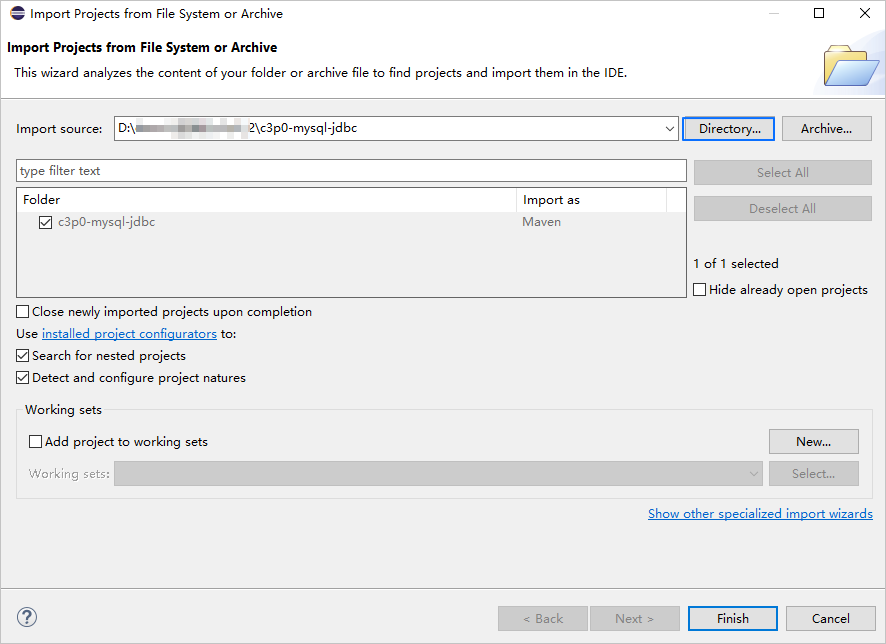
    Import

  3. View the project.

    p1

Step 2: Obtain the URL of OceanBase Database

  1. Contact the deployment personnel or administrator of OceanBase Database to obtain the connection string.

    Here is an example:

    obclient -hxxx.xxx.xxx.xxx -P2881 -utest_user001@mysql001 -p****** -Dtest
    

    For more information about the connection string, see Connect to an OceanBase tenant by using OBClient.

  2. Fill in the URL below based on the OceanBase Database connection string.

    jdbc:mysql://$host:$port/$database_name?user=$user_name&password=$password
    

    where

    • $host specifies the IP address for connecting to OceanBase Database. For connection through OceanBase Database Proxy (ODP), this parameter is the IP address of an ODP. For direct connection, this parameter is the IP address of an OBServer node.

    • $port specifies the port for connecting to OceanBase Database. For connection through ODP, the default value is 2883, which can be customized when ODP is deployed. For direct connection, the default value is 2881, which can be customized when OceanBase Database is deployed.

    • $database_name specifies the name of the database to be accessed.

      Notice

      The user used to connect to the tenant must have the CREATE, INSERT, DELETE, UPDATE, and SELECT privileges on the database. For more information about user privileges, see Privilege types in MySQL mode.

    • $user_name specifies the tenant account. For connection through ODP, the tenant account can be in the username@tenant name#cluster name or cluster name:tenant name:username format. For direct connection, the tenant account is in the username@tenant name format.

    • $password specifies the password of the account.

    For more information about the connection properties of MySQL Connector/J, see Configuration Properties.

    Here is an example:

    jdbc:mysql://xxx.xxx.xxx.xxx:2881/test?user=test_user001@mysql001&password=******
    

Step 3: Modify the database connection information in the c3p0-mysql-jdbc project

Modify the database connection information in the c3p0-mysql-jdbc/src/main/resources/c3p0-config.xml file based on the information obtained in Step 2.

Here is an example:

  • The IP address of the OBServer node is xxx.xxx.xxx.xxx.
  • The port is 2881.
  • The name of the database to be accessed is test.
  • The tenant account is test_user001@mysql001, where mysql001 is a MySQL user tenant created in OceanBase Database, and test_user001 is the username of the mysql001 tenant.
  • The password is ******.

The sample code is as follows:

...
        <property name="jdbcUrl">jdbc:mysql://xxx.xxx.xxx.xxx:2881/test</property>
        <property name="user">test_user001@mysql001</property>
        <property name="password">******</property>
...

Step 4: Run the c3p0-mysql-jdbc project

  1. In the project navigation view, locate and expand the src/main/java directory.

  2. Right-click the Main.java file and choose Run As > Java Application.
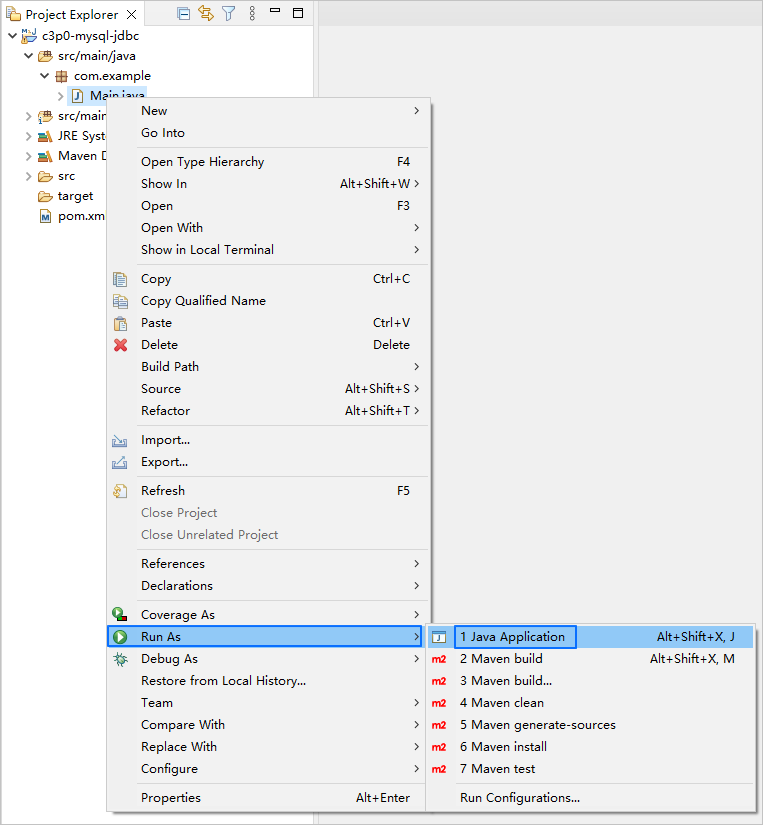
    run

  3. In the console window of Eclipse, view the project logs and output results.

    log

  4. You can also execute the following SQL statement in OceanBase Client (OBClient) to view the results:

    obclient [test]> SELECT * FROM test_c3p0;
    

    The return result is as follows:

    +------+--------------+
    | id   | name         |
    +------+--------------+
    |    5 | test_update  |
    |    6 | test_insert6 |
    |    7 | test_insert7 |
    |    8 | test_insert8 |
    |    9 | test_insert9 |
    +------+--------------+
    5 rows in set
    

Project code introduction

Click c3p0-mysql-jdbc to download the project code, which is a compressed file named c3p0-mysql-jdbc.zip.

After decompressing it, you will find a folder named c3p0-mysql-jdbc. The directory structure is as follows:

c3p0-mysql-jdbc
├── src
│   └── main
│       ├── java
│       │   └── com
│       │        └── example
│       │           └── Main.java
│       └── resources
│           └── c3p0-config.xml
└── pom.xml

Here is a breakdown of the files and directories:

  • src: the root directory for storing the source code.
  • main: the directory for storing the main code, including the major logic of the application.
  • java: the directory for storing the Java source code.
  • com: the directory for storing the Java package.
  • example: the directory for storing the packages of the sample project.
  • Main.java: the main class that contains logic such as table creation and data insertion.
  • resources: the directory for storing resource files, including configuration files.
  • c3p0-config.xml: the configuration file of the c3p0 connection pool.
  • pom.xml: the configuration file of the Maven project, which is used to manage project dependencies and build settings.

Code in the pom.xml file

The pom.xml file is a configuration file for Maven projects, which defines the dependencies, plug-ins, and build rules of the projects. Maven is a Java project management tool that can automatically download dependencies, compile, and package the projects.

To configure the pom.xml file, perform the following steps:

  1. Declare the file.

    Declare the file to be an XML file that uses XML standard 1.0 and character encoding UTF-8.

    The sample code is as follows:

    <?xml version="1.0" encoding="UTF-8"?>
    
  2. Configure the namespaces and the POM model version.

    1. xmlns: the default XML namespace, which is set to http://maven.apache.org/POM/4.0.0.
    2. xmlns:xsi: the namespace for XML elements prefixed with xsi, which is set to http://www.w3.org/2001/XMLSchema-instance.
    3. xsi:schemaLocation: the mapping between the XML namespace and its corresponding XML schema definition (XSD) file. The value typically consists of paired strings separated by spaces. Each pair consists of a default XML namespace (http://maven.apache.org/POM/4.0.0) in the first part, and the URI of the corresponding XSD file (http://maven.apache.org/xsd/maven-4.0.0.xsd) in the second part.
    4. <modelVersion>: the POM model version used by the POM file, which is set to 4.0.0.

    The sample code is as follows:

    <project xmlns="http://maven.apache.org/POM/4.0.0"
             xmlns:xsi="http://www.w3.org/2001/XMLSchema-instance"
             xsi:schemaLocation="http://maven.apache.org/POM/4.0.0 http://maven.apache.org/xsd/maven-4.0.0.xsd">
      <modelVersion>4.0.0</modelVersion>
    
     <! -- Other configurations -->
    
    </project>
    
  3. Configure basic information.

    1. <groupId>: the ID of the group to which the project belongs, which is set to com.example.
    2. <artifactId>: the name of the project, which is set to testc3p0.
    3. <version>: the project version, which is set to 1.0-SNAPSHOT.

    The sample code is as follows:

        <groupId>com.example</groupId>
        <artifactId>testc3p0</artifactId>
        <version>1.0-SNAPSHOT</version>
    
  4. Configure the properties of the project's source file.

    Specify the Maven compiler plug-in as maven-compiler-plugin, and set both the source code and target Java versions to 8. This means that the project's source code is written using Java 8, and the compiled bytecode will also be compatible with the Java 8 runtime environment. This setup ensures that the project can correctly handle the syntax and features of Java 8 during compilation and runtime.

    Note

    Java 1.8 and Java 8 are different names for the same version.

    The sample code is as follows:

        <build>
            <plugins>
                <plugin>
                    <groupId>org.apache.maven.plugins</groupId>
                    <artifactId>maven-compiler-plugin</artifactId>
                    <configuration>
                        <source>8</source>
                        <target>8</target>
                    </configuration>
                </plugin>
            </plugins>
        </build>
    
  5. Configure the components on which the project depends.

    Note

    The following code defines that the project depends on MySQL Connector/J V8.0.25. For more information about other versions, see MySQL Connector/J.

    Define the components on which the project depends by using <dependency>.

    • Add the mysql-connector-java dependency library:
    1. <groupId>: the ID of the group to which the dependency belongs, which is set to mysql.
    2. <artifactId>: the name of the dependency, which is set to mysql-connector-java.
    3. <version>: the version of the dependency, which is set to 8.0.25.
    • Add the c3p0 dependency library:
    1. <groupId>: the ID of the group to which the dependency belongs, which is set to com.mchange.
    2. <artifactId>: the name of the dependency, which is set to c3p0.
    3. <version>: the version of the dependency, which is set to 0.9.5.5.

    The sample code is as follows:

        <dependencies>
            <dependency>
                <groupId>mysql</groupId>
                <artifactId>mysql-connector-java</artifactId>
                <version>8.0.25</version>
            </dependency>
            <dependency>
                <groupId>com.mchange</groupId>
                <artifactId>c3p0</artifactId>
                <version>0.9.5.5</version>
            </dependency>
        </dependencies>
    

Code in the c3p0-config.xml file

c3p0-config.xml is the configuration file of the c3p0 connection pool and is used to configure database connection properties. You can specify values of the <property> elements to configure properties such as the database driver, connection URL, username, password, and connection pool size.

To configure the c3p0-config.xml file, perform the following steps:

  1. Declare the file.

    Declare the file to be an XML file that uses XML standard 1.0 and character encoding UTF-8.

    The sample code is as follows:

    <?xml version="1.0" encoding="UTF-8"?>
    
  2. Configure basic information.

    1. <c3p0-config>: the configuration information of the c3p0 connection pool.
    2. <named-config name="oceanbase">: a configuration named oceanbase. In the code, the name can be used to reference this configuration and obtain connection information and connection pool properties related to the database named oceanbase.

    The sample code is as follows:

    <c3p0-config>
        <named-config name="oceanbase">
    
            // Specify values of the <property> elements.
    
        </named-config>
    </c3p0-config>
    
  3. Configure the database driver.

    Set the class name of the MySQL Java Database Connectivity (JDBC) driver used to connect to OceanBase Database to com.mysql.cj.jdbc.Driver by using <property>.

    Note

    For the name of the implementation class of MySQL Connector/J, see Driver/Datasource Class Name.

    The sample code is as follows:

            <property name="driverClass">com.mysql.cj.jdbc.Driver</property>
    
  4. Configure the database connection information.

    1. Specify the URL for connecting to the database, including the host IP address, port number, database to be accessed, and other parameters.
    2. Specify the username for connecting to the database.
    3. Specify the password for connecting to the database.

    The sample code is as follows:

            <property name="jdbcUrl">jdbc:mysql://$host:$port/$database_name</property>
            <property name="user">$user_name</property>
            <property name="password">$password</property>
    

    where

    • $host specifies the IP address for connecting to OceanBase Database. For connection through OceanBase Database Proxy (ODP), this parameter is the IP address of an ODP. For direct connection, this parameter is the IP address of an OBServer node.
    • $port specifies the port for connecting to OceanBase Database. For connection through ODP, the default value is 2883, which can be customized when ODP is deployed. For direct connection, the default value is 2881, which can be customized when OceanBase Database is deployed.
    • $database_name specifies the name of the database to be accessed.
    • $user_name specifies the tenant account. For connection through ODP, the tenant account can be in the username@tenant name#cluster name or cluster name:tenant name:username format. For direct connection, the tenant account is in the username@tenant name format.
    • $password specifies the password of the account.
  5. Configure other parameters of the c3p0 connection pool.

    1. Configure the connection pool to increase the number of connections by 20 at a time when needed. This means that when there are insufficient connections in the pool, 20 connections will be added each time.
    2. Set the initial size of the connection pool to 10. This means that 10 connections are created when the connection pool is started.
    3. Set the minimum number of connections in the connection pool to 5. This means that the connection pool must have at least five connections.
    4. Set the maximum number of connections in the connection pool to 30. This means that the connection pool allows at most 30 connections.
    5. Set the maximum number of cached statements in each connection to 0. This means that no statement is cached.
    6. Set the maximum number of statements cached for each connection in the connection pool to 0. This means that no statement is cached for connections.
    7. Set the number of auxiliary threads for c3p0 to 3. These auxiliary threads are used to execute slow JDBC operations.
    8. Set the interval for checking c3p0 connection properties to 3 seconds. This means that connection properties are checked every 3 seconds.
    9. Set the timeout value for requesting a connection to 1,000 ms. If a connection fails to be obtained within 1,000 ms, a timeout exception is thrown.
    10. Set the interval for checking idle connections in the connection pool to 3 seconds. The status of idle connections is checked every 3 seconds.
    11. Set the maximum idle duration of connections in the connection pool to 10 seconds. A connection that is not used within 10 seconds will be closed.
    12. Set the maximum idle time for connections exceeding the maximum connection limit in the connection pool to 5 seconds. That is, if a connection exceeds the maximum connection limit and remains idle for more than 5 seconds, it will be closed.
    13. Set the retry interval for requesting a connection to 1,000 ms. That is, when a connection failed to be obtained, a retry is performed after 1,000 ms.
    14. Set the name of the table for automatic testing of the c3p0 connection pool to Test. This is a special table used to test whether a connection is valid.
    15. Specify whether to verify a connection when it is returned to the connection pool. If you set the value to true, a connection is verified when it is returned to the connection pool.

    The sample code is as follows:

           <property name="acquireIncrement">20</property>
           <property name="initialPoolSize">10</property>
           <property name="minPoolSize">5</property>
           <property name="maxPoolSize">30</property>
           <property name="maxStatements">0</property>
           <property name="maxStatementsPerConnection">0</property>
           <property name="numHelperThreads">3</property>
           <property name="propertyCycle">3</property>
           <property name="checkoutTimeout">1000</property>
           <property name="idleConnectionTestPeriod">3</property>
           <property name="maxIdleTime">10</property>
           <property name="maxIdleTimeExcessConnections">5</property>
           <property name="acquireRetryDelay">1000</property>
           <property name="automaticTestTable">Test</property>
           <property name="testConnectionOnCheckin">true</property>
    

Notice

The actual parameter configurations depend on the project requirements and database characteristics. We recommend that you adjust and configure the parameters based on the actual situation. For more information about c3p0 parameters, see c3p0.

The following table describes the basic parameters of the c3p0 connection pool.

Category Parameter Default value Description
Required parameters driverClass N/A The class name of the database driver.
jdbcUrl N/A The URL for connecting to the database.
user N/A The username for connecting to the database.
password N/A The password for connecting to the database.
Basic settings acquireIncrement 3 The number of connections obtained at a time from the connection pool when needed. For example, if acquireIncrement is set to 20 but the connection pool has only five idle connections, 20 new connections will be created in the connection pool to meet the requirements.
acquireRetryAttempts 30 The number of retry attempts allowed when c3p0 fails to obtain a new connection from the database. If you specify a value smaller than or equal to 0, c3p0 will keep trying until a connection is obtained.
maxIdleTime 0 The maximum idle duration for connections in the connection pool. The value 0 indicates that idle connections will never expire. For example, when maxIdleTime is set to 10 seconds, an idle connection will be closed and removed from the connection pool if it is not used within 10 seconds. When the application requests for a connection next time, a new connection will be created in the connection pool.
maxPoolSize 15 The maximum number of connections in the connection pool. When the number of connections in the connection pool reaches the value of maxPoolSize, requests for new connections will be blocked until a connection is released and returned to the connection pool.
MinPoolSize 3 The minimum number of connections in the connection pool. The connection pool retains at least the number of connections specified by minPoolSize.
initialPoolSize 3 The number of connections created when the connection pool is started. The value ranges from minPoolSiz to maxPoolSize. When the connection pool is initialized, connections are created based on the number specified by initialPoolSize.
Optional parameters acquireRetryDelay 1000 The retry delay for requesting a connection, in ms. When the application requests a connection from the connection pool, the operation fails if no connection is available. In this case, the application will retry with a delay based on the value of acquireRetryDelay.
autoCommitOnClose false Specifies whether to automatically commit the transaction when a connection is closed. The default value is false, which specifies not to automatically commit the transaction when a connection is closed. If the application needs to explicitly commit the transaction before the connection is closed, you can set autoCommitOnClose to true.

Notice

Auto-commit can result in data inconsistency or loss. Therefore, we recommend that you exercise caution and make sure that transactions are complete if you want to use autoCommitOnClose. In most cases, we recommend that you manually manage transactions to ensure that transactions are committed or rolled back at the right time.

automaticTestTable null The name of the table for automatic testing of the connection pool. c3p0 will create an empty table with the specified name and query this table to verify connections. The default value is null, which means that no test statement is executed. For example, if you set automaticTestTable to Test, c3p0 will create an empty table named Test and use the inherent query statement to test connections.

Note

If both automaticTestTable and preferredTestQuery are configured, c3p0 will use preferredTestQuery to execute test queries and ignore automaticTestTable.

idleConnectionTestPeriod 0 The interval for the connection pool to verify idle connections, in ms. The connection pool verifies idle connections at the specified interval. The default value is 0, which specifies not to verify idle connections.
maxStatements 0 The maximum number of prepared statements allowed in the connection pool.

Note

  • If both maxStatements and maxStatementsPerConnection are set to 0, statement caching is disabled.
  • If maxStatements is set to 0 but maxStatementsPerConnection is set to a non-zero value, statement caching is enabled. However, only the limit specified by maxStatementsPerConnection takes effect, and the total number of cached statements in the connection pool is not limited.
  • maxStatements controls the total number of cached statements of all connections in the connection pool. Each connection in a connection pool has an independent set of cached statements. Therefore, you must set maxStatements to a large value if you need to specify this parameter.

maxStatementsPerConnection 0 The maximum number of prepared statements allowed in each connection.

Note

  • If both maxStatements and maxStatementsPerConnection are set to 0, statement caching is disabled.
  • If maxStatementsPerConnection is set to 0 but maxStatements is set to a non-zero value, statement caching is enabled. However, only the limit specified by maxStatements takes effect, and the number of cached statements of a single connection is not limited.

numHelperThreads 3 The number of auxiliary threads for asynchronous tasks.

Note

  • More auxiliary threads can process more tasks in parallel, thereby improving the processing capabilities and increasing the response speed of the connection pool.
  • However, a large number of auxiliary threads can consume excessive system resources. Therefore, you must configure the parameter based on the hardware configurations and performance test results of the system.

preferredTestQuery null The test statement executed for all connection verifications. Defining a statement that will quickly execute in your database can significantly speed up the verification.

Notice

The test table must already exist when the data source is initialized.

checkoutTimeout 0 The timeout value for requesting a connection from the connection pool, in ms. The default value is 0, which indicates that the request does not time out. When the client calls getConnection(), an SQLException is thrown if no connection is obtained when the specified period expires.
Unrecommended parameters breakAfterAcquireFailure false Specifies whether to interrupt the operation when a connection fails to be obtained from the connection pool. If a connection failed to be obtained from the connection pool, all threads waiting for a connection from the connection pool will throw an exception. However, the data source is still valid and retained. When getConnection() is called again, the threads continue to try to obtain a connection.
  • If you set the value to true, after the connection pool failed to obtain a connection from the database several times, it stops trying and immediately throws an exception.
  • If you set the value to false, the connection pool tries to obtain a connection until the timeout value is reached.
testConnectionOnCheckout false Specifies whether to verify a connection when it is obtained from the connection pool.
  • If you set the value to true, a connection is verified when it is obtained from the connection pool. This parameter will at least double the number of calls in the database. Therefore, proceed with caution when you use this parameter.
  • If you set the value to false, connections are not verified.

Note

Connection verification ensures the validity of connections but results in considerable extra overheads. Therefore, you must determine whether to enable connection verification based on the application requirements and performance requirements. If the application demands high connection availability, you can enable connection verification. If connections in the connection pool are frequently requested and released, frequent connection verification will compromise the performance.

testConnectionOnCheckin false Specifies whether to verify a connection when it is returned to the connection pool.
  • If you set the value to true, a connection is verified when it is returned to the connection pool. This parameter will at least double the number of calls in the database. Therefore, proceed with caution when you use this parameter.
  • If you set the value to false, connections are not verified.

Note

Connection verification ensures the validity of connections but results in considerable extra overheads. Therefore, you must determine whether to enable connection verification based on the application requirements and performance requirements. If the application demands high connection availability, you can enable connection verification. If connections in the connection pool are frequently requested and returned, frequent connection verification will compromise the performance.

Code in the Main.java file

The Main.java file is a part of the sample application, demonstrating how to obtain a database connection through the c3p0 connection pool and perform a series of database operations within a transaction. These operations include creating a table, inserting data, deleting data, updating data, querying data, and printing the query results. This showcases how to use the c3p0 connection pool to manage database connections and execute transactional operations, ultimately improving the efficiency and performance of database operations.

To configure the Main.java file, perform the following steps:

  1. Define the package and import java.sql interfaces and classes.

    1. Declare the name of the package to which the current code belongs as com.example.
    2. Import the java.sql.Connection class for representing database connections.
    3. Import the java.sql.PreparedStatement class for executing precompiled database operations.
    4. Import the java.sql.ResultSet class for representing the result sets of database queries.
    5. Import the com.mchange.v2.c3p0.ComboPooledDataSource class for using the c3p0 connection pool.

    The sample code is as follows:

    package com.example;
    
    import java.sql.Connection;
    import java.sql.PreparedStatement;
    import java.sql.ResultSet;
    import com.mchange.v2.c3p0.ComboPooledDataSource;
    
  2. Define class names and methods.

    1. Define a Main public class, which is used as the entry to the application. The class name must be the same as the file name.
    2. Define a public static method named main, which is used as the execution start point of the application.
    3. Use the try-with-resources block to obtain a database connection and create a precompiled SQL statement.
    4. Perform transaction operations.
    5. Capture possible exceptions and record stack information of the exceptions.
    6. Define a private static method getConnection for requesting database connections from the c3p0 connection pool. Create a ComboPooledDataSource object named cpds in the method. This object specifies the connection pool configurations by using the oceanbase parameter. Call the cpds.getConnection() method to request a database connection from the connection pool and return the connection.

    The sample code is as follows:

    public class Main {
    
        public static void main(String[] args) {
            try (
                // Obtain a database connection.
                // Create a precompiled SQL statement.
                ) {
    
                // Perform database transaction operations. Specifically, you can start a transaction, create a table, insert data, delete data, update data, query data, and commit a transaction.
    
            } catch (Exception e) {
                e.printStackTrace();
            }
        }
    
        private static Connection getConnection() throws Exception {
            ComboPooledDataSource cpds = new ComboPooledDataSource("oceanbase");
            return cpds.getConnection();
        }
    }
    
  3. Obtain a database connection.

    Obtain a database connection and assign it to the conn variable.

    The sample code is as follows:

                 Connection conn = getConnection();
    
  4. Create precompiled SQL statements.

    1. Create a precompiled SQL statement for creating a database table named test_c3p0.
    2. Create a precompiled SQL statement for inserting data into the test_c3p0 table.
    3. Create a precompiled SQL statement for deleting data from the test_c3p0 table.
    4. Create a precompiled SQL statement for updating data in the test_c3p0 table.
    5. Create a precompiled SQL statement for querying data from the test_c3p0 table.

    The sample code is as follows:

                 PreparedStatement stmtCreate = conn.prepareStatement("CREATE TABLE test_c3p0 (id INT, name VARCHAR(32))");
                 PreparedStatement stmtInsert = conn.prepareStatement("INSERT INTO test_c3p0 VALUES (?, ?)");
                 PreparedStatement stmtDelete = conn.prepareStatement("DELETE FROM test_c3p0 WHERE id < ?");
                 PreparedStatement stmtUpdate = conn.prepareStatement("UPDATE test_c3p0 SET name = ? WHERE id = ?");
                 PreparedStatement stmtSelect = conn.prepareStatement("SELECT * FROM test_c3p0")
    
  5. Start a transaction.

    Set conn.setAutoCommit to false to start the transaction mechanism.

    The sample code is as follows:

                conn.setAutoCommit(false);
    
  6. Create a table.

    Execute the SQL statement for creating a table.

    The sample code is as follows:

                stmtCreate.execute();
    
  7. Insert data.

    Use the FOR loop to insert 10 records into the test_c3p0 table. The values of the first column are the values of the i variable. The values of the second column are the values of the test_insert string followed by the values of the i variable.

    The sample code is as follows:

                for (int i = 0; i < 10; i++) {
                    stmtInsert.setInt(1, i);
                    stmtInsert.setString(2, "test_insert" + i);
                    stmtInsert.executeUpdate();
                }
    
  8. Delete data.

    Set the value of the first parameter in the deletion statement to 5 and execute the deletion statement.

    The sample code is as follows:

                stmtDelete.setInt(1, 5);
                stmtDelete.executeUpdate();
    
  9. Update data.

    Set the first parameter to test_update and the second parameter to 5 in the update statement, and execute the update statement.

    The sample code is as follows:

                stmtUpdate.setString(1, "test_update");
                stmtUpdate.setInt(2, 5);
                stmtUpdate.executeUpdate();
    
  10. Query data.

    1. Execute a query statement and save the query result in the ResultSet object named rs.
    2. Use rs.next() to check whether the result set contains another row based on a WHILE loop. If yes, execute the code in the loop.
    3. The code in the loop returns the id and name column values of each row.
    4. Close the result set and release relevant resources.

    The sample code is as follows:

                ResultSet rs = stmtSelect.executeQuery();
                while (rs.next()) {
                    System.out.println(rs.getInt("id") + "   " + rs.getString("name"));
                }
                rs.close();
    
  11. Commit the transaction.

    The sample code is as follows:

                conn.commit();
    

Complete code

pom.xml
c3p0-config.xml
Main.java
<?xml version="1.0" encoding="UTF-8"?>
<project xmlns="http://maven.apache.org/POM/4.0.0"
         xmlns:xsi="http://www.w3.org/2001/XMLSchema-instance"
         xsi:schemaLocation="http://maven.apache.org/POM/4.0.0 http://maven.apache.org/xsd/maven-4.0.0.xsd">
    <modelVersion>4.0.0</modelVersion>

    <groupId>com.oceanbase</groupId>
    <artifactId>testc3p0</artifactId>
    <version>1.0-SNAPSHOT</version>
    <build>
        <plugins>
            <plugin>
                <groupId>org.apache.maven.plugins</groupId>
                <artifactId>maven-compiler-plugin</artifactId>
                <configuration>
                    <source>8</source>
                    <target>8</target>
                </configuration>
            </plugin>
        </plugins>
    </build>

    <dependencies>
        <dependency>
            <groupId>mysql</groupId>
            <artifactId>mysql-connector-java</artifactId>
            <version>8.0.25</version>
        </dependency>
        <dependency>
            <groupId>com.mchange</groupId>
            <artifactId>c3p0</artifactId>
            <version>0.9.5.5</version>
        </dependency>
    </dependencies>
</project>
<?xml version="1.0" encoding="UTF-8"?>
<c3p0-config>
    <named-config name="oceanbase">
        <!-- Configure Database Driver -->
        <property name="driverClass">com.mysql.cj.jdbc.Driver</property>
        <!-- Configure Database Link Address -->
        <property name="jdbcUrl">jdbc:mysql://$host:$port/$database_name</property>
        <!-- Configure database username -->
        <property name="user">$user_name</property>
        <!-- Configure database password -->
        <property name="password">$password</property>
        <!-- How many connection objects does the database Connection pool want from the database at one time -->
        <property name="acquireIncrement">20</property>
        <!-- Initialize connections -->
        <property name="initialPoolSize">10</property>
        <!-- Minimum number of connections -->
        <property name="minPoolSize">5</property>
        <!-- The maximum number of connections reserved in the Connection pool. Default: 15 -->
        <property name="maxPoolSize">30</property>
        <!-- JDBC standard parameter used to control the number of PreparedStatements loaded within the data source. However, the pre cached statements belong to a single connection rather than the entire Connection pool. So setting this parameter requires considering multiple factors. If both maxStatements and maxStatementsPerConnection are 0, the cache is turned off. Default:0 -->
        <property name="maxStatements">0</property>
        <!-- MaxStatementsPerConnection defines the maximum number of cached statements owned by a single connection in the Connection pool. Default: 0 -->
        <property name="maxStatementsPerConnection">0</property>
        <!-- C3p0 is an asynchronous operation, and slow JDBC operations are completed by the helper process. Expanding these operations can effectively improve performance by enabling multiple operations to be executed simultaneously through multithreading. Default:3 -->
        <property name="numHelperThreads">3</property>
        <!-- The user can wait up to 300 seconds before modifying the system configuration parameters. Default: 300 -->
        <property name="propertyCycle">3</property>
        <!-- The default setting for obtaining the connection timeout is to wait for a unit of milliseconds -->
        <property name="checkoutTimeout">1000</property>
        <!-- Check all free connections in the Connection pool every few seconds. Default: 0 -->
        <property name="idleConnectionTestPeriod">3</property>
        <!-- The maximum idle time, within seconds, if not used, the connection will be discarded. If it is 0, it will never be discarded. Default: 0 -->
        <property name="maxIdleTime">10</property>
        <!-- Configure the lifetime of the connection. Connections beyond this time will be automatically disconnected and discarded by the Connection pool. Of course, the connection being used will not be immediately disconnected, but will wait for it to close before disconnecting. When configured to 0, there is no restriction on the lifetime of the connection. -->
        <property name="maxIdleTimeExcessConnections">5</property>
        <!-- The interval time between two connections, in milliseconds. Default: 1000 -->
        <property name="acquireRetryDelay">1000</property>
        <!-- C3p0 will create an empty table called Test and use its built-in query statement for testing. If this parameter is defined, the property preferredTestQuery will be ignored. You cannot perform any operations on this Test table, it will only be used for c3p0 testing. Default: null -->
        <property name="automaticTestTable">Test</property>
        <!-- Test if the connection is valid when obtaining it -->
        <property name="testConnectionOnCheckin">true</property>
    </named-config>
</c3p0-config>
package com.example;

import java.sql.Connection;
import java.sql.PreparedStatement;
import java.sql.ResultSet;
import com.mchange.v2.c3p0.ComboPooledDataSource;

public class Main {

    public static void main(String[] args) {
        try (Connection conn = getConnection();

             PreparedStatement stmtCreate = conn.prepareStatement("CREATE TABLE test_c3p0 (id INT, name VARCHAR(32))");
             PreparedStatement stmtInsert = conn.prepareStatement("INSERT INTO test_c3p0 VALUES (?, ?)");
             PreparedStatement stmtDelete = conn.prepareStatement("DELETE FROM test_c3p0 WHERE id < ?");
             PreparedStatement stmtUpdate = conn.prepareStatement("UPDATE test_c3p0 SET name = ? WHERE id = ?");
             PreparedStatement stmtSelect = conn.prepareStatement("SELECT * FROM test_c3p0")) {

            // Start a transaction.
            conn.setAutoCommit(false);

            // Create a table.
            stmtCreate.execute();

            // Insert data.
            for (int i = 0; i < 10; i++) {
                stmtInsert.setInt(1, i);
                stmtInsert.setString(2, "test_insert" + i);
                stmtInsert.executeUpdate();
            }

            // Delete data.
            stmtDelete.setInt(1, 5);
            stmtDelete.executeUpdate();

            // Update data.
            stmtUpdate.setString(1, "test_update");
            stmtUpdate.setInt(2, 5);
            stmtUpdate.executeUpdate();

            // Query data.
            ResultSet rs = stmtSelect.executeQuery();
            while (rs.next()) {
                System.out.println(rs.getInt("id") + "   " + rs.getString("name"));
            }
            rs.close();

            // Commit the transaction.
            conn.commit();

        } catch (Exception e) {
            e.printStackTrace();
        }
    }

    private static Connection getConnection() throws Exception {
        ComboPooledDataSource cpds = new ComboPooledDataSource("oceanbase");
        return cpds.getConnection();
    }
}

References

For more information about MySQL Connector/J, see Overview of MySQL Connector/J.

Previous topic

Connect to OceanBase Database by using a Tomcat connection pool
Last

Next topic

Proxool
Next
What is on this page
Prerequisites
Procedure
Step 1: Import the c3p0-mysql-jdbc project into Eclipse
Step 2: Obtain the URL of OceanBase Database
Step 3: Modify the database connection information in the c3p0-mysql-jdbc project
Step 4: Run the c3p0-mysql-jdbc project
Project code introduction
Code in the pom.xml file
Code in the c3p0-config.xml file
Code in the Main.java file
Complete code
References