






This topic describes how to view and modify the parameters of a data migration task.
View parameter configurations
You can view the parameter configurations of a data migration task in the Running, Modifying, Integrating, Completed, Ending, or Ended state.
Log in to the OMS console.
In the left-side navigation pane, click Data Migration.
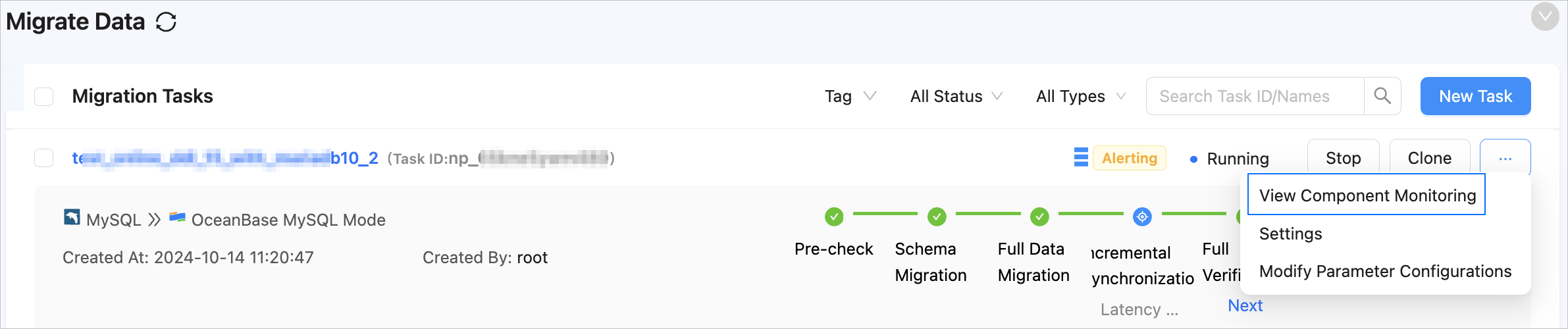
On the Migration Tasks page, click the ... next to the target task and then select Settings.
You can also click the name of the target task to go to the details page, and then click the ... in the upper-right corner and select Settings.
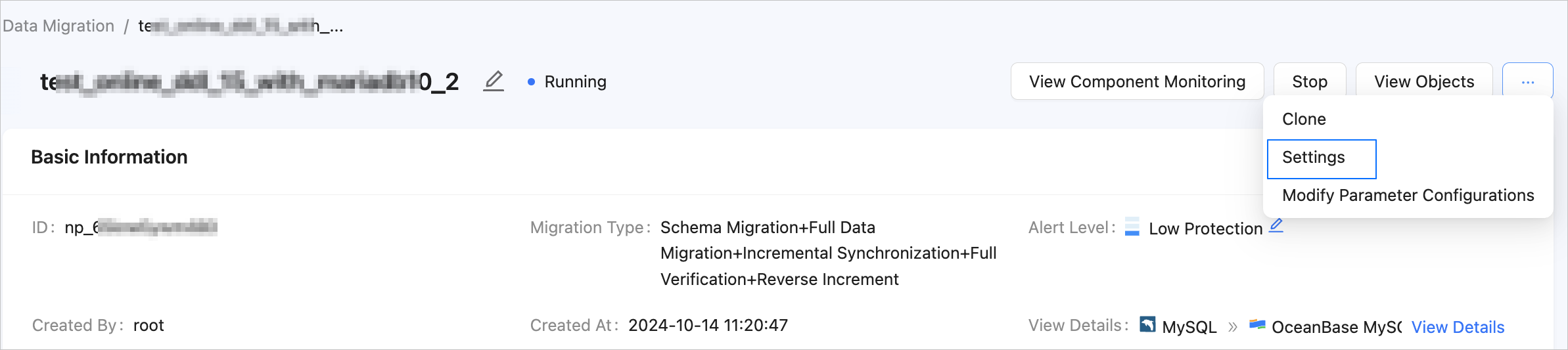
In the Settings panel, view the parameter configurations of the current task.
Modify parameter configurations
You can modify parameter configurations for data migration tasks in the Not Started, Running, Stopped, or Failed state.
Log in to the OMS console.
In the left-side navigation pane, click Data Migration.
On the Migration Tasks page, click ... > Modify Parameters in the actions column of the target task.

You can also click the name of the target task to go to the details page, and then click ... > Modify Parameters in the upper-right corner.
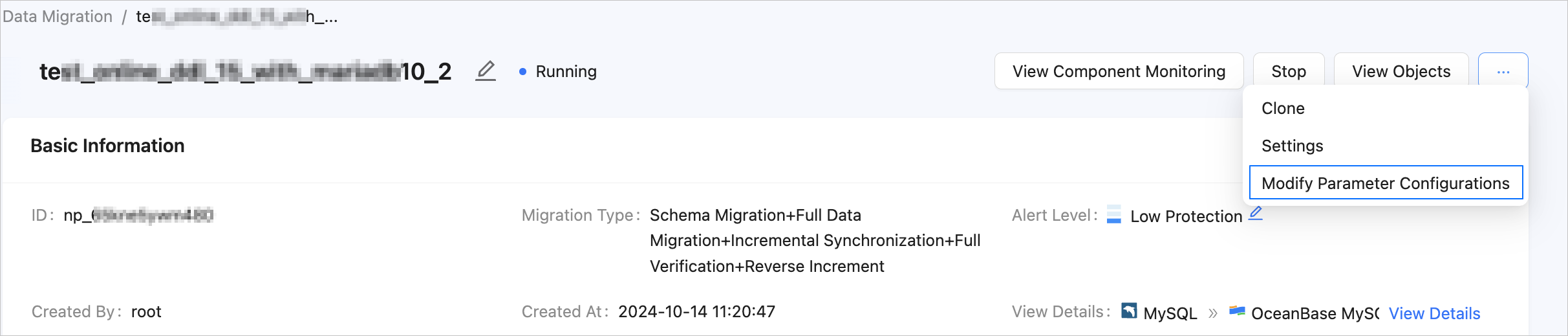
In the Modify Parameters panel, modify the parameters as needed.
Schema migration
The following parameters are displayed only if you selected Schema Migration in the Select Migration Type step.
ParameterDescriptionAutomatically Enter Next Stage upon Completion If you select this option, schema migration is automatically followed by the next phase. By default, this option is selected. You can also view and modify this setting on the Schema Migration tab of the details page of the data migration task. Normal Index Migration Method The migration mode for non-unique key indexes associated with a migrated table object. Valid values: Do Not Migrate, Migrate with Schema, and Post-Full-Migration. The Post Full Migration value is displayed only if full migration is selected. Trigger Migration Method The migration mode for triggers associated with a migrated table object. Valid values: Do Not Migrate, Migrate with Schema, and Forward Switchover Migration. Notice
- You can modify this parameter only when you are migrating data from an Oracle database to an Oracle compatible mode of OceanBase Database.
If you select only Schema Migration, the default value is Not Supported and you cannot select Forward Handover Migration.
If you select other migration types in addition to Schema Migration, you cannot select With Schema.
Full migration
The following parameters are displayed only if you selected Full Migration in the Select Migration Type step.
 ParameterDescription
Full Migration Rate Limit You can choose whether to limit the full migration rate. If you choose to limit it, you need to set the maximum number of rows that can be migrated to the destination database per second (RPS) and the maximum amount of data that can be migrated to the destination database per second (BPS). Note
The RPS and BPS values entered here are only for throttling. The actual full migration performance is affected by factors such as the source and destination databases and instance specifications.
Full Migration Resource Configuration You can select Small, Medium, or Large to use the corresponding default values of concurrency for reads, concurrency for writes, and memory. You can also customize the full migration resource configuration. The resource configuration limits the resource consumption of the full migration phase of the task. It is provided by the full migration component Full-Import. Notice
When you customize the configuration, the minimum value is 1 and only integers are supported.
Handle Non-empty Tables in Target Database Valid values: Ignore and Stop Migration: - If you select Ignore, OMS will log the conflicting data and retain the original data when there is a conflict between the original data and the data to be written to the destination database.
Notice
If you select Ignore, the full verification will use the IN mode to pull data, which cannot verify whether the destination database contains data that does not exist in the source database. The verification performance will also be slightly degraded.
- If you select Stop Migration, OMS will report an error and stop migration when there is data in the destination table. You must clear the data in the destination table before you continue the migration.
Notice
If you click Resume, OMS will ignore this setting and continue to migrate table data. Proceed with caution.
- If you select Ignore, OMS will log the conflicting data and retain the original data when there is a conflict between the original data and the data to be written to the destination database.
Incremental synchronization
The following parameters are displayed only if you selected Incremental Synchronization in the Select Migration Type step.
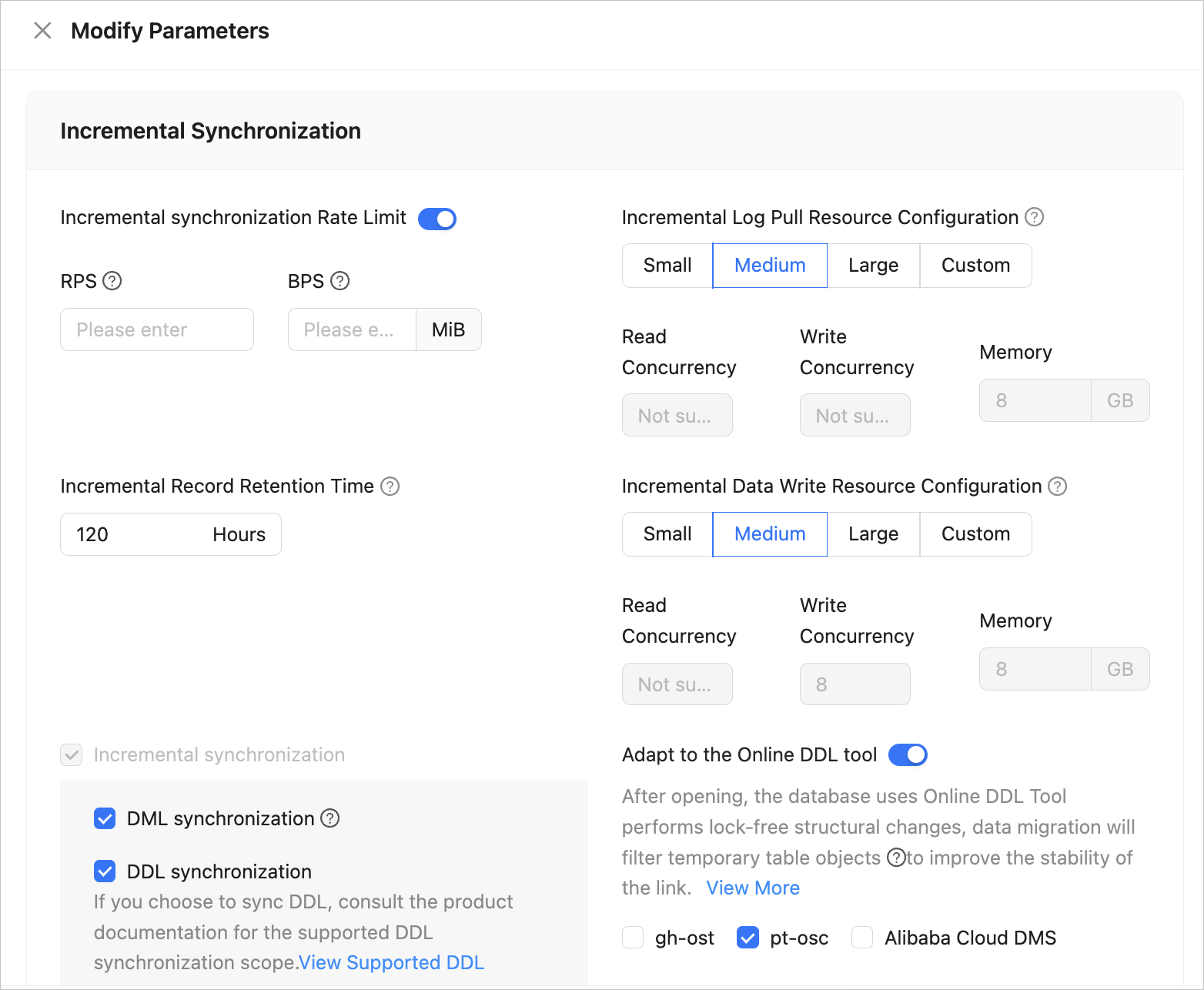
ParameterDescriptionIncremental Synchronization Rate Limit You can choose whether to limit the incremental synchronization rate. If you choose to limit it, you need to set the maximum number of rows that can be synchronized to the destination database per second (RPS) and the maximum amount of data that can be synchronized to the destination database per second (BPS). Note
The RPS and BPS values entered here are only for throttling. The actual incremental synchronization performance is affected by factors such as the source and destination databases and instance specifications.
Incremental Log Pull Resource Configuration You can select Small, Medium, or Large to use the corresponding default value of memory. You can also customize the incremental log pull resource configuration. The resource configuration limits the resource consumption of log pulling in the incremental synchronization phase of the task. It is provided by the incremental pull component Store. Notice
When you customize the configuration, the minimum value is 1 and only integers are supported.
Incremental Data Write Resource Configuration You can select Small, Medium, or Large to use the corresponding default values of concurrency for writes and memory. You can also customize the incremental data write resource configuration. The resource configuration limits the resource consumption of data writing in the incremental synchronization phase of the task. It is provided by the incremental synchronization component Incr-Sync. Notice
When you customize the configuration, the minimum value is 1 and only integers are supported.
Incremental Record Retention Time The period for which incremental parsing files are cached in OMS. The longer the retention period you specify, the more disk space the Store component needs. Incremental Synchronization Start Timestamp - If you have selected Full Migration in the Select Migration Type step, this parameter is not displayed.
- If you have selected other migration types except Full Migration but selected Incremental Synchronization, you can specify this parameter to indicate the migration of data created after a specific timestamp. By default, the current system time is used. For more information, see Set incremental synchronization start points.
- If you have configured Obtain Incremental Data through Kafka for the Oracle data source, you can modify the Incremental Synchronization Start Timestamp parameter before the incremental synchronization starts (not including full migration).
Incremental Synchronization Incremental Synchronization includes DML synchronization and DDL synchronization. You can click Customize DDL/DML to configure DDL and DML synchronization as needed. For more information, see Customize DDL/DML synchronization. Adapt to Online DDL Tool If you enable this feature, the database uses the online DDL tool to perform online schema changes, and data migration filters temporary table objects to improve the stability of data migration tasks. For more information, see Adapt to online DDL tool. Note
At present, adapting to the online DDL tool is supported only when the source database is a MySQL database and online schema changes are performed by using Alibaba Cloud DMS, gh-ost, or pt-osc.
Reverse incremental migration
The following parameters are displayed only if you selected Reverse Increment in the Select Migration Type step. The parameter settings for reverse incremental migration are the same as those for incremental synchronization by default.
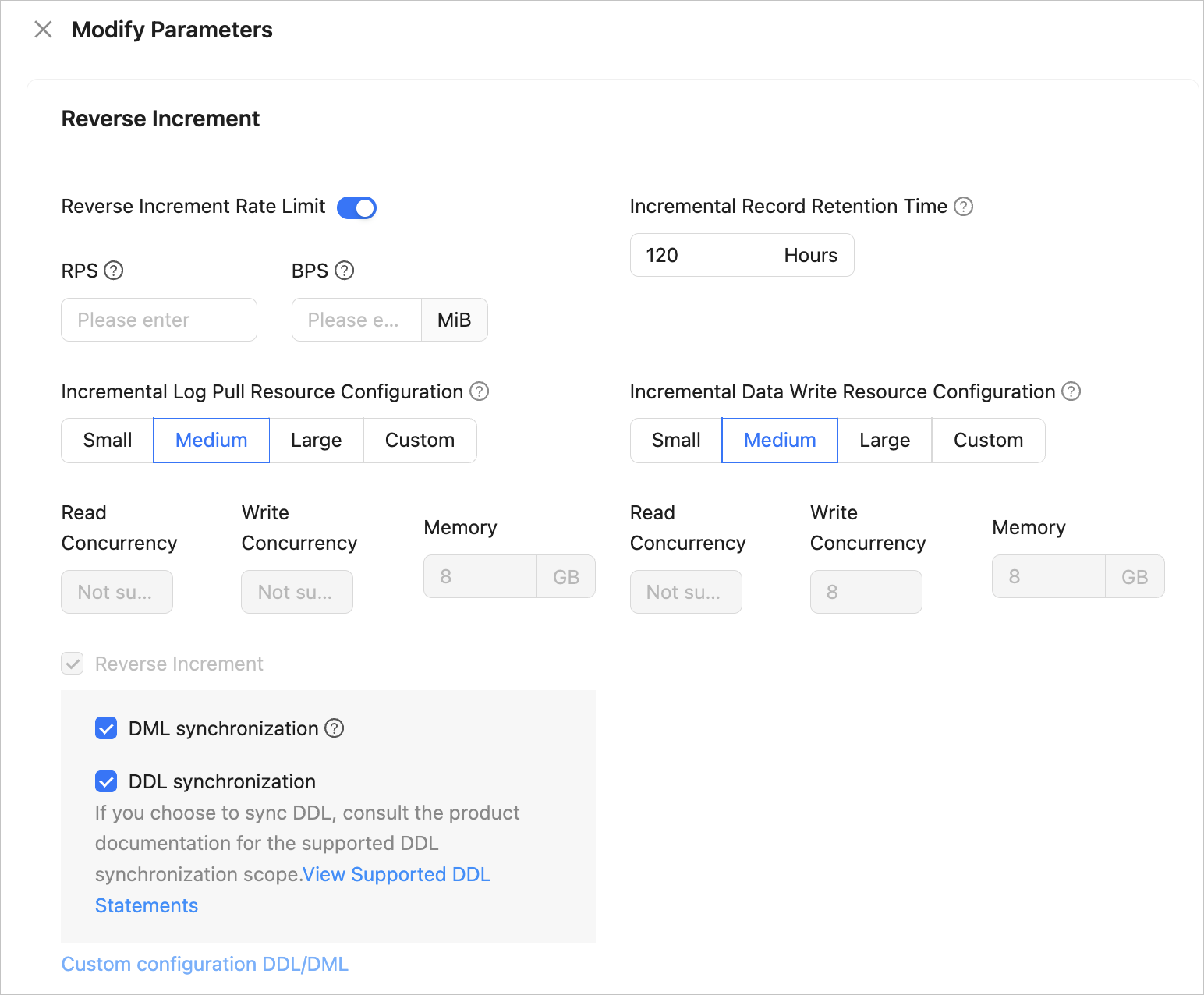
Full verification
The following parameters are displayed only if you selected Full Verification in the Select Migration Type step.
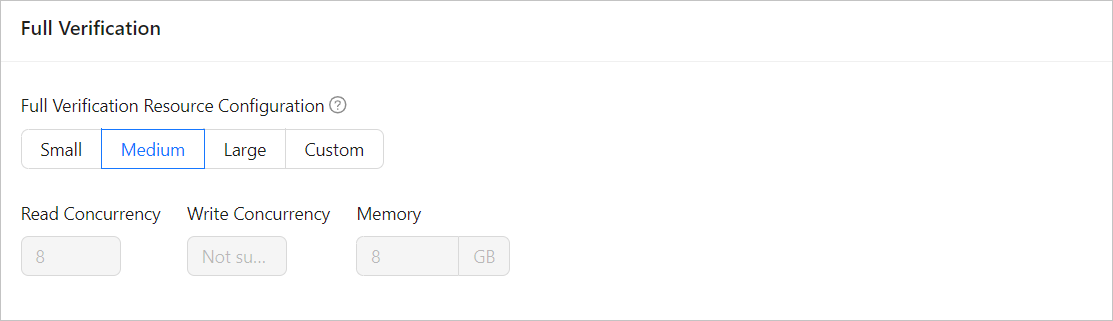 ParameterDescription
Full Verification Resource Configuration You can select Small, Medium, or Large to use the corresponding default values of concurrency for reads and memory. You can also customize the full verification resource configuration. The resource configuration limits the resource consumption of full verification. It is provided by the full verification component Full-Verification. Notice
When you customize the configuration, the minimum value is 1 and only integers are supported.
Click OK.