

OceanBase logo

OceanBase

A unified distributed database ready for your transactional, analytical, and AI workloads.

DEPLOY YOUR WAY

OceanBase Cloud

The best way to deploy and scale OceanBase

OceanBase Enterprise

Run and manage OceanBase on your infra

TRY OPEN SOURCE

OceanBase Community Edition

The free, open-source distributed database

OceanBase seekdb

Open source AI native search database

Customer Stories

Real-world success stories from enterprises across diverse industries.

View All
BY USE CASES

Mission-Critical Transactions

Global & Multicloud Application

Elastic Scaling for Peak Traffic

Real-time Analytics

Active Geo-redundancy

Database Consolidation

Resources

Comprehensive knowledge hub for OceanBase.

Blog

Live Demos

Training & Certification

Documentation

Official technical guides, tutorials, API references, and manuals for all OceanBase products.

View All
PRODUCTS

OceanBase Cloud

OceanBase Database

Tools

Connectors and Middleware

QUICK START

OceanBase Cloud

OceanBase Database

BEST PRACTICES

Practical guides for utilizing OceanBase more effectively and conveniently

Company

Learn more about OceanBase – our company, partnerships, and trust and security initiatives.

About OceanBase

Partner

Trust Center

Contact Us

International - English
中国站 - 简体中文
日本 - 日本語
Sign In
Start on Cloud

A unified distributed database ready for your transactional, analytical, and AI workloads.

DEPLOY YOUR WAY

OceanBase Cloud

The best way to deploy and scale OceanBase

OceanBase Enterprise

Run and manage OceanBase on your infra

TRY OPEN SOURCE

OceanBase Community Edition

The free, open-source distributed database

OceanBase seekdb

Open source AI native search database

Customer Stories

Real-world success stories from enterprises across diverse industries.

View All
BY USE CASES

Mission-Critical Transactions

Global & Multicloud Application

Elastic Scaling for Peak Traffic

Real-time Analytics

Active Geo-redundancy

Database Consolidation

Comprehensive knowledge hub for OceanBase.

Blog

Live Demos

Training & Certification

Documentation

Official technical guides, tutorials, API references, and manuals for all OceanBase products.

View All
PRODUCTS
OceanBase CloudOceanBase Database
ToolsConnectors and Middleware
QUICK START
OceanBase CloudOceanBase Database
BEST PRACTICES

Practical guides for utilizing OceanBase more effectively and conveniently

Learn more about OceanBase – our company, partnerships, and trust and security initiatives.

About OceanBase

Partner

Trust Center

Contact Us

Start on Cloud
编组
All Products
    • Databases
    • iconOceanBase Database
    • iconOceanBase Cloud
    • iconOceanBase Tugraph
    • iconInteractive Tutorials
    • iconOceanBase Best Practices
    • Tools
    • iconOceanBase Cloud Platform
    • iconOceanBase Migration Service
    • iconOceanBase Developer Center
    • iconOceanBase Migration Assessment
    • iconOceanBase Admin Tool
    • iconOceanBase Loader and Dumper
    • iconOceanBase Deployer
    • iconKubernetes operator for OceanBase
    • iconOceanBase Diagnostic Tool
    • iconOceanBase Binlog Service
    • Connectors and Middleware
    • iconOceanBase Database Proxy
    • iconEmbedded SQL in C for OceanBase
    • iconOceanBase Call Interface
    • iconOceanBase Connector/C
    • iconOceanBase Connector/J
    • iconOceanBase Connector/ODBC
    • iconOceanBase Connector/NET
icon

OceanBase Developer Center

V4.3.1

  • Overview
    • What is ODC?
    • Features
    • Architecture
    • Limitations
    • ODC console
  • Quick Start
    • Client ODC
      • Overview
      • Install Client ODC
      • Use Client ODC
    • Web ODC
      • Overview
      • Deploy Web ODC
      • Use Web ODC
  • Data Source Management
    • Create a data source
    • Data sources and project collaboration
    • Database O&M
      • Session management
      • Global variable management
      • Recycle bin management
  • SQL Development
    • SQL editing and execution
    • Perform PL compilation and debugging
    • Use the command-line window
    • Edit and export the result set of an SQL statement
    • Execution analysis
    • Generate test data
    • Database objects
      • Table objects
        • Overview
        • Create a table
        • Manage tables
      • View objects
        • Overview
        • Create a view
        • Manage views
      • Function objects
        • Overview
        • Create a function
        • Manage functions
      • Stored procedure objects
        • Overview
        • Create a stored procedure
        • Manage stored procedures
      • Sequence objects
        • Overview
        • Create a sequence
        • Manage sequences
      • Package objects
        • Overview
        • Create a program package
        • Manage program packages
      • Trigger objects
        • Overview
        • Create a trigger
        • Manage triggers
      • Type objects
        • Overview
        • Create a type
        • Manage types
      • Synonym objects
        • Overview
        • Create a synonym
        • Manage synonyms
  • Import and Export
    • Import schemas and data
    • Export schemas and data
  • Database Change Management
    • User Permission Management
      • Users and roles
      • Automatic authorization
    • Project collaboration management
    • Risk levels, risk identification rules, and approval processes
    • SQL check specifications
    • SQL window specification
    • Database change management
    • Logical database change management
    • Batch database change management
    • Lock-free schema changes
    • Synchronize shadow tables
    • Schema comparison
  • Data Lifecycle Management
    • Archive data
    • Clean up data
    • Partitioning Plan Management
      • Manage partitioning plans
      • Set partitioning strategies
      • Examples
    • SQL plan task
  • Data Desensitization and Auditing
    • Desensitize data
    • Operation records
  • Notification Management
    • Overview
    • View notification records
    • Manage Notification Channel
      • Create a notification channel
      • View, edit, and delete a notification channel
      • Configure a custom channel
    • Manage notification rules
  • System Integration
    • Login integration
    • Approval integration
    • SQL approval integration
  • Deployment Guide
    • Deployment overview
    • Preparations before deployment
    • Load and run an ODC image
    • Deploy ODC in high-availability mode
    • Deployment verification
  • Upgrade Guide
    • Upgrade Overview
    • Preparations before upgrade
    • Update single-node ODC
    • Update high-avaliability ODC
    • Upgrade verification
    • Rollback after upgrade failed
  • Troubleshooting
    • ODC troubleshooting process
    • Collect Message
      • View the runtime environment and version information
      • View web ODC logs
      • View client ODC logs
      • View end-to-end ODC-related logs
      • View ODC MetaDB data
      • Query the index status in OceanBase Database V4.x
      • Query the index status in OceanBase Database V1.4.x to V3.2.x
      • Collect JVM runtime information
      • Use tcpdump to capture packets
    • Common Troubleshooting
      • Deployment Upgrade
        • Web ODC cannot be accessed after startup
      • Database Connection
        • Access denied in a connection trial or test
        • Connection is refused in a connection trial or test
        • Connection times out
        • `Connection reset` is reported for a time-consuming statement
        • `socket write error` or `closed by server` is reported for a connection
      • SQL Execution
        • Disconnection during SQL execution
        • `Over tenant memory limits` is reported during SQL execution
        • `Unknown thread id` is returned during SQL execution
        • `timeout` errors returned during SQL execution
        • `OutOfMemoryError` is returned during SQL execution
        • Incomplete result columns for the SELECT statement
        • Garbled Chinese characters in the SQL execution result set
        • Garbled Chinese data is returned for query of data in GBK encoding
      • PL Object
        • Debugging is not supported for invalid PL objects
        • `JSONException` is reported during PL debugging
        • Garbled variable values in debugging
        • Failed to view PL objects or garbled characters are returned
        • PL objects cannot be executed or an execution error is returned
        • ODC issues during PL debugging
        • PL anonymous block cannot be debugged
        • Alert information of a PL object is unavailable
      • Import and Export
        • Garbled Chinese characters in an imported file in GBK encoding
        • Invalid ZIP package reported during file import
        • Time-type data exported from an Oracle tenant cannot be imported
        • Mismatched columns reported during the import of a single-table CSV file
        • Failed to export a result set in ODC to an Excel file
        • Incorrect display in Excel for a result set exported in CSV format
        • Incomplete data in batch export of multiple tables
        • `javax.crypto.BadPaddingException: Given final block not properly padded` is returned for a data import or export failure
      • Client ODC Problems
        • Client ODC startup failure / H2 Database corruption: Chuck not found
        • Garbled Chinese characters in the command-line window of ODC
        • Failed to install client ODC
        • Client ODC startup failure or no response
        • `Not a valid secret key` is returned for connection creation in client ODC
        • `User does not exist` returned for connection creation in client ODC
        • High memory usage of client ODC
        • Client ODC fails to be installed or start due to a port conflict
      • Front Page Exception
        • JavaScript exception is thrown on the ODC page
        • No response in browser after opening ODC
        • White screen in ODC
      • Account Password Problem
        • Forgot the admin account password in ODC V3.2.0 or later
        • Forgot an account password in ODC V2.4.1 to V3.1.3
        • Forgot an account password in ODC V2.4.0 or earlier
    • FAQ
      • Installation of client ODC
      • Web ODC deployment and startup
      • FAQ
      • Command-line window
      • DDL statement display
  • Release Note
    • V4.3
      • ODC V4.3.2
      • ODC V4.3.1
      • ODC V4.3.0
    • V4.2
      • ODC V4.2.4
      • ODC V4.2.3
      • ODC V4.2.2
      • ODC V4.2.1
      • ODC V4.2.0
    • V4.1
      • ODC V4.1.3
      • ODC V4.1.2
      • ODC V4.1.1
      • ODC V4.1.0
    • V4.0
      • ODC V4.0.2
      • ODC V4.0.0
    • V3.4
      • ODC V3.4.0
    • V3.3
      • ODC V3.3.3
      • ODC V3.3.2
      • ODC V3.3.1
      • ODC V3.3.0
    • V3.2
      • ODC V3.2.3
      • ODC V3.2.2
      • ODC V3.2.1
      • ODC V3.2.0

Download PDF

What is ODC? Features Architecture Limitations ODC console Overview Install Client ODC Use Client ODC Overview Deploy Web ODC Use Web ODC Create a data source Data sources and project collaboration Session management Global variable management Recycle bin management SQL editing and execution Perform PL compilation and debugging Use the command-line window Edit and export the result set of an SQL statement Execution analysis Generate test data Import schemas and data Export schemas and data Users and roles Automatic authorization Project collaboration management Risk levels, risk identification rules, and approval processes SQL check specifications SQL window specification Database change management Logical database change management Batch database change management Lock-free schema changes Synchronize shadow tables Schema comparison Archive data Clean up data Manage partitioning plans Set partitioning strategies Examples SQL plan task Desensitize data Operation records Overview View notification records Create a notification channel View, edit, and delete a notification channel Configure a custom channel Manage notification rules Login integration Approval integration SQL approval integrationDeployment overview Preparations before deployment Load and run an ODC image Deploy ODC in high-availability modeDeployment verification Upgrade OverviewPreparations before upgrade Update single-node ODC Update high-avaliability ODCUpgrade verification Rollback after upgrade failed ODC troubleshooting process View the runtime environment and version information View web ODC logsView client ODC logsView end-to-end ODC-related logsView ODC MetaDB dataQuery the index status in OceanBase Database V4.xQuery the index status in OceanBase Database V1.4.x to V3.2.xCollect JVM runtime informationUse tcpdump to capture packetsInstallation of client ODCWeb ODC deployment and startupFAQCommand-line windowDDL statement display ODC V4.3.2 ODC V4.3.1 ODC V4.3.0 ODC V4.2.4 ODC V4.2.3 ODC V4.2.2 ODC V4.2.1 ODC V4.2.0 ODC V4.1.3 ODC V4.1.2 ODC V4.1.1 ODC V4.1.0 ODC V4.0.2 ODC V4.0.0ODC V3.4.0ODC V3.3.3 ODC V3.3.2 ODC V3.3.1 ODC V3.3.0 ODC V3.2.3 ODC V3.2.2
OceanBase logo

The Unified Distributed Database for the AI Era.

Follow Us
Products
OceanBase CloudOceanBase EnterpriseOceanBase Community EditionOceanBase seekdb
Resources
DocsBlogLive DemosTraining & Certification
Company
About OceanBaseTrust CenterLegalPartnerContact Us
Follow Us

© OceanBase 2026. All rights reserved

Cloud Service AgreementPrivacy PolicySecurity
Contact Us
Document Feedback
  1. Documentation Center
  2. OceanBase Developer Center
  3. V4.3.1
iconOceanBase Developer Center
V 4.3.1
  • V 4.4.2
  • V 4.4.1
  • V 4.4.0
  • V 4.3.4
  • V 4.3.3
  • V 4.3.2
  • V 4.3.1
  • V 4.3.0
  • V 4.2.4
  • V 4.2.3
  • V 4.2.2
  • V 4.2.1
  • V 4.2.0
  • V 4.1.3 and earlier

Operation records

Last Updated:2024-08-09 02:52:24  Updated
share
What is on this page
Background information
Operation record list
View details of an operation record
Export operation records

folded

share

Background information

You can view and export historical operation records in the OceanBase Developer Center (ODC) console.

Operation record list

Note

  • Any user who owns the system_admin role can manage operation records.
  • Operation records are retained permanently.
  1. In the project collaboration window, choose Security Specifications > Operation Records to go to the Operation Records page.

    1

    • You can click the refresh icon to manually refresh the list.

    • You can select an option from Execution Duration to filter the operation records by time. Operation records in the last 7 days, 15 days, 30 days, or 6 months, or a custom time range can be queried.

  2. View the basic information displayed in the operation record list.

    Parameter Description
    No. The sequence number of the operation record.
    Event Type The type of the operation event. The following types of operation events are supported: personal settings, password management, connection management, script management, database operations, organization configuration, member management, resource group management, data mocking, database changes, import, export, permission application, and task processes. You can click the filter icon Filter to filter the operation records by event type.
    Event Operation The operation performed in the event. You can click the filter icon to filter the operation records by event operation.
    IP Address The IP address. You can click the search icon to search by IP address.
    Operator The user who performed the operation. You can click the search icon to search by operator.
    Execution Time The time when the operation was performed. By default, the operation records are sorted by execution time. The latest record is displayed at the top. You can click the up/down icon to sort the operation records in ascending or descending order of execution time.
    Execution Result The execution result. Valid values: Succeeded and Failed. You can click the filter icon to filter the operation records by execution result.
    Actions Provides options for you to manage the record. Currently, only View is available.

View details of an operation record

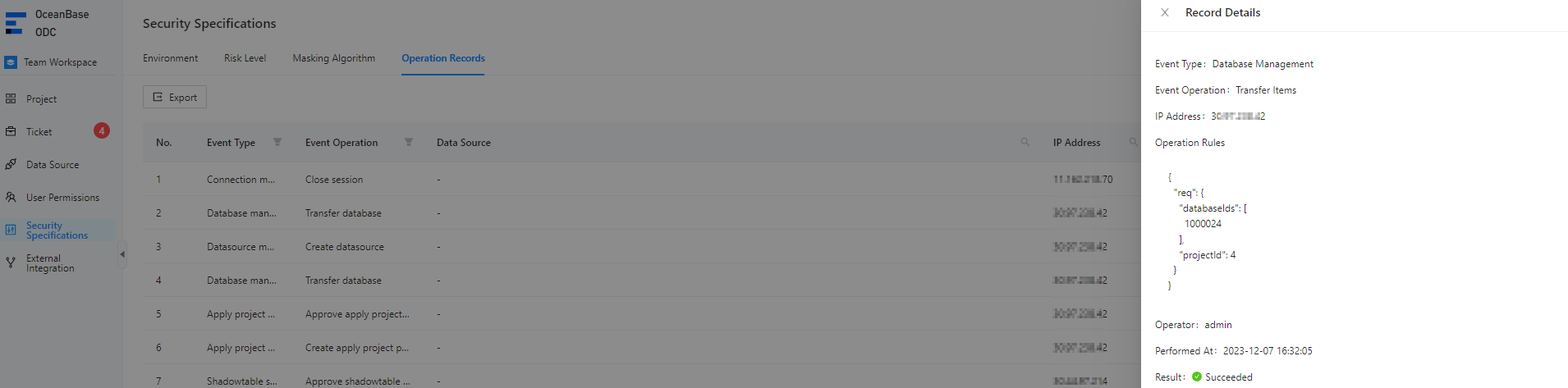
In the operation record list, click View in the Actions column of an operation record. The Record Details panel appears.
2

You can view the event type, event operation, IP address, execution details, executor, execution time, and execution result of the operation record.

Export operation records

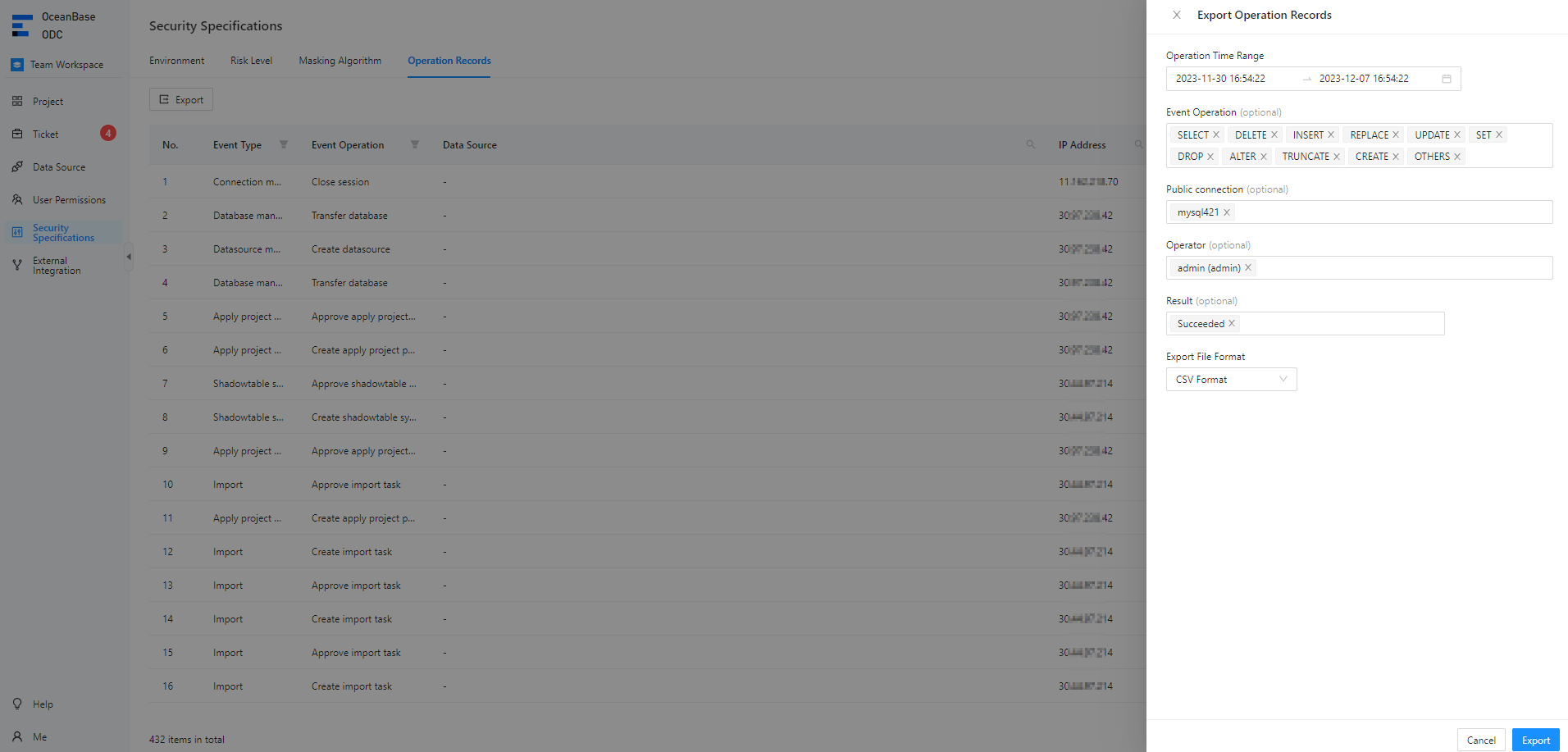
Click the export icon in the upper-left corner of the Operation Records page to go to the Export Operation Records panel.

The following table describes the parameters that you can specify when you export operation records.
3

Parameter Description
Operation Time Range Select the start date and the end date.
Event Operation Select event operations.
Connection Select data sources whose operation records that you want to export. By default, all data sources are selected.
Operator You can specify to export operation records of specific operators.
Execution Result Select the execution result.
Export Format Select the format for exported data. Supported formats are Excel and CSV.

Previous topic

Desensitize data
Last

Next topic

Overview
Next
What is on this page
Background information
Operation record list
View details of an operation record
Export operation records